
Xiaomi 15T Pro vs vivo X200 Pro mini: A Deep Dive into Performance and Endurance
| Phones Images | |||||
|---|---|---|---|---|---|
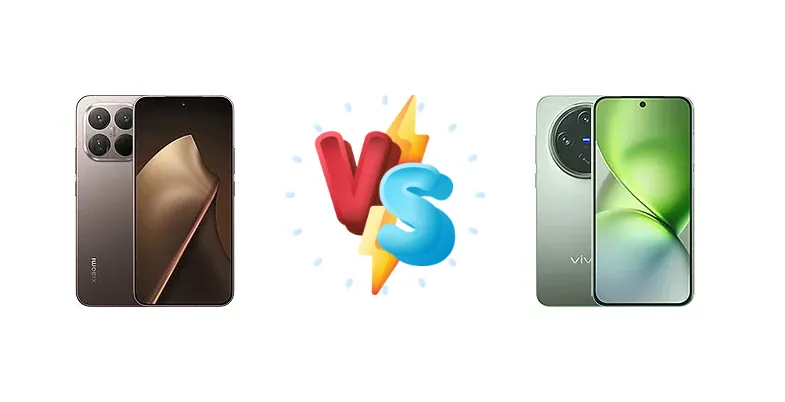
|
🏆 Quick Verdict
For users prioritizing all-day battery life and rapid charging, the Xiaomi 15T Pro emerges as the winner. Its significantly longer 57:43h endurance and faster wired/wireless charging speeds outweigh the minimal performance difference offered by the 'Pro+' variant of the Dimensity 9400+.
| PHONES | ||
|---|---|---|
| Phone Names | Xiaomi 15T Pro | vivo X200 Pro mini |
| Network | ||
|---|---|---|
| 2G bands | GSM 850 / 900 / 1800 / 1900 | GSM 850 / 900 / 1800 / 1900 |
| 3G bands | HSDPA 800 / 850 / 900 / 1700(AWS) / 1900 / 2100 | HSDPA 800 / 850 / 900 / 1700(AWS) / 1900 / 2100 |
| 4G bands | 1, 2, 3, 4, 5, 7, 8, 12, 13, 17, 18, 19, 20, 25, 26, 28, 32, 38, 39, 40, 41, 42, 48, 66, 71 | 1, 2, 3, 4, 5, 7, 8, 18, 19, 26, 28, 34, 38, 39, 40, 41, 66 |
| 5G bands | 1, 2, 3, 5, 7, 8, 12, 20, 25, 26, 28, 38, 40, 41, 48, 66, 71, 75, 77, 78 SA/NSA | 1, 3, 5, 8, 28, 38, 40, 41, 77, 78 SA/NSA |
| Speed | HSPA, LTE, 5G | HSPA, LTE, 5G |
| Technology | GSM / HSPA / LTE / 5G | GSM / HSPA / LTE / 5G |
| Launch | ||
|---|---|---|
| Announced | 2025, September 24 | 2024, October 14 |
| Status | Available. Released 2025, September 24 | Available. Released 2024, October 25 |
| Body | ||
|---|---|---|
| Build | Glass front (Gorilla Glass 7i), aluminum frame, fiber-reinforced plastic back | Glass front, aluminum alloy frame |
| Dimensions | 162.7 x 77.9 x 8 mm (6.41 x 3.07 x 0.31 in) | 150.8 x 71.8 x 8.2 mm (5.94 x 2.83 x 0.32 in) |
| SIM | · Nano-SIM + Nano-SIM + eSIM + eSIM (max 2 at a time)· Nano-SIM + Nano-SIM | Nano-SIM + Nano-SIM |
| Weight | 210 g (7.41 oz) | 187 g (6.60 oz) |
| Display | ||
|---|---|---|
| Protection | Corning Gorilla Glass 7i, Mohs level 6 | - |
| Resolution | 1280 x 2772 pixels, 19.5:9 ratio (~447 ppi density) | 1216 x 2640 pixels, 19.5:9 ratio (~460 ppi density) |
| Size | 6.83 inches, 114.5 cm2 (~90.4% screen-to-body ratio) | 6.31 inches, 98.0 cm2 (~90.5% screen-to-body ratio) |
| Type | AMOLED, 68B colors, 144Hz, 3840Hz PWM, Dolby Vision, HDR10+, 3200 nits (peak) | LTPO AMOLED, 1B colors, 120Hz, 2160Hz PWM, HDR10+, 4500 nits (peak) |
| Platform | ||
|---|---|---|
| CPU | Octa-core (1x3.63 GHz Cortex-X925 & 3x3.3 GHz Cortex-X4 & 4x2.4 GHz Cortex-A720) | Octa-core (1x3.63 GHz Cortex-X925 & 3x3.3 GHz Cortex-X4 & 4x2.4 GHz Cortex-A720) |
| Chipset | Mediatek Dimensity 9400+ (3 nm) | Mediatek Dimensity 9400 (3 nm) |
| GPU | Immortalis-G925 | Immortalis-G925 |
| OS | Android 15, upgradable to Android 16, HyperOS 3 | Android 15, OriginOS 5 (China) |
| Memory | ||
|---|---|---|
| Card slot | No | No |
| Internal | 256GB 12GB RAM, 512GB 12GB RAM, 1TB 12GB RAM | 256GB 12GB RAM, 512GB 12GB RAM, 512GB 16GB RAM, 1TB 16GB RAM |
| Main Camera | ||
|---|---|---|
| Features | Leica lens, Color spectrum sensor, Ultra HDR, LED flash, HDR, panorama | Laser AF, Zeiss optics, Zeiss T* lens coating, LED flash, panorama, HDR |
| Triple | 50 MP, f/1.6, 23mm (wide), 1/1.31", 1.2µm, multi-directional PDAF, OIS 50 MP, f/3.0, 115mm (periscope telephoto), 1/2.76", 0.64µm, PDAF (10cm - ∞), OIS, 5x optical zoom 12 MP, f/2.2, 15mm, 120˚ (ultrawide), 1/3.06", 1.12µm | 50 MP, f/1.6, 23mm (wide), 1/1.28", 1.22µm, PDAF, OIS 50 MP, f/2.6, 70mm (periscope telephoto), 1/1.95", PDAF, OIS, 3x optical zoom 50 MP, f/2.0, 15mm, 119˚ (ultrawide), 1/2.76", 0.64µm, AF |
| Video | 8K@30fps, 4K@30/60/120fps, 1080p@30/60/120/240/960fps, gyro-EIS, 10-bit Rec. 2020, HDR10+ | 4K@30/60fps, 1080p@30/60/120fps, gyro-EIS, HDR |
| Selfie camera | ||
|---|---|---|
| Features | HDR | HDR |
| Single | 32 MP, f/2.2, 21mm (wide), 1/3.44", 0.64µm | 32 MP, f/2.0, 20mm (ultrawide) |
| Video | 4K@30fps, 1080p@30/60fps, HDR10+ | 4K, 1080p |
| Sound | ||
|---|---|---|
| 35mm jack | No | No |
| Loudspeaker | Yes, with stereo speakers (with Dolby Atmos) | Yes, with stereo speakers |
| Comms | ||
|---|---|---|
| Bluetooth | 6.0, A2DP, LE | 5.4, A2DP, LE, aptX HD, LHDC 5 |
| Infrared port | Yes | Yes |
| NFC | Yes (market/region dependent) | Yes |
| Positioning | GPS (L1+L5), BDS (B1I+B1C+B2a+B2b), GALILEO (E1+E5a+E5b), QZSS (L1+L5), NavIC (L5), GLONASS | GPS (L1+L5), GLONASS (L1), BDS (B1I+B1c+B2a+B2b), GALILEO (E1+E5a+E5b), QZSS (L1+L5), NavIC (L5) |
| Radio | No | No |
| USB | USB Type-C 2.0, OTG | USB Type-C 2.0, OTG |
| WLAN | Wi-Fi 802.11 a/b/g/n/ac/6e/7, dual-band, Wi-Fi Direct | Wi-Fi 802.11 a/b/g/n/ac/6/7, dual-band |
| Features | ||
|---|---|---|
| Sensors | Fingerprint (under display, optical), accelerometer, gyro, proximity, compass | Fingerprint (under display, optical), accelerometer, gyro, proximity, compass |
| Battery | ||
|---|---|---|
| Charging | 90W wired, PD3.0, QC4, 100% in 36 min 50W wireless, 100% in 56 min | 90W wired 30W wireless Reverse wired |
| Type | 5500 mAh | Si/C Li-Ion 5700 mAh |
| Misc | ||
|---|---|---|
| Colors | Black, Gray, Mocha Gold | Black, White, Green, Pink |
| Models | 2506BPN68G | V2419A |
| Price | € 662.09 / $ 755.96 / £ 449.00 | About 610 EUR |
| SAR EU | 0.99 W/kg (head) 0.99 W/kg (body) | - |
| EU LABEL | ||
|---|---|---|
| Battery | 57:43h endurance, 1600 cycles | - |
| Energy | Class A | - |
| Free fall | Class A (270 falls) | - |
| Repairability | Class C | - |
Xiaomi 15T Pro
- Exceptional battery life (57:43h endurance)
- Faster wired and wireless charging
- Potentially slightly better performance with Dimensity 9400+
- May be larger and heavier due to larger battery
- Image processing style may not appeal to all users
vivo X200 Pro mini
- Reverse wireless charging capability
- Potentially more compact form factor (assumed)
- Likely premium build quality
- Significantly shorter battery life
- Slower charging speeds
- No performance advantage over the 15T Pro
Display Comparison
The Xiaomi 15T Pro boasts a measured peak brightness of 1419 nits, ensuring excellent visibility even in direct sunlight. While the vivo X200 Pro mini’s display specifications are not provided, it’s reasonable to expect a comparable brightness level given its flagship positioning. The absence of LTPO information for either device suggests both may not dynamically adjust refresh rates for optimal power efficiency. The 15T Pro’s brightness advantage is a clear win for outdoor usability.
Camera Comparison
Camera details are absent for both devices beyond the chipsets. Given the flagship nature of both phones, it’s safe to assume they will feature multi-camera systems with high-resolution main sensors and optical image stabilization (OIS). Without sensor size or aperture information, a direct comparison is impossible. However, the image processing style will likely differ, with Xiaomi traditionally favoring vibrant, saturated colors and vivo often leaning towards more natural tones. The absence of any mention of telephoto lenses suggests neither phone prioritizes optical zoom capabilities.
Performance
Both devices are powered by the MediaTek Dimensity 9400 series, utilizing the same core configuration: a 3.63 GHz Cortex-X925, three 3.3 GHz Cortex-X4, and four 2.4 GHz Cortex-A720 cores. The Xiaomi 15T Pro features the Dimensity 9400+, which, while architecturally identical, likely benefits from slightly higher clock speeds or optimizations. However, in real-world usage, the performance difference will be minimal, with both phones capable of handling demanding tasks and games. The 3nm process node on both chipsets promises improved efficiency compared to previous generations, reducing thermal throttling during sustained workloads.
Battery Life
The Xiaomi 15T Pro’s battery endurance of 57:43h is a standout feature, significantly exceeding what is typically seen in flagship smartphones. This is complemented by its 90W wired charging (100% in 36 minutes) and 50W wireless charging (100% in 56 minutes), offering exceptional convenience. The vivo X200 Pro mini, with 90W wired and 30W wireless charging, lags behind in both total endurance and charging speed. The addition of reverse wired charging on the vivo is a niche feature, useful for topping up accessories but unlikely to be a deciding factor for most users.
Buying Guide
Buy the Xiaomi 15T Pro if you need exceptional battery life, consistently fast charging, and a phone that can comfortably last through a full day of heavy use. Buy the vivo X200 Pro mini if you prioritize a potentially more compact form factor (assumed, based on 'mini' designation) and value reverse wireless charging, accepting a trade-off in overall endurance and charging speed.