
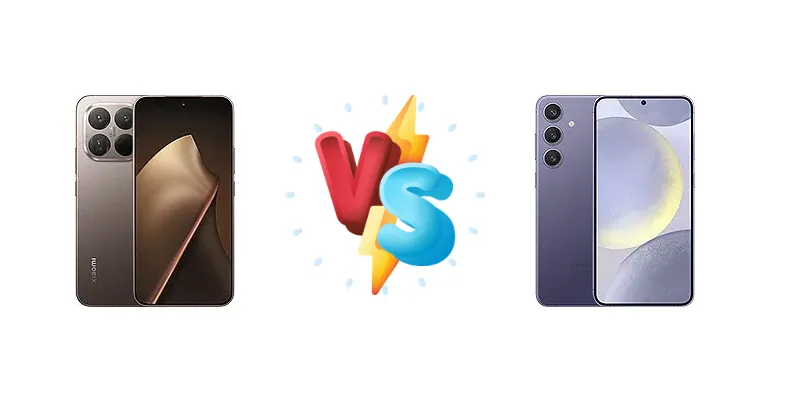
Xiaomi 15T Pro vs Samsung Galaxy S24+: A Deep Dive into Flagship Performance
| Phones Images | |||||
|---|---|---|---|---|---|
|
🏆 Quick Verdict
For users prioritizing raw performance and charging speed, the Xiaomi 15T Pro emerges as the winner. Its Mediatek Dimensity 9400+ and 90W charging significantly outperform the Galaxy S24+'s Snapdragon 8 Gen 3 (or Exynos) and 45W charging. However, Samsung’s software and established ecosystem remain compelling advantages.
| PHONES | ||
|---|---|---|
| Phone Names | Xiaomi 15T Pro | Samsung Galaxy S24+ |
| Network | ||
|---|---|---|
| 2G bands | GSM 850 / 900 / 1800 / 1900 | GSM 850 / 900 / 1800 / 1900 |
| 3G bands | HSDPA 800 / 850 / 900 / 1700(AWS) / 1900 / 2100 | HSDPA 850 / 900 / 1700(AWS) / 1900 / 2100 |
| 4G bands | 1, 2, 3, 4, 5, 7, 8, 12, 13, 17, 18, 19, 20, 25, 26, 28, 32, 38, 39, 40, 41, 42, 48, 66, 71 | 1, 2, 3, 4, 5, 7, 8, 12, 13, 17, 18, 19, 20, 25, 26, 28, 32, 38, 39, 40, 41, 66 - International |
| 5G bands | 1, 2, 3, 5, 7, 8, 12, 20, 25, 26, 28, 38, 40, 41, 48, 66, 71, 75, 77, 78 SA/NSA | 1, 2, 3, 5, 7, 8, 12, 20, 25, 26, 28, 38, 40, 41, 66, 75, 77, 78 SA/NSA/Sub6 - International |
| Speed | HSPA, LTE, 5G | HSPA, LTE (up to 7CA), 5G |
| Technology | GSM / HSPA / LTE / 5G | GSM / CDMA / HSPA / EVDO / LTE / 5G |
| Launch | ||
|---|---|---|
| Announced | 2025, September 24 | 2024, January 17 |
| Status | Available. Released 2025, September 24 | Available. Released 2024, January 24 |
| Body | ||
|---|---|---|
| Build | Glass front (Gorilla Glass 7i), aluminum frame, fiber-reinforced plastic back | Glass front (Gorilla Glass Victus 2), glass back (Gorilla Glass Victus 2), aluminum frame |
| Dimensions | 162.7 x 77.9 x 8 mm (6.41 x 3.07 x 0.31 in) | 158.5 x 75.9 x 7.7 mm (6.24 x 2.99 x 0.30 in) |
| SIM | · Nano-SIM + Nano-SIM + eSIM + eSIM (max 2 at a time)· Nano-SIM + Nano-SIM | · Nano-SIM + Nano-SIM + eSIM + eSIM (max 2 at a time) - INT· Nano-SIM + eSIM + eSIM (max 2 at a time) - USA· Nano-SIM + Nano-SIM - CN |
| Weight | 210 g (7.41 oz) | 196 g or 197 g (6.91 oz) |
| Display | ||
|---|---|---|
| Protection | Corning Gorilla Glass 7i, Mohs level 6 | Corning Gorilla Glass Victus 2 |
| Resolution | 1280 x 2772 pixels, 19.5:9 ratio (~447 ppi density) | 1440 x 3120 pixels, 19.5:9 ratio (~513 ppi density) |
| Size | 6.83 inches, 114.5 cm2 (~90.4% screen-to-body ratio) | 6.7 inches, 110.2 cm2 (~91.6% screen-to-body ratio) |
| Type | AMOLED, 68B colors, 144Hz, 3840Hz PWM, Dolby Vision, HDR10+, 3200 nits (peak) | Dynamic LTPO AMOLED 2X, 120Hz, HDR10+, 2600 nits (peak) |
| Platform | ||
|---|---|---|
| CPU | Octa-core (1x3.63 GHz Cortex-X925 & 3x3.3 GHz Cortex-X4 & 4x2.4 GHz Cortex-A720) | 8-core (1x3.39GHz Cortex-X4 & 3x3.1GHz Cortex-A720 & 2x2.9GHz Cortex-A720 & 2x2.2GHz Cortex-A520)10-core (1x3.2GHz Cortex-X4 & 2x2.9GHz Cortex-A720 & 3x2.6GHz Cortex-A720 & 4x1.95GHz Cortex-A520) |
| Chipset | Mediatek Dimensity 9400+ (3 nm) | Qualcomm SM8650-AC Snapdragon 8 Gen 3 (4 nm) - USA/Canada/ChinaExynos 2400 (4 nm) - International |
| GPU | Immortalis-G925 | Adreno 750 (1 GHz) - USA/Canada/ChinaXclipse 940 - International |
| OS | Android 15, upgradable to Android 16, HyperOS 3 | Android 14, up to 7 major Android upgrades, One UI 8.0 |
| Memory | ||
|---|---|---|
| Card slot | No | No |
| Internal | 256GB 12GB RAM, 512GB 12GB RAM, 1TB 12GB RAM | 256GB 12GB RAM, 512GB 12GB RAM |
| Main Camera | ||
|---|---|---|
| Features | Leica lens, Color spectrum sensor, Ultra HDR, LED flash, HDR, panorama | LED flash, auto-HDR, panorama |
| Triple | 50 MP, f/1.6, 23mm (wide), 1/1.31", 1.2µm, multi-directional PDAF, OIS 50 MP, f/3.0, 115mm (periscope telephoto), 1/2.76", 0.64µm, PDAF (10cm - ∞), OIS, 5x optical zoom 12 MP, f/2.2, 15mm, 120˚ (ultrawide), 1/3.06", 1.12µm | 50 MP, f/1.8, 24mm (wide), 1/1.56", 1.0µm, dual pixel PDAF, OIS 10 MP, f/2.4, 67mm (telephoto), 1/3.94", 1.0µm, PDAF, OIS, 3x optical zoom 12 MP, f/2.2, 13mm, 120˚ (ultrawide), 1/2.55" 1.4µm, Super Steady video |
| Video | 8K@30fps, 4K@30/60/120fps, 1080p@30/60/120/240/960fps, gyro-EIS, 10-bit Rec. 2020, HDR10+ | 8K@24/30fps, 4K@30/60fps, 1080p@30/60/120/240fps, HDR10+, stereo sound rec., gyro-EIS |
| Selfie camera | ||
|---|---|---|
| Features | HDR | HDR, HDR10+ |
| Single | 32 MP, f/2.2, 21mm (wide), 1/3.44", 0.64µm | 12 MP, f/2.2, 26mm (wide), 1/3.2", 1.12µm, dual pixel PDAF |
| Video | 4K@30fps, 1080p@30/60fps, HDR10+ | 4K@30/60fps, 1080p@30fps |
| Sound | ||
|---|---|---|
| 35mm jack | No | No |
| Loudspeaker | Yes, with stereo speakers (with Dolby Atmos) | Yes, with stereo speakers |
| Comms | ||
|---|---|---|
| Bluetooth | 6.0, A2DP, LE | 5.3, A2DP, LE |
| Infrared port | Yes | - |
| NFC | Yes (market/region dependent) | Yes |
| Positioning | GPS (L1+L5), BDS (B1I+B1C+B2a+B2b), GALILEO (E1+E5a+E5b), QZSS (L1+L5), NavIC (L5), GLONASS | GPS, GLONASS, BDS, GALILEO, QZSS |
| Radio | No | No |
| USB | USB Type-C 2.0, OTG | USB Type-C 3.2, DisplayPort 1.2, OTG |
| WLAN | Wi-Fi 802.11 a/b/g/n/ac/6e/7, dual-band, Wi-Fi Direct | Wi-Fi 802.11 a/b/g/n/ac/6e, tri-band, Wi-Fi Direct |
| Features | ||
|---|---|---|
| Sensors | Fingerprint (under display, optical), accelerometer, gyro, proximity, compass | Fingerprint (under display, ultrasonic), accelerometer, gyro, proximity, compass, barometer |
| Battery | ||
|---|---|---|
| Charging | 90W wired, PD3.0, QC4, 100% in 36 min 50W wireless, 100% in 56 min | 45W wired, PD3.0, 65% in 30 min 15W wireless (Qi) 4.5W reverse wireless |
| Type | 5500 mAh | Li-Ion 4900 mAh |
| Misc | ||
|---|---|---|
| Colors | Black, Gray, Mocha Gold | Onyx Black, Marble Grey, Cobalt Violet, Amber Yellow, Jade Green, Sandstone Orange, Sapphire Blue |
| Models | 2506BPN68G | SM-S926B, SM-S926B/DS, SM-S926U, SM-S926U1, SM-S926W, SM-S926N, SM-S9260, SM-S926E, SM-S926E/DS |
| Price | € 662.09 / $ 755.96 / £ 449.00 | $ 429.50 / € 549.00 / £ 445.98 |
| SAR | - | 1.16 W/kg (head) 0.84 W/kg (body) |
| SAR EU | 0.99 W/kg (head) 0.99 W/kg (body) | 0.74 W/kg (head) 1.25 W/kg (body) |
| EU LABEL | ||
|---|---|---|
| Battery | 57:43h endurance, 1600 cycles | - |
| Energy | Class A | - |
| Free fall | Class A (270 falls) | - |
| Repairability | Class C | - |
Xiaomi 15T Pro
- Significantly faster charging (90W wired, 50W wireless)
- Potentially superior CPU performance with Dimensity 9400+
- Longer battery life and 1600 charge cycles
- Camera specifications are unknown
- Software experience may not be as refined as Samsung’s
Samsung Galaxy S24+
- Polished software experience with One UI
- Seamless integration with Samsung ecosystem
- Established brand reputation and support
- Slower charging speeds (45W wired, 15W wireless)
- Potentially lower CPU performance compared to Dimensity 9400+
- Shorter battery life in active use
Display Comparison
Both devices feature excellent displays, with the Galaxy S24+ achieving a slightly higher peak brightness of 1452 nits compared to the Xiaomi 15T Pro’s 1419 nits. While the difference is minimal in real-world use, the S24+ likely benefits from Samsung’s display calibration expertise. Neither specification details refresh rate or panel technology (LTPO), but given the flagship positioning, both are expected to offer adaptive refresh rates for improved power efficiency. Bezels are assumed to be similarly minimal on both devices, reflecting current design trends.
Camera Comparison
The provided data focuses solely on the presence of a camera on the S24+. Without sensor size, aperture, or image processing details for either device, a meaningful comparison is impossible. However, Samsung’s history suggests a strong emphasis on computational photography and versatile camera systems. The Xiaomi 15T Pro’s camera capabilities remain unknown, but a flagship device would be expected to include a high-resolution main sensor and optical image stabilization (OIS). The lack of detail regarding the Xiaomi's camera is a significant omission.
Performance
The core battleground lies in the chipsets. The Xiaomi 15T Pro’s Mediatek Dimensity 9400+ (3nm) boasts a unique CPU configuration – 1x3.63 GHz Cortex-X925, 3x3.3 GHz Cortex-X4, and 4x2.4 GHz Cortex-A720 – designed for peak performance. The Galaxy S24+ utilizes either the Qualcomm Snapdragon 8 Gen 3 (4nm) or the Exynos 2400 (4nm), depending on the region. While the Snapdragon 8 Gen 3 is a formidable chip, the Dimensity 9400+'s Cortex-X925 core suggests a potential edge in single-core performance. The 3nm process of the Dimensity 9400+ also promises better thermal efficiency than the 4nm Snapdragon/Exynos, potentially leading to less throttling during sustained workloads. The S24+'s CPU configuration (Snapdragon) is 1x3.39GHz Cortex-X4, 3x3.1GHz Cortex-A720, 2x2.9GHz Cortex-A720 & 2x2.2GHz Cortex-A520. The Exynos variant has a 10-core configuration. The Xiaomi's RAM configuration is not specified, but is expected to be LPDDR5x, matching the S24+.
Battery Life
The Xiaomi 15T Pro demonstrates a clear advantage in battery endurance, achieving a 57:43h endurance score and 16:24h of active use, compared to the Galaxy S24+'s 12:30h active use. This is further bolstered by the 90W wired charging (100% in 36 minutes) and 50W wireless charging (100% in 56 minutes), significantly faster than the S24+'s 45W wired (65% in 30 minutes) and 15W wireless charging. The 1600 charge cycles rating for the Xiaomi 15T Pro also indicates superior long-term battery health. While the S24+ benefits from Samsung’s software optimizations, the Xiaomi’s hardware advantage is substantial.
Buying Guide
Buy the Xiaomi 15T Pro if you need maximum performance for gaming and demanding tasks, coupled with incredibly fast charging and long-term battery health thanks to its 1600 cycle rating. Buy the Samsung Galaxy S24+ if you prioritize a polished software experience, seamless integration with the Samsung ecosystem, and a more established brand reputation, even if it means sacrificing some charging speed and raw processing power.