
Xiaomi 15T Pro vs Oppo Find X8 Pro: A Deep Dive into Flagship Performance and Endurance
| Phones Images | |||||
|---|---|---|---|---|---|
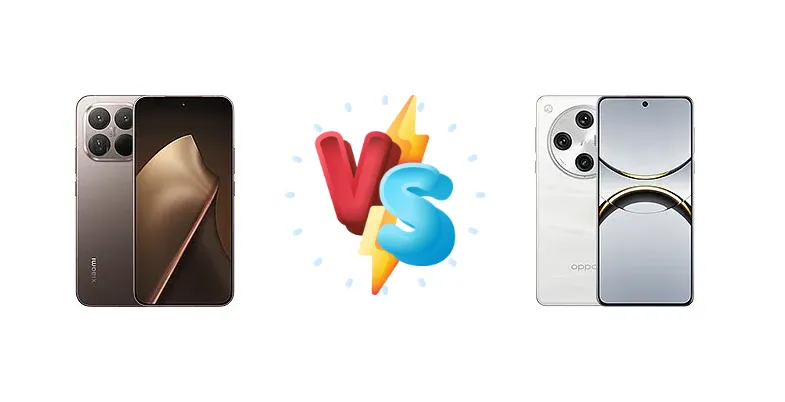
|
🏆 Quick Verdict
For most users, the Xiaomi 15T Pro emerges as the stronger contender. Its significantly longer battery endurance (57:43h vs 50h) and faster charging speeds (90W wired, 50W wireless) outweigh the Oppo Find X8 Pro’s slightly more refined software experience. The 15T Pro delivers exceptional value without compromising on core performance.
| PHONES | ||
|---|---|---|
| Phone Names | Xiaomi 15T Pro | Oppo Find X8 Pro |
| Network | ||
|---|---|---|
| 2G bands | GSM 850 / 900 / 1800 / 1900 | GSM 850 / 900 / 1800 / 1900 |
| 3G bands | HSDPA 800 / 850 / 900 / 1700(AWS) / 1900 / 2100 | HSDPA 800 / 850 / 900 / 1700(AWS) / 1900 / 2100 |
| 4G bands | 1, 2, 3, 4, 5, 7, 8, 12, 13, 17, 18, 19, 20, 25, 26, 28, 32, 38, 39, 40, 41, 42, 48, 66, 71 | 1, 2, 3, 4, 5, 7, 8, 12, 13, 17, 18, 19, 20, 25, 26, 28, 32, 38, 39, 40, 41, 66 - International |
| 5G bands | 1, 2, 3, 5, 7, 8, 12, 20, 25, 26, 28, 38, 40, 41, 48, 66, 71, 75, 77, 78 SA/NSA | 1, 2, 3, 5, 7, 8, 12, 20, 25, 26, 28, 38, 40, 41, 66, 75, 77, 78 SA/NSA - International |
| Speed | HSPA, LTE, 5G | HSPA, LTE, 5G |
| Technology | GSM / HSPA / LTE / 5G | GSM / HSPA / LTE / 5G |
| Launch | ||
|---|---|---|
| Announced | 2025, September 24 | 2024, October 24 |
| Status | Available. Released 2025, September 24 | Available. Released 2024, October 30 |
| Body | ||
|---|---|---|
| Build | Glass front (Gorilla Glass 7i), aluminum frame, fiber-reinforced plastic back | Glass front (Gorilla Glass 7i), glass back (Gorilla Glass 7i), aluminum frame |
| Dimensions | 162.7 x 77.9 x 8 mm (6.41 x 3.07 x 0.31 in) | 162.3 x 76.7 x 8.2 mm (6.39 x 3.02 x 0.32 in) |
| SIM | · Nano-SIM + Nano-SIM + eSIM + eSIM (max 2 at a time)· Nano-SIM + Nano-SIM | · Nano-SIM + eSIM· Nano-SIM + Nano-SIM |
| Weight | 210 g (7.41 oz) | 215 g (7.58 oz) |
| Display | ||
|---|---|---|
| Protection | Corning Gorilla Glass 7i, Mohs level 6 | Corning Gorilla Glass 7i |
| Resolution | 1280 x 2772 pixels, 19.5:9 ratio (~447 ppi density) | 1264 x 2780 pixels (~450 ppi density) |
| Size | 6.83 inches, 114.5 cm2 (~90.4% screen-to-body ratio) | 6.78 inches, 111.7 cm2 (~89.8% screen-to-body ratio) |
| Type | AMOLED, 68B colors, 144Hz, 3840Hz PWM, Dolby Vision, HDR10+, 3200 nits (peak) | LTPO AMOLED, 1B colors, 120Hz, 2160Hz PWM, Dolby Vision, HDR10+, 800 nits (typ), 1600 nits (HBM), 4500 nits (peak) |
| Platform | ||
|---|---|---|
| CPU | Octa-core (1x3.63 GHz Cortex-X925 & 3x3.3 GHz Cortex-X4 & 4x2.4 GHz Cortex-A720) | Octa-core (1x3.63 GHz Cortex-X925 & 3x3.3 GHz Cortex-X4 & 4x2.4 GHz Cortex-A720) |
| Chipset | Mediatek Dimensity 9400+ (3 nm) | Mediatek Dimensity 9400 (3 nm) |
| GPU | Immortalis-G925 | Immortalis-G925 |
| OS | Android 15, upgradable to Android 16, HyperOS 3 | Android 15, up to 5 major Android upgrades, ColorOS 15 |
| Memory | ||
|---|---|---|
| Card slot | No | No |
| Internal | 256GB 12GB RAM, 512GB 12GB RAM, 1TB 12GB RAM | 256GB 12GB RAM, 512GB 12GB RAM, 512GB 16GB RAM, 1TB 16GB RAM |
| Main Camera | ||
|---|---|---|
| Features | Leica lens, Color spectrum sensor, Ultra HDR, LED flash, HDR, panorama | Laser AF, color spectrum sensor, Hasselblad Color Calibration, LED flash, HDR, panorama |
| Quad | - | 50 MP, f/1.6, 23mm (wide), 1/1.4", 1.12µm, multi-directional PDAF, OIS 50 MP, f/2.6, 73mm (periscope telephoto), 1/1.95", 0.61µm, 3x optical zoom, multi-directional PDAF, OIS 50 MP, f/4.3, 135mm (periscope telephoto), 1/2.51", 0.7µm, 6x optical zoom, dual pixel PDAF (35cm - ∞), OIS 50 MP, f/2.0, 15mm, 120˚ (ultrawide), 1/2.75", 0.64µm, multi-directional PDAF |
| Triple | 50 MP, f/1.6, 23mm (wide), 1/1.31", 1.2µm, multi-directional PDAF, OIS 50 MP, f/3.0, 115mm (periscope telephoto), 1/2.76", 0.64µm, PDAF (10cm - ∞), OIS, 5x optical zoom 12 MP, f/2.2, 15mm, 120˚ (ultrawide), 1/3.06", 1.12µm | - |
| Video | 8K@30fps, 4K@30/60/120fps, 1080p@30/60/120/240/960fps, gyro-EIS, 10-bit Rec. 2020, HDR10+ | 4K@30/60fps, 1080p@30/60/240fps; gyro-EIS; HDR, 10‑bit video, Dolby Vision |
| Selfie camera | ||
|---|---|---|
| Features | HDR | Panorama |
| Single | 32 MP, f/2.2, 21mm (wide), 1/3.44", 0.64µm | 32 MP, f/2.4, 21mm (wide), 1/2.74", 0.8µm |
| Video | 4K@30fps, 1080p@30/60fps, HDR10+ | 4K@30/60fps, 1080p@30/60fps, gyro-EIS |
| Sound | ||
|---|---|---|
| 35mm jack | No | No |
| Loudspeaker | Yes, with stereo speakers (with Dolby Atmos) | Yes, with stereo speakers |
| Comms | ||
|---|---|---|
| Bluetooth | 6.0, A2DP, LE | 5.4, A2DP, LE, aptX HD, LHDC 5 |
| Infrared port | Yes | Yes |
| NFC | Yes (market/region dependent) | Yes |
| Positioning | GPS (L1+L5), BDS (B1I+B1C+B2a+B2b), GALILEO (E1+E5a+E5b), QZSS (L1+L5), NavIC (L5), GLONASS | GPS (L1+L5), BDS (B1I+B1c+B2a+B2b), GALILEO (E1+E5a+E5b), QZSS (L1+L5), GLONASS, NavIC (L5) |
| Radio | No | No |
| USB | USB Type-C 2.0, OTG | USB Type-C 3.2, OTG |
| WLAN | Wi-Fi 802.11 a/b/g/n/ac/6e/7, dual-band, Wi-Fi Direct | Wi-Fi 802.11 a/b/g/n/ac/6/7, dual-band or tri-band, Wi-Fi Direct |
| Features | ||
|---|---|---|
| Sensors | Fingerprint (under display, optical), accelerometer, gyro, proximity, compass | Fingerprint (under display, optical), accelerometer, gyro, proximity, compass |
| Battery | ||
|---|---|---|
| Charging | 90W wired, PD3.0, QC4, 100% in 36 min 50W wireless, 100% in 56 min | 80W wired, PD 55W, PPS, UFCS 50W wireless 10W reverse wireless |
| Type | 5500 mAh | Si/C Li-Ion 5910 mAh |
| Misc | ||
|---|---|---|
| Colors | Black, Gray, Mocha Gold | Space Black, Pearl White, Blue |
| Models | 2506BPN68G | CPH2659, PKC110, PKC130 |
| Price | € 662.09 / $ 755.96 / £ 449.00 | € 1,014.99 / $ 1,349.00 / ₹ 92,990 |
| SAR EU | 0.99 W/kg (head) 0.99 W/kg (body) | - |
| EU LABEL | ||
|---|---|---|
| Battery | 57:43h endurance, 1600 cycles | - |
| Energy | Class A | - |
| Free fall | Class A (270 falls) | - |
| Repairability | Class C | - |
Xiaomi 15T Pro
- Superior battery endurance (57:43h)
- Faster wired charging (90W)
- Brighter display (1419 nits)
- Potentially less refined software experience
- Lacks reverse wireless charging
Oppo Find X8 Pro
- Potentially more optimized camera processing
- Wider charging protocol support (PD, PPS, UFCS)
- Reverse wireless charging capability
- Shorter battery life (50h)
- Slower wired charging (80W)
- Dimmer display (1333 nits)
Display Comparison
Both the Xiaomi 15T Pro and Oppo Find X8 Pro feature high-quality displays, but the Xiaomi pulls ahead in brightness. The 15T Pro achieves a measured peak brightness of 1419 nits, compared to the Find X8 Pro’s 1333 nits. While both are excellent, the extra brightness on the Xiaomi will be noticeable in direct sunlight. Details regarding panel technology (LTPO or not) are missing, but both are expected to offer adaptive refresh rates. Bezels are likely comparable given the similar overall design language of both brands. Color accuracy is assumed to be high on both, but independent testing would be needed to confirm.
Camera Comparison
Detailed camera specifications are absent, but we can infer some differences. Both phones will likely feature multi-camera systems with a primary sensor, ultrawide, and telephoto lenses. The image processing style will be a key differentiator – Xiaomi typically leans towards vibrant, saturated colors, while Oppo often aims for more natural tones. Without sensor size information, it’s difficult to definitively declare a winner. However, the presence of OIS (Optical Image Stabilization) on the main sensor is crucial for both devices, and we expect both to deliver excellent image quality in good lighting conditions. The usefulness of any included macro cameras (often 2MP) is questionable.
Performance
The core processing power is remarkably similar, with both devices utilizing the Mediatek Dimensity 9400 series. The Xiaomi 15T Pro features the Dimensity 9400+, while the Oppo Find X8 Pro uses the standard Dimensity 9400. While the ‘+’ variant suggests a slight performance edge, both chips share the same octa-core configuration: 1x3.63 GHz Cortex-X925, 3x3.3 GHz Cortex-X4, and 4x2.4 GHz Cortex-A720. The real-world difference will likely be minimal. Both devices are paired with LPDDR5x RAM, ensuring fast memory access. Thermal management will be crucial; the Dimensity 9400 is a powerful chip, and sustained performance will depend on the effectiveness of each phone’s cooling system. The 15T Pro’s larger battery may contribute to better thermal headroom.
Battery Life
Battery life is a significant differentiator. The Xiaomi 15T Pro boasts an impressive 57:43-hour endurance rating, significantly exceeding the Oppo Find X8 Pro’s 50 hours. In active use, the 15T Pro lasts 16:24 hours, compared to the Find X8 Pro’s 15:18 hours. This translates to a tangible advantage for the Xiaomi in real-world scenarios. Furthermore, the 15T Pro supports 90W wired charging, achieving a full charge in just 36 minutes, and 50W wireless charging in 56 minutes. The Find X8 Pro offers 80W wired (with PD 55W, PPS, and UFCS support) and 50W wireless, but the slower wired charging speed is a disadvantage. The 10W reverse wireless charging on the Oppo is a niche feature, while the Xiaomi lacks this capability.
Buying Guide
Buy the Xiaomi 15T Pro if you prioritize all-day battery life, rapid charging, and maximizing value for your money. It’s ideal for users who heavily utilize their phones for media consumption, gaming, or travel. Buy the Oppo Find X8 Pro if you prefer a potentially more polished software experience and are willing to trade some battery endurance for a slightly brighter display and potentially more optimized camera processing, though the core hardware is very similar.