
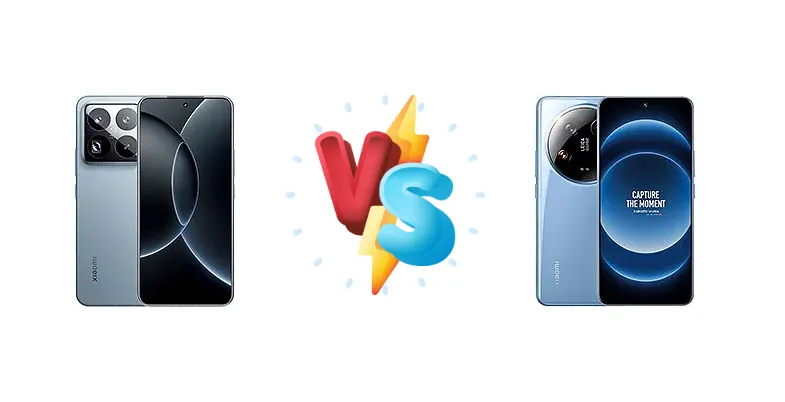
Xiaomi 15S Pro vs 14 Ultra: A Deep Dive into Xiaomi's Flagship Face-Off
| Phones Images | |||||
|---|---|---|---|---|---|
|
🏆 Quick Verdict
For the average user prioritizing raw performance and established software optimization, the Xiaomi 14 Ultra with the Snapdragon 8 Gen 3 is the better choice. Its 11:25h active use battery life and proven chipset deliver a smoother, more reliable experience. However, the 15S Pro's Xring O1 is a compelling alternative for those eager to embrace innovation.
| PHONES | ||
|---|---|---|
| Phone Names | Xiaomi 15S Pro | Xiaomi 14 Ultra |
| Network | ||
|---|---|---|
| 2G bands | GSM 850 / 900 / 1800 / 1900 | GSM 850 / 900 / 1800 / 1900 |
| 3G bands | HSDPA 800 / 850 / 900 / 1700(AWS) / 1900 / 2100 | HSDPA 800 / 850 / 900 / 1700(AWS) / 1900 / 2100 |
| 4G bands | 1, 2, 3, 4, 5, 7, 8, 12, 17, 18, 19, 20, 26, 28, 34, 38, 39, 40, 41, 42, 48, 66 | 1, 2, 3, 4, 5, 7, 8, 18, 19, 20, 26, 28, 38, 40, 41, 42, 48, 66 - International |
| 5G bands | 1, 2, 3, 5, 7, 8, 12, 20, 26, 28, 38, 40, 41, 48, 66, 77, 78, 79 SA/NSA | 1, 2, 3, 5, 7, 8, 20, 28, 38, 40, 41, 48, 66, 77, 78, 79 SA/NSA - International |
| Speed | HSPA, LTE, 5G | HSPA, LTE, 5G |
| Technology | GSM / CDMA / HSPA / EVDO / LTE / 5G | GSM / CDMA / HSPA / EVDO / LTE / 5G |
| Launch | ||
|---|---|---|
| Announced | 2025, May 22 | 2024, February 22 |
| Status | Available. Released 2025, May 22 | Available. Released 2024, February 22 |
| Body | ||
|---|---|---|
| Build | - | Glass front (Shield Glass), glass back or silicone polymer back (eco leather), titanium frame (grade 5) or aluminum alloy frame |
| Dimensions | 161.3 x 75.3 x 8.3 mm (6.35 x 2.96 x 0.33 in) | 161.4 x 75.3 x 9.2 mm (6.35 x 2.96 x 0.36 in) |
| SIM | Nano-SIM + Nano-SIM | Nano-SIM + Nano-SIM |
| Weight | 216 g (7.62 oz) | 219.8 / 224.4 / 229.5 g (7.76 oz) |
| Display | ||
|---|---|---|
| Protection | Shatterproof glass (2024 gen) | Xiaomi Shield Glass |
| Resolution | 1440 x 3200 pixels, 20:9 ratio (~521 ppi density) | 1440 x 3200 pixels, 20:9 ratio (~522 ppi density) |
| Size | 6.73 inches, 109.4 cm2 (~90.0% screen-to-body ratio) | 6.73 inches, 108.9 cm2 (~89.6% screen-to-body ratio) |
| Type | LTPO AMOLED, 68B colors, 120Hz, 1920Hz PWM, Dolby Vision, HDR10+, HDR Vivid, 3200 nits (peak) | LTPO AMOLED, 68B colors, 120Hz, 1920Hz PWM, Dolby Vision, HDR10+, 1000 nits (typ), 3000 nits (peak) |
| Platform | ||
|---|---|---|
| CPU | 10-core (2x3.9GHz Cortex-X925 & 4x3.4GHz Cortex-A725 & 2x1.9GHz Cortex-A725 & 2x1.8GHz Cortex-A520) | Octa-core (1x3.3 GHz Cortex-X4 & 3x3.2 GHz Cortex-A720 & 2x3.0 GHz Cortex-A720 & 2x2.3 GHz Cortex-A520) |
| Chipset | Xring O1 (3 nm) | Qualcomm SM8650-AB Snapdragon 8 Gen 3 (4 nm) |
| GPU | Immortalis-G925 MP16 | Adreno 750 |
| OS | Android 15, HyperOS 2 | Android 14, up to 4 major Android upgrades, HyperOS |
| Memory | ||
|---|---|---|
| Card slot | No | No |
| Internal | 512GB 16GB RAM, 1TB 16GB RAM | 256GB 12GB RAM, 512GB 16GB RAM, 1TB 16GB RAM |
| Main Camera | ||
|---|---|---|
| Features | Laser AF, color spectrum sensor, Leica lens, Dual-LED dual-tone flash, HDR, panorama | Laser AF, color spectrum sensor, Leica lenses, Dual-LED flash, HDR, panorama, 67mm filter ring holder (optional) |
| Quad | - | 50 MP, f/1.6-f/4.0, 23mm (wide), 1.0"-type, 1.6µm, dual pixel PDAF, OIS 50 MP, f/1.8, 75mm (telephoto), 1/2.51", 0.7µm, dual pixel PDAF (10cm - ∞), OIS, 3.2x optical zoom 50 MP, f/2.5, 120mm (periscope telephoto), 1/2.51", 0.7µm, dual pixel PDAF (30cm - ∞), OIS, 5x optical zoom 50 MP, f/1.8, 12mm, 122˚ (ultrawide), 1/2.51", 0.7µm, dual pixel PDAF TOF 3D, (depth) |
| Triple | 50 MP, f/1.4, 23mm (wide), 1/1.31", 1.2µm, dual pixel PDAF, OIS 50 MP, f/2.5, 120mm (periscope telephoto), PDAF (30cm - ∞), OIS, 5x optical zoom 50 MP, f/2.2, 14mm, 115˚ (ultrawide), AF | - |
| Video | 8K@24fps (HDR), 4K@30/60fps (HDR10+, 10-bit Dolby Vision HDR, 10-bit LOG), 1080p@30/60/120/240/960fps, gyro-EIS | 8K@24/30fps, 4K@24/30/60/120fps, 1080p@30/60/120/240/480/960/1920fps, gyro-EIS, Dolby Vision HDR 10-bit rec. (4K@60fps, 1080p) |
| Selfie camera | ||
|---|---|---|
| Features | HDR, panorama | HDR, panorama |
| Single | 32 MP, f/2.0, 22mm (wide), 0.7µm | 32 MP, f/2.0, 22mm (wide), 1/3.14", 0.7µm |
| Video | 4K@30/60fps, 1080p@30/60fps, gyro-EIS | 4K@30/60fps, 1080p@30/60fps, gyro-EIS |
| Sound | ||
|---|---|---|
| 35mm jack | No | No |
| Loudspeaker | Yes, with stereo speakers | Yes, with stereo speakers |
| Comms | ||
|---|---|---|
| Bluetooth | 5.4, A2DP, LE, aptX HD, aptX Adaptive, LHDC 5 | 5.4, A2DP, LE, aptX HD, aptX Adaptive, LHDC |
| Infrared port | Yes | Yes |
| NFC | Yes | Yes |
| Positioning | GPS (L1+L5), BDS (B1I+B1c+B2a), GALILEO (E1+E5a), QZSS (L1+L5), GLONASS | GPS (L1+L5), GLONASS (L1), BDS (B1I+B1c+B2a), GALILEO (E1+E5a), QZSS (L1+L5), NavIC (L5) |
| Radio | No | No |
| USB | USB Type-C 3.2 Gen2, Display Port, OTG | USB Type-C 3.2 Gen 2, DisplayPort, OTG |
| WLAN | Wi-Fi 802.11 a/b/g/n/ac/6e/7, dual-band, Wi-Fi Direct | Wi-Fi 802.11 a/b/g/n/ac/6e/7, tri-band, Wi-Fi Direct |
| Features | ||
|---|---|---|
| Sensors | Fingerprint (under display, ultrasonic), accelerometer, proximity, gyro, compass, barometer | Fingerprint (under display, optical), accelerometer, proximity, gyro, compass, barometer |
| Battery | ||
|---|---|---|
| Charging | 90W wired, PD3.0 50W wireless 10W reverse wireless | 90W wired, PD3.0, QC4, 100% in 33 min 80W wireless, 100% in 46 min 10W reverse wireless |
| Type | Si/C Li-Ion 6100 mAh | Market-dependent versions:· 5000 mAh (Global)· 5300 mAh (China only) |
| Misc | ||
|---|---|---|
| Colors | Black, Blue | Black, Blue, White, Titanium Gray |
| Models | - | 24031PN0DC, 24030PN60G |
| Price | About 680 EUR | € 663.14 |
| SAR | - | 0.83 W/kg (head) 0.82 W/kg (body) |
| SAR EU | - | 1.00 W/kg (head) 1.00 W/kg (body) |
Xiaomi 15S Pro
- Potentially more efficient 3nm Xring O1 chipset
- Innovative in-house silicon
- Competitive charging speeds (90W wired)
- Unproven Xring O1 chipset – potential for software bugs
- Missing display and camera specifications
- Potential for thermal throttling with a new architecture
Xiaomi 14 Ultra
- Proven Snapdragon 8 Gen 3 performance
- Excellent 11:25h battery life
- Bright 1281 nit display
- 4nm process – slightly less efficient than 3nm
- Relatively slower wireless charging (46 minutes)
- Higher price point (likely)
Display Comparison
The Xiaomi 14 Ultra boasts a bright display, peaking at 1281 nits, ensuring excellent visibility even in direct sunlight. While the 15S Pro’s display specs are not provided, the 14 Ultra’s high peak brightness is a significant advantage for outdoor use. The 14 Ultra’s panel likely utilizes LTPO technology for adaptive refresh rates, contributing to battery efficiency, a feature we expect to see in flagship devices. Without comparable data for the 15S Pro, it’s difficult to assess its color accuracy or bezel size relative to the 14 Ultra.
Camera Comparison
Detailed camera specs are missing for the 15S Pro, making a direct comparison difficult. However, the Xiaomi 14 Ultra is known for its exceptional camera system. The 14 Ultra’s image processing is likely optimized for color accuracy and dynamic range. Without knowing the sensor sizes and lens apertures of the 15S Pro, it’s impossible to assess its low-light performance or overall image quality. We can assume both phones will offer a range of shooting modes, but the 14 Ultra’s established reputation suggests a more refined and consistent camera experience.
Performance
The core difference lies in the chipsets. The Xiaomi 14 Ultra’s Snapdragon 8 Gen 3 (4nm) is a known quantity, delivering exceptional performance and efficiency. The 15S Pro’s Xring O1 (3nm) promises even greater efficiency, potentially leading to less thermal throttling. However, the 10-core configuration of the Xring O1 (2x3.9GHz Cortex-X925, 4x3.4GHz Cortex-A725, 2x1.9GHz Cortex-A725, 2x1.8GHz Cortex-A520) is more complex than the 14 Ultra’s octa-core setup (1x3.3 GHz Cortex-X4, 3x3.2 GHz Cortex-A720, 2x3.0 GHz Cortex-A720, 2x2.3 GHz Cortex-A520). This complexity doesn't automatically translate to better performance; software optimization is crucial. The 14 Ultra benefits from Qualcomm’s established optimizations, while the Xring O1 is newer and may require further refinement. Both devices utilize LPDDR5x RAM, but the 14 Ultra’s Snapdragon benefits from Qualcomm’s integrated memory controller.
Battery Life
The Xiaomi 14 Ultra delivers a solid 11:25h of active use, demonstrating excellent battery life. The 15S Pro offers 90W wired charging, 50W wireless, and 10W reverse wireless, while the 14 Ultra counters with 90W wired, 80W wireless, and 10W reverse wireless. The 14 Ultra’s 80W wireless charging achieves a full charge in 46 minutes, while the 15S Pro’s 50W wireless takes longer. The 14 Ultra’s 33-minute 0-100% wired charge is also faster. While the 15S Pro’s charging speeds are competitive, the 14 Ultra’s combination of fast wired and wireless charging, coupled with its longer battery life, gives it an edge.
Buying Guide
Buy the Xiaomi 15S Pro if you're a tech enthusiast willing to potentially troubleshoot early adopter issues for a glimpse into Xiaomi's silicon future and potentially benefit from the Xring O1's efficiency. Buy the Xiaomi 14 Ultra if you prioritize a polished, consistently high-performing experience with a proven chipset, excellent battery life, and a mature software ecosystem.