
Xiaomi 15S Pro vs Honor Magic6 Pro: A Deep Dive into Flagship Power
| Phones Images | |||||
|---|---|---|---|---|---|
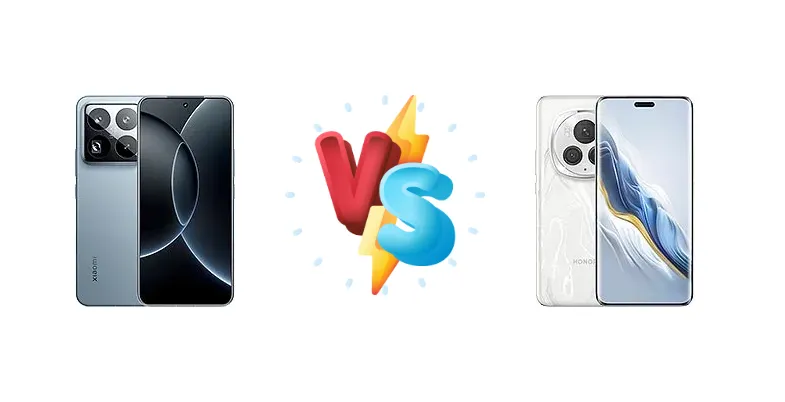
|
🏆 Quick Verdict
For the average user prioritizing sustained performance and a proven track record, the Honor Magic6 Pro emerges as the winner. Its Snapdragon 8 Gen 3 chipset, coupled with excellent battery life (14:06h active use), provides a more reliable and efficient experience than the Xiaomi 15S Pro’s Xring O1, despite the latter’s faster charging.
| PHONES | ||
|---|---|---|
| Phone Names | Xiaomi 15S Pro | Honor Magic6 Pro |
| Network | ||
|---|---|---|
| 2G bands | GSM 850 / 900 / 1800 / 1900 | GSM 850 / 900 / 1800 / 1900 |
| 3G bands | HSDPA 800 / 850 / 900 / 1700(AWS) / 1900 / 2100 | HSDPA 800 / 850 / 900 / 1700(AWS) / 1900 / 2100 |
| 4G bands | 1, 2, 3, 4, 5, 7, 8, 12, 17, 18, 19, 20, 26, 28, 34, 38, 39, 40, 41, 42, 48, 66 | LTE |
| 5G bands | 1, 2, 3, 5, 7, 8, 12, 20, 26, 28, 38, 40, 41, 48, 66, 77, 78, 79 SA/NSA | SA/NSA |
| Speed | HSPA, LTE, 5G | HSPA, LTE, 5G |
| Technology | GSM / CDMA / HSPA / EVDO / LTE / 5G | GSM / CDMA / HSPA / CDMA2000 / LTE / 5G |
| Launch | ||
|---|---|---|
| Announced | 2025, May 22 | 2024, January 11 |
| Status | Available. Released 2025, May 22 | Available. Released 2024, January 18 |
| Body | ||
|---|---|---|
| Build | - | Glass front (NanoCrystal Shield), glass back or silicone polymer back (eco leather) |
| Dimensions | 161.3 x 75.3 x 8.3 mm (6.35 x 2.96 x 0.33 in) | 162.5 x 75.8 x 8.9 mm (6.40 x 2.98 x 0.35 in) |
| SIM | Nano-SIM + Nano-SIM | · Nano-SIM + eSIM· Nano-SIM + Nano-SIM |
| Weight | 216 g (7.62 oz) | 225 g or 229 g (7.94 oz) |
| Display | ||
|---|---|---|
| Protection | Shatterproof glass (2024 gen) | NanoCrystal Shield |
| Resolution | 1440 x 3200 pixels, 20:9 ratio (~521 ppi density) | 1280 x 2800 pixels, 19.5:9 ratio (~453 ppi density) |
| Size | 6.73 inches, 109.4 cm2 (~90.0% screen-to-body ratio) | 6.8 inches, 112.8 cm2 (~91.6% screen-to-body ratio) |
| Type | LTPO AMOLED, 68B colors, 120Hz, 1920Hz PWM, Dolby Vision, HDR10+, HDR Vivid, 3200 nits (peak) | LTPO OLED, 1B colors, 120Hz, Dolby Vision, HDR, 1600 nits (HBM), 5000 nits (peak) |
| Platform | ||
|---|---|---|
| CPU | 10-core (2x3.9GHz Cortex-X925 & 4x3.4GHz Cortex-A725 & 2x1.9GHz Cortex-A725 & 2x1.8GHz Cortex-A520) | Octa-core (1x3.3 GHz Cortex-X4 & 3x3.2 GHz Cortex-A720 & 2x3.0 GHz Cortex-A720 & 2x2.3 GHz Cortex-A520) |
| Chipset | Xring O1 (3 nm) | Qualcomm SM8650-AB Snapdragon 8 Gen 3 (4 nm) |
| GPU | Immortalis-G925 MP16 | Adreno 750 |
| OS | Android 15, HyperOS 2 | Android 14, up to 4 major Android upgrades, MagicOS 8 |
| Memory | ||
|---|---|---|
| Card slot | No | No |
| Internal | 512GB 16GB RAM, 1TB 16GB RAM | 256GB 12GB RAM, 256GB 16GB RAM, 512GB 12GB RAM, 512GB 16GB RAM, 1TB 16GB RAM |
| Main Camera | ||
|---|---|---|
| Features | Laser AF, color spectrum sensor, Leica lens, Dual-LED dual-tone flash, HDR, panorama | Laser AF, color spectrum sensor, LED flash, HDR, panorama |
| Triple | 50 MP, f/1.4, 23mm (wide), 1/1.31", 1.2µm, dual pixel PDAF, OIS 50 MP, f/2.5, 120mm (periscope telephoto), PDAF (30cm - ∞), OIS, 5x optical zoom 50 MP, f/2.2, 14mm, 115˚ (ultrawide), AF | 50 MP, f/1.4-2.0, 23mm (wide), 1/1.3", 1.2µm, PDAF, OIS 180 MP, f/2.6, (periscope telephoto), 1/1.49", 0.56µm, PDAF, OIS, 2.5x optical zoom 50 MP, f/2.0, 13mm, 122˚ (ultrawide), 1/2.88", 0.61µm, AF |
| Video | 8K@24fps (HDR), 4K@30/60fps (HDR10+, 10-bit Dolby Vision HDR, 10-bit LOG), 1080p@30/60/120/240/960fps, gyro-EIS | 4K@24/30/60fps, 1080p@30/60/120/240fps, gyro-EIS, OIS, HDR, 10-bit video |
| Selfie camera | ||
|---|---|---|
| Features | HDR, panorama | - |
| Single | 32 MP, f/2.0, 22mm (wide), 0.7µm | 50 MP, f/2.0, 22mm (wide), 1/2.93", 0.6µm, AF TOF 3D, (depth/biometrics sensor) |
| Video | 4K@30/60fps, 1080p@30/60fps, gyro-EIS | 4K@30fps, 1080p@30/60fps, gyro-EIS |
| Sound | ||
|---|---|---|
| 35mm jack | No | No |
| Loudspeaker | Yes, with stereo speakers | Yes, with stereo speakers |
| Comms | ||
|---|---|---|
| Bluetooth | 5.4, A2DP, LE, aptX HD, aptX Adaptive, LHDC 5 | 5.3, A2DP, LE, aptX HD |
| Infrared port | Yes | Yes |
| NFC | Yes | Yes |
| Positioning | GPS (L1+L5), BDS (B1I+B1c+B2a), GALILEO (E1+E5a), QZSS (L1+L5), GLONASS | GPS (L1+L5), GLONASS, BDS (B1I+B1c+B2a), GALILEO (E1+E5a) |
| Radio | No | No |
| USB | USB Type-C 3.2 Gen2, Display Port, OTG | USB Type-C 3.2, DisplayPort 1.2, OTG |
| WLAN | Wi-Fi 802.11 a/b/g/n/ac/6e/7, dual-band, Wi-Fi Direct | Wi-Fi 802.11 a/b/g/n/ac/6/7, dual-band, Wi-Fi Direct |
| Features | ||
|---|---|---|
| Sensors | Fingerprint (under display, ultrasonic), accelerometer, proximity, gyro, compass, barometer | Fingerprint (under display, optical), Face ID, accelerometer, gyro, proximity, compass |
| Battery | ||
|---|---|---|
| Charging | 90W wired, PD3.0 50W wireless 10W reverse wireless | 80W wired 66W wireless Reverse wireless 5W reverse wired |
| Type | Si/C Li-Ion 6100 mAh | Si/C Li-Ion 5600 mAh |
| Misc | ||
|---|---|---|
| Colors | Black, Blue | Black, Green, Blue, Purple, White |
| Models | - | BVL-AN16, BVL-N49 |
| Price | About 680 EUR | € 455.54 / $ 899.00 / £ 598.99 |
Xiaomi 15S Pro
- Potentially higher CPU performance with the Xring O1
- Faster wired and wireless charging speeds (90W/50W)
- Faster reverse wireless charging (10W)
- Unproven Xring O1 chipset – potential for software optimization issues
- Battery life is unknown and potentially lower than the Honor
- Display specs are missing, potentially inferior to the Honor
Honor Magic6 Pro
- Proven Snapdragon 8 Gen 3 chipset for reliable performance
- Exceptional battery life (14:06h active use)
- Very bright display (1578 nits)
- Slower wired and wireless charging speeds (80W/66W)
- Slower reverse charging options (5W wired)
- May not match the Xiaomi's peak CPU performance
Display Comparison
The Honor Magic6 Pro boasts a significantly brighter display, reaching a measured 1578 nits, making it ideal for outdoor visibility. While the Xiaomi 15S Pro’s display specs are not provided, the Honor’s peak brightness is a clear advantage. The Magic6 Pro likely utilizes LTPO technology for adaptive refresh rates, contributing to battery efficiency, a feature commonly found in flagship devices. The absence of display details for the Xiaomi makes a direct comparison difficult, but the Honor’s brightness is a standout feature.
Camera Comparison
Without detailed camera specifications for either device, a direct comparison is limited. However, the focus should be on sensor size and image processing. Larger sensors generally capture more light, resulting in better low-light performance. The absence of information regarding sensor sizes necessitates relying on brand reputation; both Xiaomi and Honor typically equip their flagships with competitive camera systems. The presence of OIS (Optical Image Stabilization) is crucial for stable video recording and sharper photos, and is expected on both devices. Ignoring the likely-low-resolution macro cameras, the main sensor and processing pipeline will be the key differentiators.
Performance
The core difference lies in the chipsets. The Honor Magic6 Pro’s Snapdragon 8 Gen 3 (4nm) is a proven performer, known for its balance of power and efficiency. The Xiaomi 15S Pro’s Xring O1 (3nm) *could* theoretically offer superior efficiency due to the smaller node size, but real-world performance will depend heavily on architecture and thermal management. The Xring O1’s 10-core configuration (2x3.9GHz Cortex-X925, 4x3.4GHz Cortex-A725, 2x1.9GHz Cortex-A725, 2x1.8GHz Cortex-A520) is complex, potentially leading to scheduling overhead. The Honor’s octa-core setup (1x3.3 GHz Cortex-X4, 3x3.2 GHz Cortex-A720, 2x3.0 GHz Cortex-A720, 2x2.3 GHz Cortex-A520) is more streamlined. The Snapdragon 8 Gen 3’s Adreno GPU is also a known quantity, while the Xring O1’s GPU performance is unknown. The Honor’s LPDDR5x RAM will contribute to faster data access.
Battery Life
The Honor Magic6 Pro’s 14:06h active use score is a significant advantage, demonstrating excellent battery life. While the Xiaomi 15S Pro’s battery capacity is unknown, the Honor’s score suggests superior power efficiency. The Xiaomi offers faster charging at 90W wired and 50W wireless, compared to the Honor’s 80W wired and 66W wireless. This means the Xiaomi can replenish its battery more quickly, but the Honor’s longer battery life may negate the need for frequent charging. The 10W reverse wireless charging on the Xiaomi is also faster than the Honor’s reverse wireless/5W reverse wired options.
Buying Guide
Buy the Xiaomi 15S Pro if you are an early adopter willing to gamble on a new chipset architecture for potentially groundbreaking performance, and value the fastest possible wired and wireless charging speeds. Buy the Honor Magic6 Pro if you prioritize a stable, well-optimized experience with exceptional battery life, a brighter display, and the reassurance of Qualcomm’s Snapdragon 8 Gen 3 platform.