
Xiaomi 15S Pro vs Asus ROG Phone 8 Pro: A Detailed Comparison of Two Android Titans
| Phones Images | |||||
|---|---|---|---|---|---|
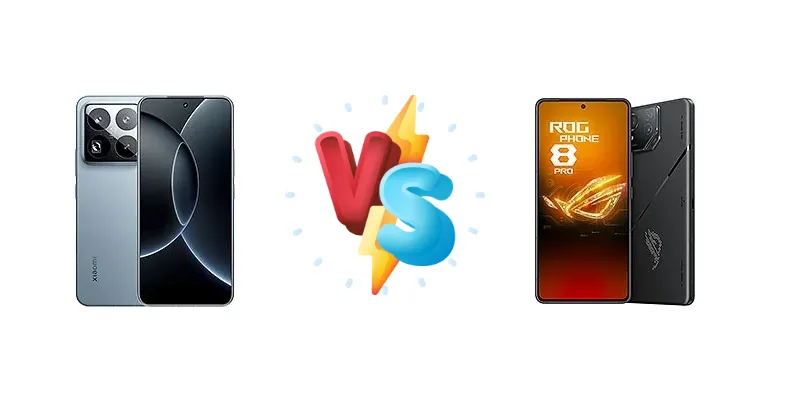
|
🏆 Quick Verdict
For the average user prioritizing all-around performance and a balanced experience, the Asus ROG Phone 8 Pro emerges as the winner. Its Snapdragon 8 Gen 3 offers proven stability and gaming prowess, coupled with a brighter display and significantly longer battery life. While the Xiaomi 15S Pro's Xring O1 is intriguing, its real-world benefits remain to be fully established.
| PHONES | ||
|---|---|---|
| Phone Names | Xiaomi 15S Pro | Asus ROG Phone 8 Pro |
| Network | ||
|---|---|---|
| 2G bands | GSM 850 / 900 / 1800 / 1900 | GSM 850 / 900 / 1800 / 1900 |
| 3G bands | HSDPA 800 / 850 / 900 / 1700(AWS) / 1900 / 2100 | HSDPA 850 / 900 / 1700(AWS) / 1800 / 1900 / 2100 - International |
| 4G bands | 1, 2, 3, 4, 5, 7, 8, 12, 17, 18, 19, 20, 26, 28, 34, 38, 39, 40, 41, 42, 48, 66 | 1, 2, 3, 4, 5, 7, 8, 12, 17, 18, 19, 20, 25, 26, 28, 32, 34, 38, 39, 40, 41, 42, 43, 48, 66 - International |
| 5G bands | 1, 2, 3, 5, 7, 8, 12, 20, 26, 28, 38, 40, 41, 48, 66, 77, 78, 79 SA/NSA | 1, 2, 3, 5, 7, 8, 12, 18, 20, 25, 26, 28, 38, 40, 41, 48, 66, 77, 78, 79 SA/NSA/Sub6 - International |
| Speed | HSPA, LTE, 5G | HSPA, LTE (Up to 7CA), 5G |
| Technology | GSM / CDMA / HSPA / EVDO / LTE / 5G | GSM / CDMA / HSPA / LTE / 5G |
| Launch | ||
|---|---|---|
| Announced | 2025, May 22 | 2024, January 08 |
| Status | Available. Released 2025, May 22 | Available. Released 2024, January 18 |
| Body | ||
|---|---|---|
| Build | - | Glass front (Gorilla Glass Victus 2), glass back (Gorilla Glass), aluminum frame |
| Dimensions | 161.3 x 75.3 x 8.3 mm (6.35 x 2.96 x 0.33 in) | 163.8 x 76.8 x 8.9 mm (6.45 x 3.02 x 0.35 in) |
| SIM | Nano-SIM + Nano-SIM | Nano-SIM + Nano-SIM |
| Weight | 216 g (7.62 oz) | 225 g (7.94 oz) |
| Display | ||
|---|---|---|
| Protection | Shatterproof glass (2024 gen) | Corning Gorilla Glass Victus 2 |
| Resolution | 1440 x 3200 pixels, 20:9 ratio (~521 ppi density) | 1080 x 2400 pixels, 20:9 ratio (~388 ppi density) |
| Size | 6.73 inches, 109.4 cm2 (~90.0% screen-to-body ratio) | 6.78 inches, 111.0 cm2 (~88.2% screen-to-body ratio) |
| Type | LTPO AMOLED, 68B colors, 120Hz, 1920Hz PWM, Dolby Vision, HDR10+, HDR Vivid, 3200 nits (peak) | LTPO AMOLED, 1B colors, 165Hz, HDR10, 1600 nits (HBM), 2500 nits (peak) |
| Platform | ||
|---|---|---|
| CPU | 10-core (2x3.9GHz Cortex-X925 & 4x3.4GHz Cortex-A725 & 2x1.9GHz Cortex-A725 & 2x1.8GHz Cortex-A520) | Octa-core (1x3.3 GHz Cortex-X4 & 3x3.2 GHz Cortex-A720 & 2x3.0 GHz Cortex-A720 & 2x2.3 GHz Cortex-A520) |
| Chipset | Xring O1 (3 nm) | Qualcomm SM8650-AB Snapdragon 8 Gen 3 (4 nm) |
| GPU | Immortalis-G925 MP16 | Adreno 750 |
| OS | Android 15, HyperOS 2 | Android 14, up to 2 major Android upgrades |
| Memory | ||
|---|---|---|
| Card slot | No | No |
| Internal | 512GB 16GB RAM, 1TB 16GB RAM | 512GB 16GB RAM, 1TB 24GB RAM |
| Main Camera | ||
|---|---|---|
| Features | Laser AF, color spectrum sensor, Leica lens, Dual-LED dual-tone flash, HDR, panorama | LED flash, HDR, panorama |
| Triple | 50 MP, f/1.4, 23mm (wide), 1/1.31", 1.2µm, dual pixel PDAF, OIS 50 MP, f/2.5, 120mm (periscope telephoto), PDAF (30cm - ∞), OIS, 5x optical zoom 50 MP, f/2.2, 14mm, 115˚ (ultrawide), AF | 50 MP, f/1.9, 24mm (wide), 1/1.56", 1.0µm, PDAF, gimbal OIS 32 MP, f/2.4, (telephoto), 1/3.2", 0.7µm, PDAF, OIS, 3x optical zoom 13 MP, f/2.2, 13mm, 120˚ (ultrawide) |
| Video | 8K@24fps (HDR), 4K@30/60fps (HDR10+, 10-bit Dolby Vision HDR, 10-bit LOG), 1080p@30/60/120/240/960fps, gyro-EIS | 8K@24fps, 4K@30/60fps, 1080p@30/60/120/240fps, 720p@480fps; gyro-EIS, HDR10+ |
| Selfie camera | ||
|---|---|---|
| Features | HDR, panorama | Panorama, HDR |
| Single | 32 MP, f/2.0, 22mm (wide), 0.7µm | 32 MP, f/2.5, 22mm (wide), 1/3.2", 0.7µm |
| Video | 4K@30/60fps, 1080p@30/60fps, gyro-EIS | 1080p@30fps |
| Sound | ||
|---|---|---|
| 35mm jack | No | Yes |
| Loudspeaker | Yes, with stereo speakers | Yes, with stereo speakers |
| Comms | ||
|---|---|---|
| Bluetooth | 5.4, A2DP, LE, aptX HD, aptX Adaptive, LHDC 5 | 5.4, A2DP, LE, aptX HD, aptX Adaptive, aptX Lossless |
| Infrared port | Yes | - |
| NFC | Yes | Yes |
| Positioning | GPS (L1+L5), BDS (B1I+B1c+B2a), GALILEO (E1+E5a), QZSS (L1+L5), GLONASS | GPS (L1+L5), BDS (B1I+B1c+B2a), GALILEO (E1+E5a), QZSS (L1+L5), NavIC (L5), GLONASS |
| Radio | No | No |
| USB | USB Type-C 3.2 Gen2, Display Port, OTG | USB Type-C (side), DisplayPort 1.4; USB Type-C (bottom), OTG |
| WLAN | Wi-Fi 802.11 a/b/g/n/ac/6e/7, dual-band, Wi-Fi Direct | Wi-Fi 802.11 a/b/g/n/ac/6e/7, tri-band, Wi-Fi Direct |
| Features | ||
|---|---|---|
| Sensors | Fingerprint (under display, ultrasonic), accelerometer, proximity, gyro, compass, barometer | Fingerprint (under display, optical), accelerometer, gyro, proximity, compass |
| Battery | ||
|---|---|---|
| Charging | 90W wired, PD3.0 50W wireless 10W reverse wireless | 65W wired, PD3.0, PPS, QC5, 100% in 39 min - International 30W wired, PD3.0, PPS - India 15W wireless (Qi) 10W reverse wired |
| Type | Si/C Li-Ion 6100 mAh | 5500 mAh |
| Misc | ||
|---|---|---|
| Colors | Black, Blue | Phantom Black |
| Models | - | AI2401, AI2401_A, AI2401_D |
| Price | About 680 EUR | $ 1,157.98 / £ 1,693.75 / € 632.66 |
Xiaomi 15S Pro
- Potentially groundbreaking Xring O1 chipset
- Faster wired and wireless charging speeds
- Reverse wireless charging capability
- Unproven chipset performance and software optimization
- Missing display brightness data
- Limited camera information
Asus ROG Phone 8 Pro
- Proven Snapdragon 8 Gen 3 performance
- Exceptional battery life (14:43h active use)
- Bright and color-accurate display (1765 nits)
- Slower wired charging than Xiaomi (especially in India)
- Wireless charging speed is lower
- Camera details are vague
Display Comparison
The Asus ROG Phone 8 Pro boasts a significantly brighter display, reaching a measured 1765 nits, making it far more usable outdoors than the Xiaomi 15S Pro (brightness data unavailable). While the Xiaomi likely employs a high-quality panel, the ROG Phone’s brightness advantage is substantial. Both devices likely support high refresh rates, but the ROG Phone’s brightness and color accuracy will be superior for media consumption and gaming. The ROG Phone’s display is also likely to have a higher PWM dimming rate, potentially reducing eye strain for sensitive users.
Camera Comparison
Detailed camera specifications for the Xiaomi 15S Pro are unavailable. The Asus ROG Phone 8 Pro’s camera capabilities are described as 'Photo / Video', lacking specifics. Without sensor size, aperture, or OIS details for either device, a meaningful comparison is difficult. However, Asus ROG Phones typically prioritize video recording capabilities, while Xiaomi flagships often excel in still photography. The absence of detailed camera information suggests neither phone is a primary focus for camera enthusiasts.
Performance
The core of this comparison lies in the chipsets. The Xiaomi 15S Pro’s Xring O1, built on a 3nm process, theoretically offers greater efficiency and transistor density compared to the Asus ROG Phone 8 Pro’s Snapdragon 8 Gen 3 (4nm). However, the Snapdragon 8 Gen 3 is a mature platform with optimized drivers and software support. The Xring O1’s 10-core configuration (2x3.9GHz Cortex-X925, 4x3.4GHz Cortex-A725, 2x1.9GHz Cortex-A725, 2x1.8GHz Cortex-A520) is complex, and its real-world performance advantage over the Snapdragon 8 Gen 3’s octa-core setup (1x3.3 GHz Cortex-X4, 3x3.2 GHz Cortex-A720, 2x3.0 GHz Cortex-A720, 2x2.3 GHz Cortex-A520) remains to be seen. The ROG Phone benefits from Qualcomm’s Adreno GPU, a proven performer in mobile gaming. Both devices likely utilize LPDDR5x RAM, but thermal management will be crucial; the Snapdragon 8 Gen 3’s 4nm node offers a potential advantage in sustained performance.
Battery Life
The Asus ROG Phone 8 Pro demonstrates a clear advantage in battery life, achieving 14 hours and 43 minutes of active use. The Xiaomi 15S Pro’s battery capacity is unknown, but its 90W wired charging, 50W wireless, and 10W reverse wireless charging capabilities are impressive. The ROG Phone offers 65W wired (International) / 30W (India), 15W wireless (Qi), and 10W reverse wired. While the Xiaomi charges faster, the ROG Phone’s superior battery life mitigates the charging speed difference. The ROG Phone’s 39-minute 0-100% charge time (International) is competitive, but the Indian variant’s 30W charging is significantly slower.
Buying Guide
Buy the Xiaomi 15S Pro if you are an early adopter fascinated by cutting-edge silicon and willing to potentially troubleshoot early software quirks for a possible performance edge. Buy the Asus ROG Phone 8 Pro if you prioritize a polished, reliable gaming experience, exceptional battery life, and a brighter, more visible display, even in direct sunlight.