
Xiaomi 15 vs. vivo X200 Pro mini: A Compact Flagship Showdown
| Phones Images | |||||
|---|---|---|---|---|---|
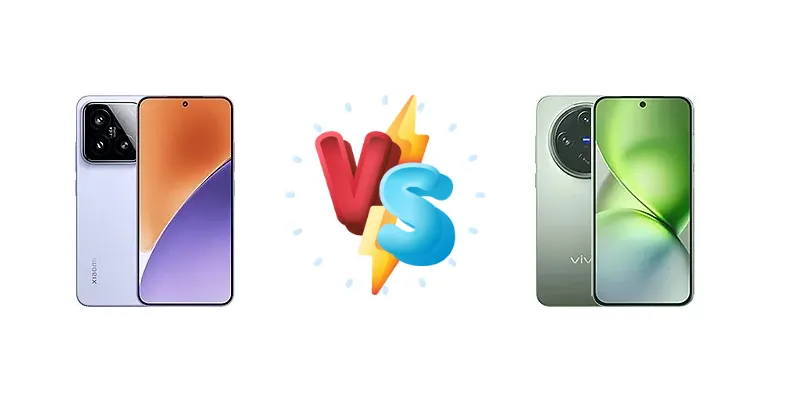
|
🏆 Quick Verdict
For the average user prioritizing sustained performance and all-day battery life, the Xiaomi 15 emerges as the winner. Its Snapdragon 8 Elite chipset, coupled with impressive 63:26h endurance, provides a more consistent experience than the vivo X200 Pro mini, despite the latter's competitive Dimensity 9400.
| PHONES | ||
|---|---|---|
| Phone Names | Xiaomi 15 | vivo X200 Pro mini |
| Network | ||
|---|---|---|
| 2G bands | GSM 850 / 900 / 1800 / 1900 | GSM 850 / 900 / 1800 / 1900 |
| 3G bands | HSDPA 800 / 850 / 900 / 1700(AWS) / 1900 / 2100 | HSDPA 800 / 850 / 900 / 1700(AWS) / 1900 / 2100 |
| 4G bands | 1, 2, 3, 4, 5, 7, 8, 12, 13, 17, 18, 19, 20, 25, 26, 28, 32, 38, 39, 40, 41, 42, 48, 66 - International | 1, 2, 3, 4, 5, 7, 8, 18, 19, 26, 28, 34, 38, 39, 40, 41, 66 |
| 5G bands | 1, 2, 3, 5, 7, 8, 12, 20, 25, 26, 28, 38, 40, 41, 48, 66, 75, 77, 78 SA/NSA - International | 1, 3, 5, 8, 28, 38, 40, 41, 77, 78 SA/NSA |
| Speed | HSPA, LTE, 5G | HSPA, LTE, 5G |
| Technology | GSM / HSPA / LTE / 5G | GSM / HSPA / LTE / 5G |
| Launch | ||
|---|---|---|
| Announced | 2024, October 29 | 2024, October 14 |
| Status | Available. Released 2024, October 29 | Available. Released 2024, October 25 |
| Body | ||
|---|---|---|
| Build | Glass front (Xiaomi Shield Glass), aluminum alloy frame (6M42) | Glass front, aluminum alloy frame |
| Dimensions | 152.3 x 71.2 x 8.1 / 8.4 / 8.5 mm | 150.8 x 71.8 x 8.2 mm (5.94 x 2.83 x 0.32 in) |
| SIM | · Nano-SIM + Nano-SIM· Nano-SIM + Nano-SIM + eSIM + eSIM (max 2 at a time) | Nano-SIM + Nano-SIM |
| Weight | 189 / 191 / 192 g (6.67 oz) | 187 g (6.60 oz) |
| Display | ||
|---|---|---|
| Protection | Xiaomi Shield Glass, Mohs level 6 | - |
| Resolution | 1200 x 2670 pixels, 20:9 ratio (~460 ppi density) | 1216 x 2640 pixels, 19.5:9 ratio (~460 ppi density) |
| Size | 6.36 inches, 97.6 cm2 (~90.0% screen-to-body ratio) | 6.31 inches, 98.0 cm2 (~90.5% screen-to-body ratio) |
| Type | LTPO AMOLED, 68B colors, 1920Hz PWM, 120Hz, Dolby Vision, HDR10+, 3200 nits (peak) | LTPO AMOLED, 1B colors, 120Hz, 2160Hz PWM, HDR10+, 4500 nits (peak) |
| Platform | ||
|---|---|---|
| CPU | Octa-core (2x4.32 GHz Oryon V2 Phoenix L + 6x3.53 GHz Oryon V2 Phoenix M) | Octa-core (1x3.63 GHz Cortex-X925 & 3x3.3 GHz Cortex-X4 & 4x2.4 GHz Cortex-A720) |
| Chipset | Qualcomm SM8750-AB Snapdragon 8 Elite (3 nm) | Mediatek Dimensity 9400 (3 nm) |
| GPU | Adreno 830 | Immortalis-G925 |
| OS | Android 15, up to 4 major Android upgrades, HyperOS 2 | Android 15, OriginOS 5 (China) |
| Memory | ||
|---|---|---|
| Card slot | No | No |
| Internal | 256GB 12GB RAM, 256GB 16GB RAM, 512GB 12GB RAM, 512GB 16GB RAM, 1TB 16GB RAM | 256GB 12GB RAM, 512GB 12GB RAM, 512GB 16GB RAM, 1TB 16GB RAM |
| Main Camera | ||
|---|---|---|
| Features | Laser AF, color spectrum sensor, Leica lens, Dual-LED dual-tone flash, HDR, panorama | Laser AF, Zeiss optics, Zeiss T* lens coating, LED flash, panorama, HDR |
| Triple | 50 MP, f/1.6, 23mm (wide), 1/1.31", 1.2µm, dual pixel PDAF, OIS 50 MP, f/2.0, 60mm (telephoto), 1/2.76", 0.64µm, PDAF (10cm - ∞), OIS, 2.6x optical zoom 50 MP, f/2.2, 14mm, 115˚ (ultrawide), 1/2.76", 0.64µm | 50 MP, f/1.6, 23mm (wide), 1/1.28", 1.22µm, PDAF, OIS 50 MP, f/2.6, 70mm (periscope telephoto), 1/1.95", PDAF, OIS, 3x optical zoom 50 MP, f/2.0, 15mm, 119˚ (ultrawide), 1/2.76", 0.64µm, AF |
| Video | 8K@24/30fps (HDR), 4K@24/30/60fps (HDR10+, 10-bit Dolby Vision HDR, 10-bit LOG), 1080p@30/60/120/240/960fps, 720p@1920fps, gyro-EIS | 4K@30/60fps, 1080p@30/60/120fps, gyro-EIS, HDR |
| Selfie camera | ||
|---|---|---|
| Features | HDR, panorama | HDR |
| Single | 32 MP, f/2.0, 21mm (wide), 1/3.14", 0.7µm | 32 MP, f/2.0, 20mm (ultrawide) |
| Video | 4K@30/60fps, 1080p@30/60fps, HDR10+, gyro-EIS | 4K, 1080p |
| Sound | ||
|---|---|---|
| 35mm jack | No | No |
| Loudspeaker | Yes, with stereo speakers | Yes, with stereo speakers |
| Comms | ||
|---|---|---|
| Bluetooth | 5.4/6.0, A2DP, LE, aptX HD, aptX Adaptive, LHDC 5 | 5.4, A2DP, LE, aptX HD, LHDC 5 |
| Infrared port | Yes | Yes |
| NFC | Yes | Yes |
| Positioning | GPS (L1+L5), GLONASS (G1), BDS (B1I+B1c+B2a), GALILEO (E1+E5a), QZSS (L1+L5) | GPS (L1+L5), GLONASS (L1), BDS (B1I+B1c+B2a+B2b), GALILEO (E1+E5a+E5b), QZSS (L1+L5), NavIC (L5) |
| Radio | No | No |
| USB | USB Type-C 3.2, Display Port, OTG | USB Type-C 2.0, OTG |
| WLAN | Wi-Fi 802.11 a/b/g/n/ac/6e/7, dual-band or tri-band, Wi-Fi Direct | Wi-Fi 802.11 a/b/g/n/ac/6/7, dual-band |
| Features | ||
|---|---|---|
| Sensors | Fingerprint (under display, ultrasonic), accelerometer, proximity, gyro, compass, barometer | Fingerprint (under display, optical), accelerometer, gyro, proximity, compass |
| Battery | ||
|---|---|---|
| Charging | 90W wired, PD3.0, QC3+ 50W wireless 10W reverse wireless | 90W wired 30W wireless Reverse wired |
| Type | Market-dependent versions:· Si/C Li-Ion 5240 mAh - Global· Si/C Li-Ion 5400 mAh - China | Si/C Li-Ion 5700 mAh |
| Misc | ||
|---|---|---|
| Colors | Black, White, Liquid Silver, Green, Lilac | Black, White, Green, Pink |
| Models | 24129PN74G, 24129PN74I, 24129PN74C | V2419A |
| Price | $ 789.99 / £ 519.00 / € 648.25 | About 610 EUR |
| SAR EU | 0.99 W/kg (head) 1.00 W/kg (body) | - |
| EU LABEL | ||
|---|---|---|
| Battery | 63:26h endurance, 1000 cycles | - |
| Energy | Class A | - |
| Free fall | Class C (90 falls) | - |
| Repairability | Class C | - |
Xiaomi 15
- Exceptional battery life (63:26h endurance)
- Brighter display (1517 nits)
- Comprehensive charging support (PD3.0, QC3+, 50W wireless)
- May have a more saturated image processing style
- Software experience can be feature-rich but potentially bloated
vivo X200 Pro mini
- Latest MediaTek Dimensity 9400 chipset
- Potentially optimized software experience
- Compact form factor
- Lower battery endurance compared to Xiaomi 15
- Wireless charging speed is slower (30W)
Display Comparison
The Xiaomi 15 boasts a display capable of reaching a measured 1517 nits of peak brightness, providing excellent readability even under direct sunlight. While the vivo X200 Pro mini’s display specifications are not provided, Xiaomi’s high peak brightness is a significant advantage for outdoor users. Both devices utilize 3nm chipsets, which should contribute to efficient display power consumption, but the Xiaomi 15’s higher brightness demands more power. The absence of LTPO information for the vivo model leaves questions about its adaptive refresh rate capabilities and potential power savings.
Camera Comparison
Without detailed camera specifications for either device, a direct comparison is limited. However, given both phones’ flagship positioning, we can expect high-quality camera systems. The focus should be on sensor size, optical image stabilization (OIS), and image processing algorithms. The absence of information regarding sensor sizes makes it difficult to assess low-light performance. The vivo brand historically emphasizes natural color reproduction, while Xiaomi often leans towards more vibrant, saturated images. The presence of OIS on both devices is expected, crucial for stable video recording and sharper low-light photos.
Performance
The core of the battle lies in the chipsets. The Xiaomi 15’s Snapdragon 8 Elite (3nm) utilizes Qualcomm’s Oryon V2 Phoenix CPU architecture – a 2+6 core configuration with peak clock speeds of 4.32 GHz and 3.53 GHz respectively. This is contrasted by the vivo X200 Pro mini’s Dimensity 9400 (3nm) featuring a 1+3+4 core setup with a Cortex-X925 prime core at 3.63 GHz. While the Dimensity 9400’s Cortex-X925 offers strong single-core performance, the Snapdragon 8 Elite’s Oryon cores are designed for sustained multi-core workloads, potentially leading to better performance in demanding tasks like video editing and prolonged gaming. The Snapdragon’s architecture is also known for its strong GPU performance, which is crucial for mobile gaming.
Battery Life
The Xiaomi 15’s battery endurance of 63:26h and active use score of 16:28h are significant advantages. This is coupled with 90W wired charging, PD3.0, QC3+, 50W wireless, and 10W reverse wireless charging. The vivo X200 Pro mini offers 90W wired charging and 30W wireless, along with reverse wired charging, but lacks the extensive charging protocol support of the Xiaomi 15. While the vivo’s 90W wired charging is fast, the Xiaomi 15’s superior battery endurance and broader charging compatibility provide greater flexibility and convenience for users.
Buying Guide
Buy the Xiaomi 15 if you need exceptional battery life, consistently high frame rates in demanding games, and a brighter display for outdoor visibility. Buy the vivo X200 Pro mini if you prioritize the latest MediaTek silicon, potentially benefiting from future software optimizations, and prefer a slightly more streamlined software experience, accepting a trade-off in battery endurance.