
Xiaomi 15 vs. Oppo Find X8 Pro: A Head-to-Head Flagship Showdown
| Phones Images | |||||
|---|---|---|---|---|---|
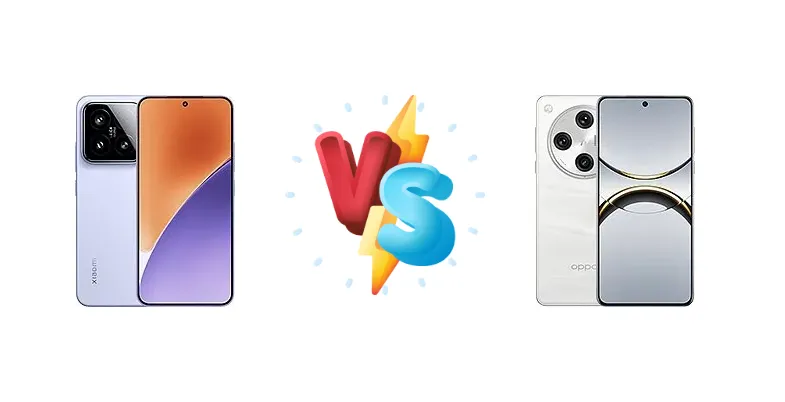
|
🏆 Quick Verdict
For the average user prioritizing sustained performance and slightly longer battery life, the Xiaomi 15 emerges as the winner. Its Snapdragon 8 Elite chipset, coupled with a measured 1517 nits peak brightness, provides a noticeable edge in demanding tasks and outdoor visibility. However, the Oppo Find X8 Pro remains a strong contender, particularly for those invested in the MediaTek ecosystem.
| PHONES | ||
|---|---|---|
| Phone Names | Xiaomi 15 | Oppo Find X8 Pro |
| Network | ||
|---|---|---|
| 2G bands | GSM 850 / 900 / 1800 / 1900 | GSM 850 / 900 / 1800 / 1900 |
| 3G bands | HSDPA 800 / 850 / 900 / 1700(AWS) / 1900 / 2100 | HSDPA 800 / 850 / 900 / 1700(AWS) / 1900 / 2100 |
| 4G bands | 1, 2, 3, 4, 5, 7, 8, 12, 13, 17, 18, 19, 20, 25, 26, 28, 32, 38, 39, 40, 41, 42, 48, 66 - International | 1, 2, 3, 4, 5, 7, 8, 12, 13, 17, 18, 19, 20, 25, 26, 28, 32, 38, 39, 40, 41, 66 - International |
| 5G bands | 1, 2, 3, 5, 7, 8, 12, 20, 25, 26, 28, 38, 40, 41, 48, 66, 75, 77, 78 SA/NSA - International | 1, 2, 3, 5, 7, 8, 12, 20, 25, 26, 28, 38, 40, 41, 66, 75, 77, 78 SA/NSA - International |
| Speed | HSPA, LTE, 5G | HSPA, LTE, 5G |
| Technology | GSM / HSPA / LTE / 5G | GSM / HSPA / LTE / 5G |
| Launch | ||
|---|---|---|
| Announced | 2024, October 29 | 2024, October 24 |
| Status | Available. Released 2024, October 29 | Available. Released 2024, October 30 |
| Body | ||
|---|---|---|
| Build | Glass front (Xiaomi Shield Glass), aluminum alloy frame (6M42) | Glass front (Gorilla Glass 7i), glass back (Gorilla Glass 7i), aluminum frame |
| Dimensions | 152.3 x 71.2 x 8.1 / 8.4 / 8.5 mm | 162.3 x 76.7 x 8.2 mm (6.39 x 3.02 x 0.32 in) |
| SIM | · Nano-SIM + Nano-SIM· Nano-SIM + Nano-SIM + eSIM + eSIM (max 2 at a time) | · Nano-SIM + eSIM· Nano-SIM + Nano-SIM |
| Weight | 189 / 191 / 192 g (6.67 oz) | 215 g (7.58 oz) |
| Display | ||
|---|---|---|
| Protection | Xiaomi Shield Glass, Mohs level 6 | Corning Gorilla Glass 7i |
| Resolution | 1200 x 2670 pixels, 20:9 ratio (~460 ppi density) | 1264 x 2780 pixels (~450 ppi density) |
| Size | 6.36 inches, 97.6 cm2 (~90.0% screen-to-body ratio) | 6.78 inches, 111.7 cm2 (~89.8% screen-to-body ratio) |
| Type | LTPO AMOLED, 68B colors, 1920Hz PWM, 120Hz, Dolby Vision, HDR10+, 3200 nits (peak) | LTPO AMOLED, 1B colors, 120Hz, 2160Hz PWM, Dolby Vision, HDR10+, 800 nits (typ), 1600 nits (HBM), 4500 nits (peak) |
| Platform | ||
|---|---|---|
| CPU | Octa-core (2x4.32 GHz Oryon V2 Phoenix L + 6x3.53 GHz Oryon V2 Phoenix M) | Octa-core (1x3.63 GHz Cortex-X925 & 3x3.3 GHz Cortex-X4 & 4x2.4 GHz Cortex-A720) |
| Chipset | Qualcomm SM8750-AB Snapdragon 8 Elite (3 nm) | Mediatek Dimensity 9400 (3 nm) |
| GPU | Adreno 830 | Immortalis-G925 |
| OS | Android 15, up to 4 major Android upgrades, HyperOS 2 | Android 15, up to 5 major Android upgrades, ColorOS 15 |
| Memory | ||
|---|---|---|
| Card slot | No | No |
| Internal | 256GB 12GB RAM, 256GB 16GB RAM, 512GB 12GB RAM, 512GB 16GB RAM, 1TB 16GB RAM | 256GB 12GB RAM, 512GB 12GB RAM, 512GB 16GB RAM, 1TB 16GB RAM |
| Main Camera | ||
|---|---|---|
| Features | Laser AF, color spectrum sensor, Leica lens, Dual-LED dual-tone flash, HDR, panorama | Laser AF, color spectrum sensor, Hasselblad Color Calibration, LED flash, HDR, panorama |
| Quad | - | 50 MP, f/1.6, 23mm (wide), 1/1.4", 1.12µm, multi-directional PDAF, OIS 50 MP, f/2.6, 73mm (periscope telephoto), 1/1.95", 0.61µm, 3x optical zoom, multi-directional PDAF, OIS 50 MP, f/4.3, 135mm (periscope telephoto), 1/2.51", 0.7µm, 6x optical zoom, dual pixel PDAF (35cm - ∞), OIS 50 MP, f/2.0, 15mm, 120˚ (ultrawide), 1/2.75", 0.64µm, multi-directional PDAF |
| Triple | 50 MP, f/1.6, 23mm (wide), 1/1.31", 1.2µm, dual pixel PDAF, OIS 50 MP, f/2.0, 60mm (telephoto), 1/2.76", 0.64µm, PDAF (10cm - ∞), OIS, 2.6x optical zoom 50 MP, f/2.2, 14mm, 115˚ (ultrawide), 1/2.76", 0.64µm | - |
| Video | 8K@24/30fps (HDR), 4K@24/30/60fps (HDR10+, 10-bit Dolby Vision HDR, 10-bit LOG), 1080p@30/60/120/240/960fps, 720p@1920fps, gyro-EIS | 4K@30/60fps, 1080p@30/60/240fps; gyro-EIS; HDR, 10‑bit video, Dolby Vision |
| Selfie camera | ||
|---|---|---|
| Features | HDR, panorama | Panorama |
| Single | 32 MP, f/2.0, 21mm (wide), 1/3.14", 0.7µm | 32 MP, f/2.4, 21mm (wide), 1/2.74", 0.8µm |
| Video | 4K@30/60fps, 1080p@30/60fps, HDR10+, gyro-EIS | 4K@30/60fps, 1080p@30/60fps, gyro-EIS |
| Sound | ||
|---|---|---|
| 35mm jack | No | No |
| Loudspeaker | Yes, with stereo speakers | Yes, with stereo speakers |
| Comms | ||
|---|---|---|
| Bluetooth | 5.4/6.0, A2DP, LE, aptX HD, aptX Adaptive, LHDC 5 | 5.4, A2DP, LE, aptX HD, LHDC 5 |
| Infrared port | Yes | Yes |
| NFC | Yes | Yes |
| Positioning | GPS (L1+L5), GLONASS (G1), BDS (B1I+B1c+B2a), GALILEO (E1+E5a), QZSS (L1+L5) | GPS (L1+L5), BDS (B1I+B1c+B2a+B2b), GALILEO (E1+E5a+E5b), QZSS (L1+L5), GLONASS, NavIC (L5) |
| Radio | No | No |
| USB | USB Type-C 3.2, Display Port, OTG | USB Type-C 3.2, OTG |
| WLAN | Wi-Fi 802.11 a/b/g/n/ac/6e/7, dual-band or tri-band, Wi-Fi Direct | Wi-Fi 802.11 a/b/g/n/ac/6/7, dual-band or tri-band, Wi-Fi Direct |
| Features | ||
|---|---|---|
| Sensors | Fingerprint (under display, ultrasonic), accelerometer, proximity, gyro, compass, barometer | Fingerprint (under display, optical), accelerometer, gyro, proximity, compass |
| Battery | ||
|---|---|---|
| Charging | 90W wired, PD3.0, QC3+ 50W wireless 10W reverse wireless | 80W wired, PD 55W, PPS, UFCS 50W wireless 10W reverse wireless |
| Type | Market-dependent versions:· Si/C Li-Ion 5240 mAh - Global· Si/C Li-Ion 5400 mAh - China | Si/C Li-Ion 5910 mAh |
| Misc | ||
|---|---|---|
| Colors | Black, White, Liquid Silver, Green, Lilac | Space Black, Pearl White, Blue |
| Models | 24129PN74G, 24129PN74I, 24129PN74C | CPH2659, PKC110, PKC130 |
| Price | $ 789.99 / £ 519.00 / € 648.25 | € 1,014.99 / $ 1,349.00 / ₹ 92,990 |
| SAR EU | 0.99 W/kg (head) 1.00 W/kg (body) | - |
| EU LABEL | ||
|---|---|---|
| Battery | 63:26h endurance, 1000 cycles | - |
| Energy | Class A | - |
| Free fall | Class C (90 falls) | - |
| Repairability | Class C | - |
Xiaomi 15
- Superior CPU performance with Oryon V2 cores
- Brighter display for outdoor visibility
- Faster 90W wired charging
- Longer battery endurance
- Qualcomm’s software ecosystem may not appeal to all users
- Potential for higher price
Oppo Find X8 Pro
- MediaTek Dimensity 9400 offers strong performance
- PD 55W charging standard support
- Potentially different image processing style
- May be more affordable
- Lower peak display brightness
- Shorter battery endurance
Display Comparison
The Xiaomi 15 boasts a significantly brighter display, reaching a measured 1517 nits compared to the Oppo Find X8 Pro’s 1333 nits. This translates to superior readability outdoors under direct sunlight. While both likely employ LTPO technology for variable refresh rates (not specified in the data, but standard for flagships), the Xiaomi 15’s higher peak brightness is a clear advantage. The absence of refresh rate data prevents a full assessment of display smoothness, but the brightness difference is immediately impactful.
Camera Comparison
Without detailed camera specifications, a direct comparison is limited. However, the chipset’s ISP (Image Signal Processor) plays a crucial role. Qualcomm’s Snapdragon 8 Elite is known for its advanced image processing capabilities, potentially offering superior dynamic range and low-light performance. The Dimensity 9400’s ISP is also highly capable, but its image processing style may differ, leaning towards more saturated colors or a different approach to noise reduction. The absence of sensor size data makes it impossible to determine which phone captures more detail.
Performance
The core of the performance difference lies in the chipsets. The Xiaomi 15’s Snapdragon 8 Elite, built on a 3nm process, utilizes Qualcomm’s Oryon V2 Phoenix CPU cores – two ‘Phoenix L’ cores clocked at 4.32 GHz and six ‘Phoenix M’ cores at 3.53 GHz. This architecture is designed for peak performance. The Oppo Find X8 Pro’s Dimensity 9400, also 3nm, employs an ARM-based configuration: one Cortex-X925 at 3.63 GHz, three Cortex-X4 at 3.3 GHz, and four Cortex-A720 at 2.4 GHz. While the Dimensity 9400’s Cortex-X925 is a powerful core, the Snapdragon 8 Elite’s Oryon cores are expected to deliver superior single-core performance, crucial for responsive UI and demanding applications. The Snapdragon’s architecture is also likely to offer better sustained performance due to thermal efficiency.
Battery Life
The Xiaomi 15 demonstrates superior battery endurance with a 63:26h rating, while the Oppo Find X8 Pro achieves 15:18h active use. This suggests the Snapdragon 8 Elite is more power-efficient, despite the Oppo’s slightly slower charging speed. The Xiaomi 15 supports 90W wired charging, allowing for a significantly faster 0-100% charge compared to the Oppo’s 80W. Both support 50W wireless charging and 10W reverse wireless charging. The Xiaomi 15’s 1000 cycle battery lifespan claim suggests a focus on long-term battery health.
Buying Guide
Buy the Xiaomi 15 if you need uncompromising CPU performance for gaming and multitasking, and value a brighter, more visible display in direct sunlight. Its 90W wired charging is also a significant advantage for quick top-ups. Buy the Oppo Find X8 Pro if you prefer the MediaTek Dimensity 9400’s architecture and potential software optimizations, and prioritize a potentially different image processing style in photography. The Find X8 Pro also supports the newer PD 55W charging standard.