
Xiaomi 15 vs. iPhone 17 Pro Max: A Head-to-Head Flagship Battle
| Phones Images | |||||
|---|---|---|---|---|---|
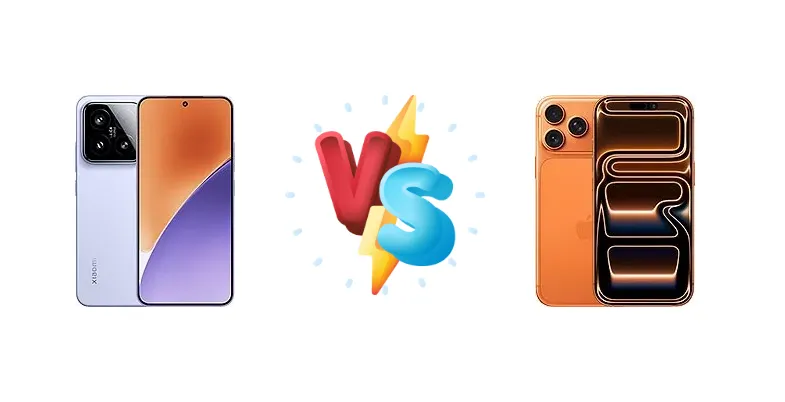
|
🏆 Quick Verdict
For the power user prioritizing charging speed and raw performance, the Xiaomi 15 emerges as the winner. Its 90W wired charging and Snapdragon 8 Elite chipset offer a noticeable edge. However, the iPhone 17 Pro Max excels in sustained active use battery life, making it ideal for users who demand all-day performance without frequent top-ups.
| PHONES | ||
|---|---|---|
| Phone Names | Xiaomi 15 | Apple iPhone 17 Pro Max |
| Network | ||
|---|---|---|
| 2G bands | GSM 850 / 900 / 1800 / 1900 | GSM 850 / 900 / 1800 / 1900 |
| 3G bands | HSDPA 800 / 850 / 900 / 1700(AWS) / 1900 / 2100 | HSDPA 850 / 900 / 1700(AWS) / 1900 / 2100 |
| 4G bands | 1, 2, 3, 4, 5, 7, 8, 12, 13, 17, 18, 19, 20, 25, 26, 28, 32, 38, 39, 40, 41, 42, 48, 66 - International | 1, 2, 3, 4, 5, 7, 8, 12, 13, 17, 18, 19, 20, 25, 26, 28, 30, 32, 34, 38, 39, 40, 41, 42, 48, 53, 66 - A3526 |
| 5G bands | 1, 2, 3, 5, 7, 8, 12, 20, 25, 26, 28, 38, 40, 41, 48, 66, 75, 77, 78 SA/NSA - International | 1, 2, 3, 5, 7, 8, 12, 20, 25, 26, 28, 30, 38, 40, 41, 48, 53, 66, 70, 75, 77, 78, 79 SA/NSA/Sub6 - A3526 |
| Speed | HSPA, LTE, 5G | HSPA, LTE, 5G, EV-DO Rev.A 3.1 Mbps |
| Technology | GSM / HSPA / LTE / 5G | GSM / CDMA / HSPA / EVDO / LTE / 5G |
| Launch | ||
|---|---|---|
| Announced | 2024, October 29 | 2025, September 09 |
| Status | Available. Released 2024, October 29 | Available. Released 2025, September 19 |
| Body | ||
|---|---|---|
| Build | Glass front (Xiaomi Shield Glass), aluminum alloy frame (6M42) | Glass front (Ceramic Shield 2), aluminum alloy frame, aluminum alloy back/ glass back (Ceramic Shield) |
| Dimensions | 152.3 x 71.2 x 8.1 / 8.4 / 8.5 mm | 163.4 x 78 x 8.8 mm (6.43 x 3.07 x 0.35 in) |
| SIM | · Nano-SIM + Nano-SIM· Nano-SIM + Nano-SIM + eSIM + eSIM (max 2 at a time) | · Nano-SIM + eSIM + eSIM (max 2 at a time; International)· eSIM + eSIM (8 or more, max 2 at a time; USA)· Nano-SIM + Nano-SIM (China) |
| Weight | 189 / 191 / 192 g (6.67 oz) | 233 g (8.22 oz) |
| Display | ||
|---|---|---|
| Protection | Xiaomi Shield Glass, Mohs level 6 | Ceramic Shield 2, Mohs level 5 |
| Resolution | 1200 x 2670 pixels, 20:9 ratio (~460 ppi density) | 1320 x 2868 pixels, 19.5:9 ratio (~460 ppi density) |
| Size | 6.36 inches, 97.6 cm2 (~90.0% screen-to-body ratio) | 6.9 inches, 115.6 cm2 (~90.7% screen-to-body ratio) |
| Type | LTPO AMOLED, 68B colors, 1920Hz PWM, 120Hz, Dolby Vision, HDR10+, 3200 nits (peak) | LTPO Super Retina XDR OLED, 120Hz, HDR10, Dolby Vision, 1000 nits (typ), 1600 nits (HBM), 3000 nits (peak) |
| Platform | ||
|---|---|---|
| CPU | Octa-core (2x4.32 GHz Oryon V2 Phoenix L + 6x3.53 GHz Oryon V2 Phoenix M) | Hexa-core (2x4.26 GHz + 4xX.X GHz) |
| Chipset | Qualcomm SM8750-AB Snapdragon 8 Elite (3 nm) | Apple A19 Pro (3 nm) |
| GPU | Adreno 830 | Apple GPU (6-core graphics) |
| OS | Android 15, up to 4 major Android upgrades, HyperOS 2 | iOS 26, upgradable to iOS 26.1 |
| Memory | ||
|---|---|---|
| Card slot | No | No |
| Internal | 256GB 12GB RAM, 256GB 16GB RAM, 512GB 12GB RAM, 512GB 16GB RAM, 1TB 16GB RAM | 256GB 12GB RAM, 512GB 12GB RAM, 1TB 12GB RAM, 2TB 12GB RAM |
| Main Camera | ||
|---|---|---|
| Features | Laser AF, color spectrum sensor, Leica lens, Dual-LED dual-tone flash, HDR, panorama | Dual-LED dual-tone flash, HDR (photo/panorama) |
| Triple | 50 MP, f/1.6, 23mm (wide), 1/1.31", 1.2µm, dual pixel PDAF, OIS 50 MP, f/2.0, 60mm (telephoto), 1/2.76", 0.64µm, PDAF (10cm - ∞), OIS, 2.6x optical zoom 50 MP, f/2.2, 14mm, 115˚ (ultrawide), 1/2.76", 0.64µm | 48 MP, f/1.8, 24mm (wide), 1/1.28", 1.22µm, dual pixel PDAF, sensor-shift OIS 48 MP, f/2.8, 100mm (periscope telephoto), 1/2.55", 0.7µm, PDAF, 3D sensor‑shift OIS, 4x optical zoom 48 MP, f/2.2, 13mm, 120˚ (ultrawide), 1/2.55", 0.7µm, PDAF TOF 3D LiDAR scanner (depth) |
| Video | 8K@24/30fps (HDR), 4K@24/30/60fps (HDR10+, 10-bit Dolby Vision HDR, 10-bit LOG), 1080p@30/60/120/240/960fps, 720p@1920fps, gyro-EIS | 4K@24/25/30/60/100/120fps, 1080p@25/30/60/120/240fps, 10-bit HDR, Dolby Vision HDR (up to 120fps), ProRes, ProRes RAW (up to 120fps), Apple Log 2, 3D (spatial) video/audio, stereo sound rec. |
| Selfie camera | ||
|---|---|---|
| Features | HDR, panorama | HDR, Dolby Vision HDR, 3D (spatial) audio, stereo sound rec., ProRes RAW, Apple Log 2 |
| Single | 32 MP, f/2.0, 21mm (wide), 1/3.14", 0.7µm | 18 MP multi-aspect, f/1.9, 20mm (ultrawide), PDAF SL 3D, (depth/biometrics sensor) |
| Video | 4K@30/60fps, 1080p@30/60fps, HDR10+, gyro-EIS | 4K@24/25/30/60fps, 1080p@25/30/60/120fps, gyro-EIS |
| Sound | ||
|---|---|---|
| 35mm jack | No | No |
| Loudspeaker | Yes, with stereo speakers | Yes, with stereo speakers |
| Comms | ||
|---|---|---|
| Bluetooth | 5.4/6.0, A2DP, LE, aptX HD, aptX Adaptive, LHDC 5 | 6.0, A2DP, LE |
| Infrared port | Yes | - |
| NFC | Yes | Yes |
| Positioning | GPS (L1+L5), GLONASS (G1), BDS (B1I+B1c+B2a), GALILEO (E1+E5a), QZSS (L1+L5) | GPS (L1+L5), GLONASS, GALILEO, BDS, QZSS, NavIC |
| Radio | No | No |
| USB | USB Type-C 3.2, Display Port, OTG | USB Type-C 3.2 Gen 2, DisplayPort |
| WLAN | Wi-Fi 802.11 a/b/g/n/ac/6e/7, dual-band or tri-band, Wi-Fi Direct | Wi-Fi 802.11 a/b/g/n/ac/6e/7, tri-band, hotspot |
| Features | ||
|---|---|---|
| Sensors | Fingerprint (under display, ultrasonic), accelerometer, proximity, gyro, compass, barometer | Face ID, accelerometer, gyro, proximity, compass, barometer |
| Battery | ||
|---|---|---|
| Charging | 90W wired, PD3.0, QC3+ 50W wireless 10W reverse wireless | Wired, PD3.2, AVS, 50% in 20 min 25W wireless MagSafe/Qi2, 50% in 30 min (15W - China) 4.5W reverse wired |
| Type | Market-dependent versions:· Si/C Li-Ion 5240 mAh - Global· Si/C Li-Ion 5400 mAh - China | Market-dependent versions:· Li-Ion 4823 mAh - Nano SIM model· Li-Ion 5088 mAh - eSIM only model |
| Misc | ||
|---|---|---|
| Colors | Black, White, Liquid Silver, Green, Lilac | Silver, Cosmic Orange, Deep Blue |
| Models | 24129PN74G, 24129PN74I, 24129PN74C | iPhone18,2, A3526, A3257, A3527, A3525 |
| Price | $ 789.99 / £ 519.00 / € 648.25 | € 1,344.19 / $ 1,419.00 / £ 1,199.00 / ₹ 149,900 |
| SAR | - | 1.19 W/kg (head) 1.19 W/kg (body) |
| SAR EU | 0.99 W/kg (head) 1.00 W/kg (body) | 1.49 W/kg (head) 1.49 W/kg (body) |
| EU LABEL | ||
|---|---|---|
| Battery | 63:26h endurance, 1000 cycles | 53:00h endurance, 1000 cycles |
| Energy | Class A | Class A |
| Free fall | Class C (90 falls) | Class B (180 falls) |
| Repairability | Class C | Class C |
Xiaomi 15
- Blazing-fast 90W wired charging
- Potentially higher peak CPU performance with Oryon cores
- Brighter display for outdoor visibility
- Shorter active use battery life compared to iPhone
- Android ecosystem fragmentation
Apple iPhone 17 Pro Max
- Longer active use battery life
- Seamless iOS ecosystem integration
- Optimized software and neural engine
- Slower charging speeds compared to Xiaomi
- Less customizable operating system
Display Comparison
The Xiaomi 15 boasts a significantly brighter display, reaching a measured 1517 nits compared to the iPhone 17 Pro Max’s 1000 nits. This translates to superior visibility in direct sunlight. While both utilize a 3nm process for their respective chipsets, the display technology differences are stark. The Xiaomi 15’s higher peak brightness is particularly beneficial for HDR content consumption. We expect the Xiaomi 15 to also feature a higher refresh rate, though this isn't specified in the data, while the iPhone 17 Pro Max likely continues with ProMotion, dynamically adjusting refresh rate for power efficiency. The lack of specific information on panel type (LTPO) for the Xiaomi 15 leaves some questions unanswered, but the brightness advantage is clear.
Camera Comparison
Without detailed camera specifications, a direct comparison is limited. However, the market positioning suggests both phones will feature advanced camera systems. The iPhone 17 Pro Max is likely to continue Apple’s computational photography approach, prioritizing image processing and consistency. Xiaomi typically focuses on hardware, potentially incorporating larger sensors and advanced lens technologies. The absence of sensor size data prevents a definitive assessment, but the iPhone’s established image stabilization and video recording capabilities are strong contenders. We can assume both will offer excellent low-light performance and 4K video recording.
Performance
The Qualcomm SM8750-AB Snapdragon 8 Elite, built on a 3nm process, features an octa-core CPU configuration with Oryon V2 Phoenix cores – a 2x4.32 GHz prime core cluster and a 6x3.53 GHz efficiency cluster. This contrasts with the Apple A19 Pro’s hexa-core setup (2x4.26 GHz + 4xX.X GHz). While core count isn’t everything, the Snapdragon’s Oryon architecture is designed for high single-core performance, potentially giving it an edge in responsiveness and burst workloads. The iPhone’s A19 Pro benefits from Apple’s tight software integration and neural engine optimizations. Both chips utilize a 3nm process, suggesting comparable power efficiency, but the Snapdragon’s more aggressive clock speeds hint at a focus on raw power. The unspecified RAM speed for both devices is a missing piece, but we anticipate LPDDR5x in both.
Battery Life
The Xiaomi 15 delivers a remarkable 63:26h endurance score and 16:28h of active use, while the iPhone 17 Pro Max achieves 53:00h endurance and a superior 17:58h of active use. This highlights a key difference: the iPhone prioritizes sustained performance under load. The Xiaomi 15 compensates with incredibly fast charging – 90W wired, 50W wireless, and 10W reverse wireless – allowing for rapid top-ups. The iPhone 17 Pro Max offers 50% charge in 20 minutes with wired PD3.2 and AVS, and 50% in 30 minutes with 15W wireless (China). The Xiaomi’s charging speed is significantly faster, but the iPhone’s active use score suggests better power management and efficiency.
Buying Guide
Buy the Xiaomi 15 if you need the fastest possible charging, prioritize peak CPU performance for demanding tasks like video editing or gaming, and appreciate the flexibility of the Android ecosystem. Buy the Apple iPhone 17 Pro Max if you prefer a seamless user experience, prioritize long-lasting battery life during active use, and value Apple’s ecosystem integration and software support.