
Xiaomi 15 Ultra vs. Oppo Find X8 Pro: A Deep Dive into Flagship Performance
| Phones Images | |||||
|---|---|---|---|---|---|
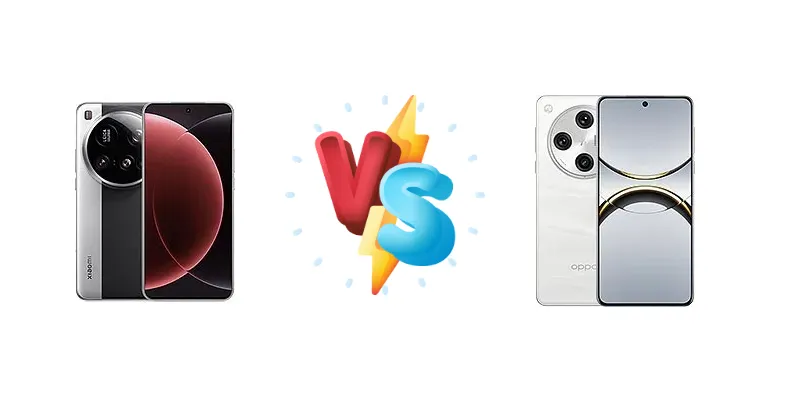
|
🏆 Quick Verdict
For users prioritizing sustained gaming performance and slightly longer battery endurance, the Xiaomi 15 Ultra emerges as the winner. Its Snapdragon 8 Elite chipset and 58:58h endurance offer a slight edge. However, the Oppo Find X8 Pro’s brighter display and efficient Dimensity 9400 make it a compelling alternative.
| PHONES | ||
|---|---|---|
| Phone Names | Xiaomi 15 Ultra | Oppo Find X8 Pro |
| Network | ||
|---|---|---|
| 2G bands | GSM 850 / 900 / 1800 / 1900 | GSM 850 / 900 / 1800 / 1900 |
| 3G bands | HSDPA 800 / 850 / 900 / 1700(AWS) / 1900 / 2100 | HSDPA 800 / 850 / 900 / 1700(AWS) / 1900 / 2100 |
| 4G bands | 1, 2, 3, 4, 5, 7, 8, 12, 13, 17, 18, 19, 20, 25, 26, 28, 32, 38, 39, 40, 41, 42, 48, 66, 71 - International | 1, 2, 3, 4, 5, 7, 8, 12, 13, 17, 18, 19, 20, 25, 26, 28, 32, 38, 39, 40, 41, 66 - International |
| 5G bands | 1, 2, 3, 5, 7, 8, 12, 20, 25, 26, 28, 38, 40, 41, 48, 66, 71, 75, 77, 78, 79 SA/NSA - International | 1, 2, 3, 5, 7, 8, 12, 20, 25, 26, 28, 38, 40, 41, 66, 75, 77, 78 SA/NSA - International |
| Speed | HSPA, LTE, 5G | HSPA, LTE, 5G |
| Technology | GSM / HSPA / LTE / 5G | GSM / HSPA / LTE / 5G |
| Launch | ||
|---|---|---|
| Announced | 2025, February 27 | 2024, October 24 |
| Status | Available. Released 2025, February 27 | Available. Released 2024, October 30 |
| Body | ||
|---|---|---|
| Build | Glass front, fiber-reinforced plastic back or silicone polymer back (eco leather), aluminum frame | Glass front (Gorilla Glass 7i), glass back (Gorilla Glass 7i), aluminum frame |
| Dimensions | 161.3 x 75.3 x 9.4 mm (6.35 x 2.96 x 0.37 in) | 162.3 x 76.7 x 8.2 mm (6.39 x 3.02 x 0.32 in) |
| SIM | · Nano-SIM + Nano-SIM· Nano-SIM + Nano-SIM + eSIM + eSIM (max 2 at a time) | · Nano-SIM + eSIM· Nano-SIM + Nano-SIM |
| Weight | 226 g or 229 g (7.97 oz) | 215 g (7.58 oz) |
| Display | ||
|---|---|---|
| Protection | Xiaomi Shield Glass 2.0, Mohs level 6 | Corning Gorilla Glass 7i |
| Resolution | 1440 x 3200 pixels, 20:9 ratio (~522 ppi density) | 1264 x 2780 pixels (~450 ppi density) |
| Size | 6.73 inches, 108.9 cm2 (~89.7% screen-to-body ratio) | 6.78 inches, 111.7 cm2 (~89.8% screen-to-body ratio) |
| Type | LTPO AMOLED, 68B colors, 120Hz, 1920Hz PWM, Dolby Vision, HDR10+, HDR Vivid, 3200 nits (peak) | LTPO AMOLED, 1B colors, 120Hz, 2160Hz PWM, Dolby Vision, HDR10+, 800 nits (typ), 1600 nits (HBM), 4500 nits (peak) |
| Platform | ||
|---|---|---|
| CPU | Octa-core (2x4.32 GHz Oryon V2 Phoenix L + 6x3.53 GHz Oryon V2 Phoenix M) | Octa-core (1x3.63 GHz Cortex-X925 & 3x3.3 GHz Cortex-X4 & 4x2.4 GHz Cortex-A720) |
| Chipset | Qualcomm SM8750-AB Snapdragon 8 Elite (3 nm) | Mediatek Dimensity 9400 (3 nm) |
| GPU | Adreno 830 | Immortalis-G925 |
| OS | Android 15, up to 4 major Android upgrades, HyperOS 2 | Android 15, up to 5 major Android upgrades, ColorOS 15 |
| Memory | ||
|---|---|---|
| Card slot | No | No |
| Internal | 256GB 12GB RAM, 512GB 16GB RAM, 1TB 16GB RAM | 256GB 12GB RAM, 512GB 12GB RAM, 512GB 16GB RAM, 1TB 16GB RAM |
| Main Camera | ||
|---|---|---|
| Features | Laser AF, color spectrum sensor, Leica lenses, Dual-LED flash, HDR, panorama, 67mm filter ring holder (optional) | Laser AF, color spectrum sensor, Hasselblad Color Calibration, LED flash, HDR, panorama |
| Quad | 50 MP, f/1.6, 23mm (wide), 1.0"-type, 1.6µm, dual pixel PDAF, OIS 50 MP, f/1.8, 70mm (telephoto), 1/2.51", 0.7µm, dual pixel PDAF (10cm - ∞), OIS, 3x optical zoom 200 MP, f/2.6, 100mm (periscope telephoto), 1/1.4", 0.56µm, multi-directional PDAF, OIS, 4.3x optical zoom 50 MP, f/2.2, 14mm, 115˚ (ultrawide), 1/2.76", 0.64µm, dual pixel PDAF TOF 3D, (depth) | 50 MP, f/1.6, 23mm (wide), 1/1.4", 1.12µm, multi-directional PDAF, OIS 50 MP, f/2.6, 73mm (periscope telephoto), 1/1.95", 0.61µm, 3x optical zoom, multi-directional PDAF, OIS 50 MP, f/4.3, 135mm (periscope telephoto), 1/2.51", 0.7µm, 6x optical zoom, dual pixel PDAF (35cm - ∞), OIS 50 MP, f/2.0, 15mm, 120˚ (ultrawide), 1/2.75", 0.64µm, multi-directional PDAF |
| Video | 8K@30fps, 4K@30/60/120fps, 1080p@30/60/120/240/480/960/1920fps, gyro-EIS, Dolby Vision HDR 10-bit rec. (4K@60fps, 1080p) | 4K@30/60fps, 1080p@30/60/240fps; gyro-EIS; HDR, 10‑bit video, Dolby Vision |
| Selfie camera | ||
|---|---|---|
| Features | HDR, panorama | Panorama |
| Single | 32 MP, f/2.0, 21mm (wide), 1/3.14", 0.7µm | 32 MP, f/2.4, 21mm (wide), 1/2.74", 0.8µm |
| Video | 4K@30/60fps, 1080p@30/60fps, gyro-EIS | 4K@30/60fps, 1080p@30/60fps, gyro-EIS |
| Sound | ||
|---|---|---|
| 35mm jack | No | No |
| Loudspeaker | Yes, with stereo speakers | Yes, with stereo speakers |
| Comms | ||
|---|---|---|
| Bluetooth | 6.0, A2DP, LE, aptX HD, aptX Adaptive, LHDC 5 | 5.4, A2DP, LE, aptX HD, LHDC 5 |
| Infrared port | Yes | Yes |
| NFC | Yes | Yes |
| Positioning | GPS (L1+L5), BDS (B1I+B1c+B2a), GALILEO (E1+E5a), QZSS (L1+L5), NavIC (L5), GLONASS | GPS (L1+L5), BDS (B1I+B1c+B2a+B2b), GALILEO (E1+E5a+E5b), QZSS (L1+L5), GLONASS, NavIC (L5) |
| Radio | No | No |
| USB | USB Type-C 3.2 Gen 2, DisplayPort, OTG | USB Type-C 3.2, OTG |
| WLAN | Wi-Fi 802.11 a/b/g/n/ac/6e/7, dual-band or tri-band, Wi-Fi Direct | Wi-Fi 802.11 a/b/g/n/ac/6/7, dual-band or tri-band, Wi-Fi Direct |
| Features | ||
|---|---|---|
| Sensors | Fingerprint (under display, ultrasonic), accelerometer, proximity, gyro, compass, barometer | Fingerprint (under display, optical), accelerometer, gyro, proximity, compass |
| Battery | ||
|---|---|---|
| Charging | 90W wired, PD3.0, QC3+ 80W wireless 10W reverse wireless | 80W wired, PD 55W, PPS, UFCS 50W wireless 10W reverse wireless |
| Type | Market-dependent versions:· Si/C Li-Ion 5410 mAh - Global· Si/C Li-Ion 6000 mAh - China | Si/C Li-Ion 5910 mAh |
| Misc | ||
|---|---|---|
| Colors | Black, White, Silver Chrome, Green | Space Black, Pearl White, Blue |
| Models | 25010PN30G | CPH2659, PKC110, PKC130 |
| Price | $ 1,328.84 / £ 889.00 / € 1,099.00 | € 1,014.99 / $ 1,349.00 / ₹ 92,990 |
| SAR EU | 1.00 W/kg (head) 1.00 W/kg (body) | - |
| EU LABEL | ||
|---|---|---|
| Battery | 58:58h endurance, 1000 cycles | - |
| Energy | Class A | - |
| Free fall | Class C (90 falls) | - |
| Repairability | Class C | - |
Xiaomi 15 Ultra
- Exceptional gaming performance due to Snapdragon 8 Elite.
- Faster wired and wireless charging speeds.
- Slightly longer battery endurance.
- Potential for higher thermal throttling under sustained load.
- Software experience may not appeal to all users.
Oppo Find X8 Pro
- Brighter display for superior outdoor visibility.
- Potentially better sustained performance due to Dimensity 9400’s efficiency.
- Refined software experience (typical of Oppo).
- Slower wired and wireless charging speeds.
- Slightly shorter battery endurance.
Display Comparison
The Oppo Find X8 Pro immediately stands out with its measured 1333 nits of peak brightness, significantly exceeding what we anticipate from the Xiaomi 15 Ultra (spec not provided). This translates to superior visibility in direct sunlight. While both likely employ LTPO technology for adaptive refresh rates, the Oppo’s brightness advantage is a key differentiator for outdoor users. We expect both to offer excellent color accuracy, but the Oppo’s panel is likely to be more visually impactful in bright environments.
Camera Comparison
Without detailed camera specifications, a direct comparison is limited. However, both manufacturers are known for their imaging prowess. The focus will likely be on sensor size and image processing algorithms. We anticipate both phones to feature advanced computational photography capabilities. The absence of specific sensor details necessitates a wait-and-see approach, but both brands typically prioritize high-resolution main sensors and robust optical image stabilization (OIS).
Performance
The core of this comparison lies in the chipsets. The Xiaomi 15 Ultra utilizes the Qualcomm SM8750-AB Snapdragon 8 Elite, featuring a unique octa-core configuration with Oryon V2 Phoenix cores clocked up to 4.32 GHz. This architecture is designed for peak performance. The Oppo Find X8 Pro counters with the MediaTek Dimensity 9400, employing a more traditional core arrangement (1x Cortex-X925, 3x Cortex-X4, 4x Cortex-A720) clocked at 3.63 GHz. While clock speed isn’t everything, the Snapdragon’s Oryon cores are expected to deliver superior single-core performance, crucial for responsive UI and app loading. However, the Dimensity 9400’s efficiency could lead to better sustained performance under heavy load, minimizing thermal throttling. Both are built on a 3nm process, suggesting comparable power efficiency.
Battery Life
The Xiaomi 15 Ultra boasts impressive battery endurance, achieving 58:58h in testing and 16:13h of active use. The Oppo Find X8 Pro delivers a respectable 15:18h of active use. While the Xiaomi has a longer overall endurance score, the difference in active use is relatively small. The Xiaomi 15 Ultra supports a blistering 90W wired charging, 80W wireless, and 10W reverse wireless. The Oppo Find X8 Pro offers 80W wired (with support for PD 55W, PPS, and UFCS), 50W wireless, and 10W reverse wireless. The Xiaomi’s faster wired charging provides a significant convenience advantage, allowing for quicker top-ups.
Buying Guide
Buy the Xiaomi 15 Ultra if you demand the absolute best in mobile gaming, frequently engage in resource-intensive tasks, and value the fastest possible charging speeds. Buy the Oppo Find X8 Pro if you prioritize a vibrant, exceptionally bright display for media consumption, prefer a more balanced power profile, and appreciate Oppo’s refined software experience.