
Xiaomi 15 Ultra vs OnePlus 13s: A Deep Dive into Snapdragon 8 Elite Flagships
| Phones Images | |||||
|---|---|---|---|---|---|
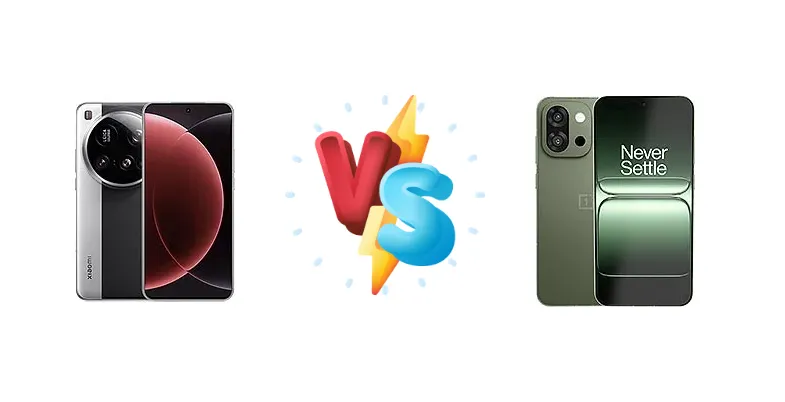
|
🏆 Quick Verdict
For users demanding maximum battery longevity and the convenience of ultra-fast wireless charging, the Xiaomi 15 Ultra emerges as the winner. Its 58:58h endurance and 80W wireless capabilities provide a significant advantage. However, the OnePlus 13s remains a strong contender, offering comparable performance in a potentially more refined package.
| PHONES | ||
|---|---|---|
| Phone Names | Xiaomi 15 Ultra | OnePlus 13s |
| Network | ||
|---|---|---|
| 2G bands | GSM 850 / 900 / 1800 / 1900 | GSM 850 / 900 / 1800 / 1900 |
| 3G bands | HSDPA 800 / 850 / 900 / 1700(AWS) / 1900 / 2100 | HSDPA 850 / 900 / 1900 / 2100 |
| 4G bands | 1, 2, 3, 4, 5, 7, 8, 12, 13, 17, 18, 19, 20, 25, 26, 28, 32, 38, 39, 40, 41, 42, 48, 66, 71 - International | 1, 3, 4, 5, 8, 18, 19, 26, 28, 34, 38, 39, 40, 41, 42, 48, 66 |
| 5G bands | 1, 2, 3, 5, 7, 8, 12, 20, 25, 26, 28, 38, 40, 41, 48, 66, 71, 75, 77, 78, 79 SA/NSA - International | 1, 3, 5, 8, 26, 28, 38, 40, 41, 48, 66, 77, 78 SA/NSA |
| Speed | HSPA, LTE, 5G | HSPA, LTE, 5G |
| Technology | GSM / HSPA / LTE / 5G | GSM / HSPA / LTE / 5G |
| Launch | ||
|---|---|---|
| Announced | 2025, February 27 | 2025, June 05 |
| Status | Available. Released 2025, February 27 | Available. Released 2025, June 12 |
| Body | ||
|---|---|---|
| Build | Glass front, fiber-reinforced plastic back or silicone polymer back (eco leather), aluminum frame | Glass front, aluminum alloy frame |
| Dimensions | 161.3 x 75.3 x 9.4 mm (6.35 x 2.96 x 0.37 in) | 150.8 x 71.7 x 8.2 mm (5.94 x 2.82 x 0.32 in) |
| SIM | · Nano-SIM + Nano-SIM· Nano-SIM + Nano-SIM + eSIM + eSIM (max 2 at a time) | Nano-SIM + Nano-SIM + eSIM (max 2 at a time) |
| Weight | 226 g or 229 g (7.97 oz) | 185 g (6.53 oz) |
| Display | ||
|---|---|---|
| Protection | Xiaomi Shield Glass 2.0, Mohs level 6 | Crystal Shield Glass |
| Resolution | 1440 x 3200 pixels, 20:9 ratio (~522 ppi density) | 1216 x 2640 pixels, 19.5:9 ratio (~460 ppi density) |
| Size | 6.73 inches, 108.9 cm2 (~89.7% screen-to-body ratio) | 6.32 inches, 97.9 cm2 (~90.6% screen-to-body ratio) |
| Type | LTPO AMOLED, 68B colors, 120Hz, 1920Hz PWM, Dolby Vision, HDR10+, HDR Vivid, 3200 nits (peak) | LTPO AMOLED, 1B colors, 120Hz, 2160Hz PWM, Dolby Vision, HDR10+, HDR Vivid, 1600 nits (HBM) |
| Platform | ||
|---|---|---|
| CPU | Octa-core (2x4.32 GHz Oryon V2 Phoenix L + 6x3.53 GHz Oryon V2 Phoenix M) | Octa-core (2x4.32 GHz Oryon V2 Phoenix L + 6x3.53 GHz Oryon V2 Phoenix M) |
| Chipset | Qualcomm SM8750-AB Snapdragon 8 Elite (3 nm) | Qualcomm SM8750-AB Snapdragon 8 Elite (3 nm) |
| GPU | Adreno 830 | Adreno 830 |
| OS | Android 15, up to 4 major Android upgrades, HyperOS 2 | Android 15, OxygenOS 15 |
| Memory | ||
|---|---|---|
| Card slot | No | No |
| Internal | 256GB 12GB RAM, 512GB 16GB RAM, 1TB 16GB RAM | 256GB 12GB RAM, 512GB 12GB RAM |
| Main Camera | ||
|---|---|---|
| Dual | - | 50 MP, f/1.8, 24mm (wide), 1/1.56", 1.0µm, multi-directional PDAF, OIS 50 MP, f/2.0, (telephoto), 1/2.75", 0.64µm, 2x optical zoom, PDAF |
| Features | Laser AF, color spectrum sensor, Leica lenses, Dual-LED flash, HDR, panorama, 67mm filter ring holder (optional) | Color spectrum sensor, LED flash, HDR, panorama |
| Quad | 50 MP, f/1.6, 23mm (wide), 1.0"-type, 1.6µm, dual pixel PDAF, OIS 50 MP, f/1.8, 70mm (telephoto), 1/2.51", 0.7µm, dual pixel PDAF (10cm - ∞), OIS, 3x optical zoom 200 MP, f/2.6, 100mm (periscope telephoto), 1/1.4", 0.56µm, multi-directional PDAF, OIS, 4.3x optical zoom 50 MP, f/2.2, 14mm, 115˚ (ultrawide), 1/2.76", 0.64µm, dual pixel PDAF TOF 3D, (depth) | - |
| Video | 8K@30fps, 4K@30/60/120fps, 1080p@30/60/120/240/480/960/1920fps, gyro-EIS, Dolby Vision HDR 10-bit rec. (4K@60fps, 1080p) | 4K@30/60fps, 1080p@30/60/240fps, gyro-EIS, OIS, Dolby Vision HDR |
| Selfie camera | ||
|---|---|---|
| Features | HDR, panorama | HDR, panorama |
| Single | 32 MP, f/2.0, 21mm (wide), 1/3.14", 0.7µm | 32 MP, f/2.0, 21mm (wide), 1/3.1", 0.7µm, AF |
| Video | 4K@30/60fps, 1080p@30/60fps, gyro-EIS | 4K@30fps, 1080p@30fps, gyro-EIS |
| Sound | ||
|---|---|---|
| 35mm jack | No | No |
| Loudspeaker | Yes, with stereo speakers | Yes, with stereo speakers |
| Comms | ||
|---|---|---|
| Bluetooth | 6.0, A2DP, LE, aptX HD, aptX Adaptive, LHDC 5 | 6.0, A2DP, LE, aptX HD, LHDC 5 |
| Infrared port | Yes | Yes |
| NFC | Yes | Yes |
| Positioning | GPS (L1+L5), BDS (B1I+B1c+B2a), GALILEO (E1+E5a), QZSS (L1+L5), NavIC (L5), GLONASS | GPS (L1+L5), BDS (B1I+B1C+B2a), GALILEO (E1+E5a), QZSS (L1+L5), NavIC (L5), GLONASS |
| Radio | No | No |
| USB | USB Type-C 3.2 Gen 2, DisplayPort, OTG | USB Type-C 2.0, OTG |
| WLAN | Wi-Fi 802.11 a/b/g/n/ac/6e/7, dual-band or tri-band, Wi-Fi Direct | Wi-Fi 802.11 a/b/g/n/ac/6/7, dual-band, Wi-Fi Direct |
| Features | ||
|---|---|---|
| Sensors | Fingerprint (under display, ultrasonic), accelerometer, proximity, gyro, compass, barometer | Fingerprint (under display, optical), accelerometer, gyro, proximity, compass |
| Battery | ||
|---|---|---|
| Charging | 90W wired, PD3.0, QC3+ 80W wireless 10W reverse wireless | 80W wired, 33W PPS, 18W PD, 18W QC 5W reverse wired |
| Type | Market-dependent versions:· Si/C Li-Ion 5410 mAh - Global· Si/C Li-Ion 6000 mAh - China | 5850 mAh |
| Misc | ||
|---|---|---|
| Colors | Black, White, Silver Chrome, Green | Green Silk, Black Velvet, Pink Satin |
| Models | 25010PN30G | CPH2723 |
| Price | $ 1,328.84 / £ 889.00 / € 1,099.00 | ₹ 52,999 |
| SAR EU | 1.00 W/kg (head) 1.00 W/kg (body) | - |
| EU LABEL | ||
|---|---|---|
| Battery | 58:58h endurance, 1000 cycles | - |
| Energy | Class A | - |
| Free fall | Class C (90 falls) | - |
| Repairability | Class C | - |
Xiaomi 15 Ultra
- Exceptional battery endurance (58:58h)
- Ultra-fast 80W wireless charging
- Versatile charging options (PD3.0, QC3+, Reverse Wireless)
- Potential for larger size due to battery capacity
- Xiaomi's MIUI software can be polarizing
OnePlus 13s
- Comparable Snapdragon 8 Elite performance
- Potentially more refined software experience (OxygenOS)
- Fast 80W wired charging
- Significantly slower wireless charging (33W PPS)
- Limited reverse wired charging (5W)
Display Comparison
While both devices are expected to feature high-refresh-rate AMOLED displays, the provided data doesn't detail screen specifications. However, given their flagship status, both will likely boast vibrant colors and excellent viewing angles. The absence of display data necessitates relying on brand reputation; OnePlus typically prioritizes color accuracy, while Xiaomi often aims for maximum brightness. Expect both to utilize LTPO technology for adaptive refresh rates, optimizing battery consumption.
Camera Comparison
The provided data lacks camera specifications, making a direct comparison impossible. However, Xiaomi's Ultra series historically focuses on camera innovation, suggesting the 15 Ultra may feature a more advanced camera system with larger sensors and more sophisticated image processing. OnePlus has also significantly improved its camera capabilities in recent generations, but typically prioritizes a more natural image profile. Without sensor details, it's difficult to assess which device will excel in low-light performance or dynamic range.
Performance
Both the Xiaomi 15 Ultra and OnePlus 13s are equipped with the Qualcomm SM8750-AB Snapdragon 8 Elite (3nm) chipset, featuring an octa-core CPU configuration of (2x4.32 GHz Oryon V2 Phoenix L + 6x3.53 GHz Oryon V2 Phoenix M). This means raw processing power will be virtually identical. Performance differences will likely stem from thermal management and RAM optimization. The 3nm process node promises improved thermal efficiency, reducing throttling during sustained workloads. The absence of RAM specifications prevents a definitive comparison, but both are expected to utilize LPDDR5x for fast memory access.
Battery Life
The Xiaomi 15 Ultra boasts a significant advantage in battery endurance, achieving 58:58h compared to the OnePlus 13s' unspecified endurance. The 16:13h active use score for the Xiaomi further highlights its superior battery performance. This is coupled with a more versatile charging ecosystem: 90W wired, 80W wireless, and 10W reverse wireless for the Xiaomi versus 80W wired, 33W PPS, 18W PD/QC, and 5W reverse wired for the OnePlus. The Xiaomi’s 80W wireless charging is a standout feature, offering significantly faster wireless top-ups than the OnePlus’s 33W PPS. The Xiaomi also supports both PD3.0 and QC3+ for wider wired charging compatibility.
Buying Guide
Buy the Xiaomi 15 Ultra if you need exceptional battery life, prioritize wireless charging speed, and frequently engage in power-intensive tasks like gaming or video editing. Buy the OnePlus 13s if you value a streamlined software experience, prefer a potentially more compact design (based on brand history), and are comfortable with a slightly less extensive charging ecosystem, focusing on wired speeds.