
Xiaomi 14T vs 13T Pro: Which Xiaomi Flagship Reigns Supreme?
| Phones Images | |||||
|---|---|---|---|---|---|
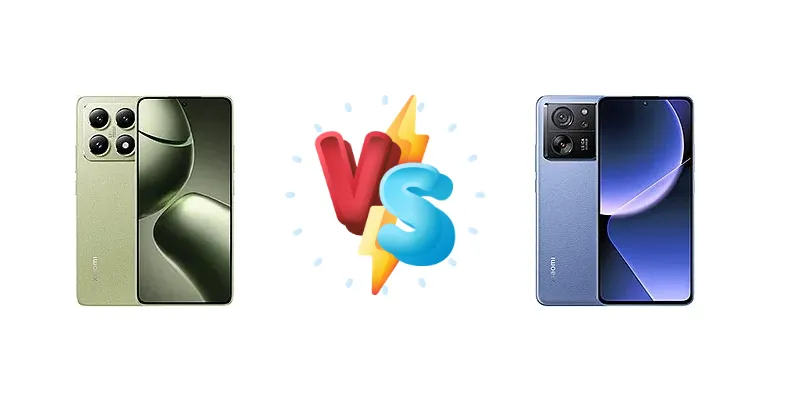
|
🏆 Quick Verdict
For most users, the Xiaomi 14T emerges as the better choice. While the 13T Pro boasts faster 120W charging, the 14T’s more modern Dimensity 8300 Ultra chipset offers comparable performance with improved efficiency, and its brighter display enhances outdoor visibility. The slightly longer battery life seals the deal.
| PHONES | ||
|---|---|---|
| Phone Names | Xiaomi 14T | Xiaomi 13T Pro |
| Network | ||
|---|---|---|
| 2G bands | GSM 850 / 900 / 1800 / 1900 | GSM 850 / 900 / 1800 / 1900 |
| 3G bands | HSDPA 800 / 850 / 900 / 1700(AWS) / 1900 / 2100 | HSDPA 800 / 850 / 900 / 1700(AWS) / 1900 / 2100 |
| 4G bands | 1, 2, 3, 4, 5, 7, 8, 12, 13, 17, 18, 19, 20, 26, 28, 32, 38, 40, 41, 42, 48, 66 | 1, 2, 3, 4, 5, 7, 8, 12, 13, 17, 18, 19, 20, 25, 26, 28, 32, 38, 39, 40, 41, 42, 48, 66 |
| 5G bands | 1, 2, 3, 5, 7, 8, 12, 20, 26, 28, 38, 40, 41, 48, 66, 77, 78 SA/NSA | 1, 3, 5, 7, 8, 20, 28, 38, 40, 41, 66, 75, 77, 78 SA/NSA |
| Speed | HSPA, LTE, 5G | HSPA, LTE, 5G |
| Technology | GSM / HSPA / LTE / 5G | GSM / HSPA / LTE / 5G |
| Launch | ||
|---|---|---|
| Announced | 2024, September 26 | 2023, September 26 |
| Status | Available. Released 2024, September 26 | Available. Released 2023, September 26 |
| Body | ||
|---|---|---|
| Build | Glass front (Gorilla Glass 5), plastic frame, glass back (Panda X) | Glass front (Gorilla Glass 5), glass back or silicone polymer back, plastic frame |
| Dimensions | 160.5 x 75.1 x 7.8 mm or 8.0 mm | 162.2 x 75.7 x 8.5 mm (6.39 x 2.98 x 0.33 in) |
| SIM | · Nano-SIM + eSIM· eSIM + eSIM· Nano-SIM + Nano-SIM | · Nano-SIM + eSIM· Nano-SIM + Nano-SIM |
| Weight | 193 g or 195 g (6.81 oz) | 200 g or 206 g (7.05 oz) |
| Display | ||
|---|---|---|
| Protection | Corning Gorilla Glass 5 | Corning Gorilla Glass 5 |
| Resolution | 1220 x 2712 pixels, 20:9 ratio (~446 ppi density) | 1220 x 2712 pixels, 20:9 ratio (~446 ppi density) |
| Size | 6.67 inches, 107.4 cm2 (~89.1% screen-to-body ratio) | 6.67 inches, 107.4 cm2 (~87.5% screen-to-body ratio) |
| Type | AMOLED, 68B colors, 144Hz, 2880Hz PWM, Dolby Vision, HDR10+, 1600 nits (HBM), 4000 nits (peak) | AMOLED, 68B colors, 144Hz, Dolby Vision, HDR10+, 1200 nits (HBM), 2600 nits (peak) |
| Platform | ||
|---|---|---|
| CPU | Octa-core (1x3.35 GHz Cortex-A715 & 3x3.20 GHz Cortex-A715 & 4x2.20 GHz Cortex-A510) | Octa-core (1x3.35 GHz Cortex-X3 & 3x3.0 GHz Cortex-A715 & 4x2.0 GHz Cortex-A510) |
| Chipset | Mediatek Dimensity 8300 Ultra (4 nm) | Mediatek Dimensity 9200+ (4 nm) |
| GPU | Mali G615-MC6 | Immortalis-G715 MC11 |
| OS | Android 14, upgradable to Android 15, HyperOS 2 | Android 13, up to 4 major Android upgrades, HyperOS |
| Memory | ||
|---|---|---|
| Card slot | No | No |
| Internal | 256GB 12GB RAM, 512GB 12GB RAM, 512GB 16GB RAM, 1TB 12GB RAM | 256GB 12GB RAM, 512GB 12GB RAM, 1TB 16GB RAM |
| Main Camera | ||
|---|---|---|
| Features | Leica lens, Ultra HDR, LED flash, HDR, panorama | Leica lens, color spectrum sensor, LED flash, HDR, panorama |
| Triple | 50 MP, f/1.7, 23mm (wide), 1/1.56", 1.0µm, PDAF, OIS 50 MP, f/1.9, 50mm (telephoto), 1/2.76", 0.64µm, PDAF, 2x optical zoom 12 MP, f/2.2, 15mm (ultrawide), 1/3.06", 1.12µm | 50 MP, f/1.9, 24mm (wide), 1/1.28", 1.22µm, PDAF, OIS 50 MP, f/1.9, 50mm (telephoto), 1/2.88", 0.61µm, PDAF, 2x optical zoom 12 MP, f/2.2, 15mm (ultrawide), 1/3.06", 1.12µm |
| Video | 4K@24/30/60fps, 1080p@30/60/120/240/960fps, gyro-EIS, 10-bit Rec. 2020, HDR10+ | 8K@24fps, 4K@24/30/60fps, 4K/1080p@30fps HDR10+, 1080p@30/60/120/240fps; 10-bit LOG, gyro-EIS |
| Selfie camera | ||
|---|---|---|
| Features | HDR | HDR |
| Single | 32 MP, f/2.0, 25mm (wide), 1/3.44", 0.64µm | 20 MP, f/2.2, (wide), 0.8µm |
| Video | 4K@30fps, 1080p@30/60fps, HDR10+ | 1080p@30fps, HDR10+ |
| Sound | ||
|---|---|---|
| 35mm jack | No | No |
| Loudspeaker | Yes, with stereo speakers | Yes, with stereo speakers |
| Comms | ||
|---|---|---|
| Bluetooth | 5.4, A2DP, LE, LHDC | 5.4, A2DP, LE |
| Infrared port | Yes | Yes |
| NFC | Yes (market/region dependent) | Yes |
| Positioning | GPS (L1+L5), BDS (B1I+B1C+B2a), GALILEO (E1+E5a), NavIC (L5), GLONASS | GPS (L1+L5), GLONASS (G1), GALILEO (E1+E5a), NavIC (L5), BDS |
| Radio | No | No |
| USB | USB Type-C 2.0, OTG | USB Type-C 2.0, OTG |
| WLAN | Wi-Fi 802.11 a/b/g/n/ac/6e, dual-band, Wi-Fi Direct | Wi-Fi 802.11 a/b/g/n/ac/6e/7, dual/tri-band (market/region dependent), Wi-Fi Direct |
| Features | ||
|---|---|---|
| Sensors | Fingerprint (under display, optical), accelerometer, gyro, proximity, compass | Fingerprint (under display, optical), accelerometer, gyro, proximity, compass |
| Battery | ||
|---|---|---|
| Charging | 67W wired, PD3.0, 100% in 45 min | 120W wired, PD3.0, QC4, 100% in 19 min |
| Type | Li-Po 5000 mAh | Li-Po 5000 mAh |
| Misc | ||
|---|---|---|
| Colors | Titan Gray, Titan Blue, Titan Black, Lemon Green | Alpine Blue, Meadow Green, Black |
| Models | 2406APNFAG | 23078PND5G |
| Price | € 337.12 / $ 469.99 / £ 373.06 | $ 370.00 / £ 482.55 / € 301.99 |
| SAR EU | 0.98 W/kg (head) 0.99 W/kg (body) | 1.00 W/kg (head) 0.99 W/kg (body) |
Xiaomi 14T
- Brighter display for better outdoor visibility
- More efficient Dimensity 8300 Ultra chipset
- Slightly longer battery life in real-world use
- Modern chipset architecture for sustained performance
- Slower 67W charging compared to 120W
- Camera specs are currently unknown
Xiaomi 13T Pro
- Ultra-fast 120W charging (19 minutes to full)
- Powerful Dimensity 9200+ for peak performance
- Potentially better gaming performance in short bursts
- Established track record and user reviews
- Less efficient chipset leading to shorter battery life
- Diminished brightness compared to the 14T
Display Comparison
The Xiaomi 14T boasts a significantly brighter display, reaching a measured 1355 nits compared to the 13T Pro’s 1094 nits. This translates to superior visibility under direct sunlight. While both utilize high refresh rate panels, the 14T’s increased brightness is a tangible benefit for outdoor users. Details regarding panel technology (LTPO vs. standard OLED) are missing, but the brightness difference is a clear win for the 14T. Bezels appear comparable based on available imagery, and color accuracy is likely similar given Xiaomi’s consistent calibration.
Camera Comparison
Context data is limited regarding camera performance. Both phones are listed as having 'Photo / Video' capabilities, but specifics like sensor size, OIS, and lens apertures are absent. Given Xiaomi’s history, both likely feature a multi-camera system with a primary sensor capable of high-resolution images. The absence of details prevents a meaningful comparison; however, focusing on the main sensor specs would be crucial in a full review. We can safely assume any 2MP macro cameras included are of limited utility.
Performance
Both phones utilize a 4nm process, but the chipsets differ significantly. The Xiaomi 13T Pro’s Dimensity 9200+ features a Cortex-X3 prime core clocked at 3.35 GHz, designed for peak performance. The 14T’s Dimensity 8300 Ultra, while also clocked at 3.35 GHz on its primary core (A715), employs a different core configuration – a 1+3+4 arrangement versus the 1+3+4 of the 13T Pro. The 8300 Ultra’s architecture focuses on sustained performance and efficiency. While the 9200+ may edge out the 8300 Ultra in short bursts, the 8300 Ultra is likely to maintain higher frame rates for longer periods during demanding tasks like gaming. Both phones likely feature LPDDR5X RAM, but specific speeds aren't provided.
Battery Life
The Xiaomi 13T Pro’s 120W charging is its standout feature, achieving a 100% charge in just 19 minutes. The 14T’s 67W charging, while still fast, takes 45 minutes to fully charge. However, the 14T compensates with slightly better real-world battery life, achieving 11:32 hours of active use compared to the 13T Pro’s 11:50 hours. The 13T Pro’s older endurance rating of 102 hours is less relevant than the active use score. The 14T’s more efficient chipset likely contributes to this improved endurance, mitigating the impact of the slower charging speed.
Buying Guide
Buy the Xiaomi 14T if you prioritize all-day battery life, a brighter and more modern display, and a chipset that balances performance with thermal efficiency. Buy the Xiaomi 13T Pro if you absolutely need the fastest possible charging speeds and are willing to trade some battery endurance for it. Gamers who prioritize peak performance above all else might also lean towards the 13T Pro, though the difference is narrowing.