
Xiaomi 14T vs Samsung Galaxy S23 FE: A Deep Dive into Value and Performance
| Phones Images | |||||
|---|---|---|---|---|---|
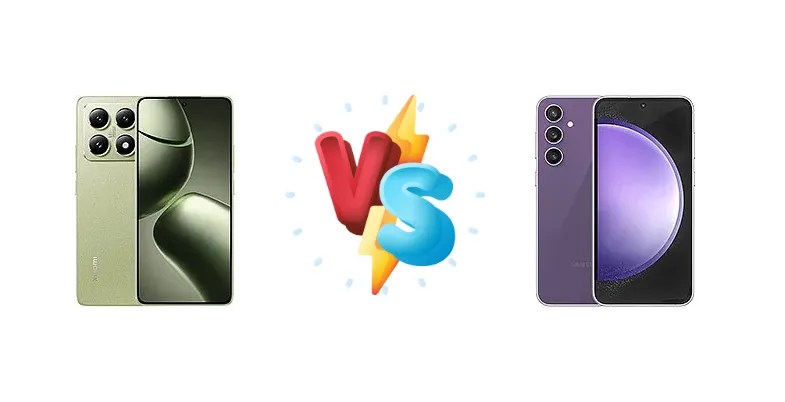
|
🏆 Quick Verdict
For the average user prioritizing battery life and raw performance, the Xiaomi 14T emerges as the winner. Its significantly longer 11:32h active use battery score and the efficient Dimensity 8300 Ultra chipset provide a compelling advantage, especially considering the faster 67W charging. The S23 FE remains a strong contender, particularly for those deeply embedded in the Samsung ecosystem.
| PHONES | ||
|---|---|---|
| Phone Names | Xiaomi 14T | Samsung Galaxy S23 FE |
| Network | ||
|---|---|---|
| 2G bands | GSM 850 / 900 / 1800 / 1900 | GSM 850 / 900 / 1800 / 1900 |
| 3G bands | HSDPA 800 / 850 / 900 / 1700(AWS) / 1900 / 2100 | HSDPA 850 / 900 / 1700(AWS) / 1900 / 2100 |
| 4G bands | 1, 2, 3, 4, 5, 7, 8, 12, 13, 17, 18, 19, 20, 26, 28, 32, 38, 40, 41, 42, 48, 66 | 1, 2, 3, 4, 5, 7, 8, 12, 13, 17, 20, 26, 28, 38, 40, 41, 66 - International |
| 5G bands | 1, 2, 3, 5, 7, 8, 12, 20, 26, 28, 38, 40, 41, 48, 66, 77, 78 SA/NSA | 1, 2, 3, 5, 7, 8, 20, 28, 38, 40, 41, 66, 77, 78 SA/NSA/Sub6 - International |
| Speed | HSPA, LTE, 5G | HSPA, LTE, 5G |
| Technology | GSM / HSPA / LTE / 5G | GSM / HSPA / LTE / 5G |
| Launch | ||
|---|---|---|
| Announced | 2024, September 26 | 2023, October 04 |
| Status | Available. Released 2024, September 26 | Available. Released 2023, October 05 |
| Body | ||
|---|---|---|
| Build | Glass front (Gorilla Glass 5), plastic frame, glass back (Panda X) | Glass front (Gorilla Glass 5), glass back (Gorilla Glass 5), aluminum frame |
| Dimensions | 160.5 x 75.1 x 7.8 mm or 8.0 mm | 158 x 76.5 x 8.2 mm (6.22 x 3.01 x 0.32 in) |
| SIM | · Nano-SIM + eSIM· eSIM + eSIM· Nano-SIM + Nano-SIM | · Nano-SIM· Nano-SIM + Nano-SIM· Nano-SIM + Nano-SIM + eSIM (max 2 at a time) |
| Weight | 193 g or 195 g (6.81 oz) | 209 g (7.37 oz) |
| Display | ||
|---|---|---|
| Protection | Corning Gorilla Glass 5 | Corning Gorilla Glass 5 |
| Resolution | 1220 x 2712 pixels, 20:9 ratio (~446 ppi density) | 1080 x 2340 pixels, 19.5:9 ratio (~403 ppi density) |
| Size | 6.67 inches, 107.4 cm2 (~89.1% screen-to-body ratio) | 6.4 inches, 100.5 cm2 (~83.2% screen-to-body ratio) |
| Type | AMOLED, 68B colors, 144Hz, 2880Hz PWM, Dolby Vision, HDR10+, 1600 nits (HBM), 4000 nits (peak) | Dynamic AMOLED 2X, 120Hz, HDR10+, 1450 nits (peak) |
| Platform | ||
|---|---|---|
| CPU | Octa-core (1x3.35 GHz Cortex-A715 & 3x3.20 GHz Cortex-A715 & 4x2.20 GHz Cortex-A510) | Octa-core (1x2.8 GHz Cortex-X2 & 3x2.50 GHz Cortex-A710 & 4x1.8 GHz Cortex-A510) - InternationalOcta-core (1x3.00 GHz Cortex-X2 & 3x2.50 GHz Cortex-A710 & 4x1.80 GHz Cortex-A510) - USA |
| Chipset | Mediatek Dimensity 8300 Ultra (4 nm) | Exynos 2200 (4 nm) - InternationalQualcomm SM8450 Snapdragon 8 Gen 1 (4 nm) - USA |
| GPU | Mali G615-MC6 | Xclipse 920 - InternationalAdreno 730 - USA |
| OS | Android 14, upgradable to Android 15, HyperOS 2 | Android 13, up to 4 major Android upgrades, One UI 8 |
| Memory | ||
|---|---|---|
| Card slot | No | No |
| Internal | 256GB 12GB RAM, 512GB 12GB RAM, 512GB 16GB RAM, 1TB 12GB RAM | 128GB 8GB RAM, 256GB 8GB RAM |
| Main Camera | ||
|---|---|---|
| Features | Leica lens, Ultra HDR, LED flash, HDR, panorama | LED flash, HDR, panorama |
| Triple | 50 MP, f/1.7, 23mm (wide), 1/1.56", 1.0µm, PDAF, OIS 50 MP, f/1.9, 50mm (telephoto), 1/2.76", 0.64µm, PDAF, 2x optical zoom 12 MP, f/2.2, 15mm (ultrawide), 1/3.06", 1.12µm | 50 MP, f/1.8, 23mm (wide), 1/1.57", 1.0µm, dual pixel PDAF, OIS 8 MP, f/2.4, 76mm (telephoto), 1/4.5", 1.0µm, PDAF, OIS, 3x optical zoom 12 MP, f/2.2, 13mm, 123˚ (ultrawide), 1/3.0", 1.12µm |
| Video | 4K@24/30/60fps, 1080p@30/60/120/240/960fps, gyro-EIS, 10-bit Rec. 2020, HDR10+ | 8K@24fps, 4K@30/60fps, 1080p@30/60/120/240fps |
| Selfie camera | ||
|---|---|---|
| Features | HDR | - |
| Single | 32 MP, f/2.0, 25mm (wide), 1/3.44", 0.64µm | 10 MP, f/2.4, 25mm (wide), 1/3.0", 1.22µm |
| Video | 4K@30fps, 1080p@30/60fps, HDR10+ | 4K@30/60fps, 1080p@30/60fps; gyro-EIS |
| Sound | ||
|---|---|---|
| 35mm jack | No | No |
| Loudspeaker | Yes, with stereo speakers | Yes, with stereo speakers |
| Comms | ||
|---|---|---|
| Bluetooth | 5.4, A2DP, LE, LHDC | 5.3, A2DP, LE |
| Infrared port | Yes | - |
| NFC | Yes (market/region dependent) | Yes |
| Positioning | GPS (L1+L5), BDS (B1I+B1C+B2a), GALILEO (E1+E5a), NavIC (L5), GLONASS | GPS, GLONASS, GALILEO, BDS |
| Radio | No | Unspecified |
| USB | USB Type-C 2.0, OTG | USB Type-C, OTG |
| WLAN | Wi-Fi 802.11 a/b/g/n/ac/6e, dual-band, Wi-Fi Direct | Wi-Fi 802.11 a/b/g/n/ac/6e, dual-band, Wi-Fi Direct |
| Features | ||
|---|---|---|
| Sensors | Fingerprint (under display, optical), accelerometer, gyro, proximity, compass | Fingerprint (under display, optical), accelerometer, gyro, compass |
| Battery | ||
|---|---|---|
| Charging | 67W wired, PD3.0, 100% in 45 min | 25W wired, PD3.0, 50% in 30 min 15W wireless Reverse wireless |
| Type | Li-Po 5000 mAh | Li-Ion 4500 mAh |
| Misc | ||
|---|---|---|
| Colors | Titan Gray, Titan Blue, Titan Black, Lemon Green | Mint, Cream, Graphite, Purple, Indigo, Tangerine |
| Models | 2406APNFAG | SM-S711B, SM-S711B/DS, SM-S711U1, SM-S711U, SM-S711W, SM-S7110, SM-S711N |
| Price | € 337.12 / $ 469.99 / £ 373.06 | $ 219.95 / C$ 327.90 / £ 248.99 / € 272.00 / ₹ 34,999 |
| SAR | - | 0.80 W/kg (head) 0.72 W/kg (body) |
| SAR EU | 0.98 W/kg (head) 0.99 W/kg (body) | 0.76 W/kg (head) 1.04 W/kg (body) |
Xiaomi 14T
- Exceptional battery life (11:32h)
- Faster 67W wired charging
- Potentially superior CPU performance with Dimensity 8300 Ultra
- Camera system details unknown
- Software experience may not be as refined as Samsung's
Samsung Galaxy S23 FE
- Well-established camera system
- Wireless charging and reverse wireless power share
- Refined Samsung One UI software
- Significantly shorter battery life (8:28h)
- Slower 25W wired charging
- Exynos 2200 variant may experience thermal throttling
Display Comparison
The Xiaomi 14T boasts a brighter display, reaching a measured 1355 nits compared to the S23 FE’s 985 nits. This translates to superior visibility outdoors under direct sunlight. While both utilize 4nm chipsets, the display power draw will be higher on the 14T. Neither device specifies refresh rate or panel type, but the brightness difference is a clear win for the Xiaomi. The S23 FE’s display, while dimmer, likely benefits from Samsung’s well-regarded color calibration.
Camera Comparison
The provided data lacks detailed camera specifications. However, given Samsung’s history, the S23 FE likely features a more polished and versatile camera system, with a stronger emphasis on software processing and image stabilization. The Xiaomi 14T may rely more on raw sensor capabilities. Without knowing sensor sizes, apertures, or OIS implementation, it’s difficult to definitively declare a winner. We can assume the S23 FE will offer a more refined and consistent photography experience, while the 14T might excel in specific scenarios with ample light.
Performance
The chipset choice is the core of the performance debate. The Xiaomi 14T’s Dimensity 8300 Ultra (4nm) features a unique core configuration – 1x3.35 GHz Cortex-A715, 3x3.20 GHz Cortex-A715, and 4x2.20 GHz Cortex-A510 – designed for sustained performance. The S23 FE offers either the Snapdragon 8 Gen 1 (4nm - USA) or Exynos 2200 (4nm - International). The Snapdragon 8 Gen 1 is generally considered more efficient than the Exynos 2200, which has historically faced thermal throttling concerns. The 14T’s CPU architecture, with its emphasis on the Cortex-A715, suggests a focus on both peak and sustained performance, potentially outperforming the S23 FE’s Exynos variant in prolonged workloads. Both phones likely utilize LPDDR5X RAM, but the chipset’s inherent efficiency will be the deciding factor.
Battery Life
Battery life is where the Xiaomi 14T truly shines. Its active use score of 11:32h significantly surpasses the S23 FE’s 8:28h. This difference is substantial and will be noticeable in everyday use. While the S23 FE offers 25W wired charging, 15W wireless, and reverse wireless charging, the 14T’s 67W wired charging is considerably faster, reaching 100% in just 45 minutes. The S23 FE takes 30 minutes to reach 50%. The faster charging speed of the 14T mitigates any concerns about its potentially slightly smaller battery capacity (not specified in the data).
Buying Guide
Buy the Xiaomi 14T if you need exceptional battery life, fast charging, and top-tier performance for demanding tasks like gaming and video editing. Buy the Samsung Galaxy S23 FE if you prioritize a more refined software experience, a well-established camera system, and the convenience of wireless charging and reverse wireless power share, and are willing to trade some battery life for it.