
Xiaomi 14T vs Nothing Phone (2): A Deep Dive into Performance, Battery, and Value
| Phones Images | |||||
|---|---|---|---|---|---|
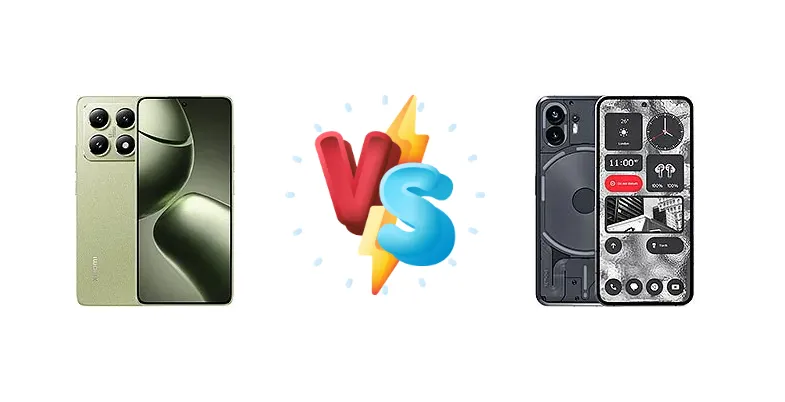
|
🏆 Quick Verdict
For most users, the Nothing Phone (2) emerges as the stronger all-rounder. Its significantly longer 14:21 active use battery life and efficient Snapdragon 8+ Gen 1 chipset provide a smoother, more sustained experience. While the Xiaomi 14T boasts faster charging, the Nothing Phone (2)'s overall balance is more appealing.
| PHONES | ||
|---|---|---|
| Phone Names | Xiaomi 14T | Nothing Phone (2) |
| Network | ||
|---|---|---|
| 2G bands | GSM 850 / 900 / 1800 / 1900 | GSM 850 / 900 / 1800 / 1900 |
| 3G bands | HSDPA 800 / 850 / 900 / 1700(AWS) / 1900 / 2100 | HSDPA 800 / 850 / 900 / 1700(AWS) / 1900 / 2100 |
| 4G bands | 1, 2, 3, 4, 5, 7, 8, 12, 13, 17, 18, 19, 20, 26, 28, 32, 38, 40, 41, 42, 48, 66 | 1, 2, 3, 4, 5, 7, 8, 12, 17, 18, 19, 20, 25, 26, 28, 30, 32, 34, 38, 39, 40, 41, 42, 48, 66, 71 |
| 5G bands | 1, 2, 3, 5, 7, 8, 12, 20, 26, 28, 38, 40, 41, 48, 66, 77, 78 SA/NSA | 1, 2, 3, 5, 7, 8, 12, 20, 25, 28, 30, 38, 40, 41, 66, 71, 75, 77, 78 SA/NSA |
| Speed | HSPA, LTE, 5G | HSPA, LTE, 5G |
| Technology | GSM / HSPA / LTE / 5G | GSM / HSPA / LTE / 5G |
| Launch | ||
|---|---|---|
| Announced | 2024, September 26 | 2023, July 11 |
| Status | Available. Released 2024, September 26 | Available. Released 2023, July 17 |
| Body | ||
|---|---|---|
| Build | Glass front (Gorilla Glass 5), plastic frame, glass back (Panda X) | Glass front (Gorilla Glass 5), glass back (Gorilla Glass 5), aluminum frame |
| Dimensions | 160.5 x 75.1 x 7.8 mm or 8.0 mm | 162.1 x 76.4 x 8.6 mm (6.38 x 3.01 x 0.34 in) |
| SIM | · Nano-SIM + eSIM· eSIM + eSIM· Nano-SIM + Nano-SIM | Nano-SIM + Nano-SIM |
| Weight | 193 g or 195 g (6.81 oz) | 201.2 g (7.09 oz) |
| Display | ||
|---|---|---|
| Protection | Corning Gorilla Glass 5 | Corning Gorilla Glass 5 |
| Resolution | 1220 x 2712 pixels, 20:9 ratio (~446 ppi density) | 1080 x 2412 pixels, 20:9 ratio (~394 ppi density) |
| Size | 6.67 inches, 107.4 cm2 (~89.1% screen-to-body ratio) | 6.7 inches, 108.0 cm2 (~87.2% screen-to-body ratio) |
| Type | AMOLED, 68B colors, 144Hz, 2880Hz PWM, Dolby Vision, HDR10+, 1600 nits (HBM), 4000 nits (peak) | LTPO OLED, 1B colors, 120Hz, 1920Hz PWM, HDR10+, 1600 nits (HBM), 1600 nits (peak) |
| Platform | ||
|---|---|---|
| CPU | Octa-core (1x3.35 GHz Cortex-A715 & 3x3.20 GHz Cortex-A715 & 4x2.20 GHz Cortex-A510) | Octa-core (1x3.0 GHz Cortex-X2 & 3x2.5 GHz Cortex-A710 & 4x1.80 GHz Cortex-A510) |
| Chipset | Mediatek Dimensity 8300 Ultra (4 nm) | Qualcomm SM8475 Snapdragon 8+ Gen 1 (4 nm) |
| GPU | Mali G615-MC6 | Adreno 730 |
| OS | Android 14, upgradable to Android 15, HyperOS 2 | Android 13, upgradable to Android 15, up to 3 major Android upgrades, Nothing OS 3.0 |
| Memory | ||
|---|---|---|
| Card slot | No | No |
| Internal | 256GB 12GB RAM, 512GB 12GB RAM, 512GB 16GB RAM, 1TB 12GB RAM | 128GB 8GB RAM, 256GB 12GB RAM, 512GB 12GB RAM |
| Main Camera | ||
|---|---|---|
| Dual | - | 50 MP, f/1.9, 24mm (wide), 1/1.56", 1.0µm, PDAF, OIS 50 MP, f/2.2, 114˚ (ultrawide), 1/2.76", 0.64µm, AF |
| Features | Leica lens, Ultra HDR, LED flash, HDR, panorama | LED flash, panorama, HDR |
| Triple | 50 MP, f/1.7, 23mm (wide), 1/1.56", 1.0µm, PDAF, OIS 50 MP, f/1.9, 50mm (telephoto), 1/2.76", 0.64µm, PDAF, 2x optical zoom 12 MP, f/2.2, 15mm (ultrawide), 1/3.06", 1.12µm | - |
| Video | 4K@24/30/60fps, 1080p@30/60/120/240/960fps, gyro-EIS, 10-bit Rec. 2020, HDR10+ | 4K@30/60fps, 1080p@30/60fps, gyro-EIS, live HDR, OIS |
| Selfie camera | ||
|---|---|---|
| Features | HDR | HDR |
| Single | 32 MP, f/2.0, 25mm (wide), 1/3.44", 0.64µm | 32 MP, f/2.5, (wide), 1/2.74", 0.8µm |
| Video | 4K@30fps, 1080p@30/60fps, HDR10+ | 1080p@30fps |
| Sound | ||
|---|---|---|
| 35mm jack | No | No |
| Loudspeaker | Yes, with stereo speakers | Yes, with stereo speakers |
| Comms | ||
|---|---|---|
| Bluetooth | 5.4, A2DP, LE, LHDC | 5.3, A2DP, LE, aptX HD, aptX Adaptive |
| Infrared port | Yes | - |
| NFC | Yes (market/region dependent) | Yes |
| Positioning | GPS (L1+L5), BDS (B1I+B1C+B2a), GALILEO (E1+E5a), NavIC (L5), GLONASS | GPS (L1+L5), GLONASS (L1), BDS (B1I+B1c), GALILEO (E1), QZSS (L1), NavIC |
| Radio | No | No |
| USB | USB Type-C 2.0, OTG | USB Type-C 2.0, OTG |
| WLAN | Wi-Fi 802.11 a/b/g/n/ac/6e, dual-band, Wi-Fi Direct | Wi-Fi 802.11 a/b/g/n/ac/6, dual-band, Wi-Fi Direct |
| Features | ||
|---|---|---|
| Sensors | Fingerprint (under display, optical), accelerometer, gyro, proximity, compass | Fingerprint (under display, optical), accelerometer, proximity, gyro, compass |
| Battery | ||
|---|---|---|
| Charging | 67W wired, PD3.0, 100% in 45 min | 45W wired, PD3.0, PPS, QC4, 100% in 55 min 15W wireless, 100% in 130 min 5W reverse wireless |
| Type | Li-Po 5000 mAh | Li-Ion 4700 mAh |
| Misc | ||
|---|---|---|
| Colors | Titan Gray, Titan Blue, Titan Black, Lemon Green | White, Dark Gray |
| Models | 2406APNFAG | A065 |
| Price | € 337.12 / $ 469.99 / £ 373.06 | $ 379.99 / £ 370.00 |
| SAR EU | 0.98 W/kg (head) 0.99 W/kg (body) | - |
Xiaomi 14T
- Faster 67W wired charging
- Potentially higher CPU performance with Dimensity 8300 Ultra
- Brighter display for outdoor visibility
- Shorter battery life in active use
- Limited camera information available
- Less distinctive design
Nothing Phone (2)
- Significantly longer battery life
- Efficient Snapdragon 8+ Gen 1 chipset
- Unique Glyph Interface and software experience
- Slower wired charging compared to Xiaomi 14T
- Lower peak display brightness
- Wireless charging adds bulk
Display Comparison
The Xiaomi 14T boasts a brighter display, reaching a measured 1355 nits, compared to the Nothing Phone (2)'s 998 nits. This translates to better visibility under direct sunlight. However, both utilize a 4nm process, suggesting similar efficiency. While neither specification details refresh rate or panel type, the higher peak brightness of the 14T gives it an edge for outdoor usability. The Nothing Phone (2)'s Glyph Interface, while not a display feature, is a unique visual element absent on the Xiaomi.
Camera Comparison
The provided data lacks detailed camera specifications for both devices. However, the Nothing Phone (2) explicitly mentions 'Photo / Video' capabilities, suggesting a focus on camera performance. Without sensor size, aperture, or OIS details, it's difficult to make a definitive judgment. We can assume both phones will offer a versatile camera system, but the Nothing Phone (2)'s marketing emphasizes its imaging capabilities, potentially indicating a more refined camera experience. The absence of details on the Xiaomi 14T's camera suggests it may not be a primary selling point.
Performance
The core difference lies in the chipsets: the Xiaomi 14T features the Mediatek Dimensity 8300 Ultra, while the Nothing Phone (2) uses the Qualcomm Snapdragon 8+ Gen 1. The Dimensity 8300 Ultra’s octa-core configuration (1x3.35 GHz Cortex-A715, 3x3.20 GHz Cortex-A715, 4x2.20 GHz Cortex-A510) aims for high single-core and multi-core performance. The Snapdragon 8+ Gen 1 (1x3.0 GHz Cortex-X2, 3x2.5 GHz Cortex-A710, 4x1.80 GHz Cortex-A510) is a proven performer known for its thermal efficiency. While the 14T may win in raw benchmark scores, the Snapdragon 8+ Gen 1’s efficiency contributes to the Nothing Phone (2)'s superior battery life.
Battery Life
Battery life is where the Nothing Phone (2) truly shines. Its active use score of 14:21h significantly surpasses the Xiaomi 14T’s 11:32h. While the Xiaomi 14T compensates with 67W wired charging (45 minutes to 100%), the Nothing Phone (2) offers 45W wired (55 minutes), 15W wireless, and even 5W reverse wireless charging. The Nothing Phone (2)'s older endurance rating of 103h further reinforces its battery prowess. The faster charging of the 14T is useful, but the longer runtime of the Nothing Phone (2) is more impactful for most users.
Buying Guide
Buy the Xiaomi 14T if you prioritize peak CPU performance for demanding tasks like video editing or gaming and need the fastest possible charging speeds. You'll benefit from the Dimensity 8300 Ultra's raw power. Buy the Nothing Phone (2) if you value battery life, a distinctive design, and a clean software experience. Its Snapdragon 8+ Gen 1 offers excellent performance with superior efficiency, making it ideal for everyday use and media consumption.