
Xiaomi 14 vs. vivo X100 Pro: A Deep Dive into Android Flagship Performance
| Phones Images | |||||
|---|---|---|---|---|---|
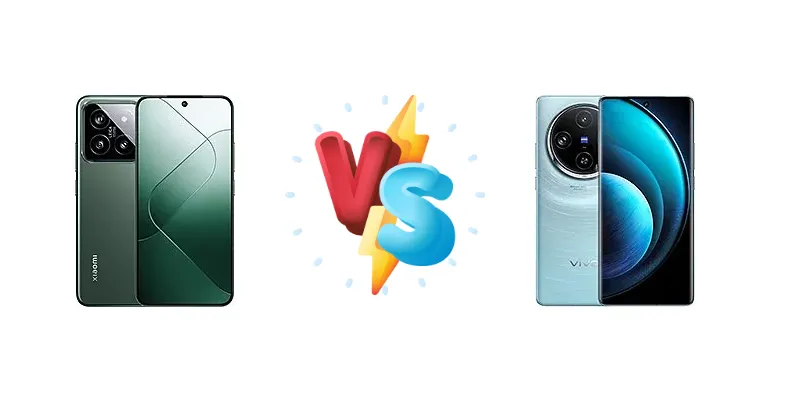
|
🏆 Quick Verdict
For the average user prioritizing raw performance and a slightly more refined software experience, the Xiaomi 14 emerges as the winner. Its Snapdragon 8 Gen 3 offers a consistent edge in demanding tasks, and the 90W charging is remarkably efficient. However, the vivo X100 Pro’s superior display brightness and potentially more versatile camera system make it a strong contender for photography enthusiasts.
| PHONES | ||
|---|---|---|
| Phone Names | Xiaomi 14 | vivo X100 Pro |
| Network | ||
|---|---|---|
| 2G bands | GSM 850 / 900 / 1800 / 1900 | GSM 850 / 900 / 1800 / 1900 |
| 3G bands | HSDPA 800 / 850 / 900 / 1700(AWS) / 1900 / 2100 | HSDPA 800 / 850 / 900 / 1700(AWS) / 1900 / 2100 |
| 4G bands | 1, 2, 3, 4, 5, 7, 8, 12, 13, 17, 18, 19, 20, 25, 26, 28, 32, 38, 39, 40, 41, 42, 48, 66 - International | 1, 2, 3, 4, 5, 7, 8, 12, 17, 18, 19, 20, 26, 28, 32, 38, 39, 40, 41, 42, 66 - International |
| 5G bands | 1, 2, 3, 5, 7, 8, 20, 25, 28, 38, 40, 41, 48, 66, 75, 77, 78 SA/NSA - International | 1, 3, 5, 7, 8, 20, 28, 38, 40, 41, 66, 75, 77, 78, 79 SA/NSA - International |
| Speed | HSPA, LTE, 5G | HSPA, LTE, 5G |
| Technology | GSM / CDMA / HSPA / CDMA2000 / LTE / 5G | GSM / CDMA / HSPA / LTE / 5G |
| Launch | ||
|---|---|---|
| Announced | 2023, October 26 | 2023, November 13 |
| Status | Available. Released 2023, November 01 | Available. Released 2023, November 21 |
| Body | ||
|---|---|---|
| Build | Glass front (Gorilla Glass Victus), glass back or silicone polymer back, aluminum frame | Glass front, aluminum frame, glass back |
| Dimensions | 152.8 x 71.5 x 8.2 mm or 8.3 mm | 164.1 x 75.3 x 8.9 mm or 9.1 mm |
| SIM | · Nano-SIM + eSIM· Nano-SIM + Nano-SIM | · Nano-SIM + eSIM· Nano-SIM + Nano-SIM |
| Weight | 188 g or 193 g (6.63 oz) | 221 g or 225 g (7.80 oz) |
| Display | ||
|---|---|---|
| Protection | Corning Gorilla Glass Victus | - |
| Resolution | 1200 x 2670 pixels, 20:9 ratio (~460 ppi density) | 1260 x 2800 pixels, 20:9 ratio (~452 ppi density) |
| Size | 6.36 inches, 97.6 cm2 (~89.3% screen-to-body ratio) | 6.78 inches, 111.5 cm2 (~90.2% screen-to-body ratio) |
| Type | LTPO OLED, 68B colors, 120Hz, Dolby Vision, HDR10+, 1000 nits (typ), 3000 nits (peak) | LTPO AMOLED, 1B colors, 120Hz, HDR10+, 3000 nits (peak) |
| Platform | ||
|---|---|---|
| CPU | Octa-core (1x3.3 GHz Cortex-X4 & 3x3.2 GHz Cortex-A720 & 2x3.0 GHz Cortex-A720 & 2x2.3 GHz Cortex-A520) | Octa-core (1x3.25 GHz Cortex-X4 & 3x2.85 GHz Cortex-X4 & 4x2.0 GHz Cortex-A720) |
| Chipset | Qualcomm SM8650-AB Snapdragon 8 Gen 3 (4 nm) | Mediatek Dimensity 9300 (4 nm) |
| GPU | Adreno 750 | Immortalis-G720 MC12 |
| OS | Android 14, upgradable to Android 15, up to 4 major Android upgrades, HyperOS 1.1 | Android 14, upgradable to Android 15, Funtouch 15 (International), OriginOS 4 (China) |
| Memory | ||
|---|---|---|
| Card slot | No | No |
| Internal | 256GB 8GB RAM, 256GB 12GB RAM, 512GB 12GB RAM, 512GB 16GB RAM, 1TB 16GB RAM | 256GB 12GB RAM, 256GB 16GB RAM, 512GB 16GB RAM, 1TB 16GB RAM |
| Main Camera | ||
|---|---|---|
| Features | Laser AF, color spectrum sensor, Leica lens, Dual-LED dual-tone flash, HDR, panorama | Laser AF, color spectrum sensor, Zeiss optics, Zeiss T* lens coating, LED flash, panorama, HDR, 3D LUT import |
| Triple | 50 MP, f/1.6, 23mm (wide), 1/1.31", 1.2µm, dual pixel PDAF, OIS 50 MP, f/2.0, 75mm (telephoto), PDAF (10cm - ∞), OIS, 3.2x optical zoom 50 MP, f/2.2, 14mm, 115˚ (ultrawide) | 50 MP, f/1.8, 23mm (wide), 1/0.98", 1.6µm, dual pixel PDAF, OIS 50 MP, f/2.5, 100mm (periscope telephoto), 1/2.51", 0.7µm, PDAF (18cm - ∞), OIS, 4.3x optical zoom 50 MP, f/2.0, 15mm, 119˚ (ultrawide), 1/2.76", 0.64µm, AF |
| Video | 8K@24fps (HDR), 4K@24/30/60fps (HDR10+, 10-bit Dolby Vision HDR, 10-bit LOG), 1080p@30/60/120/240/960fps, 720p@1920fps, gyro-EIS | 8K@30fps, 4K@30/60fps, 1080p, gyro-EIS |
| Selfie camera | ||
|---|---|---|
| Features | HDR, panorama | HDR |
| Single | 32 MP, f/2.0, 22mm (wide), 0.7µm | 32 MP, f/2.0, 20mm (ultrawide) |
| Video | 4K@30/60fps, 1080p@30/60fps, gyro-EIS | 4K@30/60fps, 1080p@30/60fps |
| Sound | ||
|---|---|---|
| 35mm jack | No | No |
| Loudspeaker | Yes, with stereo speakers | Yes, with stereo speakers |
| Comms | ||
|---|---|---|
| Bluetooth | 5.4, A2DP, LE, aptX HD, aptX Adaptive, LHDC | 5.4, A2DP, LE, aptX HD, LHDC |
| Infrared port | Yes | Yes |
| NFC | Yes | Yes |
| Positioning | GPS (L1+L5), GLONASS (G1), BDS (B1I+B1c+B2a), GALILEO (E1+E5a), QZSS (L1+L5), NavIC (L5) | GPS (L1+L5), GLONASS (L1), BDS (B1I+B1c+B2a+B2b), GALILEO (E1+E5a+E5b), QZSS (L1+L5), NavIC (L5) |
| Radio | No | No |
| USB | USB Type-C 3.2, OTG | USB Type-C 3.2, OTG |
| WLAN | Wi-Fi 802.11 a/b/g/n/ac/6e/7, dual-band, Wi-Fi Direct | Wi-Fi 802.11 a/b/g/n/ac/6/7, tri-band, Wi-Fi Direct |
| Features | ||
|---|---|---|
| Sensors | Fingerprint (under display, optical), accelerometer, proximity, gyro, compass, barometer | Fingerprint (under display, optical), accelerometer, gyro, proximity, compass |
| Battery | ||
|---|---|---|
| Charging | 90W wired, PD3.0, QC4, 100% in 31 min 50W wireless, 100% in 46 min 10W reverse wireless | 100W wired, 50% in 14 min 50W wireless Reverse wired |
| Type | Li-Po 4610 mAh | Li-Ion 5400 mAh |
| Misc | ||
|---|---|---|
| Colors | Black, White, Jade Green, Pink | Startrail Blue, Asteroid Black, Sunset Orange, White |
| Models | 23127PN0CC, 23127PN0CG | V2324A, V2309 |
| Price | € 527.07 / $ 342.37 / ₹ 59,999 | ₹ 59,999 |
| SAR EU | 1.00 W/kg (head) 0.99 W/kg (body) | 0.99 W/kg (head) 1.19 W/kg (body) |
Xiaomi 14
- Superior single-core and gaming performance with Snapdragon 8 Gen 3
- Efficient 90W wired and 50W wireless charging
- Potentially more streamlined software experience
- Lower peak display brightness compared to vivo X100 Pro
- Camera system details are limited in the provided data
vivo X100 Pro
- Brighter display for better outdoor visibility
- Potentially more versatile camera system with advanced features
- Faster initial charging speed with 100W wired
- Dimensity 9300 may exhibit more thermal throttling under sustained load
- Software experience may be less refined than Xiaomi's MIUI
Display Comparison
The vivo X100 Pro boasts a brighter display, reaching a measured 1472 nits compared to the Xiaomi 14’s 1175 nits. This translates to superior visibility under direct sunlight. While both likely employ LTPO technology for adaptive refresh rates (not explicitly stated, but standard for this class), the X100 Pro’s higher peak brightness is a clear advantage for outdoor use. The Xiaomi 14’s display, while excellent, doesn’t quite match the X100 Pro’s vibrancy and readability in challenging lighting conditions.
Camera Comparison
The context data highlights the vivo X100 Pro’s focus on photography and videography, though specific sensor details are missing. The inclusion of 'Photo / Video' as a feature suggests a more comprehensive camera experience. While the Xiaomi 14 is undoubtedly capable, the X100 Pro’s likely larger main sensor (based on vivo’s history) and advanced image processing algorithms could yield superior image quality, particularly in low-light scenarios. The absence of details on the Xiaomi 14’s camera system makes a direct comparison difficult, but the X100 Pro’s emphasis on camera features positions it as the stronger choice for serious photographers.
Performance
Both phones utilize a 4nm process, but the chipset architectures differ significantly. The Xiaomi 14’s Snapdragon 8 Gen 3 features a 1x3.3 GHz Cortex-X4 prime core, complemented by 3x3.2 GHz Cortex-A720 cores, 2x3.0 GHz Cortex-A720 cores, and 2x2.3 GHz Cortex-A520 cores. The vivo X100 Pro’s Dimensity 9300 employs a 1x3.25 GHz Cortex-X4 prime core, but notably includes *three* additional 2.85 GHz Cortex-X4 performance cores, alongside 4x2.0 GHz Cortex-A720 cores. This configuration suggests the Dimensity 9300 prioritizes sustained multi-core performance, potentially benefiting video editing and other heavily threaded tasks. However, the Snapdragon 8 Gen 3’s more efficient core arrangement and Qualcomm’s Adreno GPU typically deliver a stronger single-core and gaming experience. Thermal management will be crucial; the Dimensity 9300’s four X4 cores could generate more heat under prolonged load.
Battery Life
Both devices exhibit remarkably similar battery life, with the Xiaomi 14 achieving 13:56h of active use and the vivo X100 Pro managing 13:53h. This suggests efficient power management on both sides. However, the charging speeds differ. The Xiaomi 14 supports 90W wired charging, reaching 100% in 31 minutes, alongside 50W wireless charging (46 minutes). The vivo X100 Pro boasts 100W wired charging, claiming 50% charge in just 14 minutes, and 50W wireless. While the Xiaomi 14’s charging is fast, the vivo X100 Pro’s quicker initial charge and potentially faster overall charging cycle provide a slight convenience advantage.
Buying Guide
Buy the Xiaomi 14 if you need uncompromising gaming performance, a streamlined user interface, and fast charging speeds. It’s the ideal choice for power users who demand responsiveness and efficiency. Buy the vivo X100 Pro if you prioritize display quality, are a dedicated mobile photographer, and appreciate a unique camera-centric feature set. It caters to those who value visual fidelity and creative control.