
Xiaomi 14 vs Samsung Galaxy S24 Ultra: A Deep Dive into Flagship Performance
| Phones Images | |||||
|---|---|---|---|---|---|
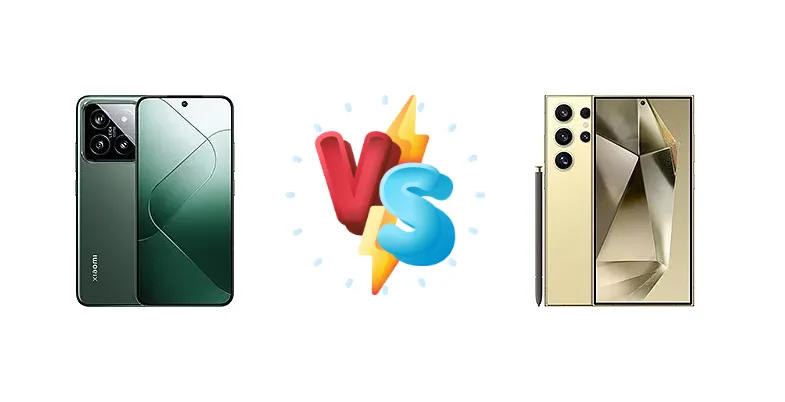
|
🏆 Quick Verdict
For the average user prioritizing display quality and a versatile camera system, the Samsung Galaxy S24 Ultra emerges as the winner. While the Xiaomi 14 offers incredibly fast charging and competitive performance, the S24 Ultra’s brighter display and refined software experience provide a more polished overall package.
| PHONES | ||
|---|---|---|
| Phone Names | Xiaomi 14 | Samsung Galaxy S24 Ultra |
| Network | ||
|---|---|---|
| 2G bands | GSM 850 / 900 / 1800 / 1900 | GSM 850 / 900 / 1800 / 1900 |
| 3G bands | HSDPA 800 / 850 / 900 / 1700(AWS) / 1900 / 2100 | HSDPA 850 / 900 / 1700(AWS) / 1900 / 2100 |
| 4G bands | 1, 2, 3, 4, 5, 7, 8, 12, 13, 17, 18, 19, 20, 25, 26, 28, 32, 38, 39, 40, 41, 42, 48, 66 - International | 1, 2, 3, 4, 5, 7, 8, 12, 13, 17, 18, 19, 20, 25, 26, 28, 32, 38, 39, 40, 41, 66 - International |
| 5G bands | 1, 2, 3, 5, 7, 8, 20, 25, 28, 38, 40, 41, 48, 66, 75, 77, 78 SA/NSA - International | 1, 2, 3, 5, 7, 8, 12, 20, 25, 26, 28, 38, 40, 41, 66, 75, 77, 78 SA/NSA/Sub6 - International |
| Speed | HSPA, LTE, 5G | HSPA, LTE (up to 7CA), 5G |
| Technology | GSM / CDMA / HSPA / CDMA2000 / LTE / 5G | GSM / CDMA / HSPA / EVDO / LTE / 5G |
| Launch | ||
|---|---|---|
| Announced | 2023, October 26 | 2024, January 17 |
| Status | Available. Released 2023, November 01 | Available. Released 2024, January 24 |
| Body | ||
|---|---|---|
| Build | Glass front (Gorilla Glass Victus), glass back or silicone polymer back, aluminum frame | Glass front (Corning Gorilla Armor), glass back (Corning Gorilla Armor), titanium frame (grade 2) |
| Dimensions | 152.8 x 71.5 x 8.2 mm or 8.3 mm | 162.3 x 79 x 8.6 mm (6.39 x 3.11 x 0.34 in) |
| SIM | · Nano-SIM + eSIM· Nano-SIM + Nano-SIM | · Nano-SIM + Nano-SIM + eSIM + eSIM (max 2 at a time) - INT· Nano-SIM + eSIM + eSIM (max 2 at a time) - USA· Nano-SIM + Nano-SIM - CN |
| Weight | 188 g or 193 g (6.63 oz) | 232 g or 233 g (8.18 oz) |
| Display | ||
|---|---|---|
| Protection | Corning Gorilla Glass Victus | Corning Gorilla Armor |
| Resolution | 1200 x 2670 pixels, 20:9 ratio (~460 ppi density) | 1440 x 3120 pixels, 19.5:9 ratio (~505 ppi density) |
| Size | 6.36 inches, 97.6 cm2 (~89.3% screen-to-body ratio) | 6.8 inches, 113.5 cm2 (~88.5% screen-to-body ratio) |
| Type | LTPO OLED, 68B colors, 120Hz, Dolby Vision, HDR10+, 1000 nits (typ), 3000 nits (peak) | Dynamic LTPO AMOLED 2X, 120Hz, HDR10+, 2600 nits (peak) |
| Platform | ||
|---|---|---|
| CPU | Octa-core (1x3.3 GHz Cortex-X4 & 3x3.2 GHz Cortex-A720 & 2x3.0 GHz Cortex-A720 & 2x2.3 GHz Cortex-A520) | 8-core (1x3.39GHz Cortex-X4 & 3x3.1GHz Cortex-A720 & 2x2.9GHz Cortex-A720 & 2x2.2GHz Cortex-A520) |
| Chipset | Qualcomm SM8650-AB Snapdragon 8 Gen 3 (4 nm) | Qualcomm SM8650-AC Snapdragon 8 Gen 3 (4 nm) |
| GPU | Adreno 750 | Adreno 750 (1 GHz) |
| OS | Android 14, upgradable to Android 15, up to 4 major Android upgrades, HyperOS 1.1 | Android 14, up to 7 major Android upgrades, One UI 8.0 |
| Memory | ||
|---|---|---|
| Card slot | No | No |
| Internal | 256GB 8GB RAM, 256GB 12GB RAM, 512GB 12GB RAM, 512GB 16GB RAM, 1TB 16GB RAM | 256GB 12GB RAM, 512GB 12GB RAM, 1TB 12GB RAM |
| Main Camera | ||
|---|---|---|
| Features | Laser AF, color spectrum sensor, Leica lens, Dual-LED dual-tone flash, HDR, panorama | Laser AF, LED flash, auto-HDR, panorama |
| Quad | - | 200 MP, f/1.7, 24mm (wide), 1/1.3", 0.6µm, multi-directional PDAF, OIS 10 MP, f/2.4, 67mm (telephoto), 1/3.52", 1.12µm, PDAF, OIS, 3x optical zoom 50 MP, f/3.4, 111mm (periscope telephoto), 1/2.52", 0.7µm, PDAF, OIS, 5x optical zoom 12 MP, f/2.2, 13mm, 120˚ (ultrawide), 1/2.55", 1.4µm, dual pixel PDAF, Super Steady video |
| Triple | 50 MP, f/1.6, 23mm (wide), 1/1.31", 1.2µm, dual pixel PDAF, OIS 50 MP, f/2.0, 75mm (telephoto), PDAF (10cm - ∞), OIS, 3.2x optical zoom 50 MP, f/2.2, 14mm, 115˚ (ultrawide) | - |
| Video | 8K@24fps (HDR), 4K@24/30/60fps (HDR10+, 10-bit Dolby Vision HDR, 10-bit LOG), 1080p@30/60/120/240/960fps, 720p@1920fps, gyro-EIS | 8K@24/30fps, 4K@30/60/120fps, 1080p@30/60/120/240fps, HDR10+, stereo sound rec., gyro-EIS |
| Selfie camera | ||
|---|---|---|
| Features | HDR, panorama | HDR, HDR10+ |
| Single | 32 MP, f/2.0, 22mm (wide), 0.7µm | 12 MP, f/2.2, 26mm (wide), 1/3.2", 1.12µm, dual pixel PDAF |
| Video | 4K@30/60fps, 1080p@30/60fps, gyro-EIS | 4K@30/60fps, 1080p@30fps |
| Sound | ||
|---|---|---|
| 35mm jack | No | No |
| Loudspeaker | Yes, with stereo speakers | Yes, with stereo speakers |
| Comms | ||
|---|---|---|
| Bluetooth | 5.4, A2DP, LE, aptX HD, aptX Adaptive, LHDC | 5.3, A2DP, LE |
| Infrared port | Yes | - |
| NFC | Yes | Yes |
| Positioning | GPS (L1+L5), GLONASS (G1), BDS (B1I+B1c+B2a), GALILEO (E1+E5a), QZSS (L1+L5), NavIC (L5) | GPS, GLONASS, BDS, GALILEO, QZSS |
| Radio | No | No |
| USB | USB Type-C 3.2, OTG | USB Type-C 3.2, DisplayPort 1.2, OTG |
| WLAN | Wi-Fi 802.11 a/b/g/n/ac/6e/7, dual-band, Wi-Fi Direct | Wi-Fi 802.11 a/b/g/n/ac/6e/7, tri-band, Wi-Fi Direct |
| Features | ||
|---|---|---|
| Sensors | Fingerprint (under display, optical), accelerometer, proximity, gyro, compass, barometer | Fingerprint (under display, ultrasonic), accelerometer, gyro, proximity, compass, barometer |
| Battery | ||
|---|---|---|
| Charging | 90W wired, PD3.0, QC4, 100% in 31 min 50W wireless, 100% in 46 min 10W reverse wireless | 45W wired, PD3.0, 65% in 30 min 15W wireless (Qi) 4.5W reverse wireless |
| Type | Li-Po 4610 mAh | Li-Ion 5000 mAh |
| Misc | ||
|---|---|---|
| Colors | Black, White, Jade Green, Pink | Titanium Black, Titanium Gray, Titanium Violet, Titanium Yellow, Titanium Blue, Titanium Green, Titanium Orange |
| Models | 23127PN0CC, 23127PN0CG | SM-S928B, SM-S928B/DS, SM-S928U, SM-S928U1, SM-S928W, SM-S928N, SM-S9280, SM-S928E, SM-S928E/DS |
| Price | € 527.07 / $ 342.37 / ₹ 59,999 | $ 514.94 / C$ 929.99 / £ 630.00 / € 658.53 / ₹ 84,999 |
| SAR | - | 1.26 W/kg (head) 0.62 W/kg (body) |
| SAR EU | 1.00 W/kg (head) 0.99 W/kg (body) | 1.06 W/kg (head) 1.30 W/kg (body) |
Xiaomi 14
- Incredibly fast 90W wired charging
- Faster 50W wireless charging
- Potentially more compact form factor
- Lower peak display brightness
- Camera system may not match S24 Ultra's versatility
Samsung Galaxy S24 Ultra
- Brighter and more vibrant display
- Superior camera system with advanced features
- Robust software support and ecosystem
- Slower 45W wired charging
- Slower 15W wireless charging
- Larger and heavier form factor
Display Comparison
The Samsung Galaxy S24 Ultra boasts a significantly brighter display, reaching a measured 1447 nits compared to the Xiaomi 14’s 1175 nits. This translates to superior visibility in direct sunlight. While both utilize advanced panel technology, the S24 Ultra’s higher peak brightness and likely higher contrast ratio provide a more immersive viewing experience. We expect the S24 Ultra to also benefit from Samsung’s industry-leading color accuracy calibration. Bezels are comparable, but the S24 Ultra’s slightly larger screen real estate may appeal to users who consume a lot of media.
Camera Comparison
The context data focuses on the chipsets, but Samsung’s camera prowess is a key differentiator. While the Xiaomi 14 is expected to have a strong camera system, the S24 Ultra’s reputation for image processing and versatile lens options (telephoto, ultrawide) gives it an edge. The S24 Ultra’s larger main sensor (expected, based on previous models) will capture more light, resulting in better low-light performance. The Xiaomi 14 will likely excel in specific scenarios, but the S24 Ultra offers a more consistently excellent camera experience across various shooting conditions. We'll need to see detailed camera samples to fully assess the differences.
Performance
Both devices are equipped with the Qualcomm Snapdragon 8 Gen 3 (4nm), but subtle CPU clock speed differences exist. The S24 Ultra’s CPU peaks at 3.39GHz, slightly higher than the Xiaomi 14’s 3.3 GHz. While this difference is unlikely to be noticeable in most everyday tasks, it could translate to a marginal performance advantage in sustained, CPU-intensive workloads. Both utilize a similar core configuration (1xX4, 3xA720, 2xA720, 2xA520), but the S24 Ultra’s thermal management will be crucial to maintaining peak performance. Both devices likely utilize LPDDR5x RAM, but specific speeds weren't provided.
Battery Life
Battery life is remarkably similar, with both phones achieving around 13:50 hours of active use. However, charging speeds are drastically different. The Xiaomi 14’s 90W wired charging can fully charge the battery in just 31 minutes, while the S24 Ultra’s 45W charging takes approximately 65% in 30 minutes. The Xiaomi 14 also offers significantly faster 50W wireless charging compared to the S24 Ultra’s 15W Qi wireless charging. The Xiaomi 14’s 10W reverse wireless charging is also superior to the S24 Ultra’s 4.5W offering. This makes the Xiaomi 14 the clear winner for users who prioritize quick top-ups.
Buying Guide
Buy the Xiaomi 14 if you prioritize blazing-fast charging speeds (90W wired, 50W wireless) and a more compact flagship experience. It’s ideal for users who frequently top up their phones and value portability. Buy the Samsung Galaxy S24 Ultra if you demand the brightest possible display, a comprehensive camera system with advanced features, and a robust software ecosystem with long-term support. It’s the choice for power users and content creators.