
Xiaomi 14 vs OnePlus 12R: A Deep Dive into Performance, Battery, and Value
| Phones Images | |||||
|---|---|---|---|---|---|
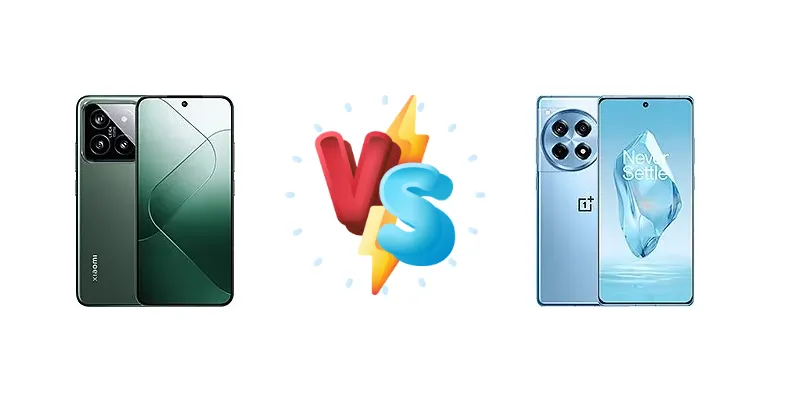
|
🏆 Quick Verdict
For most users, the OnePlus 12R emerges as the stronger value proposition. Its 14:32 active use battery life surpasses the Xiaomi 14’s 13:56, and the 100W charging is significantly faster at 26 minutes to full compared to the Xiaomi 14’s 31 minutes. While the Xiaomi 14 boasts the newer chipset, the real-world performance difference isn't substantial enough to justify the price premium for the average user.
| PHONES | ||
|---|---|---|
| Phone Names | Xiaomi 14 | OnePlus 12R |
| Network | ||
|---|---|---|
| 2G bands | GSM 850 / 900 / 1800 / 1900 | GSM 850 / 900 / 1800 / 1900 |
| 3G bands | HSDPA 800 / 850 / 900 / 1700(AWS) / 1900 / 2100 | HSDPA 850 / 900 / 1700(AWS) / 1900 / 2100 |
| 4G bands | 1, 2, 3, 4, 5, 7, 8, 12, 13, 17, 18, 19, 20, 25, 26, 28, 32, 38, 39, 40, 41, 42, 48, 66 - International | 1, 2, 3, 4, 5, 7, 8, 12, 17, 18, 19, 20, 26, 28, 32, 38, 39, 40, 41, 66 |
| 5G bands | 1, 2, 3, 5, 7, 8, 20, 25, 28, 38, 40, 41, 48, 66, 75, 77, 78 SA/NSA - International | 1, 2, 3, 5, 7, 8, 12, 20, 28, 38, 40, 41, 66, 77, 78 SA/NSA |
| Speed | HSPA, LTE, 5G | HSPA, LTE, 5G |
| Technology | GSM / CDMA / HSPA / CDMA2000 / LTE / 5G | GSM / CDMA / HSPA / LTE / 5G |
| Launch | ||
|---|---|---|
| Announced | 2023, October 26 | 2024, January 23 |
| Status | Available. Released 2023, November 01 | Available. Released 2024, February 06 |
| Body | ||
|---|---|---|
| Build | Glass front (Gorilla Glass Victus), glass back or silicone polymer back, aluminum frame | Glass front (Gorilla Glass Victus 2), aluminum frame, glass back |
| Dimensions | 152.8 x 71.5 x 8.2 mm or 8.3 mm | 163.3 x 75.3 x 8.8 mm (6.43 x 2.96 x 0.35 in) |
| SIM | · Nano-SIM + eSIM· Nano-SIM + Nano-SIM | · Nano-SIM + Nano-SIM + eSIM (max 2 at a time)· Nano-SIM + Nano-SIM |
| Weight | 188 g or 193 g (6.63 oz) | 207 g (7.30 oz) |
| Display | ||
|---|---|---|
| Protection | Corning Gorilla Glass Victus | Corning Gorilla Glass Victus 2 |
| Resolution | 1200 x 2670 pixels, 20:9 ratio (~460 ppi density) | 1264 x 2780 pixels (~450 ppi density) |
| Size | 6.36 inches, 97.6 cm2 (~89.3% screen-to-body ratio) | 6.78 inches, 111.7 cm2 (~90.9% screen-to-body ratio) |
| Type | LTPO OLED, 68B colors, 120Hz, Dolby Vision, HDR10+, 1000 nits (typ), 3000 nits (peak) | LTPO4 AMOLED, 1B colors, 120Hz, HDR10+, Dolby Vision, 1600 nits (HBM), 4500 nits (peak) |
| Platform | ||
|---|---|---|
| CPU | Octa-core (1x3.3 GHz Cortex-X4 & 3x3.2 GHz Cortex-A720 & 2x3.0 GHz Cortex-A720 & 2x2.3 GHz Cortex-A520) | Octa-core (1x3.2 GHz Cortex-X3 & 2x2.8 GHz Cortex-A715 & 2x2.8 GHz Cortex-A710 & 3x2.0 GHz Cortex-A510) |
| Chipset | Qualcomm SM8650-AB Snapdragon 8 Gen 3 (4 nm) | Qualcomm SM8550-AB Snapdragon 8 Gen 2 (4 nm) |
| GPU | Adreno 750 | Adreno 740 |
| OS | Android 14, upgradable to Android 15, up to 4 major Android upgrades, HyperOS 1.1 | Android 14, up to 3 major Android upgrades, OxygenOS 15 |
| Memory | ||
|---|---|---|
| Card slot | No | No |
| Internal | 256GB 8GB RAM, 256GB 12GB RAM, 512GB 12GB RAM, 512GB 16GB RAM, 1TB 16GB RAM | 128GB 8GB RAM, 256GB 8GB RAM, 256GB 12GB RAM, 256GB 16GB RAM |
| Main Camera | ||
|---|---|---|
| Features | Laser AF, color spectrum sensor, Leica lens, Dual-LED dual-tone flash, HDR, panorama | Laser AF, color spectrum sensor, LED flash, HDR, panorama |
| Triple | 50 MP, f/1.6, 23mm (wide), 1/1.31", 1.2µm, dual pixel PDAF, OIS 50 MP, f/2.0, 75mm (telephoto), PDAF (10cm - ∞), OIS, 3.2x optical zoom 50 MP, f/2.2, 14mm, 115˚ (ultrawide) | 50 MP, f/1.8, 24mm (wide), 1/1.56", 1.0µm, multi-directional PDAF, OIS 8 MP, f/2.2, 16mm, 112˚ (ultrawide), 1/4.0", 1.12µm 2 MP (macro) |
| Video | 8K@24fps (HDR), 4K@24/30/60fps (HDR10+, 10-bit Dolby Vision HDR, 10-bit LOG), 1080p@30/60/120/240/960fps, 720p@1920fps, gyro-EIS | 4K@30/60fps, 1080p@30/60/120/240fps, gyro-EIS, OIS |
| Selfie camera | ||
|---|---|---|
| Features | HDR, panorama | HDR, panorama |
| Single | 32 MP, f/2.0, 22mm (wide), 0.7µm | 16 MP, f/2.4, 26mm (wide), 1/3", 1.0µm |
| Video | 4K@30/60fps, 1080p@30/60fps, gyro-EIS | 1080p@30fps, gyro-EIS |
| Sound | ||
|---|---|---|
| 35mm jack | No | No |
| Loudspeaker | Yes, with stereo speakers | Yes, with stereo speakers |
| Comms | ||
|---|---|---|
| Bluetooth | 5.4, A2DP, LE, aptX HD, aptX Adaptive, LHDC | 5.3, A2DP, LE, aptX HD |
| Infrared port | Yes | Yes |
| NFC | Yes | Yes |
| Positioning | GPS (L1+L5), GLONASS (G1), BDS (B1I+B1c+B2a), GALILEO (E1+E5a), QZSS (L1+L5), NavIC (L5) | GPS, GALILEO, GLONASS, BDS, QZSS |
| Radio | No | No |
| USB | USB Type-C 3.2, OTG | USB Type-C 2.0 |
| WLAN | Wi-Fi 802.11 a/b/g/n/ac/6e/7, dual-band, Wi-Fi Direct | Wi-Fi 802.11 a/b/g/n/ac/6/7, dual-band |
| Features | ||
|---|---|---|
| Sensors | Fingerprint (under display, optical), accelerometer, proximity, gyro, compass, barometer | Fingerprint (under display, optical), accelerometer, gyro, proximity, compass |
| Battery | ||
|---|---|---|
| Charging | 90W wired, PD3.0, QC4, 100% in 31 min 50W wireless, 100% in 46 min 10W reverse wireless | 100W wired, 100% in 26 min |
| Type | Li-Po 4610 mAh | Li-Ion 5500 mAh |
| Misc | ||
|---|---|---|
| Colors | Black, White, Jade Green, Pink | Iron Gray, Cool Blue, Electric Violet, Sunset Dune |
| Models | 23127PN0CC, 23127PN0CG | CPH2609, CPH2585, CPH2611 |
| Price | € 527.07 / $ 342.37 / ₹ 59,999 | € 410.84 / $ 399.95 / £ 649.00 |
| SAR | - | 1.19 W/kg (head) 0.82 W/kg (body) |
| SAR EU | 1.00 W/kg (head) 0.99 W/kg (body) | - |
Xiaomi 14
- Latest Snapdragon 8 Gen 3 processor
- Wireless charging support (50W)
- Reverse wireless charging support (10W)
- Shorter battery life (13:56h)
- Slower wired charging (31 minutes)
OnePlus 12R
- Longer battery life (14:32h)
- Faster wired charging (26 minutes)
- Excellent value for money
- Older Snapdragon 8 Gen 2 processor
- No wireless charging
Display Comparison
Both the Xiaomi 14 and OnePlus 12R feature excellent displays, achieving very similar peak brightness levels at 1175 nits and 1181 nits respectively. This ensures excellent visibility even in direct sunlight. While both likely utilize AMOLED panels, the specifics regarding refresh rate and PWM dimming are not provided. However, the minimal brightness difference suggests comparable viewing experiences. The OnePlus 12R’s slightly higher peak brightness is a marginal advantage, but unlikely to be noticeable in everyday use.
Camera Comparison
Context data does not provide camera specifications. Given the Xiaomi 14’s positioning as a flagship, it likely features a more advanced camera system with larger sensors and more sophisticated image processing. OnePlus typically focuses on delivering strong overall camera performance, but often prioritizes value over bleeding-edge sensor technology. Without specific details, it’s reasonable to assume the Xiaomi 14 will offer superior image quality, particularly in low-light conditions, and more advanced features.
Performance
The Xiaomi 14’s Snapdragon 8 Gen 3 (4nm) represents a generational leap over the OnePlus 12R’s Snapdragon 8 Gen 2 (4nm). The Xiaomi 14’s CPU configuration – 1x3.3 GHz Cortex-X4, 3x3.2 GHz Cortex-A720, 2x3.0 GHz Cortex-A720, and 2x2.3 GHz Cortex-A520 – offers a theoretical performance advantage over the OnePlus 12R’s 1x3.2 GHz Cortex-X3, 2x2.8 GHz Cortex-A715, 2x2.8 GHz Cortex-A710, and 3x2.0 GHz Cortex-A510. However, the 8 Gen 2 is still a powerhouse, and the difference in real-world application performance will be less pronounced than the raw specs suggest. The 8 Gen 3’s improved Neural Processing Unit (NPU) will benefit AI-driven tasks, but the impact on typical user workflows is currently limited.
Battery Life
The OnePlus 12R boasts a clear advantage in battery endurance, achieving 14:32 hours of active use compared to the Xiaomi 14’s 13:56 hours. This difference, while not massive, is significant for power users. Furthermore, the OnePlus 12R’s 100W wired charging (100% in 26 minutes) is considerably faster than the Xiaomi 14’s 90W wired charging (100% in 31 minutes). The Xiaomi 14 does offer 50W wireless charging and 10W reverse wireless charging, features absent on the OnePlus 12R, providing added convenience for users invested in wireless ecosystems.
Buying Guide
Buy the Xiaomi 14 if you prioritize having the absolute latest processor and are willing to pay a premium for it, and if you value wireless charging capabilities. Buy the OnePlus 12R if you prioritize exceptional battery life, incredibly fast wired charging, and maximizing value for your money without sacrificing significant performance.