
Xiaomi 14 vs Honor Magic6 Pro: A Deep Dive into Flagship Performance and Display Prowess
| Phones Images | |||||
|---|---|---|---|---|---|
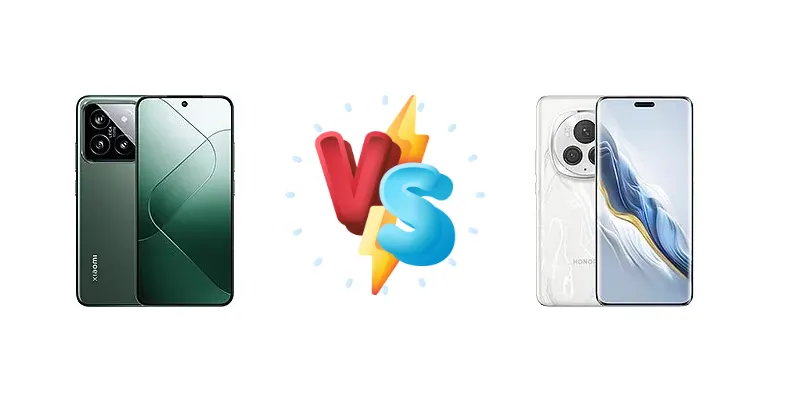
|
🏆 Quick Verdict
For most users, the Honor Magic6 Pro emerges as the superior choice. Its significantly brighter display (1578 nits vs 1175 nits) and slightly longer battery life (14:06h vs 13:56h) provide a more compelling user experience, despite the similar core performance.
| PHONES | ||
|---|---|---|
| Phone Names | Xiaomi 14 | Honor Magic6 Pro |
| Network | ||
|---|---|---|
| 2G bands | GSM 850 / 900 / 1800 / 1900 | GSM 850 / 900 / 1800 / 1900 |
| 3G bands | HSDPA 800 / 850 / 900 / 1700(AWS) / 1900 / 2100 | HSDPA 800 / 850 / 900 / 1700(AWS) / 1900 / 2100 |
| 4G bands | 1, 2, 3, 4, 5, 7, 8, 12, 13, 17, 18, 19, 20, 25, 26, 28, 32, 38, 39, 40, 41, 42, 48, 66 - International | LTE |
| 5G bands | 1, 2, 3, 5, 7, 8, 20, 25, 28, 38, 40, 41, 48, 66, 75, 77, 78 SA/NSA - International | SA/NSA |
| Speed | HSPA, LTE, 5G | HSPA, LTE, 5G |
| Technology | GSM / CDMA / HSPA / CDMA2000 / LTE / 5G | GSM / CDMA / HSPA / CDMA2000 / LTE / 5G |
| Launch | ||
|---|---|---|
| Announced | 2023, October 26 | 2024, January 11 |
| Status | Available. Released 2023, November 01 | Available. Released 2024, January 18 |
| Body | ||
|---|---|---|
| Build | Glass front (Gorilla Glass Victus), glass back or silicone polymer back, aluminum frame | Glass front (NanoCrystal Shield), glass back or silicone polymer back (eco leather) |
| Dimensions | 152.8 x 71.5 x 8.2 mm or 8.3 mm | 162.5 x 75.8 x 8.9 mm (6.40 x 2.98 x 0.35 in) |
| SIM | · Nano-SIM + eSIM· Nano-SIM + Nano-SIM | · Nano-SIM + eSIM· Nano-SIM + Nano-SIM |
| Weight | 188 g or 193 g (6.63 oz) | 225 g or 229 g (7.94 oz) |
| Display | ||
|---|---|---|
| Protection | Corning Gorilla Glass Victus | NanoCrystal Shield |
| Resolution | 1200 x 2670 pixels, 20:9 ratio (~460 ppi density) | 1280 x 2800 pixels, 19.5:9 ratio (~453 ppi density) |
| Size | 6.36 inches, 97.6 cm2 (~89.3% screen-to-body ratio) | 6.8 inches, 112.8 cm2 (~91.6% screen-to-body ratio) |
| Type | LTPO OLED, 68B colors, 120Hz, Dolby Vision, HDR10+, 1000 nits (typ), 3000 nits (peak) | LTPO OLED, 1B colors, 120Hz, Dolby Vision, HDR, 1600 nits (HBM), 5000 nits (peak) |
| Platform | ||
|---|---|---|
| CPU | Octa-core (1x3.3 GHz Cortex-X4 & 3x3.2 GHz Cortex-A720 & 2x3.0 GHz Cortex-A720 & 2x2.3 GHz Cortex-A520) | Octa-core (1x3.3 GHz Cortex-X4 & 3x3.2 GHz Cortex-A720 & 2x3.0 GHz Cortex-A720 & 2x2.3 GHz Cortex-A520) |
| Chipset | Qualcomm SM8650-AB Snapdragon 8 Gen 3 (4 nm) | Qualcomm SM8650-AB Snapdragon 8 Gen 3 (4 nm) |
| GPU | Adreno 750 | Adreno 750 |
| OS | Android 14, upgradable to Android 15, up to 4 major Android upgrades, HyperOS 1.1 | Android 14, up to 4 major Android upgrades, MagicOS 8 |
| Memory | ||
|---|---|---|
| Card slot | No | No |
| Internal | 256GB 8GB RAM, 256GB 12GB RAM, 512GB 12GB RAM, 512GB 16GB RAM, 1TB 16GB RAM | 256GB 12GB RAM, 256GB 16GB RAM, 512GB 12GB RAM, 512GB 16GB RAM, 1TB 16GB RAM |
| Main Camera | ||
|---|---|---|
| Features | Laser AF, color spectrum sensor, Leica lens, Dual-LED dual-tone flash, HDR, panorama | Laser AF, color spectrum sensor, LED flash, HDR, panorama |
| Triple | 50 MP, f/1.6, 23mm (wide), 1/1.31", 1.2µm, dual pixel PDAF, OIS 50 MP, f/2.0, 75mm (telephoto), PDAF (10cm - ∞), OIS, 3.2x optical zoom 50 MP, f/2.2, 14mm, 115˚ (ultrawide) | 50 MP, f/1.4-2.0, 23mm (wide), 1/1.3", 1.2µm, PDAF, OIS 180 MP, f/2.6, (periscope telephoto), 1/1.49", 0.56µm, PDAF, OIS, 2.5x optical zoom 50 MP, f/2.0, 13mm, 122˚ (ultrawide), 1/2.88", 0.61µm, AF |
| Video | 8K@24fps (HDR), 4K@24/30/60fps (HDR10+, 10-bit Dolby Vision HDR, 10-bit LOG), 1080p@30/60/120/240/960fps, 720p@1920fps, gyro-EIS | 4K@24/30/60fps, 1080p@30/60/120/240fps, gyro-EIS, OIS, HDR, 10-bit video |
| Selfie camera | ||
|---|---|---|
| Features | HDR, panorama | - |
| Single | 32 MP, f/2.0, 22mm (wide), 0.7µm | 50 MP, f/2.0, 22mm (wide), 1/2.93", 0.6µm, AF TOF 3D, (depth/biometrics sensor) |
| Video | 4K@30/60fps, 1080p@30/60fps, gyro-EIS | 4K@30fps, 1080p@30/60fps, gyro-EIS |
| Sound | ||
|---|---|---|
| 35mm jack | No | No |
| Loudspeaker | Yes, with stereo speakers | Yes, with stereo speakers |
| Comms | ||
|---|---|---|
| Bluetooth | 5.4, A2DP, LE, aptX HD, aptX Adaptive, LHDC | 5.3, A2DP, LE, aptX HD |
| Infrared port | Yes | Yes |
| NFC | Yes | Yes |
| Positioning | GPS (L1+L5), GLONASS (G1), BDS (B1I+B1c+B2a), GALILEO (E1+E5a), QZSS (L1+L5), NavIC (L5) | GPS (L1+L5), GLONASS, BDS (B1I+B1c+B2a), GALILEO (E1+E5a) |
| Radio | No | No |
| USB | USB Type-C 3.2, OTG | USB Type-C 3.2, DisplayPort 1.2, OTG |
| WLAN | Wi-Fi 802.11 a/b/g/n/ac/6e/7, dual-band, Wi-Fi Direct | Wi-Fi 802.11 a/b/g/n/ac/6/7, dual-band, Wi-Fi Direct |
| Features | ||
|---|---|---|
| Sensors | Fingerprint (under display, optical), accelerometer, proximity, gyro, compass, barometer | Fingerprint (under display, optical), Face ID, accelerometer, gyro, proximity, compass |
| Battery | ||
|---|---|---|
| Charging | 90W wired, PD3.0, QC4, 100% in 31 min 50W wireless, 100% in 46 min 10W reverse wireless | 80W wired 66W wireless Reverse wireless 5W reverse wired |
| Type | Li-Po 4610 mAh | Si/C Li-Ion 5600 mAh |
| Misc | ||
|---|---|---|
| Colors | Black, White, Jade Green, Pink | Black, Green, Blue, Purple, White |
| Models | 23127PN0CC, 23127PN0CG | BVL-AN16, BVL-N49 |
| Price | € 527.07 / $ 342.37 / ₹ 59,999 | € 455.54 / $ 899.00 / £ 598.99 |
| SAR EU | 1.00 W/kg (head) 0.99 W/kg (body) | - |
Xiaomi 14
- Faster 90W wired charging
- Potentially more compact design
- Established Xiaomi ecosystem
- Lower peak display brightness
- Slightly shorter battery life
- Slower wireless charging
Honor Magic6 Pro
- Significantly brighter display (1578 nits)
- Longer battery life (14:06h)
- Faster 66W wireless charging
- Slower 80W wired charging
- Potentially larger and heavier
- Honor's software experience may not appeal to all
Display Comparison
The Honor Magic6 Pro boasts a substantial advantage in display brightness, reaching a measured 1578 nits compared to the Xiaomi 14’s 1175 nits. This difference is immediately noticeable in direct sunlight, making the Magic6 Pro far more readable outdoors. While both utilize high-quality panels, the higher peak brightness of the Honor device translates to a more vibrant and usable experience in challenging lighting conditions. Details regarding panel technology (LTPO) and color accuracy are not provided, but both are expected to deliver excellent visual fidelity given their flagship status.
Camera Comparison
Context data does not provide sufficient detail for a comprehensive camera comparison. However, given the flagship positioning of both devices, it’s reasonable to expect high-quality camera systems. The absence of sensor size or aperture information prevents a definitive assessment. The focus should be on image processing algorithms and software features, which are brand-specific. The presence of OIS (Optical Image Stabilization) is assumed on the main sensors of both phones, crucial for sharp images and stable video recording. The inclusion of a 2MP macro camera on either device is likely a marketing feature with limited practical utility.
Performance
Both the Xiaomi 14 and Honor Magic6 Pro are equipped with the Qualcomm SM8650-AB Snapdragon 8 Gen 3 (4nm) chipset, featuring an octa-core CPU configuration identical in clock speeds (1x3.3 GHz Cortex-X4, 3x3.2 GHz Cortex-A720, 2x3.0 GHz Cortex-A720, 2x2.3 GHz Cortex-A520). This means raw processing power will be virtually indistinguishable between the two. Performance will likely be limited by thermal management and software optimization, areas where Honor has historically excelled. Both devices likely utilize LPDDR5x RAM, further minimizing performance bottlenecks. The 4nm fabrication process ensures efficient power consumption, mitigating potential throttling during extended gaming sessions.
Battery Life
The Honor Magic6 Pro edges out the Xiaomi 14 in battery endurance, achieving an active use score of 14:06h versus 13:56h. While the difference is relatively small, it suggests more efficient power management or a slightly larger battery capacity within the Magic6 Pro. Charging speeds are a key differentiator: the Xiaomi 14 supports 90W wired charging, achieving a full charge in 31 minutes, while the Honor Magic6 Pro is limited to 80W. However, the Magic6 Pro compensates with significantly faster 66W wireless charging (vs 50W on the Xiaomi 14), and both offer reverse wireless charging, albeit at different wattages (10W vs 5W).
Buying Guide
Buy the Xiaomi 14 if you prioritize a more compact form factor and faster wired charging (90W vs 80W). It’s ideal for users who frequently top up their phones throughout the day and value portability. Buy the Honor Magic6 Pro if you prioritize a stunningly bright display for outdoor visibility, longer sustained battery life, and faster wireless charging (66W vs 50W). This phone is geared towards power users and media consumers.