
Xiaomi 14 Civi vs Xiaomi 14T: A Deep Dive into Performance and Value
| Phones Images | |||||
|---|---|---|---|---|---|
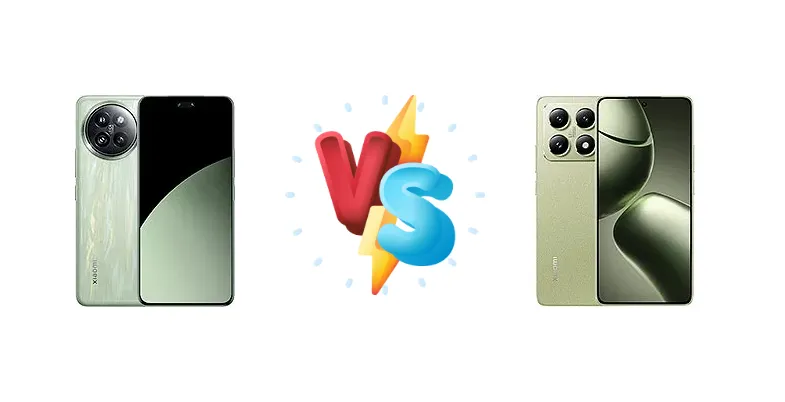
|
🏆 Quick Verdict
For the average user prioritizing responsiveness and demanding tasks, the Xiaomi 14 Civi is the better choice. Its Snapdragon 8s Gen 3 chipset delivers a slight edge in CPU performance, translating to smoother multitasking and gaming. While the 14T offers strong performance, the Civi’s processor provides a more future-proof experience.
| PHONES | ||
|---|---|---|
| Phone Names | Xiaomi 14 Civi | Xiaomi 14T |
| Network | ||
|---|---|---|
| 2G bands | GSM 850 / 900 / 1800 / 1900 | GSM 850 / 900 / 1800 / 1900 |
| 3G bands | HSDPA 800 / 850 / 900 / 1700(AWS) / 1900 / 2100 | HSDPA 800 / 850 / 900 / 1700(AWS) / 1900 / 2100 |
| 4G bands | 1, 3, 5, 8, 28, 40, 41 | 1, 2, 3, 4, 5, 7, 8, 12, 13, 17, 18, 19, 20, 26, 28, 32, 38, 40, 41, 42, 48, 66 |
| 5G bands | 1, 3, 5, 8, 28, 40, 41, 78 SA/NSA | 1, 2, 3, 5, 7, 8, 12, 20, 26, 28, 38, 40, 41, 48, 66, 77, 78 SA/NSA |
| Speed | HSPA, LTE, 5G | HSPA, LTE, 5G |
| Technology | GSM / HSPA / LTE / 5G | GSM / HSPA / LTE / 5G |
| Launch | ||
|---|---|---|
| Announced | 2024, June 12 | 2024, September 26 |
| Status | Available. Released 2024, June 20 | Available. Released 2024, September 26 |
| Body | ||
|---|---|---|
| Build | Glass front (Gorilla Glass Victus 2), glass back or silicone polymer back (eco leather), aluminum frame | Glass front (Gorilla Glass 5), plastic frame, glass back (Panda X) |
| Dimensions | 157.2 x 72.8 x 7.5 mm or 7.8 mm | 160.5 x 75.1 x 7.8 mm or 8.0 mm |
| SIM | Nano-SIM + Nano-SIM | · Nano-SIM + eSIM· eSIM + eSIM· Nano-SIM + Nano-SIM |
| Weight | 177.6 g or 179.3 g (6.28 oz) | 193 g or 195 g (6.81 oz) |
| Display | ||
|---|---|---|
| Protection | Corning Gorilla Glass Victus 2 | Corning Gorilla Glass 5 |
| Resolution | 1236 x 2750 pixels, 20:9 ratio (~460 ppi density) | 1220 x 2712 pixels, 20:9 ratio (~446 ppi density) |
| Size | 6.55 inches, 103.5 cm2 (~90.4% screen-to-body ratio) | 6.67 inches, 107.4 cm2 (~89.1% screen-to-body ratio) |
| Type | AMOLED, 68B colors, 120Hz, Dolby Vision, HDR10+, 3000 nits (peak) | AMOLED, 68B colors, 144Hz, 2880Hz PWM, Dolby Vision, HDR10+, 1600 nits (HBM), 4000 nits (peak) |
| Platform | ||
|---|---|---|
| CPU | Octa-core (1x3.0 GHz Cortex-X4 & 4x2.8 GHz Cortex-A720 & 3x2.0 GHz Cortex-A520) | Octa-core (1x3.35 GHz Cortex-A715 & 3x3.20 GHz Cortex-A715 & 4x2.20 GHz Cortex-A510) |
| Chipset | Qualcomm SM8635 Snapdragon 8s Gen 3 (4 nm) | Mediatek Dimensity 8300 Ultra (4 nm) |
| GPU | Adreno 735 | Mali G615-MC6 |
| OS | Android 14, HyperOS | Android 14, upgradable to Android 15, HyperOS 2 |
| Memory | ||
|---|---|---|
| Card slot | No | No |
| Internal | 256GB 8GB RAM, 512GB 12GB RAM | 256GB 12GB RAM, 512GB 12GB RAM, 512GB 16GB RAM, 1TB 12GB RAM |
| Main Camera | ||
|---|---|---|
| Features | Dual-LED flash, HDR, panorama, Leica lenses | Leica lens, Ultra HDR, LED flash, HDR, panorama |
| Triple | 50 MP, f/1.6, 25mm (wide), 1/1.55", 1.0µm, PDAF, OIS 50 MP, f/2.0, 50mm (telephoto), 0.64µm, PDAF, 2x optical zoom 12 MP, f/2.2, 15mm, 120˚ (ultrawide), 1.12µm | 50 MP, f/1.7, 23mm (wide), 1/1.56", 1.0µm, PDAF, OIS 50 MP, f/1.9, 50mm (telephoto), 1/2.76", 0.64µm, PDAF, 2x optical zoom 12 MP, f/2.2, 15mm (ultrawide), 1/3.06", 1.12µm |
| Video | 4K@24/30/60fps, 1080p@30/60/120/240/960fps, 720p@1920fps, gyro-EIS | 4K@24/30/60fps, 1080p@30/60/120/240/960fps, gyro-EIS, 10-bit Rec. 2020, HDR10+ |
| Selfie camera | ||
|---|---|---|
| Dual | 32 MP, f/2.0, 26mm (wide), 1/2.8", 0.8µm, AF 32 MP, f/2.4, 100˚ (ultrawide), 1/2.8", 0.8µm | - |
| Features | HDR | HDR |
| Single | - | 32 MP, f/2.0, 25mm (wide), 1/3.44", 0.64µm |
| Video | 4K@30fps, 1080p@30/60fps; gyro-EIS | 4K@30fps, 1080p@30/60fps, HDR10+ |
| Sound | ||
|---|---|---|
| 35mm jack | No | No |
| Loudspeaker | Yes, with stereo speakers | Yes, with stereo speakers |
| Comms | ||
|---|---|---|
| Bluetooth | 5.4, A2DP, LE | 5.4, A2DP, LE, LHDC |
| Infrared port | Yes | Yes |
| NFC | Yes | Yes (market/region dependent) |
| Positioning | GPS, GLONASS, GALILEO, BDS, NavIC | GPS (L1+L5), BDS (B1I+B1C+B2a), GALILEO (E1+E5a), NavIC (L5), GLONASS |
| Radio | No | No |
| USB | USB Type-C 2.0, OTG | USB Type-C 2.0, OTG |
| WLAN | Wi-Fi 802.11 a/b/g/n/ac/6, dual-band, Wi-Fi Direct | Wi-Fi 802.11 a/b/g/n/ac/6e, dual-band, Wi-Fi Direct |
| Features | ||
|---|---|---|
| Sensors | Fingerprint (under display, optical), accelerometer, gyro, proximity, compass | Fingerprint (under display, optical), accelerometer, gyro, proximity, compass |
| Battery | ||
|---|---|---|
| Charging | 67W wired, PD3.0, 100% in 40 minutes | 67W wired, PD3.0, 100% in 45 min |
| Type | Li-Po 4700 mAh | Li-Po 5000 mAh |
| Misc | ||
|---|---|---|
| Colors | Cruise Blue, Matcha Green, Shadow Black | Titan Gray, Titan Blue, Titan Black, Lemon Green |
| Models | 24053PY09I | 2406APNFAG |
| Price | ₹ 26,249 | € 337.12 / $ 469.99 / £ 373.06 |
| SAR | 0.93 W/kg (head) 0.81 W/kg (body) | - |
| SAR EU | - | 0.98 W/kg (head) 0.99 W/kg (body) |
Xiaomi 14 Civi
- Faster CPU performance with Snapdragon 8s Gen 3
- Brighter display for better outdoor visibility
- Slightly faster charging speed
- Potentially higher thermal throttling under sustained load
- May be slightly more expensive
Xiaomi 14T
- Efficient Dimensity 8300 Ultra chipset
- Potentially better sustained performance due to thermal efficiency
- Competitive price point
- Slightly less powerful CPU compared to the Civi
- Dimmer display
Display Comparison
Both the Xiaomi 14 Civi and 14T feature 4nm chipsets, but their displays differ noticeably. The Civi boasts a peak brightness of 1441 nits, significantly exceeding the 14T’s 1355 nits. This translates to better visibility in direct sunlight. While both likely utilize AMOLED panels, the Civi’s higher peak brightness provides a more vibrant and readable experience. Details regarding refresh rates and panel technology (LTPO) are missing, but assuming standard 120Hz panels, the brightness difference is the key differentiator.
Camera Comparison
Without detailed camera specifications, a direct comparison is limited. However, the chipset’s ISP (Image Signal Processor) plays a significant role. Qualcomm’s Snapdragon ISPs are generally known for their strong image processing capabilities, particularly in low-light conditions. The Dimensity 8300 Ultra’s ISP is also capable, but may lean towards a different image profile. The absence of information regarding sensor sizes and OIS (Optical Image Stabilization) makes a definitive judgment impossible. We can assume both phones will offer a versatile camera system, but the Civi’s ISP may provide a slight edge in image quality.
Performance
The core of the difference lies in the chipsets. The Xiaomi 14 Civi’s Snapdragon 8s Gen 3 (4nm) features a 1x3.0 GHz Cortex-X4 prime core, paired with 4x2.8 GHz Cortex-A720 cores and 3x2.0 GHz Cortex-A520 cores. This configuration prioritizes peak performance. Conversely, the Xiaomi 14T utilizes the Mediatek Dimensity 8300 Ultra (4nm) with a 1x3.35 GHz Cortex-A715 core, 3x3.20 GHz Cortex-A715 cores, and 4x2.20 GHz Cortex-A510 cores. While the Dimensity 8300 Ultra has a higher clocked prime core, the Snapdragon’s Cortex-X4 architecture generally offers superior single-core performance. This difference will be most noticeable in tasks that aren’t heavily multi-threaded. Both phones likely feature LPDDR5x RAM, but specific speeds are unknown. Thermal management will be crucial; the Snapdragon 8s Gen 3, while powerful, can run hotter than the Dimensity 8300 Ultra.
Battery Life
Both the Xiaomi 14 Civi and 14T deliver comparable battery life, with active use scores of 11:36h and 11:32h respectively. This suggests similar real-world endurance despite potential differences in battery capacity (not specified). Both support 67W wired charging with PD3.0, but the Civi charges slightly faster, reaching 100% in 40 minutes compared to the 14T’s 45 minutes. This 5-minute difference, while minor, favors the Civi for users who prioritize quick top-ups.
Buying Guide
Buy the Xiaomi 14 Civi if you need a phone that excels in demanding applications, enjoys consistently fast performance, and benefits from a slightly brighter display. Buy the Xiaomi 14T if you prioritize a balanced experience with a focus on efficiency, potentially longer sustained performance under load, and are comfortable with a slightly less powerful processor.