
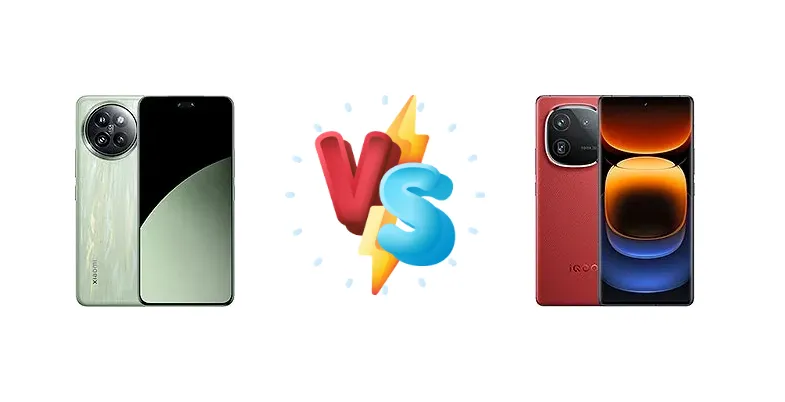
Xiaomi 14 Civi vs. vivo iQOO 12 Pro: A Deep Dive into Flagship Performance and Value
| Phones Images | |||||
|---|---|---|---|---|---|
|
🏆 Quick Verdict
For the average user prioritizing all-day battery life and a vibrant display, the Xiaomi 14 Civi is the stronger choice. However, the vivo iQOO 12 Pro’s Snapdragon 8 Gen 3 and 120W charging make it the clear winner for gamers and power users who demand uncompromising performance.
| PHONES | ||
|---|---|---|
| Phone Names | Xiaomi 14 Civi | vivo iQOO 12 Pro |
| Network | ||
|---|---|---|
| 2G bands | GSM 850 / 900 / 1800 / 1900 | GSM 850 / 900 / 1800 / 1900 |
| 3G bands | HSDPA 800 / 850 / 900 / 1700(AWS) / 1900 / 2100 | HSDPA 800 / 850 / 900 / 1700(AWS) / 1900 / 2100 |
| 4G bands | 1, 3, 5, 8, 28, 40, 41 | 1, 2, 3, 4, 5, 7, 8, 12, 17, 18, 19, 20, 25, 26, 28, 34, 38, 39, 40, 41, 42, 66 |
| 5G bands | 1, 3, 5, 8, 28, 40, 41, 78 SA/NSA | 1, 2, 3, 5, 7, 8, 12, 20, 25, 26, 28, 66, 38, 40, 41, 77, 78 SA/NSA |
| Speed | HSPA, LTE, 5G | HSPA, LTE, 5G |
| Technology | GSM / HSPA / LTE / 5G | GSM / CDMA / HSPA / CDMA2000 / LTE / 5G |
| Launch | ||
|---|---|---|
| Announced | 2024, June 12 | 2023, November 07 |
| Status | Available. Released 2024, June 20 | Available. Released 2023, November 14 |
| Body | ||
|---|---|---|
| Build | Glass front (Gorilla Glass Victus 2), glass back or silicone polymer back (eco leather), aluminum frame | - |
| Dimensions | 157.2 x 72.8 x 7.5 mm or 7.8 mm | 164.6 x 75.4 x 8.6 mm or 8.8 mm |
| SIM | Nano-SIM + Nano-SIM | Nano-SIM + Nano-SIM |
| Weight | 177.6 g or 179.3 g (6.28 oz) | 205 g or 210 g (7.23 oz) |
| Display | ||
|---|---|---|
| Protection | Corning Gorilla Glass Victus 2 | - |
| Resolution | 1236 x 2750 pixels, 20:9 ratio (~460 ppi density) | 1440 x 3200 pixels, 20:9 ratio (~518 ppi density) |
| Size | 6.55 inches, 103.5 cm2 (~90.4% screen-to-body ratio) | 6.78 inches, 111.0 cm2 (~89.4% screen-to-body ratio) |
| Type | AMOLED, 68B colors, 120Hz, Dolby Vision, HDR10+, 3000 nits (peak) | LTPO AMOLED, 1B colors, 144Hz, HDR10+, 1600 nits (HBM), 3000 nits (peak) |
| Platform | ||
|---|---|---|
| CPU | Octa-core (1x3.0 GHz Cortex-X4 & 4x2.8 GHz Cortex-A720 & 3x2.0 GHz Cortex-A520) | Octa-core (1x3.3 GHz Cortex-X4 & 3x3.2 GHz Cortex-A720 & 2x3.0 GHz Cortex-A720 & 2x2.3 GHz Cortex-A520) |
| Chipset | Qualcomm SM8635 Snapdragon 8s Gen 3 (4 nm) | Qualcomm SM8650-AB Snapdragon 8 Gen 3 (4 nm) |
| GPU | Adreno 735 | Adreno 750 |
| OS | Android 14, HyperOS | Android 14, up to 2 major Android upgrades, Funtouch 14 (International), OriginOS 4 (China) |
| Memory | ||
|---|---|---|
| Card slot | No | No |
| Internal | 256GB 8GB RAM, 512GB 12GB RAM | 256GB 16GB RAM, 512GB 16GB RAM, 1TB 16GB RAM |
| Main Camera | ||
|---|---|---|
| Features | Dual-LED flash, HDR, panorama, Leica lenses | Color spectrum sensor, Dual-LED flash, HDR, panorama |
| Triple | 50 MP, f/1.6, 25mm (wide), 1/1.55", 1.0µm, PDAF, OIS 50 MP, f/2.0, 50mm (telephoto), 0.64µm, PDAF, 2x optical zoom 12 MP, f/2.2, 15mm, 120˚ (ultrawide), 1.12µm | 50 MP, f/1.7, 23mm (wide), 1/1.3", 1.2µm, ulti-directional PDAF, OIS 64 MP, f/2.6, 70mm (periscope telephoto), 1/2.0", PDAF, OIS, 3x optical zoom 50 MP, f/2.0, 15mm, 119˚ (ultrawide), AF |
| Video | 4K@24/30/60fps, 1080p@30/60/120/240/960fps, 720p@1920fps, gyro-EIS | 8K@30fps, 4K@24/30/60fps, 1080p@30/60/120/240fps, gyro-EIS |
| Selfie camera | ||
|---|---|---|
| Dual | 32 MP, f/2.0, 26mm (wide), 1/2.8", 0.8µm, AF 32 MP, f/2.4, 100˚ (ultrawide), 1/2.8", 0.8µm | - |
| Features | HDR | HDR |
| Single | - | 16 MP, f/2.5, (wide) |
| Video | 4K@30fps, 1080p@30/60fps; gyro-EIS | 1080p@30fps, gyro-EIS |
| Sound | ||
|---|---|---|
| 35mm jack | No | No |
| Loudspeaker | Yes, with stereo speakers | Yes, with stereo speakers |
| Comms | ||
|---|---|---|
| Bluetooth | 5.4, A2DP, LE | 5.4, A2DP, LE, aptX HD, aptX Adaptive, aptX Lossless |
| Infrared port | Yes | Yes |
| NFC | Yes | Yes |
| Positioning | GPS, GLONASS, GALILEO, BDS, NavIC | GPS (L1+L5), GLONASS (G1), BDS (B1I+B1c+B2a), GALILEO (E1+E5a), QZSS (L1+L5) |
| Radio | No | No |
| USB | USB Type-C 2.0, OTG | USB Type-C 2.0, OTG |
| WLAN | Wi-Fi 802.11 a/b/g/n/ac/6, dual-band, Wi-Fi Direct | Wi-Fi 802.11 a/b/g/n/ac/6/7, tri-band, Wi-Fi Direct |
| Features | ||
|---|---|---|
| Sensors | Fingerprint (under display, optical), accelerometer, gyro, proximity, compass | Fingerprint (under display, ultrasonic), accelerometer, gyro, proximity, compass |
| Battery | ||
|---|---|---|
| Charging | 67W wired, PD3.0, 100% in 40 minutes | 120W wired 50W wireless 10W reverse wireless |
| Type | Li-Po 4700 mAh | 5100 mAh |
| Misc | ||
|---|---|---|
| Colors | Cruise Blue, Matcha Green, Shadow Black | Black, Red, White (BMW M branding) |
| Models | 24053PY09I | V2329A |
| Price | ₹ 26,249 | About 650 EUR |
| SAR | 0.93 W/kg (head) 0.81 W/kg (body) | - |
Xiaomi 14 Civi
- Excellent battery life (11:36h active use)
- Bright and vibrant display (1441 nits)
- Balanced flagship experience
- Less powerful chipset than the iQOO 12 Pro
- Slower charging speeds
vivo iQOO 12 Pro
- Top-tier Snapdragon 8 Gen 3 performance
- Blazing-fast 120W wired charging
- Wireless and reverse wireless charging
- Likely shorter battery life due to power-hungry chipset
- May run hotter under sustained load
Display Comparison
The Xiaomi 14 Civi boasts a peak brightness of 1441 nits, ensuring excellent visibility even in direct sunlight. While the iQOO 12 Pro’s display specifications aren’t provided, iQOO phones typically prioritize high refresh rates and color accuracy. The Civi’s brightness advantage is significant, and its panel likely offers a more comfortable viewing experience outdoors. Without knowing the iQOO 12 Pro’s panel technology (LTPO or not), it’s difficult to assess its power efficiency compared to the Civi.
Camera Comparison
Without detailed camera specifications for either device, a direct comparison is challenging. However, the iQOO series often focuses on delivering versatile camera systems with strong low-light performance. The Xiaomi 14 Civi, positioned as a more lifestyle-oriented device, likely prioritizes accurate color reproduction and pleasing portrait modes. The absence of information regarding sensor sizes and OIS capabilities makes it difficult to determine which phone offers superior image quality.
Performance
The iQOO 12 Pro’s Snapdragon 8 Gen 3 (4nm) represents a substantial leap in performance over the Xiaomi 14 Civi’s Snapdragon 8s Gen 3 (4nm). The Gen 3 features a faster Cortex-X4 prime core (3.3 GHz vs 3.0 GHz) and more powerful Adreno GPU, translating to significantly faster app loading times, smoother multitasking, and higher frame rates in graphically intensive games. The iQOO 12 Pro’s CPU configuration (1x3.3 GHz, 3x3.2 GHz, 2x3.0 GHz, 2x2.3 GHz) also offers a higher sustained clock speed compared to the Civi’s (1x3.0 GHz, 4x2.8 GHz, 3x2.0 GHz).
Battery Life
The Xiaomi 14 Civi achieves an impressive 11:36h of active use, demonstrating excellent battery optimization. The iQOO 12 Pro, while likely having a larger battery capacity (typical for iQOO), will likely consume more power due to its more powerful chipset. However, the iQOO 12 Pro compensates with significantly faster charging: 120W wired, 50W wireless, and 10W reverse wireless, allowing it to reach 100% charge in a fraction of the time compared to the Civi’s 67W wired charging (40 minutes to 100%).
Buying Guide
Buy the Xiaomi 14 Civi if you need a phone that comfortably lasts a full day with active use, offers a bright and color-accurate display for media consumption, and provides a well-rounded flagship experience without breaking the bank. Buy the vivo iQOO 12 Pro if you prioritize raw processing power for demanding games and applications, require the fastest possible charging speeds, and are willing to trade some battery longevity for peak performance.