
Xiaomi 14 Civi vs. Samsung Galaxy S24 FE: Which Mid-Range Flagship Reigns Supreme?
| Phones Images | |||||
|---|---|---|---|---|---|
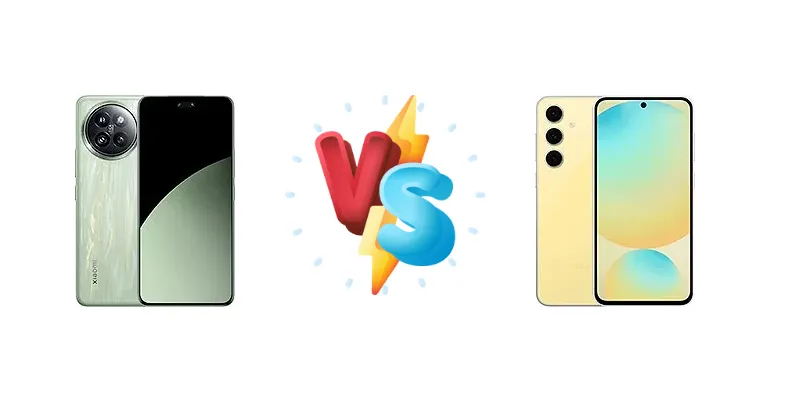
|
🏆 Quick Verdict
For the average user prioritizing longevity and consistent performance, the Samsung Galaxy S24 FE is the better choice. Its significantly longer battery endurance (42 hours vs 11:36h) and 2000 charge cycles outweigh the Xiaomi 14 Civi’s slightly brighter display and faster charging.
| PHONES | ||
|---|---|---|
| Phone Names | Xiaomi 14 Civi | Samsung Galaxy S24 FE |
| Network | ||
|---|---|---|
| 2G bands | GSM 850 / 900 / 1800 / 1900 | GSM 850 / 900 / 1800 / 1900 |
| 3G bands | HSDPA 800 / 850 / 900 / 1700(AWS) / 1900 / 2100 | HSDPA 850 / 900 / 1700(AWS) / 1900 / 2100 |
| 4G bands | 1, 3, 5, 8, 28, 40, 41 | 1, 2, 3, 4, 5, 7, 8, 12, 17, 18, 19, 20, 25, 26, 28, 32, 38, 40, 41, 66 - International |
| 5G bands | 1, 3, 5, 8, 28, 40, 41, 78 SA/NSA | 1, 2, 3, 5, 7, 8, 12, 20, 25, 26, 28, 38, 40, 41, 66, 75, 77, 78 SA/NSA/Sub6 - International |
| Speed | HSPA, LTE, 5G | HSPA, LTE, 5G |
| Technology | GSM / HSPA / LTE / 5G | GSM / HSPA / LTE / 5G |
| Launch | ||
|---|---|---|
| Announced | 2024, June 12 | 2024, September 26 |
| Status | Available. Released 2024, June 20 | Available. Released 2024, October 03 |
| Body | ||
|---|---|---|
| Build | Glass front (Gorilla Glass Victus 2), glass back or silicone polymer back (eco leather), aluminum frame | Glass front (Gorilla Glass Victus+), glass back (Gorilla Glass Victus+), aluminum frame |
| Dimensions | 157.2 x 72.8 x 7.5 mm or 7.8 mm | 162 x 77.3 x 8 mm (6.38 x 3.04 x 0.31 in) |
| SIM | Nano-SIM + Nano-SIM | · Nano-SIM· Nano-SIM + Nano-SIM· Nano-SIM + eSIM· eSIM + eSIM |
| Weight | 177.6 g or 179.3 g (6.28 oz) | 213 g (7.51 oz) |
| Display | ||
|---|---|---|
| Protection | Corning Gorilla Glass Victus 2 | Corning Gorilla Glass Victus+, Mohs level 5 |
| Resolution | 1236 x 2750 pixels, 20:9 ratio (~460 ppi density) | 1080 x 2340 pixels, 19.5:9 ratio (~385 ppi density) |
| Size | 6.55 inches, 103.5 cm2 (~90.4% screen-to-body ratio) | 6.7 inches, 110.2 cm2 (~88.0% screen-to-body ratio) |
| Type | AMOLED, 68B colors, 120Hz, Dolby Vision, HDR10+, 3000 nits (peak) | Dynamic AMOLED 2X, 120Hz, HDR10+, 1900 nits (peak) |
| Platform | ||
|---|---|---|
| CPU | Octa-core (1x3.0 GHz Cortex-X4 & 4x2.8 GHz Cortex-A720 & 3x2.0 GHz Cortex-A520) | 10-core (1x3.1 GHz + 2x2.9 GHz + 3x2.6 GHz + 4x1.95 GHz) |
| Chipset | Qualcomm SM8635 Snapdragon 8s Gen 3 (4 nm) | Exynos 2400e (4 nm) |
| GPU | Adreno 735 | Xclipse 940 |
| OS | Android 14, HyperOS | Android 14, up to 7 major Android upgrades, One UI 8.0 |
| Memory | ||
|---|---|---|
| Card slot | No | No |
| Internal | 256GB 8GB RAM, 512GB 12GB RAM | 128GB 8GB RAM, 256GB 8GB RAM, 512GB 8GB RAM |
| Main Camera | ||
|---|---|---|
| Features | Dual-LED flash, HDR, panorama, Leica lenses | LED flash, HDR, panorama |
| Triple | 50 MP, f/1.6, 25mm (wide), 1/1.55", 1.0µm, PDAF, OIS 50 MP, f/2.0, 50mm (telephoto), 0.64µm, PDAF, 2x optical zoom 12 MP, f/2.2, 15mm, 120˚ (ultrawide), 1.12µm | 50 MP, f/1.8, 24mm (wide), 1/1.57", 1.0µm, dual pixel PDAF, OIS 8 MP, f/2.4, 75mm (telephoto), 1/4.4", 1.0µm, PDAF, OIS, 3x optical zoom 12 MP, f/2.2, 13mm, 123˚ (ultrawide), 1/3.0", 1.12µm |
| Video | 4K@24/30/60fps, 1080p@30/60/120/240/960fps, 720p@1920fps, gyro-EIS | 8K@30fps, 4K@30/60/120fps, 1080p@30/60/120/240fps |
| Selfie camera | ||
|---|---|---|
| Dual | 32 MP, f/2.0, 26mm (wide), 1/2.8", 0.8µm, AF 32 MP, f/2.4, 100˚ (ultrawide), 1/2.8", 0.8µm | - |
| Features | HDR | - |
| Single | - | 10 MP, f/2.4, 26mm (wide), 1/3.0", 1.22µm |
| Video | 4K@30fps, 1080p@30/60fps; gyro-EIS | 4K@30/60fps, 1080p@30/60fps; gyro-EIS |
| Sound | ||
|---|---|---|
| 35mm jack | No | No |
| Loudspeaker | Yes, with stereo speakers | Yes, with stereo speakers |
| Comms | ||
|---|---|---|
| Bluetooth | 5.4, A2DP, LE | 5.3, A2DP, LE |
| Infrared port | Yes | - |
| NFC | Yes | Yes |
| Positioning | GPS, GLONASS, GALILEO, BDS, NavIC | GPS, GLONASS, GALILEO, BDS |
| Radio | No | Unspecified |
| USB | USB Type-C 2.0, OTG | USB Type-C 3.2, OTG |
| WLAN | Wi-Fi 802.11 a/b/g/n/ac/6, dual-band, Wi-Fi Direct | Wi-Fi 802.11 a/b/g/n/ac/6e, dual-band or tri-band (market/region dependent), Wi-Fi Direct |
| Features | ||
|---|---|---|
| Sensors | Fingerprint (under display, optical), accelerometer, gyro, proximity, compass | Fingerprint (under display, optical), accelerometer, gyro, compass |
| Battery | ||
|---|---|---|
| Charging | 67W wired, PD3.0, 100% in 40 minutes | 25W wired, PD, QC2, 50% in 30 min 15W wireless Reverse wireless |
| Type | Li-Po 4700 mAh | 4700 mAh |
| Misc | ||
|---|---|---|
| Colors | Cruise Blue, Matcha Green, Shadow Black | Blue, Graphite, Gray, Mint, Yellow |
| Models | 24053PY09I | SM-S721B, SM-S721B/DS, SM-S721U1, SM-S721U, SM-S721W, SM-S7210, SM-S721N |
| Price | ₹ 26,249 | $ 249.74 / C$ 498.99 / £ 335.00 / € 387.00 / ₹ 34,180 |
| SAR | 0.93 W/kg (head) 0.81 W/kg (body) | 0.94 W/kg (head) 0.71 W/kg (body) |
| SAR EU | - | 0.86 W/kg (head) 1.29 W/kg (body) |
| EU LABEL | ||
|---|---|---|
| Battery | - | 42:00h endurance, 2000 cycles |
| Energy | - | Class B |
| Free fall | - | Class A (270 falls) |
| Repairability | - | Class C |
Xiaomi 14 Civi
- Faster 67W wired charging
- Slightly brighter display (1441 nits)
- Potentially better thermal management with Snapdragon 8s Gen 3
- Significantly shorter battery life (11:36h)
- No information on battery cycle life
- Limited wireless charging options
Samsung Galaxy S24 FE
- Exceptional battery life (42h endurance)
- 2000 charge cycle battery longevity
- Wireless and reverse wireless charging
- Slower 25W wired charging
- Slightly dimmer display (1372 nits)
- Potential for Exynos throttling under sustained load
Display Comparison
Both devices feature 4nm chipsets, but their displays differ noticeably. The Xiaomi 14 Civi boasts a peak brightness of 1441 nits, exceeding the Samsung Galaxy S24 FE’s 1372 nits. This translates to better visibility in direct sunlight. However, Samsung’s display technology is known for its color accuracy, and while not quantified here, it’s likely to offer a more calibrated experience. Neither specification details refresh rate or panel type (OLED/AMOLED), but both are expected to be high-quality panels given their price points. The slight brightness advantage of the Civi is likely more noticeable in specific scenarios than a fundamental difference in panel quality.
Camera Comparison
Without detailed camera specifications, a direct comparison is limited. However, the market positioning suggests both phones will offer capable camera systems. The absence of sensor size or aperture information necessitates relying on brand reputation. Samsung generally excels in image processing, producing vibrant and shareable photos. Xiaomi has been improving its camera capabilities, but often leans towards a more natural color profile. The lack of information on Optical Image Stabilization (OIS) is a significant omission; OIS is crucial for low-light photography and video stabilization. The presence of a 2MP macro camera on either device is likely a marketing gimmick and shouldn’t heavily influence purchasing decisions.
Performance
The core of the performance difference lies in the chipsets. The Xiaomi 14 Civi utilizes the Qualcomm SM8635 Snapdragon 8s Gen 3, an octa-core processor with a prime Cortex-X4 core clocked at 3.0 GHz. The Samsung Galaxy S24 FE, conversely, employs the Exynos 2400e, a 10-core processor with a peak clock speed of 3.1 GHz. While the Exynos has more cores, the Snapdragon’s architecture, particularly the X4 prime core, is generally more efficient. The Snapdragon 8s Gen 3’s 4nm process node should also contribute to better thermal management, potentially reducing throttling during sustained workloads. The S24 FE’s 10-core configuration may offer benefits in multi-threaded tasks, but the real-world impact will depend on software optimization.
Battery Life
Battery life is where the Samsung Galaxy S24 FE truly shines. Its endurance rating of 42 hours is significantly higher than the Xiaomi 14 Civi’s 11:36h. While the Civi charges faster at 67W (100% in 40 minutes) compared to the S24 FE’s 25W (50% in 30 minutes), the S24 FE’s superior capacity and efficiency outweigh this advantage. Furthermore, the S24 FE boasts a claimed 2000 charge cycles, indicating exceptional long-term battery health, a feature absent in the Civi’s specifications. The S24 FE also supports 15W wireless charging and reverse wireless charging, adding to its versatility.
Buying Guide
Buy the Xiaomi 14 Civi if you prioritize a brighter display for outdoor visibility and need the fastest possible wired charging. It’s ideal for users who frequently consume media on the go and don’t mind topping up their phone more often. Buy the Samsung Galaxy S24 FE if you value exceptional battery life, long-term battery health, and a more established software ecosystem. This phone suits users who need a reliable device that can easily last a full day, even with heavy usage.