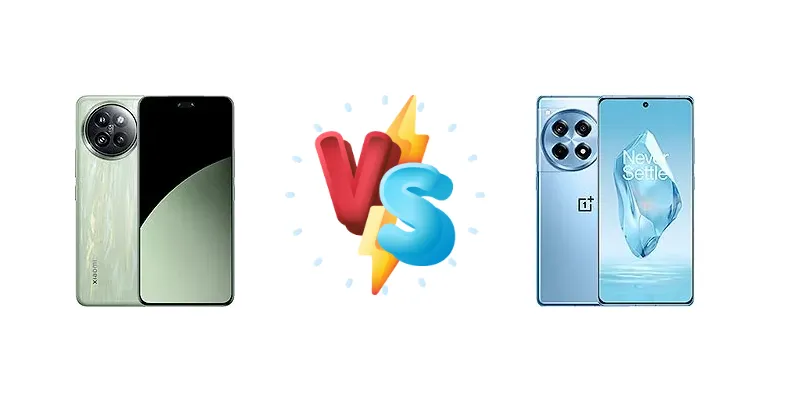
The Xiaomi 14 Civi and OnePlus 12R represent compelling options in the increasingly competitive mid-to-high range smartphone market. The Civi, powered by the newer Snapdragon 8s Gen 3, aims to deliver flagship-level performance in a sleek package. Meanwhile, the 12R leverages the proven Snapdragon 8 Gen 2, prioritizing sustained performance and battery endurance. This comparison dissects their key differences to determine which device best suits your needs.
🏆 Quick Verdict
For the average user prioritizing all-day battery life and consistent performance, the OnePlus 12R emerges as the stronger choice. Its significantly longer active use battery score (14:32h vs 11:36h) and faster 100W charging outweigh the Xiaomi 14 Civi’s brighter display for most users.
| Network |
|---|
| 2G bands | GSM 850 / 900 / 1800 / 1900 | GSM 850 / 900 / 1800 / 1900 |
| 3G bands | HSDPA 800 / 850 / 900 / 1700(AWS) / 1900 / 2100 | HSDPA 850 / 900 / 1700(AWS) / 1900 / 2100 |
| 4G bands | 1, 3, 5, 8, 28, 40, 41 | 1, 2, 3, 4, 5, 7, 8, 12, 17, 18, 19, 20, 26, 28, 32, 38, 39, 40, 41, 66 |
| 5G bands | 1, 3, 5, 8, 28, 40, 41, 78 SA/NSA | 1, 2, 3, 5, 7, 8, 12, 20, 28, 38, 40, 41, 66, 77, 78 SA/NSA |
| Speed | HSPA, LTE, 5G | HSPA, LTE, 5G |
| Technology | GSM / HSPA / LTE / 5G | GSM / CDMA / HSPA / LTE / 5G |
| Launch |
|---|
| Announced | 2024, June 12 | 2024, January 23 |
| Status | Available. Released 2024, June 20 | Available. Released 2024, February 06 |
| Body |
|---|
| Build | Glass front (Gorilla Glass Victus 2), glass back or silicone polymer back (eco leather), aluminum frame | Glass front (Gorilla Glass Victus 2), aluminum frame, glass back |
| Dimensions | 157.2 x 72.8 x 7.5 mm or 7.8 mm | 163.3 x 75.3 x 8.8 mm (6.43 x 2.96 x 0.35 in) |
| SIM | Nano-SIM + Nano-SIM | · Nano-SIM + Nano-SIM + eSIM (max 2 at a time)· Nano-SIM + Nano-SIM |
| Weight | 177.6 g or 179.3 g (6.28 oz) | 207 g (7.30 oz) |
| Display |
|---|
| Protection | Corning Gorilla Glass Victus 2 | Corning Gorilla Glass Victus 2 |
| Resolution | 1236 x 2750 pixels, 20:9 ratio (~460 ppi density) | 1264 x 2780 pixels (~450 ppi density) |
| Size | 6.55 inches, 103.5 cm2 (~90.4% screen-to-body ratio) | 6.78 inches, 111.7 cm2 (~90.9% screen-to-body ratio) |
| Type | AMOLED, 68B colors, 120Hz, Dolby Vision, HDR10+, 3000 nits (peak) | LTPO4 AMOLED, 1B colors, 120Hz, HDR10+, Dolby Vision, 1600 nits (HBM), 4500 nits (peak) |
| Platform |
|---|
| CPU | Octa-core (1x3.0 GHz Cortex-X4 & 4x2.8 GHz Cortex-A720 & 3x2.0 GHz Cortex-A520) | Octa-core (1x3.2 GHz Cortex-X3 & 2x2.8 GHz Cortex-A715 & 2x2.8 GHz Cortex-A710 & 3x2.0 GHz Cortex-A510) |
| Chipset | Qualcomm SM8635 Snapdragon 8s Gen 3 (4 nm) | Qualcomm SM8550-AB Snapdragon 8 Gen 2 (4 nm) |
| GPU | Adreno 735 | Adreno 740 |
| OS | Android 14, HyperOS | Android 14, up to 3 major Android upgrades, OxygenOS 15 |
| Memory |
|---|
| Card slot | No | No |
| Internal | 256GB 8GB RAM, 512GB 12GB RAM | 128GB 8GB RAM, 256GB 8GB RAM, 256GB 12GB RAM, 256GB 16GB RAM |
| Main Camera |
|---|
| Features | Dual-LED flash, HDR, panorama, Leica lenses | Laser AF, color spectrum sensor, LED flash, HDR, panorama |
| Triple | 50 MP, f/1.6, 25mm (wide), 1/1.55", 1.0µm, PDAF, OIS
50 MP, f/2.0, 50mm (telephoto), 0.64µm, PDAF, 2x optical zoom
12 MP, f/2.2, 15mm, 120˚ (ultrawide), 1.12µm | 50 MP, f/1.8, 24mm (wide), 1/1.56", 1.0µm, multi-directional PDAF, OIS
8 MP, f/2.2, 16mm, 112˚ (ultrawide), 1/4.0", 1.12µm
2 MP (macro) |
| Video | 4K@24/30/60fps, 1080p@30/60/120/240/960fps, 720p@1920fps, gyro-EIS | 4K@30/60fps, 1080p@30/60/120/240fps, gyro-EIS, OIS |
| Selfie camera |
|---|
| Dual | 32 MP, f/2.0, 26mm (wide), 1/2.8", 0.8µm, AF
32 MP, f/2.4, 100˚ (ultrawide), 1/2.8", 0.8µm | - |
| Features | HDR | HDR, panorama |
| Single | - | 16 MP, f/2.4, 26mm (wide), 1/3", 1.0µm |
| Video | 4K@30fps, 1080p@30/60fps; gyro-EIS | 1080p@30fps, gyro-EIS |
| Sound |
|---|
| 35mm jack | No | No |
| Loudspeaker | Yes, with stereo speakers | Yes, with stereo speakers |
| Comms |
|---|
| Bluetooth | 5.4, A2DP, LE | 5.3, A2DP, LE, aptX HD |
| Infrared port | Yes | Yes |
| NFC | Yes | Yes |
| Positioning | GPS, GLONASS, GALILEO, BDS, NavIC | GPS, GALILEO, GLONASS, BDS, QZSS |
| Radio | No | No |
| USB | USB Type-C 2.0, OTG | USB Type-C 2.0 |
| WLAN | Wi-Fi 802.11 a/b/g/n/ac/6, dual-band, Wi-Fi Direct | Wi-Fi 802.11 a/b/g/n/ac/6/7, dual-band |
| Features |
|---|
| Sensors | Fingerprint (under display, optical), accelerometer, gyro, proximity, compass | Fingerprint (under display, optical), accelerometer, gyro, proximity, compass |
| Battery |
|---|
| Charging | 67W wired, PD3.0, 100% in 40 minutes | 100W wired, 100% in 26 min |
| Type | Li-Po 4700 mAh | Li-Ion 5500 mAh |
| Misc |
|---|
| Colors | Cruise Blue, Matcha Green, Shadow Black | Iron Gray, Cool Blue, Electric Violet, Sunset Dune |
| Models | 24053PY09I | CPH2609, CPH2585, CPH2611 |
| Price | ₹ 26,249 | € 410.84 / $ 399.95 / £ 649.00 |
| SAR | 0.93 W/kg (head) 0.81 W/kg (body) | 1.19 W/kg (head) 0.82 W/kg (body) |
Xiaomi 14 Civi
- Brighter display for outdoor visibility
- Sleek and modern design (assumed)
- Newer Snapdragon 8s Gen 3 chipset
- Shorter battery life
- Slower charging speed
- Potentially more thermal throttling under sustained load
OnePlus 12R
- Longer battery life
- Faster 100W charging
- Proven Snapdragon 8 Gen 2 performance
- Less bright display
- Potentially larger footprint (assumed)
- Older chipset architecture
Display Comparison
The Xiaomi 14 Civi boasts a brighter display, reaching a measured peak brightness of 1441 nits, compared to the OnePlus 12R’s 1181 nits. This difference is immediately noticeable in direct sunlight, making the Civi more readable outdoors. However, both displays utilize a 4nm chipset, which doesn't directly impact display quality. The Civi’s higher brightness comes at the cost of battery life, as maintaining that level of luminance requires more power. While both likely employ AMOLED panels, the Civi’s brightness advantage makes it superior for HDR content viewing.
Camera Comparison
Without detailed camera specs, a direct comparison is limited. However, the chipset’s ISP (Image Signal Processor) plays a crucial role. The Snapdragon 8 Gen 2 in the OnePlus 12R is known for its excellent image processing capabilities, delivering vibrant and detailed photos. The 8s Gen 3 in the Civi is also capable, but the Gen 2 has a proven track record. The absence of information regarding sensor size and OIS makes it difficult to assess the low-light performance of either device. We can assume both phones will offer a competent camera experience, but the 12R likely has a slight edge due to the more established ISP.
Performance
The OnePlus 12R’s Snapdragon 8 Gen 2 (SM8550-AB) features a Cortex-X3 prime core clocked at 3.2 GHz, while the Xiaomi 14 Civi utilizes the Snapdragon 8s Gen 3 (SM8635) with a Cortex-X4 clocked at 3.0 GHz. Despite the newer architecture of the X4 core in the Civi, the Gen 2’s higher clock speed and more mature optimization provide a performance edge in sustained workloads. The 12R’s CPU configuration (1x3.2GHz, 2x2.8GHz, 2x2.8GHz, 3x2.0GHz) is geared towards maintaining peak performance for longer durations, while the Civi’s (1x3.0GHz, 4x2.8GHz, 3x2.0GHz) prioritizes efficiency. Both phones utilize 4nm fabrication, but the Gen 2’s larger cache and refined architecture contribute to its superior thermal management.
Battery Life
The OnePlus 12R’s active use battery score of 14:32h significantly surpasses the Xiaomi 14 Civi’s 11:36h. This difference is substantial and translates to a noticeable advantage in real-world usage. While the Civi’s 67W charging is respectable, the 12R’s 100W charging is considerably faster, achieving a full charge in just 26 minutes compared to the Civi’s 40 minutes. The 12R’s combination of larger battery capacity (implied by the longer runtime) and faster charging makes it the clear winner in this category.
Buying Guide
Buy the Xiaomi 14 Civi if you prioritize a vibrant, exceptionally bright display for media consumption and are willing to trade some battery life for it. It’s ideal for users who frequently watch videos or use their phone outdoors. Buy the OnePlus 12R if you value long-lasting battery life, faster charging speeds, and sustained gaming performance. This phone is perfect for power users and mobile gamers who demand reliability throughout the day.
Frequently Asked Questions
❓ Does the Snapdragon 8s Gen 3 in the Xiaomi 14 Civi experience significant thermal throttling during extended gaming sessions?
While the Snapdragon 8s Gen 3 is a capable chip, its thermal performance is a concern. The OnePlus 12R’s Snapdragon 8 Gen 2, with its more mature architecture and larger cache, is better equipped to handle sustained workloads without significant throttling. Users prioritizing long gaming sessions should lean towards the 12R.
❓ How does the 100W charging on the OnePlus 12R compare to the 67W charging on the Xiaomi 14 Civi in terms of real-world convenience?
The 100W charging on the OnePlus 12R is substantially faster, taking just 26 minutes to fully charge the battery. The Xiaomi 14 Civi’s 67W charging takes 40 minutes. This 14-minute difference is significant for users who frequently need to quickly top up their battery.
❓ Is the difference in display brightness between the two phones noticeable in everyday use, or only in direct sunlight?
The difference is most noticeable in direct sunlight, where the Xiaomi 14 Civi’s 1441 nits peak brightness provides a much clearer view. However, even indoors, the Civi’s brighter display can offer a more vibrant and immersive viewing experience, particularly with HDR content.