
Xiaomi 13 vs. ZTE nubia RedMagic 8 Pro: A Deep Dive into Performance and Priorities
| Phones Images | |||||
|---|---|---|---|---|---|
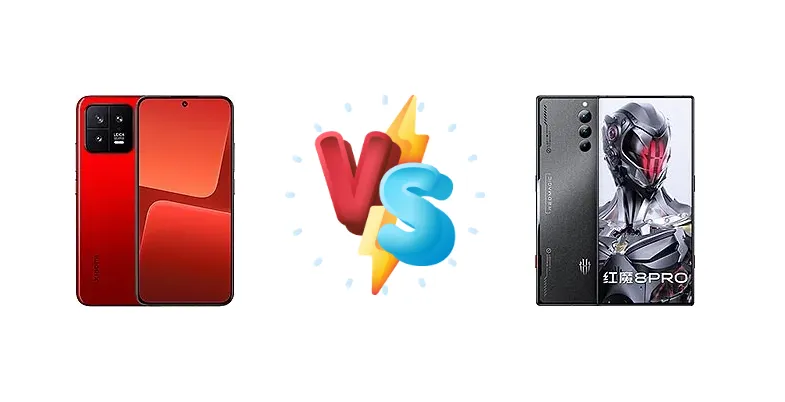
|
🏆 Quick Verdict
For the average user, the Xiaomi 13 emerges as the more well-rounded choice. Its brighter display, coupled with a more versatile camera system, makes it better suited for everyday tasks. However, gamers will find the RedMagic 8 Pro’s superior battery endurance and faster charging a compelling advantage.
| PHONES | ||
|---|---|---|
| Phone Names | Xiaomi 13 | ZTE nubia RedMagic 8 Pro |
| Network | ||
|---|---|---|
| 2G bands | GSM 850 / 900 / 1800 / 1900 | GSM 850 / 900 / 1800 / 1900 |
| 3G bands | HSDPA 800 / 850 / 900 / 1700(AWS) / 1900 / 2100 | HSDPA 850 / 900 / 1700(AWS) / 1900 / 2100 |
| 4G bands | 1, 2, 3, 4, 5, 7, 8, 12, 13, 17, 18, 19, 20, 25, 26, 28, 32, 38, 39, 40, 41, 42, 48, 66 - International | 1, 2, 3, 4, 5, 7, 8, 12, 17, 18, 19, 20, 26, 28, 34, 38, 39, 40, 41, 66 |
| 5G bands | 1, 3, 5, 7, 8, 20, 28, 38, 40, 41, 66, 71, 75, 77, 78 SA/NSA - International | 1, 3, 5, 7, 8, 20, 28, 38, 41, 66, 77, 78 SA/NSA |
| Speed | HSPA, LTE, 5G | HSPA, LTE, 5G |
| Technology | GSM / CDMA / HSPA / CDMA2000 / LTE / 5G | GSM / CDMA / HSPA / EVDO / LTE / 5G |
| 1, 3, 5, 8, 28, 38, 40, 41, 77, 78 SA/NSA - China | - | |
| Launch | ||
|---|---|---|
| Announced | 2022, December 11 | 2022, December 26 |
| Status | Available. Released 2022, December 14 | Available. Released 2022, December 28 |
| Body | ||
|---|---|---|
| Build | Glass front (Gorilla Glass 5), glass back or silicone polymer back, aluminum frame | Glass front (Gorilla Glass 5), glass back, aluminum frame |
| Dimensions | 152.8 x 71.5 x 8.0 mm or 8.1 mm | 164 x 76.4 x 8.9 mm (6.46 x 3.01 x 0.35 in) |
| SIM | · Nano-SIM + eSIM· Nano-SIM + Nano-SIM | Nano-SIM + Nano-SIM |
| Weight | 185 g or 189 g (6.53 oz) | 228 g (8.04 oz) |
| IP68 dust/water resistant (up to 1.5m for 30 min) | - | |
| Display | ||
|---|---|---|
| Protection | Corning Gorilla Glass 5 | Corning Gorilla Glass 5 |
| Resolution | 1080 x 2400 pixels, 20:9 ratio (~414 ppi density) | 1116 x 2480 pixels, 20:9 ratio (~400 ppi density) |
| Size | 6.36 inches, 97.7 cm2 (~89.4% screen-to-body ratio) | 6.8 inches, 111.6 cm2 (~89.1% screen-to-body ratio) |
| Type | AMOLED, 120Hz, Dolby Vision, HDR10+, 1200 nits (HBM), 1900 nits (peak) | AMOLED, 1B colors (China only), 120Hz, 1300 nits (peak) |
| Platform | ||
|---|---|---|
| CPU | Octa-core (1x3.2 GHz Cortex-X3 & 2x2.8 GHz Cortex-A715 & 2x2.8 GHz Cortex-A710 & 3x2.0 GHz Cortex-A510) | Octa-core (1x3.2 GHz Cortex-X3 & 2x2.8 GHz Cortex-A715 & 2x2.8 GHz Cortex-A710 & 3x2.0 GHz Cortex-A510) |
| Chipset | Qualcomm SM8550-AB Snapdragon 8 Gen 2 (4 nm) | Qualcomm SM8550-AB Snapdragon 8 Gen 2 (4 nm) |
| GPU | Adreno 740 | Adreno 740 |
| OS | Android 13, upgradable to Android 14, MIUI 14 | Android 13, Redmagic OS 6 |
| Memory | ||
|---|---|---|
| Card slot | No | No |
| Internal | 128GB 8GB RAM, 256GB 8GB RAM, 256GB 12GB RAM, 512GB 12GB RAM | 128GB 8GB RAM, 256GB 8GB RAM, 256GB 12GB RAM, 512GB 16GB RAM |
| UFS 3.1 - 128GB UFS 4.0 - 256/512GB | - | |
| Main Camera | ||
|---|---|---|
| Features | Leica lens, color spectrum sensor, Dual-LED dual-tone flash, HDR, panorama | LED flash, HDR, panorama |
| Triple | 50 MP, f/1.8, 23mm (wide), 1/1.49", 1.0µm, PDAF, OIS 10 MP, f/2.0, 75mm (telephoto), 1/3.75", 1.0µm, PDAF, OIS, 3.2x optical zoom 12 MP, f/2.2, 15mm, 120˚ (ultrawide), 1/3.06", 1.12µm | 50 MP, f/1.9, 25mm (wide), 1/1.57", 1.0µm, PDAF 8 MP, f/2.2, 120˚, 13mm (ultrawide), 1/4.0", 1.12µm 2 MP (macro) |
| Video | 8K@24fps (HDR), 4K@24/30/60fps (HDR10+, 10-bit Dolby Vision HDR, 10-bit LOG), 1080p@30/120/240/960fps, 1080p@1920fps, gyro-EIS | 8K@30fps, 4K@30/60fps, 1080p@30/60/120/240fps |
| Selfie camera | ||
|---|---|---|
| Features | HDR, panorama | HDR |
| Single | 32 MP, f/2.0, 22mm (wide), 1/3.14", 0.7µm | 16 MP, f/2.0, (wide), 1.12µm, under display |
| Video | 1080p@30fps | 1080p@30/60fps |
| Sound | ||
|---|---|---|
| 3.5mm jack | No | - |
| 35mm jack | No | Yes |
| Loudspeaker | Yes, with stereo speakers | Yes, with stereo speakers |
| 24-bit/192kHz audio | - | |
| Comms | ||
|---|---|---|
| Bluetooth | 5.3, A2DP, LE, aptX HD, aptX Adaptive | 5.3, A2DP, LE |
| Infrared port | Yes | - |
| NFC | Yes | Yes (market/region dependent) |
| Positioning | GPS (L1+L5), GLONASS (G1), BDS (B1I+B1c+B2a), GALILEO (E1+E5a), QZSS (L1+L5), NavIC (L5) | GPS (L1+L5), GLONASS, BDS, GALILEO |
| Radio | No | No |
| USB | USB Type-C 2.0, OTG | USB Type-C 3.2 (China), 3.1 (International), OTG, accessory connector, DisplayPort |
| WLAN | Wi-Fi 802.11 a/b/g/n/ac/6e, dual-band, Wi-Fi Direct | Wi-Fi 802.11 a/b/g/n/ac/6e/7, tri-band, Wi-Fi Direct |
| Features | ||
|---|---|---|
| Sensors | Fingerprint (under display, optical), accelerometer, proximity, gyro, compass | Fingerprint (under display, optical), accelerometer, gyro, proximity, compass |
| Battery | ||
|---|---|---|
| Charging | 67W wired, PD3.0, QC4, 100% in 38 min 50W wireless, 100% in 48 min 10W reverse wireless | 80W wired, PD3.0, 100% in 35 min - China 65W wired, PD3.0, 100% in 43 min - International |
| Type | Li-Po 4500 mAh | Li-Po 6000 mAh |
| Misc | ||
|---|---|---|
| Colors | White, Black, Flora Green, Mountain Blue, Red, Blue, Yellow, Green, Gray | Black, Transparent |
| Models | 2211133C, 2211133G | NX729J |
| Price | € 314.00 | About 680 EUR |
| Tests | ||
|---|---|---|
| Battery life | Endurance rating 108h | - |
| Camera | Photo / Video | - |
| Display | Contrast ratio: Infinite (nominal) | - |
| Loudspeaker | -25.8 LUFS (Very good) | - |
| Performance | AnTuTu: 1248260 (v9) GeekBench: 5129 (v5.1) GFXBench: 109fps (ES 3.1 onscreen) | - |
Xiaomi 13
- Brighter, more vibrant display for media consumption.
- Likely superior camera system with advanced image processing.
- More compact and refined design.
- Shorter battery life compared to the RedMagic 8 Pro.
- Potentially more thermal throttling under sustained load.
ZTE nubia RedMagic 8 Pro
- Exceptional battery life for extended gaming sessions.
- Faster wired charging speeds.
- Advanced cooling system for sustained performance.
- Dimmer display, less ideal for outdoor use.
- Camera likely less refined than the Xiaomi 13.
Display Comparison
The Xiaomi 13 boasts a significantly brighter display, reaching a measured 1254 nits compared to the RedMagic 8 Pro’s 821 nits. This translates to superior visibility under direct sunlight. While both utilize high refresh rate panels, the Xiaomi 13’s higher peak brightness and likely superior color calibration (though not specified in the data) make it the better choice for multimedia. The RedMagic 8 Pro, however, likely prioritizes refresh rate consistency for gaming, potentially at the expense of peak brightness.
Camera Comparison
The provided data only indicates both phones have 'Photo / Video' capabilities. Given Xiaomi’s strong camera reputation, the Xiaomi 13 is likely to offer a more refined and versatile camera experience. We can infer that Xiaomi will focus on image processing and software features, while the RedMagic 8 Pro likely prioritizes camera functionality as secondary to gaming. Without sensor size or aperture data, it’s difficult to make a definitive statement, but Xiaomi’s history suggests a more comprehensive camera system.
Performance
Both devices are powered by the Qualcomm SM8550-AB Snapdragon 8 Gen 2 (4 nm) with an identical CPU configuration – a 1x3.2 GHz Cortex-X3, 2x2.8 GHz Cortex-A715, 2x2.8 GHz Cortex-A710, and 3x2.0 GHz Cortex-A510. Performance will be nearly indistinguishable in CPU-bound tasks. The RedMagic 8 Pro’s advantage lies in its cooling system, designed to sustain peak performance for longer durations during demanding games. While the Xiaomi 13 will deliver similar peak performance, it’s more likely to experience thermal throttling under prolonged heavy load. The RedMagic 8 Pro’s larger battery also contributes to sustained performance.
Battery Life
The ZTE nubia RedMagic 8 Pro holds a clear advantage in battery endurance, achieving a 131-hour rating versus the Xiaomi 13’s 108 hours. This is a substantial difference, translating to significantly longer gaming sessions or daily usage. While the Xiaomi 13 offers both 67W wired and 50W wireless charging, the RedMagic 8 Pro’s 80W (China) / 65W (International) wired charging is faster, reaching 100% in 35/43 minutes respectively, compared to the Xiaomi 13’s 38/48 minutes. The RedMagic 8 Pro also includes 10W reverse wireless charging, a feature absent in the Xiaomi 13.
Buying Guide
Buy the Xiaomi 13 if you need a premium smartphone with a fantastic camera, a bright and color-accurate display for media consumption, and a more compact form factor. Buy the ZTE nubia RedMagic 8 Pro if you prioritize uninterrupted gaming sessions, demand the longest possible battery life, and appreciate features like incredibly fast charging and a cooling system designed for sustained performance.