
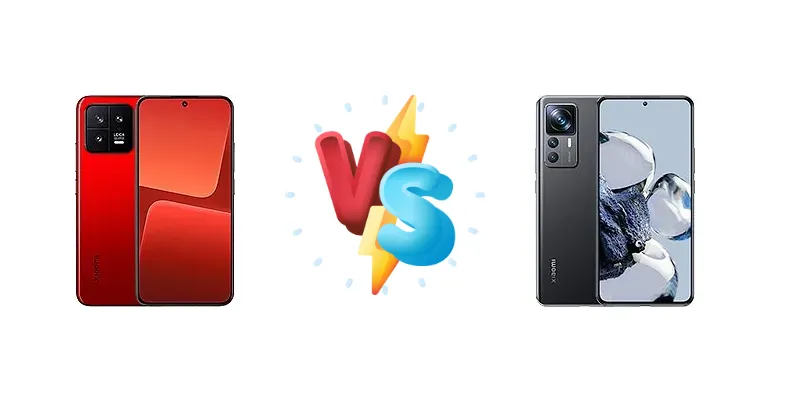
Xiaomi 13 vs Xiaomi 12T Pro: The Ultimate Showdown
| Phones Images | |||||
|---|---|---|---|---|---|
|
🏆 Quick Verdict
The Xiaomi 13 offers a superior chipset (Snapdragon 8 Gen 2), brighter display, and slightly better battery life. However, the 12T Pro boasts significantly faster 120W charging and a potentially more appealing price point. The 13 is the overall winner for performance, while the 12T Pro excels in charging speed and value.
| PHONES | ||
|---|---|---|
| Phone Names | Xiaomi 13 | Xiaomi 12T Pro |
| Network | ||
|---|---|---|
| 2G bands | GSM 850 / 900 / 1800 / 1900 | GSM 850 / 900 / 1800 / 1900 |
| 3G bands | HSDPA 800 / 850 / 900 / 1700(AWS) / 1900 / 2100 | HSDPA 800 / 850 / 900 / 1700(AWS) / 1900 / 2100 |
| 4G bands | 1, 2, 3, 4, 5, 7, 8, 12, 13, 17, 18, 19, 20, 25, 26, 28, 32, 38, 39, 40, 41, 42, 48, 66 - International | 1, 2, 3, 4, 5, 7, 8, 12, 13, 17, 18, 19, 20, 25, 26, 28, 32, 38, 39, 40, 41, 42, 48, 66 |
| 5G bands | 1, 3, 5, 7, 8, 20, 28, 38, 40, 41, 66, 71, 75, 77, 78 SA/NSA - International | 1, 3, 5, 7, 8, 20, 28, 38, 40, 41, 66, 77, 78, 75 SA/NSA |
| Speed | HSPA, LTE, 5G | HSPA, LTE, 5G |
| Technology | GSM / CDMA / HSPA / CDMA2000 / LTE / 5G | GSM / HSPA / LTE / 5G |
| 1, 3, 5, 8, 28, 38, 40, 41, 77, 78 SA/NSA - China | - | |
| Launch | ||
|---|---|---|
| Announced | 2022, December 11 | 2022, October 04 |
| Status | Available. Released 2022, December 14 | Available. Released 2022, October 06 |
| Body | ||
|---|---|---|
| Build | Glass front (Gorilla Glass 5), glass back or silicone polymer back, aluminum frame | - |
| Dimensions | 152.8 x 71.5 x 8.0 mm or 8.1 mm | 163.1 x 75.9 x 8.6 mm (6.42 x 2.99 x 0.34 in) |
| SIM | · Nano-SIM + eSIM· Nano-SIM + Nano-SIM | · Nano-SIM + eSIM· Nano-SIM + Nano-SIM |
| Weight | 185 g or 189 g (6.53 oz) | 205 g (7.23 oz) |
| IP68 dust/water resistant (up to 1.5m for 30 min) | IP53, dust and splash resistant | |
| Display | ||
|---|---|---|
| Protection | Corning Gorilla Glass 5 | Corning Gorilla Glass 5 |
| Resolution | 1080 x 2400 pixels, 20:9 ratio (~414 ppi density) | 1220 x 2712 pixels, 20:9 ratio (~446 ppi density) |
| Size | 6.36 inches, 97.7 cm2 (~89.4% screen-to-body ratio) | 6.67 inches, 107.4 cm2 (~86.7% screen-to-body ratio) |
| Type | AMOLED, 120Hz, Dolby Vision, HDR10+, 1200 nits (HBM), 1900 nits (peak) | AMOLED, 68B colors, 120Hz, Dolby Vision, HDR10+, 500 nits (typ), 900 nits (peak) |
| Platform | ||
|---|---|---|
| CPU | Octa-core (1x3.2 GHz Cortex-X3 & 2x2.8 GHz Cortex-A715 & 2x2.8 GHz Cortex-A710 & 3x2.0 GHz Cortex-A510) | Octa-core (1x3.19 GHz Cortex-X2 & 3x2.75 GHz Cortex-A710 & 4x2.0 GHz Cortex-A510) |
| Chipset | Qualcomm SM8550-AB Snapdragon 8 Gen 2 (4 nm) | Qualcomm SM8475 Snapdragon 8+ Gen 1 (4 nm) |
| GPU | Adreno 740 | Adreno 730 |
| OS | Android 13, upgradable to Android 14, MIUI 14 | Android 12, upgradable to Android 14, HyperOS |
| Memory | ||
|---|---|---|
| Card slot | No | No |
| Internal | 128GB 8GB RAM, 256GB 8GB RAM, 256GB 12GB RAM, 512GB 12GB RAM | 128GB 8GB RAM, 256GB 8GB RAM, 256GB 12GB RAM |
| UFS 3.1 - 128GB UFS 4.0 - 256/512GB | UFS 3.1 | |
| Main Camera | ||
|---|---|---|
| Features | Leica lens, color spectrum sensor, Dual-LED dual-tone flash, HDR, panorama | Color spectrum sensor, Dual-LED dual-tone flash, HDR, panorama |
| Triple | 50 MP, f/1.8, 23mm (wide), 1/1.49", 1.0µm, PDAF, OIS 10 MP, f/2.0, 75mm (telephoto), 1/3.75", 1.0µm, PDAF, OIS, 3.2x optical zoom 12 MP, f/2.2, 15mm, 120˚ (ultrawide), 1/3.06", 1.12µm | 200 MP, f/1.7, (wide), 1/1.22", 0.64µm, PDAF, OIS 8 MP, f/2.2, 120˚ (ultrawide), 1/4.0", 1.12µm 2 MP (macro) |
| Video | 8K@24fps (HDR), 4K@24/30/60fps (HDR10+, 10-bit Dolby Vision HDR, 10-bit LOG), 1080p@30/120/240/960fps, 1080p@1920fps, gyro-EIS | 8K@24fps, 4K@30/60fps, 1080p@30/60/120/240fps, HDR10+ |
| Selfie camera | ||
|---|---|---|
| Features | HDR, panorama | HDR, panorama |
| Single | 32 MP, f/2.0, 22mm (wide), 1/3.14", 0.7µm | 20 MP, f/2.2, (wide), 1/3.47", 0.8µm |
| Video | 1080p@30fps | 1080p@30/60fps, HDR |
| Sound | ||
|---|---|---|
| 3.5mm jack | No | No |
| 35mm jack | No | No |
| Loudspeaker | Yes, with stereo speakers | Yes, with stereo speakers |
| 24-bit/192kHz audio | Tuned by Harman Kardon 24-bit/192kHz audio | |
| Comms | ||
|---|---|---|
| Bluetooth | 5.3, A2DP, LE, aptX HD, aptX Adaptive | 5.2, A2DP, LE, aptX HD |
| Infrared port | Yes | Yes |
| NFC | Yes | Yes (market/region dependent) |
| Positioning | GPS (L1+L5), GLONASS (G1), BDS (B1I+B1c+B2a), GALILEO (E1+E5a), QZSS (L1+L5), NavIC (L5) | GPS (L1+L5), GLONASS (L1), BDS (B1I+B1c+B2a), GALILEO (E1+E5a), QZSS (L1+L5), NavIC (L5) |
| Radio | No | No |
| USB | USB Type-C 2.0, OTG | USB Type-C 2.0, OTG |
| WLAN | Wi-Fi 802.11 a/b/g/n/ac/6e, dual-band, Wi-Fi Direct | Wi-Fi 802.11 a/b/g/n/ac/6, dual-band, Wi-Fi Direct |
| Features | ||
|---|---|---|
| Sensors | Fingerprint (under display, optical), accelerometer, proximity, gyro, compass | Fingerprint (under display, optical), accelerometer, gyro, proximity, compass |
| Battery | ||
|---|---|---|
| Charging | 67W wired, PD3.0, QC4, 100% in 38 min 50W wireless, 100% in 48 min 10W reverse wireless | 120W wired, 100% in 19 min |
| Type | Li-Po 4500 mAh | Li-Po 5000 mAh |
| Misc | ||
|---|---|---|
| Colors | White, Black, Flora Green, Mountain Blue, Red, Blue, Yellow, Green, Gray | Black, Silver, Blue |
| Models | 2211133C, 2211133G | 22081212UG, 22081212G |
| Price | € 314.00 | $ 208.76 / € 167.62 |
| SAR | - | 1.08 W/kg (head) 1.07 W/kg (body) |
| SAR EU | - | 1.00 W/kg (head) 1.00 W/kg (body) |
| Tests | ||
|---|---|---|
| Battery life | Endurance rating 108h | Endurance rating 91h |
| Camera | Photo / Video | Photo / Video |
| Display | Contrast ratio: Infinite (nominal) | Contrast ratio: Infinite (nominal) |
| Loudspeaker | -25.8 LUFS (Very good) | -24.1 LUFS (Very good) |
| Performance | AnTuTu: 1248260 (v9) GeekBench: 5129 (v5.1) GFXBench: 109fps (ES 3.1 onscreen) | AnTuTu: 1032185 (v9) GeekBench: 4081 (v5.1) GFXBench: 65fps (ES 3.1 onscreen) |
Xiaomi 13
- Superior Snapdragon 8 Gen 2 Chipset
- Brighter Display (1254 nits)
- Slightly Better Battery Life (108h)
- Refined Design and Build Quality (assumed)
- Slower Charging Speed (38 min)
- Potentially Higher Price
- Camera improvements may be marginal
Xiaomi 12T Pro
- Incredibly Fast 120W Charging (19 min)
- More Affordable Price Point
- Large and Vibrant Display
- Excellent Performance (Snapdragon 8+ Gen 1)
- Slightly Older Chipset (Snapdragon 8+ Gen 1)
- Lower Peak Brightness (913 nits)
- Slightly Shorter Battery Life (91h)
Display Comparison
The Xiaomi 13 takes the lead in display brightness, measuring a peak of 1254 nits compared to the 12T Pro's 913 nits. Both feature excellent contrast ratios (Infinite nominal), offering deep blacks and vibrant colors. While both displays are likely AMOLED panels with 120Hz refresh rates, the 13's higher brightness provides better visibility in direct sunlight.
Camera Comparison
Both phones feature capable camera systems, but the Xiaomi 13 is expected to have slightly improved image processing and low-light performance due to the newer chipset and potentially refined software. Both likely offer versatile camera setups with main, ultrawide, and potentially telephoto lenses. Detailed camera comparisons would require extensive testing, but the 13 holds a slight edge.
Performance
The Xiaomi 13's Snapdragon 8 Gen 2 chipset is a clear winner here. It offers a noticeable performance boost over the 12T Pro's Snapdragon 8+ Gen 1, particularly in sustained workloads and gaming. The Gen 2's improved efficiency also contributes to better thermal management. Both phones offer smooth multitasking and responsive performance for everyday tasks.
Battery Life
The Xiaomi 13 boasts a slightly better endurance rating (108h vs 91h), suggesting longer battery life under typical usage. However, the 12T Pro's 120W charging is a game-changer, allowing it to charge from 0% to 100% in just 19 minutes, significantly faster than the 13's 38 minutes.
Buying Guide
The Xiaomi 13 is ideal for users prioritizing top-tier performance, a vibrant display, and a refined overall experience. It's a great choice for gamers and power users. The Xiaomi 12T Pro is perfect for those seeking incredibly fast charging, a large display, and a more budget-friendly flagship experience, especially if charging speed is a top priority.