
Xiaomi 13 vs Xiaomi 12: The Ultimate Flagship Showdown
| Phones Images | |||||
|---|---|---|---|---|---|
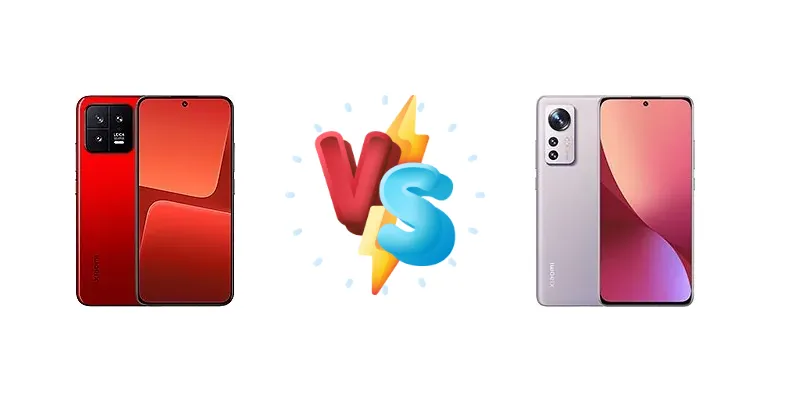
|
🏆 Quick Verdict
The Xiaomi 13 emerges as the clear winner, boasting a significantly improved Snapdragon 8 Gen 2 chipset, a brighter display, and notably better battery life. While the Xiaomi 12 remains a capable device, the 13's upgrades make it the superior choice for most users.
| PHONES | ||
|---|---|---|
| Phone Names | Xiaomi 13 | Xiaomi 12 |
| Network | ||
|---|---|---|
| 2G bands | GSM 850 / 900 / 1800 / 1900 | GSM 850 / 900 / 1800 / 1900 |
| 3G bands | HSDPA 800 / 850 / 900 / 1700(AWS) / 1900 / 2100 | HSDPA 800 / 850 / 900 / 1700(AWS) / 1900 / 2100 |
| 4G bands | 1, 2, 3, 4, 5, 7, 8, 12, 13, 17, 18, 19, 20, 25, 26, 28, 32, 38, 39, 40, 41, 42, 48, 66 - International | 1, 2, 3, 4, 5, 7, 8, 12, 13, 17, 18, 19, 20, 25, 26, 28, 32, 38, 39, 40, 41, 42, 48, 66 - International |
| 5G bands | 1, 3, 5, 7, 8, 20, 28, 38, 40, 41, 66, 71, 75, 77, 78 SA/NSA - International | 1, 3, 5, 7, 8, 20, 28, 38, 40, 41, 66, 77, 78, 79 SA/NSA - International |
| Speed | HSPA, LTE, 5G | HSPA, LTE, 5G |
| Technology | GSM / CDMA / HSPA / CDMA2000 / LTE / 5G | GSM / CDMA / HSPA / EVDO / LTE / 5G |
| 1, 3, 5, 8, 28, 38, 40, 41, 77, 78 SA/NSA - China | 1, 3, 5, 8, 28, 41, 77, 78, 79 SA/NSA - China | |
| Launch | ||
|---|---|---|
| Announced | 2022, December 11 | 2021, December 28 |
| Status | Available. Released 2022, December 14 | Available. Released 2021, December 31 |
| Body | ||
|---|---|---|
| Build | Glass front (Gorilla Glass 5), glass back or silicone polymer back, aluminum frame | Glass front (Gorilla Glass Victus), glass back (Gorilla Glass 5), aluminum frame |
| Dimensions | 152.8 x 71.5 x 8.0 mm or 8.1 mm | 152.7 x 69.9 x 8.2 mm (6.01 x 2.75 x 0.32 in) |
| SIM | · Nano-SIM + eSIM· Nano-SIM + Nano-SIM | Nano-SIM + Nano-SIM |
| Weight | 185 g or 189 g (6.53 oz) | 179 g or 180 g (6.31 oz) |
| IP68 dust/water resistant (up to 1.5m for 30 min) | - | |
| Display | ||
|---|---|---|
| Protection | Corning Gorilla Glass 5 | Corning Gorilla Glass Victus |
| Resolution | 1080 x 2400 pixels, 20:9 ratio (~414 ppi density) | 1080 x 2400 pixels, 20:9 ratio (~419 ppi density) |
| Size | 6.36 inches, 97.7 cm2 (~89.4% screen-to-body ratio) | 6.28 inches, 95.2 cm2 (~89.2% screen-to-body ratio) |
| Type | AMOLED, 120Hz, Dolby Vision, HDR10+, 1200 nits (HBM), 1900 nits (peak) | AMOLED, 68B colors, 120Hz, Dolby Vision, HDR10+, 1100 nits (peak) |
| Platform | ||
|---|---|---|
| CPU | Octa-core (1x3.2 GHz Cortex-X3 & 2x2.8 GHz Cortex-A715 & 2x2.8 GHz Cortex-A710 & 3x2.0 GHz Cortex-A510) | Octa-core (1x3.00 GHz Cortex-X2 & 3x2.50 GHz Cortex-A710 & 4x1.80 GHz Cortex-A510) |
| Chipset | Qualcomm SM8550-AB Snapdragon 8 Gen 2 (4 nm) | Qualcomm SM8450 Snapdragon 8 Gen 1 (4 nm) |
| GPU | Adreno 740 | Adreno 730 |
| OS | Android 13, upgradable to Android 14, MIUI 14 | Android 12, MIUI 13 |
| Memory | ||
|---|---|---|
| Card slot | No | No |
| Internal | 128GB 8GB RAM, 256GB 8GB RAM, 256GB 12GB RAM, 512GB 12GB RAM | 128GB 8GB RAM, 256GB 8GB RAM, 256GB 12GB RAM |
| UFS 3.1 - 128GB UFS 4.0 - 256/512GB | UFS 3.1 | |
| Main Camera | ||
|---|---|---|
| Features | Leica lens, color spectrum sensor, Dual-LED dual-tone flash, HDR, panorama | Color spectrum sensor, Dual-LED dual-tone flash, HDR, panorama |
| Single | - | 32 MP, f/2.5, 26mm (wide), 0.7µm |
| Triple | 50 MP, f/1.8, 23mm (wide), 1/1.49", 1.0µm, PDAF, OIS 10 MP, f/2.0, 75mm (telephoto), 1/3.75", 1.0µm, PDAF, OIS, 3.2x optical zoom 12 MP, f/2.2, 15mm, 120˚ (ultrawide), 1/3.06", 1.12µm | 50 MP, f/1.9, 26mm (wide), 1/1.56", 1.0µm, PDAF, OIS 13 MP, f/2.4, 12mm, 123˚ (ultrawide), 1/3.06", 1.12µm 5 MP, f/2.4, 50mm (telephoto macro), AF |
| Video | 8K@24fps (HDR), 4K@24/30/60fps (HDR10+, 10-bit Dolby Vision HDR, 10-bit LOG), 1080p@30/120/240/960fps, 1080p@1920fps, gyro-EIS | 8K@24fps (HDR), 4K@30/60fps (HDR10+), 1080p@30/120/240/960fps, 720p@1920fps, gyro-EIS |
| Selfie camera | ||
|---|---|---|
| Features | HDR, panorama | HDR, panorama |
| Single | 32 MP, f/2.0, 22mm (wide), 1/3.14", 0.7µm | 32 MP, f/2.5, 26mm (wide), 0.7µm |
| Video | 1080p@30fps | 1080p@30/60fps, 720p@120fps, HDR |
| Sound | ||
|---|---|---|
| 3.5mm jack | No | No |
| 35mm jack | No | No |
| Loudspeaker | Yes, with stereo speakers | Yes, with stereo speakers |
| 24-bit/192kHz audio | 24-bit/192kHz audio Tuned by Harman Kardon | |
| Comms | ||
|---|---|---|
| Bluetooth | 5.3, A2DP, LE, aptX HD, aptX Adaptive | 5.2, A2DP, LE, aptX HD, aptX Adaptive |
| Infrared port | Yes | Yes |
| NFC | Yes | Yes (market/region dependent) |
| Positioning | GPS (L1+L5), GLONASS (G1), BDS (B1I+B1c+B2a), GALILEO (E1+E5a), QZSS (L1+L5), NavIC (L5) | GPS (L1+L5), GLONASS (L1), BDS (B1I+B1c+B2a), GALILEO (E1+E5a), QZSS (L1+L5), NavIC (L5) |
| Radio | No | No |
| USB | USB Type-C 2.0, OTG | USB Type-C 2.0, OTG |
| WLAN | Wi-Fi 802.11 a/b/g/n/ac/6e, dual-band, Wi-Fi Direct | Wi-Fi 802.11 a/b/g/n/ac/6 or 6e (market dependent), dual-band, Wi-Fi Direct |
| Features | ||
|---|---|---|
| Sensors | Fingerprint (under display, optical), accelerometer, proximity, gyro, compass | Fingerprint (under display, optical), accelerometer, gyro, compass |
| - | Virtual Proximity Sensing | |
| Battery | ||
|---|---|---|
| Charging | 67W wired, PD3.0, QC4, 100% in 38 min 50W wireless, 100% in 48 min 10W reverse wireless | 67W wired, PD3.0, QC4, 100% in 39 min 50W wireless, 100% in 53 min 10W reverse wireless |
| Type | Li-Po 4500 mAh | Li-Po 4500 mAh |
| Misc | ||
|---|---|---|
| Colors | White, Black, Flora Green, Mountain Blue, Red, Blue, Yellow, Green, Gray | Gray, Blue, Purple, Green |
| Models | 2211133C, 2211133G | 2201123G, 2201123C |
| Price | € 314.00 | $ 284.99 / € 149.99 |
| SAR | - | 1.09 W/kg (head) 0.91 W/kg (body) |
| SAR EU | - | 0.60 W/kg (head) 1.00 W/kg (body) |
| Tests | ||
|---|---|---|
| Battery life | Endurance rating 108h | Endurance rating 82h |
| Camera | Photo / Video | Photo / Video |
| Display | Contrast ratio: Infinite (nominal) | Contrast ratio: Infinite (nominal) |
| Loudspeaker | -25.8 LUFS (Very good) | -25.3 LUFS (Very good) |
| Performance | AnTuTu: 1248260 (v9) GeekBench: 5129 (v5.1) GFXBench: 109fps (ES 3.1 onscreen) | AnTuTu: 985115 (v9) GeekBench: 3652 (v5.1) GFXBench: 75fps (ES 3.1 onscreen) |
Xiaomi 13
- Significantly faster performance (Snapdragon 8 Gen 2)
- Brighter and more vibrant display
- Longer battery life
- Improved camera processing
- Fast charging (wired & wireless)
- Potentially higher price
- Design may be similar to previous models
Xiaomi 12
- More affordable (especially now)
- Capable camera system
- Fast charging (wired & wireless)
- Good overall performance
- Slower performance (Snapdragon 8 Gen 1)
- Less bright display
- Shorter battery life
- Potential for thermal throttling
Display Comparison
The Xiaomi 13's display shines with a measured peak brightness of 1254 nits, significantly brighter than the Xiaomi 12's 896 nits. Both offer excellent contrast ratios (Infinite nominal), but the 13's increased brightness provides better visibility in direct sunlight and a more immersive viewing experience. The 13 likely has slightly improved color accuracy as well, though specific panel details are needed for confirmation.
Camera Comparison
While both phones offer capable camera systems, the Xiaomi 13 likely benefits from software optimizations and potentially improved sensor technology. The Snapdragon 8 Gen 2's improved image signal processor (ISP) contributes to better image processing. Expect slightly better dynamic range, noise reduction, and overall image quality from the Xiaomi 13, particularly in challenging lighting conditions. Video recording capabilities are also likely enhanced.
Performance
The Snapdragon 8 Gen 2 in the Xiaomi 13 is a substantial upgrade over the Snapdragon 8 Gen 1 in the Xiaomi 12. The Gen 2 offers improved CPU and GPU performance, better power efficiency, and enhanced AI capabilities. Expect smoother multitasking, faster app loading times, and significantly better gaming performance on the Xiaomi 13. Thermal management is also likely improved on the 13, preventing throttling during extended use.
Battery Life
The Xiaomi 13 boasts a significantly better endurance rating of 108 hours compared to the Xiaomi 12's 82 hours. Coupled with the more efficient Snapdragon 8 Gen 2, this translates to noticeably longer battery life on the Xiaomi 13. Both phones offer fast wired (67W) and wireless (50W) charging, with similar charging times.
Buying Guide
The Xiaomi 13 is ideal for users who prioritize performance, a vibrant display, and extended battery life. It's a great choice for gamers, content creators, and anyone who wants a premium experience. The Xiaomi 12 is a good option for budget-conscious buyers who still want a flagship experience, especially if they can find it at a discounted price.