
Xiaomi 13 vs. Sony Xperia 1 VII: A Flagship Face-Off
| Phones Images | |||||
|---|---|---|---|---|---|
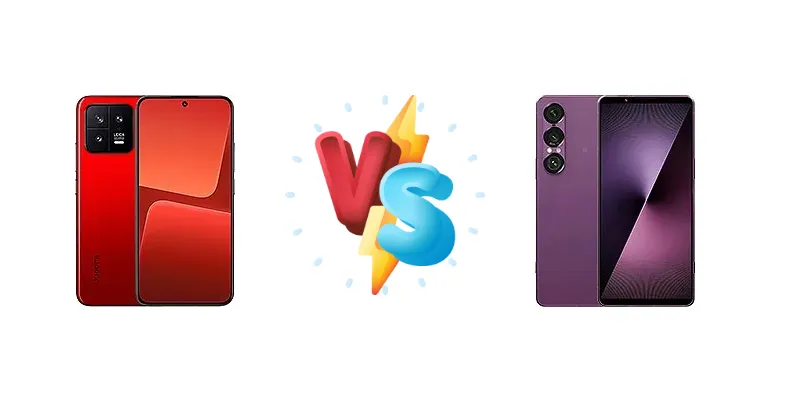
|
🏆 Quick Verdict
For the average user prioritizing value and fast charging, the Xiaomi 13 remains a compelling choice. However, the Sony Xperia 1 VII emerges as the superior device for power users and content creators, thanks to its significantly longer battery life, more powerful Snapdragon 8 Elite chipset, and brighter display.
| PHONES | ||
|---|---|---|
| Phone Names | Xiaomi 13 | Sony Xperia 1 VII |
| Network | ||
|---|---|---|
| 2G bands | GSM 850 / 900 / 1800 / 1900 | GSM 850 / 900 / 1800 / 1900 |
| 3G bands | HSDPA 800 / 850 / 900 / 1700(AWS) / 1900 / 2100 | HSDPA 800 / 850 / 900 / 1700(AWS) / 1900 / 2100 |
| 4G bands | 1, 2, 3, 4, 5, 7, 8, 12, 13, 17, 18, 19, 20, 25, 26, 28, 32, 38, 39, 40, 41, 42, 48, 66 - International | 1, 2, 3, 4, 5, 7, 8, 12, 13, 17, 19, 20, 25, 26, 28, 32, 34, 38, 39, 40, 41, 66 - Europe |
| 5G bands | 1, 3, 5, 7, 8, 20, 28, 38, 40, 41, 66, 71, 75, 77, 78 SA/NSA - International | 1, 3, 5, 7, 8, 20, 28, 38, 40, 41, 75, 77, 78 SA/NSA/Sub6 - Europe |
| Speed | HSPA, LTE, 5G | HSPA, LTE, 5G |
| Technology | GSM / CDMA / HSPA / CDMA2000 / LTE / 5G | GSM / HSPA / LTE / 5G |
| 1, 3, 5, 8, 28, 38, 40, 41, 77, 78 SA/NSA - China | - | |
| Launch | ||
|---|---|---|
| Announced | 2022, December 11 | 2025, May 13 |
| Status | Available. Released 2022, December 14 | Available. Released 2025, June 04 |
| Body | ||
|---|---|---|
| Build | Glass front (Gorilla Glass 5), glass back or silicone polymer back, aluminum frame | Glass front (Gorilla Glass Victus 2), glass back (Gorilla Glass Victus), aluminum frame |
| Dimensions | 152.8 x 71.5 x 8.0 mm or 8.1 mm | 162 x 74 x 8.2 mm (6.38 x 2.91 x 0.32 in) |
| SIM | · Nano-SIM + eSIM· Nano-SIM + Nano-SIM | · Nano-SIM + eSIM· Nano-SIM + Nano-SIM |
| Weight | 185 g or 189 g (6.53 oz) | 197 g (6.95 oz) |
| IP68 dust/water resistant (up to 1.5m for 30 min) | - | |
| Display | ||
|---|---|---|
| Protection | Corning Gorilla Glass 5 | Corning Gorilla Glass Victus 2, Mohs level 5 |
| Resolution | 1080 x 2400 pixels, 20:9 ratio (~414 ppi density) | 1080 x 2340 pixels, 19.5:9 ratio (~396 ppi density) |
| Size | 6.36 inches, 97.7 cm2 (~89.4% screen-to-body ratio) | 6.5 inches, 103.7 cm2 (~86.5% screen-to-body ratio) |
| Type | AMOLED, 120Hz, Dolby Vision, HDR10+, 1200 nits (HBM), 1900 nits (peak) | LTPO OLED, 1B colors, 120Hz, HDR BT.2020 |
| Platform | ||
|---|---|---|
| CPU | Octa-core (1x3.2 GHz Cortex-X3 & 2x2.8 GHz Cortex-A715 & 2x2.8 GHz Cortex-A710 & 3x2.0 GHz Cortex-A510) | Octa-core (2x4.32 GHz Oryon V2 Phoenix L + 6x3.53 GHz Oryon V2 Phoenix M) |
| Chipset | Qualcomm SM8550-AB Snapdragon 8 Gen 2 (4 nm) | Qualcomm SM8750-AB Snapdragon 8 Elite (3 nm) |
| GPU | Adreno 740 | Adreno 830 |
| OS | Android 13, upgradable to Android 14, MIUI 14 | Android 15, up to 4 major Android upgrades |
| Memory | ||
|---|---|---|
| Card slot | No | microSDXC (uses shared SIM slot) |
| Internal | 128GB 8GB RAM, 256GB 8GB RAM, 256GB 12GB RAM, 512GB 12GB RAM | 256GB 12GB RAM, 512GB 12GB RAM |
| UFS 3.1 - 128GB UFS 4.0 - 256/512GB | - | |
| Main Camera | ||
|---|---|---|
| Features | Leica lens, color spectrum sensor, Dual-LED dual-tone flash, HDR, panorama | Zeiss optics, Zeiss T* lens coating, color spectrum sensor, LED flash, panorama, HDR, eye tracking |
| Triple | 50 MP, f/1.8, 23mm (wide), 1/1.49", 1.0µm, PDAF, OIS 10 MP, f/2.0, 75mm (telephoto), 1/3.75", 1.0µm, PDAF, OIS, 3.2x optical zoom 12 MP, f/2.2, 15mm, 120˚ (ultrawide), 1/3.06", 1.12µm | 48 MP, f/1.9, 24mm (wide), 1/1.35", 1.12µm, dual pixel PDAF, OIS 12 MP, f/2.3, 85mm (telephoto), f/3.5, 170mm (telephoto), 1/3.5", 1.0µm, dual pixel PDAF, 3.5x-7.1x continuous optical zoom, OIS, 4cm macro @ 120mm, no AF 48 MP, f/2.0, 16mm (ultrawide), 1/1.56", 1.0µm, PDAF |
| Video | 8K@24fps (HDR), 4K@24/30/60fps (HDR10+, 10-bit Dolby Vision HDR, 10-bit LOG), 1080p@30/120/240/960fps, 1080p@1920fps, gyro-EIS | 4K@24/30/60/120fps HDR, 1080p@30/60/120fps; 5-axis gyro-EIS, OIS |
| Selfie camera | ||
|---|---|---|
| Features | HDR, panorama | HDR |
| Single | 32 MP, f/2.0, 22mm (wide), 1/3.14", 0.7µm | 12 MP, f/2.0, 24mm (wide), 1/2.9", 1.22µm |
| Video | 1080p@30fps | 4K@30/60fps, 1080p@30/60fps, 5-axis gyro-EIS |
| Sound | ||
|---|---|---|
| 3.5mm jack | No | - |
| 35mm jack | No | Yes |
| Loudspeaker | Yes, with stereo speakers | Yes, with stereo speakers |
| 24-bit/192kHz audio | - | |
| Comms | ||
|---|---|---|
| Bluetooth | 5.3, A2DP, LE, aptX HD, aptX Adaptive | 6.0, A2DP, LE Audio, aptX HD, aptX Adaptive, aptX Lossless |
| Infrared port | Yes | - |
| NFC | Yes | Yes |
| Positioning | GPS (L1+L5), GLONASS (G1), BDS (B1I+B1c+B2a), GALILEO (E1+E5a), QZSS (L1+L5), NavIC (L5) | GPS, GLONASS, BDS, GALILEO, QZSS |
| Radio | No | No |
| USB | USB Type-C 2.0, OTG | USB Type-C 3.2, OTG, video output |
| WLAN | Wi-Fi 802.11 a/b/g/n/ac/6e, dual-band, Wi-Fi Direct | Wi-Fi 802.11 a/b/g/n/ac/6e/7, tri-band, Wi-Fi Direct, DLNA |
| Features | ||
|---|---|---|
| Sensors | Fingerprint (under display, optical), accelerometer, proximity, gyro, compass | Fingerprint (side-mounted), accelerometer, gyro, proximity, barometer, compass |
| Battery | ||
|---|---|---|
| Charging | 67W wired, PD3.0, QC4, 100% in 38 min 50W wireless, 100% in 48 min 10W reverse wireless | 30W wired, PD3.0, PPS, 50% in 30 min 15W wireless Reverse wireless |
| Type | Li-Po 4500 mAh | 5000 mAh |
| Misc | ||
|---|---|---|
| Colors | White, Black, Flora Green, Mountain Blue, Red, Blue, Yellow, Green, Gray | Moss Green, Orchid Purple, Slate Black |
| Models | 2211133C, 2211133G | XQ-FS54, XQFS54EUKCG.GC, XQFS54EUKCV.GC, XQFS54EUKCB.GC, PDX256 |
| Price | € 314.00 | € 1,338.99 / $ 1,394.99 / £ 1,149.94 |
| Tests | ||
|---|---|---|
| Battery life | Endurance rating 108h | - |
| Camera | Photo / Video | - |
| Display | Contrast ratio: Infinite (nominal) | - |
| Loudspeaker | -25.8 LUFS (Very good) | - |
| Performance | AnTuTu: 1248260 (v9) GeekBench: 5129 (v5.1) GFXBench: 109fps (ES 3.1 onscreen) | - |
| EU LABEL | ||
|---|---|---|
| Battery | - | 43:30h endurance, 1400 cycles |
| Energy | - | Class B |
| Free fall | - | Class B (181 falls) |
| Repairability | - | Class D |
Xiaomi 13
- Faster wired and wireless charging speeds
- Potentially lower price point
- Well-rounded feature set
- Significantly shorter battery life
- Less powerful chipset compared to the Xperia 1 VII
- Limited battery cycle lifespan
Sony Xperia 1 VII
- Exceptional battery life and longevity (1400 cycles)
- More powerful Snapdragon 8 Elite chipset
- Brighter display for outdoor visibility
- Slower charging speeds
- Higher price point
- Less mainstream Android experience
Display Comparison
The Sony Xperia 1 VII boasts a brighter display, reaching 1475 nits compared to the Xiaomi 13’s 1254 nits, offering improved visibility in direct sunlight. While both displays feature an infinite (nominal) contrast ratio, the Xperia 1 VII’s superior brightness is a tangible advantage. The Xperia 1 VII’s display technology isn’t specified, but Sony’s history suggests a focus on color accuracy, crucial for professional content consumption. The Xiaomi 13’s display, while excellent, doesn’t match the Xperia 1 VII’s peak luminance.
Camera Comparison
Both devices are equipped with capable camera systems, but detailed sensor information is lacking for the Xiaomi 13. The Xperia 1 VII’s camera system is likely to prioritize image quality and video capabilities, leveraging Sony’s expertise in imaging sensors. The absence of specific sensor details for the Xiaomi 13 makes a direct comparison difficult, but it’s reasonable to assume a focus on versatility. The Xperia 1 VII’s image processing will likely lean towards natural colors and detail preservation, while the Xiaomi 13 may offer more vibrant, social media-ready images. Without further details, it's difficult to assess the low-light performance or video recording capabilities of the Xiaomi 13.
Performance
The core difference lies in the chipsets. The Xiaomi 13 utilizes the Qualcomm Snapdragon 8 Gen 2 (4nm), a powerhouse in its own right, with an octa-core CPU configuration peaking at 3.2 GHz. However, the Sony Xperia 1 VII steps up with the Snapdragon 8 Elite (3nm), featuring a custom Oryon V2 Phoenix CPU architecture. The Xperia 1 VII’s CPU, with its 4.32 GHz Oryon V2 Phoenix L cores and 3.53 GHz Phoenix M cores, promises a significant performance uplift, particularly in multi-threaded workloads. The 3nm process node of the Snapdragon 8 Elite also translates to improved thermal efficiency, potentially reducing throttling during sustained heavy use. The Xperia 1 VII is designed for sustained performance, while the Xiaomi 13 excels in burst performance.
Battery Life
Battery life is a clear win for the Sony Xperia 1 VII. Its endurance rating of 43:30h and active use score of 15:32h significantly outperform the Xiaomi 13’s 108h endurance rating. While the Xiaomi 13 offers faster wired charging at 67W (100% in 38 min) and 50W wireless charging, the Xperia 1 VII’s 30W wired charging (50% in 30 min) and 15W wireless charging are offset by its substantially larger battery capacity and more efficient chipset. The Xperia 1 VII also boasts an impressive 1400 charge cycles, indicating exceptional long-term battery health.
Buying Guide
Buy the Xiaomi 13 if you need a fast-charging, well-rounded flagship experience at a potentially lower price point and value a more mainstream Android experience. Buy the Sony Xperia 1 VII if you prioritize exceptional battery life, top-tier performance for demanding tasks like video editing, and a unique, creator-focused feature set, and are willing to pay a premium.