
Xiaomi 13 vs. Samsung Galaxy S23 FE: A Deep Dive into Flagship Performance and Value
| Phones Images | |||||
|---|---|---|---|---|---|
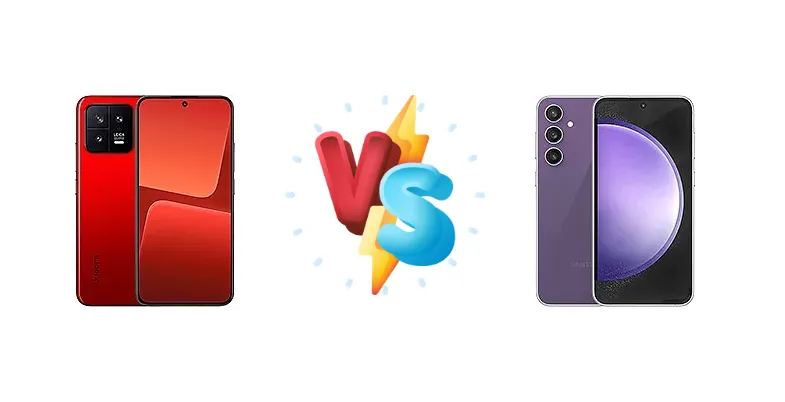
|
🏆 Quick Verdict
For most users, the Xiaomi 13 emerges as the superior choice. Its Snapdragon 8 Gen 2 chipset provides a significant performance advantage, coupled with faster charging and a brighter display. While the S23 FE offers a familiar Samsung experience, the Xiaomi 13 delivers more power for the price.
| PHONES | ||
|---|---|---|
| Phone Names | Xiaomi 13 | Samsung Galaxy S23 FE |
| Network | ||
|---|---|---|
| 2G bands | GSM 850 / 900 / 1800 / 1900 | GSM 850 / 900 / 1800 / 1900 |
| 3G bands | HSDPA 800 / 850 / 900 / 1700(AWS) / 1900 / 2100 | HSDPA 850 / 900 / 1700(AWS) / 1900 / 2100 |
| 4G bands | 1, 2, 3, 4, 5, 7, 8, 12, 13, 17, 18, 19, 20, 25, 26, 28, 32, 38, 39, 40, 41, 42, 48, 66 - International | 1, 2, 3, 4, 5, 7, 8, 12, 13, 17, 20, 26, 28, 38, 40, 41, 66 - International |
| 5G bands | 1, 3, 5, 7, 8, 20, 28, 38, 40, 41, 66, 71, 75, 77, 78 SA/NSA - International | 1, 2, 3, 5, 7, 8, 20, 28, 38, 40, 41, 66, 77, 78 SA/NSA/Sub6 - International |
| Speed | HSPA, LTE, 5G | HSPA, LTE, 5G |
| Technology | GSM / CDMA / HSPA / CDMA2000 / LTE / 5G | GSM / HSPA / LTE / 5G |
| 1, 3, 5, 8, 28, 38, 40, 41, 77, 78 SA/NSA - China | - | |
| Launch | ||
|---|---|---|
| Announced | 2022, December 11 | 2023, October 04 |
| Status | Available. Released 2022, December 14 | Available. Released 2023, October 05 |
| Body | ||
|---|---|---|
| Build | Glass front (Gorilla Glass 5), glass back or silicone polymer back, aluminum frame | Glass front (Gorilla Glass 5), glass back (Gorilla Glass 5), aluminum frame |
| Dimensions | 152.8 x 71.5 x 8.0 mm or 8.1 mm | 158 x 76.5 x 8.2 mm (6.22 x 3.01 x 0.32 in) |
| SIM | · Nano-SIM + eSIM· Nano-SIM + Nano-SIM | · Nano-SIM· Nano-SIM + Nano-SIM· Nano-SIM + Nano-SIM + eSIM (max 2 at a time) |
| Weight | 185 g or 189 g (6.53 oz) | 209 g (7.37 oz) |
| IP68 dust/water resistant (up to 1.5m for 30 min) | - | |
| Display | ||
|---|---|---|
| Protection | Corning Gorilla Glass 5 | Corning Gorilla Glass 5 |
| Resolution | 1080 x 2400 pixels, 20:9 ratio (~414 ppi density) | 1080 x 2340 pixels, 19.5:9 ratio (~403 ppi density) |
| Size | 6.36 inches, 97.7 cm2 (~89.4% screen-to-body ratio) | 6.4 inches, 100.5 cm2 (~83.2% screen-to-body ratio) |
| Type | AMOLED, 120Hz, Dolby Vision, HDR10+, 1200 nits (HBM), 1900 nits (peak) | Dynamic AMOLED 2X, 120Hz, HDR10+, 1450 nits (peak) |
| Platform | ||
|---|---|---|
| CPU | Octa-core (1x3.2 GHz Cortex-X3 & 2x2.8 GHz Cortex-A715 & 2x2.8 GHz Cortex-A710 & 3x2.0 GHz Cortex-A510) | Octa-core (1x2.8 GHz Cortex-X2 & 3x2.50 GHz Cortex-A710 & 4x1.8 GHz Cortex-A510) - InternationalOcta-core (1x3.00 GHz Cortex-X2 & 3x2.50 GHz Cortex-A710 & 4x1.80 GHz Cortex-A510) - USA |
| Chipset | Qualcomm SM8550-AB Snapdragon 8 Gen 2 (4 nm) | Exynos 2200 (4 nm) - InternationalQualcomm SM8450 Snapdragon 8 Gen 1 (4 nm) - USA |
| GPU | Adreno 740 | Xclipse 920 - InternationalAdreno 730 - USA |
| OS | Android 13, upgradable to Android 14, MIUI 14 | Android 13, up to 4 major Android upgrades, One UI 8 |
| Memory | ||
|---|---|---|
| Card slot | No | No |
| Internal | 128GB 8GB RAM, 256GB 8GB RAM, 256GB 12GB RAM, 512GB 12GB RAM | 128GB 8GB RAM, 256GB 8GB RAM |
| UFS 3.1 - 128GB UFS 4.0 - 256/512GB | - | |
| Main Camera | ||
|---|---|---|
| Features | Leica lens, color spectrum sensor, Dual-LED dual-tone flash, HDR, panorama | LED flash, HDR, panorama |
| Triple | 50 MP, f/1.8, 23mm (wide), 1/1.49", 1.0µm, PDAF, OIS 10 MP, f/2.0, 75mm (telephoto), 1/3.75", 1.0µm, PDAF, OIS, 3.2x optical zoom 12 MP, f/2.2, 15mm, 120˚ (ultrawide), 1/3.06", 1.12µm | 50 MP, f/1.8, 23mm (wide), 1/1.57", 1.0µm, dual pixel PDAF, OIS 8 MP, f/2.4, 76mm (telephoto), 1/4.5", 1.0µm, PDAF, OIS, 3x optical zoom 12 MP, f/2.2, 13mm, 123˚ (ultrawide), 1/3.0", 1.12µm |
| Video | 8K@24fps (HDR), 4K@24/30/60fps (HDR10+, 10-bit Dolby Vision HDR, 10-bit LOG), 1080p@30/120/240/960fps, 1080p@1920fps, gyro-EIS | 8K@24fps, 4K@30/60fps, 1080p@30/60/120/240fps |
| Selfie camera | ||
|---|---|---|
| Features | HDR, panorama | - |
| Single | 32 MP, f/2.0, 22mm (wide), 1/3.14", 0.7µm | 10 MP, f/2.4, 25mm (wide), 1/3.0", 1.22µm |
| Video | 1080p@30fps | 4K@30/60fps, 1080p@30/60fps; gyro-EIS |
| Sound | ||
|---|---|---|
| 3.5mm jack | No | - |
| 35mm jack | No | No |
| Loudspeaker | Yes, with stereo speakers | Yes, with stereo speakers |
| 24-bit/192kHz audio | - | |
| Comms | ||
|---|---|---|
| Bluetooth | 5.3, A2DP, LE, aptX HD, aptX Adaptive | 5.3, A2DP, LE |
| Infrared port | Yes | - |
| NFC | Yes | Yes |
| Positioning | GPS (L1+L5), GLONASS (G1), BDS (B1I+B1c+B2a), GALILEO (E1+E5a), QZSS (L1+L5), NavIC (L5) | GPS, GLONASS, GALILEO, BDS |
| Radio | No | Unspecified |
| USB | USB Type-C 2.0, OTG | USB Type-C, OTG |
| WLAN | Wi-Fi 802.11 a/b/g/n/ac/6e, dual-band, Wi-Fi Direct | Wi-Fi 802.11 a/b/g/n/ac/6e, dual-band, Wi-Fi Direct |
| Features | ||
|---|---|---|
| Sensors | Fingerprint (under display, optical), accelerometer, proximity, gyro, compass | Fingerprint (under display, optical), accelerometer, gyro, compass |
| Battery | ||
|---|---|---|
| Charging | 67W wired, PD3.0, QC4, 100% in 38 min 50W wireless, 100% in 48 min 10W reverse wireless | 25W wired, PD3.0, 50% in 30 min 15W wireless Reverse wireless |
| Type | Li-Po 4500 mAh | Li-Ion 4500 mAh |
| Misc | ||
|---|---|---|
| Colors | White, Black, Flora Green, Mountain Blue, Red, Blue, Yellow, Green, Gray | Mint, Cream, Graphite, Purple, Indigo, Tangerine |
| Models | 2211133C, 2211133G | SM-S711B, SM-S711B/DS, SM-S711U1, SM-S711U, SM-S711W, SM-S7110, SM-S711N |
| Price | € 314.00 | $ 219.95 / C$ 327.90 / £ 248.99 / € 272.00 / ₹ 34,999 |
| SAR | - | 0.80 W/kg (head) 0.72 W/kg (body) |
| SAR EU | - | 0.76 W/kg (head) 1.04 W/kg (body) |
| Tests | ||
|---|---|---|
| Battery life | Endurance rating 108h | - |
| Camera | Photo / Video | - |
| Display | Contrast ratio: Infinite (nominal) | - |
| Loudspeaker | -25.8 LUFS (Very good) | - |
| Performance | AnTuTu: 1248260 (v9) GeekBench: 5129 (v5.1) GFXBench: 109fps (ES 3.1 onscreen) | - |
Xiaomi 13
- Significantly faster processor (Snapdragon 8 Gen 2)
- Faster wired and wireless charging
- Brighter display for better outdoor visibility
- Less established brand recognition in some markets
- MIUI software may not appeal to all users
Samsung Galaxy S23 FE
- Familiar Samsung One UI software
- Strong brand reputation and support
- Potentially lower price point (depending on region)
- Slower processor (Exynos 2200 or Snapdragon 8 Gen 1)
- Slower charging speeds
- Dimmer display compared to Xiaomi 13
Display Comparison
The Xiaomi 13 boasts a brighter display, reaching a measured 1254 nits compared to the S23 FE’s 985 nits. This translates to better visibility under direct sunlight. While both displays feature an 'infinite' (nominal) contrast ratio, the Xiaomi 13’s higher peak brightness provides a more vibrant and engaging viewing experience. The S23 FE’s display, while still excellent, is noticeably dimmer in comparison. We lack PWM frequency data for both, but the Xiaomi 13’s generally well-regarded panel quality suggests a lower risk of flicker-related eye strain.
Camera Comparison
Both phones offer versatile camera systems, but details beyond 'Photo/Video' are lacking. Assuming similar sensor sizes and lens quality (based on market positioning), the Snapdragon 8 Gen 2’s superior image signal processor (ISP) in the Xiaomi 13 likely provides better image processing, particularly in low-light conditions. The S23 FE’s camera performance will vary slightly depending on the chipset variant, with the Snapdragon version potentially offering a marginal advantage. The absence of specific sensor details makes a definitive comparison difficult, but the Xiaomi 13’s processing power gives it an edge.
Performance
The core difference lies in the chipsets. The Xiaomi 13’s Snapdragon 8 Gen 2 (4nm) is a clear step up from both versions of the S23 FE’s processor. The Snapdragon 8 Gen 2 features a more modern CPU architecture – Cortex-X3 vs Cortex-X2 – and a more efficient 4nm process. The S23 FE comes in two variants: the Snapdragon 8 Gen 1 (US) and the Exynos 2200 (International). The Exynos 2200 has historically faced criticism for thermal throttling under sustained load, a problem less prevalent with the Snapdragon 8 Gen 2. The Xiaomi 13’s CPU configuration (1x3.2 GHz Cortex-X3, 2x2.8 GHz Cortex-A715, 2x2.8 GHz Cortex-A710, 3x2.0 GHz Cortex-A510) offers a performance edge over the S23 FE’s (1x2.8 GHz Cortex-X2, 3x2.50 GHz Cortex-A710, 4x1.8 GHz Cortex-A510 - International / 1x3.00 GHz Cortex-X2, 3x2.50 GHz Cortex-A710, 4x1.80 GHz Cortex-A510 - USA).
Battery Life
The Xiaomi 13 boasts an endurance rating of 108 hours, while the S23 FE achieves 8:28 hours of active use. While these metrics aren’t directly comparable, the Xiaomi 13’s endurance suggests superior battery optimization. The Xiaomi 13 also significantly outperforms the S23 FE in charging speed: 67W wired (38 minutes to 100%), 50W wireless (48 minutes to 100%), and 10W reverse wireless, compared to the S23 FE’s 25W wired (50% in 30 minutes) and 15W wireless. This faster charging is a major convenience factor for the Xiaomi 13.
Buying Guide
Buy the Xiaomi 13 if you prioritize peak performance for demanding tasks like gaming and video editing, and value faster charging speeds. Buy the Samsung Galaxy S23 FE if you prefer Samsung’s One UI software ecosystem, a more established brand reputation, and are willing to trade some raw power for a potentially lower price (depending on region and promotions).