
Xiaomi 13 vs OnePlus 11R: A Deep Dive into Performance, Battery, and Value
| Phones Images | |||||
|---|---|---|---|---|---|
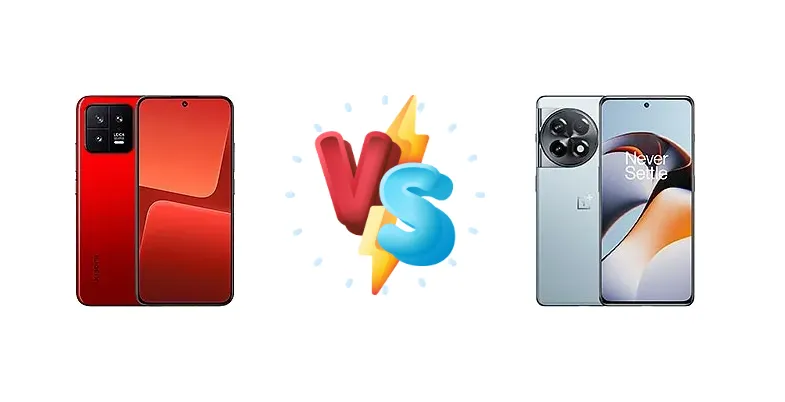
|
🏆 Quick Verdict
For most users, the OnePlus 11R offers a compelling blend of performance and value. While the Xiaomi 13 boasts the superior Snapdragon 8 Gen 2, the 11R’s Snapdragon 8+ Gen 1 provides excellent performance for everyday tasks and gaming, coupled with incredibly fast 100W charging, making it the more practical choice.
| PHONES | ||
|---|---|---|
| Phone Names | Xiaomi 13 | OnePlus 11R |
| Network | ||
|---|---|---|
| 2G bands | GSM 850 / 900 / 1800 / 1900 | GSM 850 / 900 / 1800 / 1900 |
| 3G bands | HSDPA 800 / 850 / 900 / 1700(AWS) / 1900 / 2100 | HSDPA 850 / 900 / 1700(AWS) / 2100 |
| 4G bands | 1, 2, 3, 4, 5, 7, 8, 12, 13, 17, 18, 19, 20, 25, 26, 28, 32, 38, 39, 40, 41, 42, 48, 66 - International | 1, 3, 4, 5, 8, 28, 34, 38, 39, 40, 41 |
| 5G bands | 1, 3, 5, 7, 8, 20, 28, 38, 40, 41, 66, 71, 75, 77, 78 SA/NSA - International | 1, 3, 5, 8, 28, 40, 41, 77, 78 SA/NSA |
| Speed | HSPA, LTE, 5G | HSPA, LTE (3CA), 5G |
| Technology | GSM / CDMA / HSPA / CDMA2000 / LTE / 5G | GSM / CDMA / HSPA / LTE / 5G |
| 1, 3, 5, 8, 28, 38, 40, 41, 77, 78 SA/NSA - China | CDMA 800 | |
| Launch | ||
|---|---|---|
| Announced | 2022, December 11 | 2023, February 07 |
| Status | Available. Released 2022, December 14 | Available. Released 2023, February 21 |
| Body | ||
|---|---|---|
| Build | Glass front (Gorilla Glass 5), glass back or silicone polymer back, aluminum frame | Glass front, glass back (Gorilla Glass 5), plastic frame |
| Dimensions | 152.8 x 71.5 x 8.0 mm or 8.1 mm | 163.4 x 74.3 x 8.7 mm (6.43 x 2.93 x 0.34 in) |
| SIM | · Nano-SIM + eSIM· Nano-SIM + Nano-SIM | Nano-SIM + Nano-SIM |
| Weight | 185 g or 189 g (6.53 oz) | 204 g (7.20 oz) |
| IP68 dust/water resistant (up to 1.5m for 30 min) | - | |
| Display | ||
|---|---|---|
| Protection | Corning Gorilla Glass 5 | - |
| Resolution | 1080 x 2400 pixels, 20:9 ratio (~414 ppi density) | 1240 x 2772 pixels, 20:9 ratio (~451 ppi density) |
| Size | 6.36 inches, 97.7 cm2 (~89.4% screen-to-body ratio) | 6.74 inches, 109.2 cm2 (~90.0% screen-to-body ratio) |
| Type | AMOLED, 120Hz, Dolby Vision, HDR10+, 1200 nits (HBM), 1900 nits (peak) | Fluid AMOLED, 1B colors, 120Hz, HDR10+, 1450 nits (peak) |
| Platform | ||
|---|---|---|
| CPU | Octa-core (1x3.2 GHz Cortex-X3 & 2x2.8 GHz Cortex-A715 & 2x2.8 GHz Cortex-A710 & 3x2.0 GHz Cortex-A510) | Octa-core (1x3.0 GHz Cortex-X2 & 3x2.5 GHz Cortex-A710 & 4x1.80 GHz Cortex-A510) |
| Chipset | Qualcomm SM8550-AB Snapdragon 8 Gen 2 (4 nm) | Qualcomm SM8475 Snapdragon 8+ Gen 1 (4 nm) |
| GPU | Adreno 740 | Adreno 730 |
| OS | Android 13, upgradable to Android 14, MIUI 14 | Android 13, upgradable to Android 15, OxygenOS 15 |
| Memory | ||
|---|---|---|
| Card slot | No | No |
| Internal | 128GB 8GB RAM, 256GB 8GB RAM, 256GB 12GB RAM, 512GB 12GB RAM | 128GB 8GB RAM, 256GB 16GB RAM, 512GB 18GB RAM |
| UFS 3.1 - 128GB UFS 4.0 - 256/512GB | UFS 3.1 | |
| Main Camera | ||
|---|---|---|
| Features | Leica lens, color spectrum sensor, Dual-LED dual-tone flash, HDR, panorama | Color spectrum sensor, LED flash, HDR, panorama |
| Single | - | 16 MP, f/2.4, 24mm (wide), 1/3.09", 1.0µm |
| Triple | 50 MP, f/1.8, 23mm (wide), 1/1.49", 1.0µm, PDAF, OIS 10 MP, f/2.0, 75mm (telephoto), 1/3.75", 1.0µm, PDAF, OIS, 3.2x optical zoom 12 MP, f/2.2, 15mm, 120˚ (ultrawide), 1/3.06", 1.12µm | 50 MP, f/1.8, 24mm (wide), 1/1.56", 1.0µm, multi-directional PDAF, OIS 8 MP, f/2.2, 120˚ (ultrawide), 1/4.0", 1.12µm 2 MP (macro) |
| Video | 8K@24fps (HDR), 4K@24/30/60fps (HDR10+, 10-bit Dolby Vision HDR, 10-bit LOG), 1080p@30/120/240/960fps, 1080p@1920fps, gyro-EIS | 4K@30/60fps, 1080p@30/60/240fps, gyro-EIS |
| Selfie camera | ||
|---|---|---|
| Features | HDR, panorama | HDR |
| Single | 32 MP, f/2.0, 22mm (wide), 1/3.14", 0.7µm | 16 MP, f/2.4, 24mm (wide), 1/3.09", 1.0µm |
| Video | 1080p@30fps | 1080p@30fps |
| Sound | ||
|---|---|---|
| 3.5mm jack | No | No |
| 35mm jack | No | No |
| Loudspeaker | Yes, with stereo speakers | Yes, with stereo speakers |
| 24-bit/192kHz audio | 24-bit/192kHz audio | |
| Comms | ||
|---|---|---|
| Bluetooth | 5.3, A2DP, LE, aptX HD, aptX Adaptive | 5.3, A2DP, LE, aptX HD |
| Infrared port | Yes | Yes |
| NFC | Yes | Yes |
| Positioning | GPS (L1+L5), GLONASS (G1), BDS (B1I+B1c+B2a), GALILEO (E1+E5a), QZSS (L1+L5), NavIC (L5) | GPS (L1+L5), GLONASS (G1), BDS (B1I+B1c+B2a), GALILEO (E1+E5a), QZSS (L1+L5) |
| Radio | No | No |
| USB | USB Type-C 2.0, OTG | USB Type-C 2.0 |
| WLAN | Wi-Fi 802.11 a/b/g/n/ac/6e, dual-band, Wi-Fi Direct | Wi-Fi 802.11 a/b/g/n/ac/6, dual-band |
| Features | ||
|---|---|---|
| Sensors | Fingerprint (under display, optical), accelerometer, proximity, gyro, compass | Fingerprint (under display, optical), accelerometer, gyro, proximity, compass |
| Battery | ||
|---|---|---|
| Charging | 67W wired, PD3.0, QC4, 100% in 38 min 50W wireless, 100% in 48 min 10W reverse wireless | 100W wired |
| Type | Li-Po 4500 mAh | Li-Po 5000 mAh |
| Misc | ||
|---|---|---|
| Colors | White, Black, Flora Green, Mountain Blue, Red, Blue, Yellow, Green, Gray | Galactic Silver, Sonic Black, Solar Red |
| Models | 2211133C, 2211133G | CPH2487 |
| Price | € 314.00 | About 600 EUR |
| SAR | - | 1.16 W/kg (head) 0.61 W/kg (body) |
| Tests | ||
|---|---|---|
| Battery life | Endurance rating 108h | - |
| Camera | Photo / Video | - |
| Display | Contrast ratio: Infinite (nominal) | - |
| Loudspeaker | -25.8 LUFS (Very good) | - |
| Performance | AnTuTu: 1248260 (v9) GeekBench: 5129 (v5.1) GFXBench: 109fps (ES 3.1 onscreen) | - |
Xiaomi 13
- Latest Snapdragon 8 Gen 2 processor for top-tier performance
- Higher peak display brightness for excellent outdoor visibility
- Wireless and reverse wireless charging capabilities
- Higher price point
- Slower wired charging compared to the OnePlus 11R
OnePlus 11R
- Incredibly fast 100W wired charging
- More affordable price
- Excellent performance with the Snapdragon 8+ Gen 1
- Lacks wireless charging
- Potentially less refined camera system
Display Comparison
The Xiaomi 13 features a display capable of reaching 1254 nits of peak brightness, ensuring excellent visibility even in direct sunlight. While the OnePlus 11R’s display specifications aren’t provided, OnePlus typically prioritizes high refresh rates and color accuracy in this segment. The Xiaomi 13’s infinite (nominal) contrast ratio suggests a high-quality OLED panel, likely offering deeper blacks and more vibrant colors. The absence of LTPO information for the 11R means it may not dynamically adjust refresh rates as efficiently as the Xiaomi 13, potentially impacting battery life during static content viewing.
Camera Comparison
Both devices are listed as having 'Photo / Video' capabilities, but detailed camera specifications are missing. Given Xiaomi’s history, the 13 likely features a more sophisticated camera system with a larger main sensor and advanced image processing algorithms. The OnePlus 11R, while capable, likely prioritizes value over outright camera performance. Without sensor size or aperture information, it’s difficult to make a definitive comparison, but the Xiaomi 13 is expected to deliver superior image quality, particularly in low-light conditions. The absence of details suggests neither phone features a dedicated telephoto lens.
Performance
The core difference lies in the chipsets: the Xiaomi 13 utilizes the Qualcomm SM8550-AB Snapdragon 8 Gen 2 (4nm), while the OnePlus 11R employs the SM8475 Snapdragon 8+ Gen 1 (4nm). The Snapdragon 8 Gen 2’s CPU configuration – a 1x3.2 GHz Cortex-X3 prime core – offers a performance advantage over the 11R’s 1x3.0 GHz Cortex-X2. However, the 8+ Gen 1 is still a very capable chip. The 4nm process node in both chips contributes to improved thermal efficiency compared to older generations, but the Gen 2 is generally more efficient. The Xiaomi 13’s CPU architecture (Cortex-A715 and A710) is a generation newer than the 11R’s A710, translating to incremental gains in single-core performance. The 11R’s larger Cortex-A710 cluster (3x vs 2x on the Xiaomi 13) could offer benefits in multi-threaded workloads.
Battery Life
The Xiaomi 13 boasts an endurance rating of 108 hours, indicating respectable battery life. However, the OnePlus 11R’s standout feature is its 100W wired charging, capable of fully charging the device much faster than the Xiaomi 13’s 67W charging (38 minutes vs. unspecified). The Xiaomi 13 also offers 50W wireless and 10W reverse wireless charging, features absent on the 11R. While the Xiaomi 13’s endurance rating suggests a larger battery capacity, the 11R’s rapid charging mitigates concerns about battery life, allowing for quick top-ups throughout the day.
Buying Guide
Buy the Xiaomi 13 if you prioritize having the absolute latest processor for demanding tasks like video editing or consistently high frame rates in graphically intensive games, and if a more compact form factor is essential. Buy the OnePlus 11R if you value exceptional charging speed, a smooth user experience, and a significantly lower price tag without sacrificing substantial performance. It’s the ideal choice for gamers and power users who don’t need the absolute bleeding edge.