
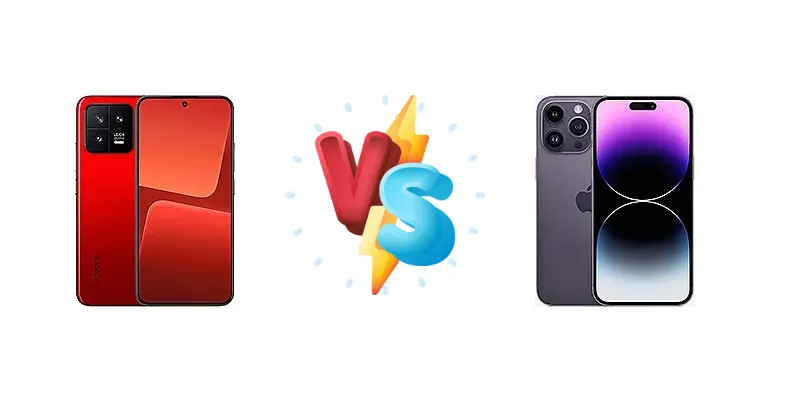
Xiaomi 13 vs. iPhone 14 Pro Max: A Head-to-Head Battle of Flagship Power
| Phones Images | |||||
|---|---|---|---|---|---|
|
🏆 Quick Verdict
For the average user prioritizing longevity and a seamless ecosystem, the iPhone 14 Pro Max emerges as the winner. Its superior battery endurance (121h vs 108h) and brighter display (1760 nits) provide a more consistently premium experience. However, the Xiaomi 13 offers comparable performance at a potentially lower price point, making it a compelling alternative for Android enthusiasts.
| PHONES | ||
|---|---|---|
| Phone Names | Xiaomi 13 | Apple iPhone 14 Pro Max |
| Network | ||
|---|---|---|
| 2G bands | GSM 850 / 900 / 1800 / 1900 | GSM 850 / 900 / 1800 / 1900 |
| 3G bands | HSDPA 800 / 850 / 900 / 1700(AWS) / 1900 / 2100 | HSDPA 850 / 900 / 1700(AWS) / 1900 / 2100 |
| 4G bands | 1, 2, 3, 4, 5, 7, 8, 12, 13, 17, 18, 19, 20, 25, 26, 28, 32, 38, 39, 40, 41, 42, 48, 66 - International | 1, 2, 3, 4, 5, 7, 8, 12, 13, 17, 18, 19, 20, 25, 26, 28, 30, 32, 34, 38, 39, 40, 41, 42, 46, 48, 66 - A2894, A2896 |
| 5G bands | 1, 3, 5, 7, 8, 20, 28, 38, 40, 41, 66, 71, 75, 77, 78 SA/NSA - International | 1, 2, 3, 5, 7, 8, 12, 20, 25, 26, 28, 30, 38, 40, 41, 48, 66, 70, 77, 78, 79 SA/NSA/Sub6 - A2894, A2896 |
| Speed | HSPA, LTE, 5G | HSPA, LTE, 5G, EV-DO Rev.A 3.1 Mbps |
| Technology | GSM / CDMA / HSPA / CDMA2000 / LTE / 5G | GSM / CDMA / HSPA / EVDO / LTE / 5G |
| 1, 3, 5, 8, 28, 38, 40, 41, 77, 78 SA/NSA - China | 1, 2, 3, 5, 7, 8, 12, 20, 25, 26, 28, 30, 38, 40, 41, 48, 66, 70, 77, 78, 79 SA/NSA/Sub6 - A2895 | |
| Launch | ||
|---|---|---|
| Announced | 2022, December 11 | 2022, September 07 |
| Status | Available. Released 2022, December 14 | Available. Released 2022, September 16 |
| Body | ||
|---|---|---|
| Build | Glass front (Gorilla Glass 5), glass back or silicone polymer back, aluminum frame | Glass front, glass back, stainless steel frame |
| Dimensions | 152.8 x 71.5 x 8.0 mm or 8.1 mm | 160.7 x 77.6 x 7.9 mm (6.33 x 3.06 x 0.31 in) |
| SIM | · Nano-SIM + eSIM· Nano-SIM + Nano-SIM | · Nano-SIM + eSIM + eSIM (max 2 at a time; International)· eSIM + eSIM (8 or more, max 2 at a time; USA)· Nano-SIM + Nano-SIM (China) |
| Weight | 185 g or 189 g (6.53 oz) | 240 g (8.47 oz) |
| IP68 dust/water resistant (up to 1.5m for 30 min) | IP68 dust/water resistant (up to 6m for 30 min) Apple Pay (Visa, MasterCard, AMEX certified) | |
| Display | ||
|---|---|---|
| Protection | Corning Gorilla Glass 5 | Ceramic Shield glass |
| Resolution | 1080 x 2400 pixels, 20:9 ratio (~414 ppi density) | 1290 x 2796 pixels, 19.5:9 ratio (~460 ppi density) |
| Size | 6.36 inches, 97.7 cm2 (~89.4% screen-to-body ratio) | 6.7 inches, 110.2 cm2 (~88.3% screen-to-body ratio) |
| Type | AMOLED, 120Hz, Dolby Vision, HDR10+, 1200 nits (HBM), 1900 nits (peak) | LTPO Super Retina XDR OLED, 120Hz, HDR10, Dolby Vision, 1000 nits (typ), 2000 nits (HBM) |
| - | Always-On display | |
| Platform | ||
|---|---|---|
| CPU | Octa-core (1x3.2 GHz Cortex-X3 & 2x2.8 GHz Cortex-A715 & 2x2.8 GHz Cortex-A710 & 3x2.0 GHz Cortex-A510) | Hexa-core (2x3.46 GHz Everest + 4x2.02 GHz Sawtooth) |
| Chipset | Qualcomm SM8550-AB Snapdragon 8 Gen 2 (4 nm) | Apple A16 Bionic (4 nm) |
| GPU | Adreno 740 | Apple GPU (5-core graphics) |
| OS | Android 13, upgradable to Android 14, MIUI 14 | iOS 16, upgradable to iOS 26.1 |
| Memory | ||
|---|---|---|
| Card slot | No | No |
| Internal | 128GB 8GB RAM, 256GB 8GB RAM, 256GB 12GB RAM, 512GB 12GB RAM | 128GB 6GB RAM, 256GB 6GB RAM, 512GB 6GB RAM, 1TB 6GB RAM |
| UFS 3.1 - 128GB UFS 4.0 - 256/512GB | NVMe | |
| Main Camera | ||
|---|---|---|
| Features | Leica lens, color spectrum sensor, Dual-LED dual-tone flash, HDR, panorama | Dual-LED dual-tone flash, HDR (photo/panorama) |
| Single | - | 12 MP, f/1.9, 23mm (wide), 1/3.6", PDAF, OIS (unconfirmed) SL 3D, (depth/biometrics sensor) |
| Triple | 50 MP, f/1.8, 23mm (wide), 1/1.49", 1.0µm, PDAF, OIS 10 MP, f/2.0, 75mm (telephoto), 1/3.75", 1.0µm, PDAF, OIS, 3.2x optical zoom 12 MP, f/2.2, 15mm, 120˚ (ultrawide), 1/3.06", 1.12µm | 48 MP, f/1.8, 24mm (wide), 1/1.28", 1.22µm, dual pixel PDAF, sensor-shift OIS 12 MP, f/2.8, 77mm (telephoto), 1/3.5", 1.0µm, PDAF, OIS, 3x optical zoom 12 MP, f/2.2, 13mm, 120˚ (ultrawide), 1/2.55", 1.4µm, dual pixel PDAF TOF 3D LiDAR scanner (depth) |
| Video | 8K@24fps (HDR), 4K@24/30/60fps (HDR10+, 10-bit Dolby Vision HDR, 10-bit LOG), 1080p@30/120/240/960fps, 1080p@1920fps, gyro-EIS | 4K@24/25/30/60fps, 1080p@25/30/60/120/240fps, 10-bit HDR, Dolby Vision HDR (up to 60fps), ProRes, stereo sound rec. |
| Selfie camera | ||
|---|---|---|
| Features | HDR, panorama | HDR |
| Single | 32 MP, f/2.0, 22mm (wide), 1/3.14", 0.7µm | 12 MP, f/1.9, 23mm (wide), 1/3.6", 1.0µm, PDAF, OIS SL 3D, (depth/biometrics sensor) |
| Video | 1080p@30fps | 4K@24/25/30/60fps, 1080p@25/30/60/120fps, gyro-EIS |
| Sound | ||
|---|---|---|
| 3.5mm jack | No | No |
| 35mm jack | No | No |
| Loudspeaker | Yes, with stereo speakers | Yes, with stereo speakers |
| 24-bit/192kHz audio | - | |
| Comms | ||
|---|---|---|
| Bluetooth | 5.3, A2DP, LE, aptX HD, aptX Adaptive | 5.3, A2DP, LE |
| Infrared port | Yes | - |
| NFC | Yes | Yes |
| Positioning | GPS (L1+L5), GLONASS (G1), BDS (B1I+B1c+B2a), GALILEO (E1+E5a), QZSS (L1+L5), NavIC (L5) | GPS (L1+L5), GLONASS, GALILEO, BDS, QZSS |
| Radio | No | No |
| USB | USB Type-C 2.0, OTG | Lightning, USB 2.0 |
| WLAN | Wi-Fi 802.11 a/b/g/n/ac/6e, dual-band, Wi-Fi Direct | Wi-Fi 802.11 a/b/g/n/ac/6, dual-band, hotspot |
| Features | ||
|---|---|---|
| Sensors | Fingerprint (under display, optical), accelerometer, proximity, gyro, compass | Face ID, accelerometer, gyro, proximity, compass, barometer |
| - | Ultra Wideband (UWB) support Emergency SOS via satellite (SMS sending/receiving) | |
| Battery | ||
|---|---|---|
| Charging | 67W wired, PD3.0, QC4, 100% in 38 min 50W wireless, 100% in 48 min 10W reverse wireless | Wired, PD2.0, 50% in 30 min 15W wireless (MagSafe) 15W wireless (Qi2) - requires iOS 17.2 update |
| Type | Li-Po 4500 mAh | Li-Ion 4323 mAh (16.68 Wh) |
| Misc | ||
|---|---|---|
| Colors | White, Black, Flora Green, Mountain Blue, Red, Blue, Yellow, Green, Gray | Space Black, Silver, Gold, Deep Purple |
| Models | 2211133C, 2211133G | A2894, A2651, A2893, A2895, A2896, iphone15,3 |
| Price | € 314.00 | € 530.79 / $ 489.81 / £ 446.75 |
| SAR | - | 1.15 W/kg (head) 1.07 W/kg (body) |
| SAR EU | - | 0.99 W/kg (head) 0.98 W/kg (body) |
| Tests | ||
|---|---|---|
| Battery life | Endurance rating 108h | Endurance rating 121h |
| Camera | Photo / Video | Photo / Video |
| Display | Contrast ratio: Infinite (nominal) | Contrast ratio: Infinite (nominal) |
| Loudspeaker | -25.8 LUFS (Very good) | -24.3 LUFS (Very good) |
| Performance | AnTuTu: 1248260 (v9) GeekBench: 5129 (v5.1) GFXBench: 109fps (ES 3.1 onscreen) | AnTuTu: 955884 (v9) GeekBench: 5423 (v5.1) GFXBench: 54fps (ES 3.1 onscreen) |
Xiaomi 13
- Significantly faster wired and wireless charging.
- More flexible Android operating system.
- Potentially lower price point.
- Shorter battery life.
- Less bright display.
- Ecosystem limitations compared to Apple.
Apple iPhone 14 Pro Max
- Superior battery life.
- Brighter and more visible display.
- Seamless Apple ecosystem integration.
- Slower charging speeds.
- Higher price point.
- Less customization options in iOS.
Display Comparison
The iPhone 14 Pro Max boasts a significantly brighter display, reaching a measured 1760 nits compared to the Xiaomi 13’s 1254 nits. This translates to superior visibility in direct sunlight. Both displays share an infinite (nominal) contrast ratio, but the iPhone’s higher peak brightness is a clear advantage for outdoor use. While both likely employ LTPO technology for adaptive refresh rates (not specified in the data), the iPhone’s brightness advantage is the defining characteristic. The Xiaomi 13’s display is still excellent, but the iPhone offers a more impactful visual experience.
Camera Comparison
Both phones are capable of excellent photo and video capture, but the specifics are missing from the provided data. Given Apple’s computational photography prowess and the iPhone 14 Pro Max’s larger sensor size (typically), it likely delivers more consistent results across various lighting conditions. The Xiaomi 13, leveraging the Snapdragon 8 Gen 2’s ISP, will likely excel in low-light performance and offer more manual control options. Without detailed sensor specifications, it’s difficult to definitively declare a winner, but Apple’s image processing pipeline generally prioritizes natural-looking images, while Xiaomi often leans towards more vibrant, saturated colors.
Performance
Both devices utilize a 4nm process, but their CPU architectures differ drastically. The Xiaomi 13’s Snapdragon 8 Gen 2 employs an octa-core configuration with a Cortex-X3 prime core clocked at 3.2 GHz, while the iPhone 14 Pro Max features a hexa-core A16 Bionic. Apple’s A16 Bionic consistently demonstrates industry-leading single-core performance, crucial for responsive app launches and smooth UI navigation. The Snapdragon 8 Gen 2 excels in multi-core tasks and GPU performance, potentially offering a slight edge in demanding games. However, the A16’s efficiency contributes to the iPhone’s superior battery life. The Xiaomi 13 benefits from LPDDR5x RAM, but the A16’s Neural Engine provides dedicated hardware acceleration for machine learning tasks.
Battery Life
The iPhone 14 Pro Max achieves an endurance rating of 121 hours, surpassing the Xiaomi 13’s 108 hours. This difference is attributable to a combination of factors: the A16 Bionic’s power efficiency and potentially a larger battery capacity (not specified). While the Xiaomi 13 offers significantly faster wired charging (67W vs. iPhone’s 50% in 30 minutes with PD2.0) and wireless charging (50W vs. 15W MagSafe/Qi2), the iPhone’s longer battery life reduces the need for frequent top-ups. The Xiaomi 13’s 10W reverse wireless charging is a useful addition, but the iPhone lacks this feature.
Buying Guide
Buy the Xiaomi 13 if you need blazing-fast charging (67W wired, 50W wireless) and prefer the flexibility of the Android operating system, alongside a potentially lower upfront cost. Buy the Apple iPhone 14 Pro Max if you prioritize all-day battery life, a consistently bright and color-accurate display, and the tight integration of the Apple ecosystem, even if it means a higher price tag and slower charging.