
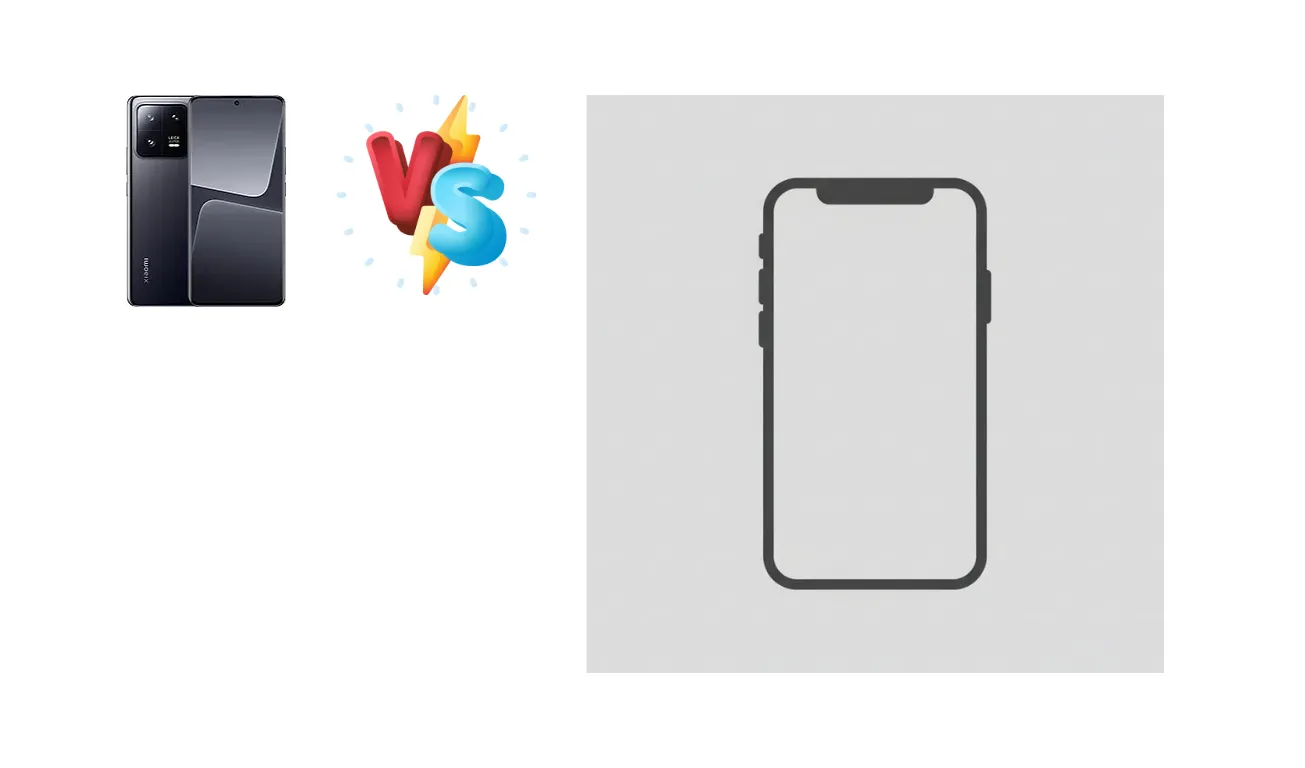
Xiaomi 13 Pro vs Samsung Galaxy S23+: Which Flagship Reigns Supreme?
| Phones Images | |||||
|---|---|---|---|---|---|
|
🏆 Quick Verdict
The Xiaomi 13 Pro takes the lead with its significantly faster charging, brighter display, and arguably more versatile camera system. However, the Galaxy S23+ benefits from Samsung's refined software, broader ecosystem integration, and generally more consistent performance. It's a close call, but the Xiaomi offers more 'wow' factor.
| PHONES | ||
|---|---|---|
| Phone Names | Xiaomi 13 Pro | Samsung Galaxy S23+ |
| Network | ||
|---|---|---|
| 2G bands | GSM 850 / 900 / 1800 / 1900 | GSM 850 / 900 / 1800 / 1900 - SIM 1 & SIM 2 (Dual SIM model only) |
| 3G bands | HSDPA 800 / 850 / 900 / 1700(AWS) / 1900 / 2100 | HSDPA 850 / 900 / 1700(AWS) / 1900 / 2100 |
| 4G bands | 1, 2, 3, 4, 5, 7, 8, 12, 13, 17, 18, 19, 20, 25, 26, 28, 32, 38, 39, 40, 41, 42, 48, 66 - International | 1, 2, 3, 4, 5, 7, 8, 12, 13, 17, 18, 19, 20, 25, 26, 28, 32, 38, 39, 40, 41, 66 - International |
| 5G bands | 1, 3, 5, 7, 8, 20, 28, 38, 40, 41, 66, 71, 75, 77, 78 SA/NSA - International | 1, 2, 3, 5, 7, 8, 12, 20, 25, 28, 38, 40, 41, 66, 75, 77, 78 SA/NSA/Sub6 - International |
| Speed | HSPA, LTE, 5G | HSPA, LTE-A (up to 7CA), 5G |
| Technology | GSM / CDMA / HSPA / CDMA2000 / LTE / 5G | GSM / CDMA / HSPA / EVDO / LTE / 5G |
| 1, 3, 5, 8, 28, 38, 40, 41, 77, 78, 79 SA/NSA - China | 1, 7, 28, 41, 66, 71, 78, 258, 260, 261 SA/NSA/Sub6/mmWave - USA | |
| Launch | ||
|---|---|---|
| Announced | 2022, December 11 | 2023, February 01 |
| Status | Available. Released 2022, December 14 | Available. Released 2023, February 17 |
| Body | ||
|---|---|---|
| Build | Glass front (Gorilla Glass Victus), ceramic back or silicone polymer back, aluminum frame | Glass front (Gorilla Glass Victus 2), glass back (Gorilla Glass Victus 2), aluminum frame |
| Dimensions | 162.9 x 74.6 x 8.4 mm or 8.7 mm | 157.8 x 76.2 x 7.6 mm (6.21 x 3.00 x 0.30 in) |
| SIM | · Nano-SIM + eSIM· Nano-SIM + Nano-SIM | Nano-SIM and eSIM or Dual SIM (2 Nano-SIMs and eSIM, dual stand-by) |
| Weight | 210 g or 229 g (7.41 oz) | 196 g (6.91 oz) |
| IP68 dust/water resistant (up to 1.5m for 30 min) | IP68 dust/water resistant (up to 1.5m for 30 min) Armor aluminum frame with tougher drop and scratch resistance (advertised) | |
| Display | ||
|---|---|---|
| Protection | Corning Gorilla Glass Victus | Corning Gorilla Glass Victus 2 |
| Resolution | 1440 x 3200 pixels, 20:9 ratio (~522 ppi density) | 1080 x 2340 pixels, 19.5:9 ratio (~393 ppi density) |
| Size | 6.73 inches, 108.9 cm2 (~89.6% screen-to-body ratio) | 6.6 inches, 105.3 cm2 (~87.6% screen-to-body ratio) |
| Type | LTPO AMOLED, 1B colors, 120Hz, Dolby Vision, HDR10+, 1200 nits (HBM), 1900 nits (peak) | Dynamic AMOLED 2X, 120Hz, HDR10+, 1200 nits (HBM), 1750 nits (peak) |
| - | Always-on display | |
| Platform | ||
|---|---|---|
| CPU | Octa-core (1x3.2 GHz Cortex-X3 & 2x2.8 GHz Cortex-A715 & 2x2.8 GHz Cortex-A710 & 3x2.0 GHz Cortex-A510) | Octa-core (1x3.36 GHz Cortex-X3 & 2x2.8 GHz Cortex-A715 & 2x2.8 GHz Cortex-A710 & 3x2.0 GHz Cortex-A510) |
| Chipset | Qualcomm SM8550-AB Snapdragon 8 Gen 2 (4 nm) | Qualcomm SM8550-AC Snapdragon 8 Gen 2 (4 nm) |
| GPU | Adreno 740 | Adreno 740 |
| OS | Android 13, upgradable to Android 14, HyperOS | Android 13, One UI 5.1 |
| Memory | ||
|---|---|---|
| Card slot | No | No |
| Internal | 128GB 8GB RAM, 256GB 8GB RAM, 256GB 12GB RAM, 512GB 12GB RAM | 256GB 8GB RAM, 512GB 8GB RAM |
| UFS 3.1 - 128GB UFS 4.0 - 256/512GB | UFS 4.0 | |
| Main Camera | ||
|---|---|---|
| Features | Laser AF, color spectrum sensor, Leica lens, Dual-LED dual-tone flash, HDR, panorama | LED flash, auto-HDR, panorama |
| Triple | 50.3 MP, f/1.9, 23mm (wide), 1.0"-type, 1.6µm, dual pixel PDAF, OIS 50 MP, f/2.0, 75mm (telephoto), PDAF (10cm - ∞), 3.2x optical zoom 50 MP, f/2.2, 14mm, 115˚ (ultrawide), AF | 50 MP, f/1.8, 24mm (wide), 1/1.56", 1.0µm, Dual Pixel PDAF, OIS 10 MP, f/2.4, 70mm (telephoto), 1/3.94", 1.0µm, PDAF, OIS, 3x optical zoom 12 MP, f/2.2, 13mm, 120˚ (ultrawide), 1/2.55" 1.4µm, Super Steady video |
| Video | 8K@24fps (HDR), 4K@24/30/60fps (HDR10+, 10-bit Dolby Vision HDR, 10-bit LOG), 1080p@30/120/240/960fps, 1080p@1920fps, gyro-EIS | 8K@24/30fps, 4K@30/60fps, 1080p@30/60/240fps, 1080p@960fps, HDR10+, stereo sound rec., gyro-EIS |
| Selfie camera | ||
|---|---|---|
| Features | HDR, panorama | Dual video call, Auto-HDR, HDR10+ |
| Single | 32 MP, f/2.0, 22mm (wide), 1/3.14", 0.7µm | 12 MP, f/2.2, 26mm (wide), Dual Pixel PDAF |
| Video | 1080p@30fps | 4K@30/60fps, 1080p@30fps |
| Sound | ||
|---|---|---|
| 3.5mm jack | No | No |
| 35mm jack | No | - |
| Loudspeaker | Yes, with stereo speakers | Yes, with stereo speakers |
| 24-bit/192kHz audio | 32-bit/384kHz audio Tuned by AKG | |
| Comms | ||
|---|---|---|
| Bluetooth | 5.3, A2DP, aptX HD, aptX Adaptive | 5.3, A2DP, LE |
| Infrared port | Yes | - |
| NFC | Yes | Yes |
| Positioning | GPS (L1+L5), GLONASS (G1), BDS (B1I+B1c+B2a), GALILEO (E1+E5a), QZSS (L1+L5), NavIC (L5) | GPS, GLONASS, BDS, GALILEO |
| Radio | No | No |
| USB | USB Type-C 2.0, OTG | USB Type-C 3.2, OTG |
| WLAN | Wi-Fi 802.11 a/b/g/n/ac/6e, dual-band, Wi-Fi Direct | Wi-Fi 802.11 a/b/g/n/ac/6e, tri-band, Wi-Fi Direct |
| Features | ||
|---|---|---|
| Sensors | Fingerprint (under display, optical), accelerometer, proximity, gyro, compass, barometer | Fingerprint (under display, ultrasonic), accelerometer, gyro, proximity, compass, barometer |
| - | Samsung DeX, Samsung Wireless DeX (desktop experience support) Bixby natural language commands and dictation Samsung Pay (Visa, MasterCard certified) Ultra Wideband (UWB) support | |
| Battery | ||
|---|---|---|
| Charging | 120W wired, PD3.0, QC4, 100% in 19 min 50W wireless, 100% in 36 min 10W reverse wireless | 45W wired, PD3.0, 65% in 30 min (advertised) 15W wireless (Qi/PMA) 4.5W reverse wireless |
| Type | Li-Po 4820 mAh | Li-Ion 4700 mAh, non-removable |
| Misc | ||
|---|---|---|
| Colors | Ceramic White, Ceramic Black, Ceramic Flora Green, Mountain Blue | Phantom Black, Cream, Green, Lavender, Graphite, Lime |
| Models | 2210132G, 2210132C | SM-S916B, SM-S916B/DS, SM-S916U, SM-S916U1, SM-S916W, SM-S916N, SM-S9160, SM-S916E, SM-S916E/DS |
| Price | About 750 EUR | $ 780.00 / C$ 1,399.99 / £ 919.08 / € 1,185.89 / ₹ 94,999 |
| SAR | - | 0.95 W/kg (head) 1.04 W/kg (body) |
| SAR EU | - | 0.77 W/kg (head) 1.45 W/kg (body) |
| Tests | ||
|---|---|---|
| Battery life | Endurance rating 115h | Endurance rating 111h |
| Camera | Photo / Video | Photo / Video |
| Display | Contrast ratio: Infinite (nominal) | Contrast ratio: Infinite (nominal) |
| Loudspeaker | -25.6 LUFS (Very good) | -26.5 LUFS (Good) |
| Performance | AnTuTu: 1281666 (v9) GeekBench: 5087 (v5.1), 5323 (v6) GFXBench: 64fps (ES 3.1 onscreen) | AnTuTu: 1234077 (v9) GeekBench: 5073 (v5.1) GFXBench: 110fps (ES 3.1 onscreen) |
Xiaomi 13 Pro
- Blazing-fast 120W charging
- Brighter display
- Versatile camera system with 1-inch sensor
- Excellent performance
- MIUI software can be polarizing
- Camera processing can be inconsistent
Samsung Galaxy S23+
- Refined One UI software
- Strong ecosystem integration
- Consistent camera performance
- Premium build quality
- Slower charging speeds
- Less impressive display brightness compared to Xiaomi
- Higher price
Display Comparison
Both phones feature excellent AMOLED displays with vibrant colors and deep blacks. However, the Xiaomi 13 Pro boasts a significantly higher peak brightness (1253 nits vs. estimated 1200 nits for the S23+), making it easier to see in direct sunlight. Both have excellent contrast ratios (Infinite nominal). The Xiaomi's display might offer a slightly more visually striking experience.
Camera Comparison
The Xiaomi 13 Pro features a larger 1-inch sensor on its main camera, promising superior low-light performance and dynamic range. While both phones capture excellent photos and videos, the Xiaomi's camera system offers more versatility with its telephoto lens. Samsung's image processing tends to be more consistent and color-accurate, while Xiaomi's can sometimes be more saturated. Video recording capabilities are excellent on both.
Performance
Both devices are powered by the Snapdragon 8 Gen 2, but the Xiaomi 13 Pro has a slightly higher clocked prime core (3.2 GHz vs 3.36 GHz). In real-world usage, the difference is minimal. Both phones offer blazing-fast performance for gaming, multitasking, and demanding applications. Samsung's software optimization might provide a slightly smoother, more consistent experience overall.
Battery Life
The Xiaomi 13 Pro shines in this category with its incredibly fast 120W wired charging (100% in 19 minutes) and 50W wireless charging. The Galaxy S23+ offers a more modest 45W wired charging (advertised 65% in 30 minutes) and 15W wireless charging. Both phones have similar endurance ratings (115h vs 111h), suggesting comparable battery life under typical usage.
Buying Guide
The Xiaomi 13 Pro is ideal for power users who prioritize fast charging, a vibrant display, and a camera that excels in various conditions. The Samsung Galaxy S23+ is a better choice for those deeply invested in the Samsung ecosystem, who value software stability and a more polished, user-friendly experience.