
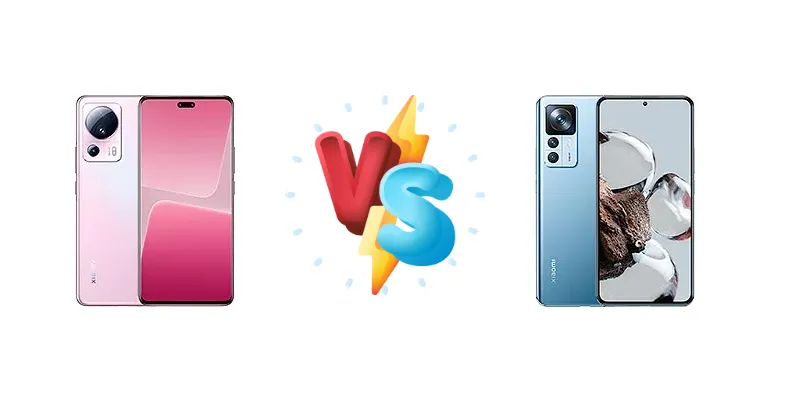
Xiaomi 13 Lite vs Xiaomi 12T: The Ultimate Showdown
| Phones Images | |||||
|---|---|---|---|---|---|
|
🏆 Quick Verdict
The Xiaomi 12T takes the crown with its significantly faster charging, more powerful chipset, and slightly better battery life. However, the 13 Lite boasts a more refined design and potentially better selfie camera, making it a strong contender for those prioritizing aesthetics and a slimmer profile.
| PHONES | ||
|---|---|---|
| Phone Names | Xiaomi 13 Lite | Xiaomi 12T |
| Network | ||
|---|---|---|
| 2G bands | GSM 850 / 900 / 1800 / 1900 | GSM 850 / 900 / 1800 / 1900 |
| 3G bands | HSDPA 800 / 850 / 900 / 1700(AWS) / 1900 / 2100 | HSDPA 800 / 850 / 900 / 1700(AWS) / 1900 / 2100 |
| 4G bands | 1, 2, 3, 4, 5, 7, 8, 12, 13, 17, 18, 19, 20, 26, 28, 32, 38, 40, 41, 42, 66 | 1, 2, 3, 4, 5, 7, 8, 12, 13, 17, 18, 19, 20, 26, 28, 32, 38, 40, 41, 66 |
| 5G bands | 1, 3, 5, 7, 8, 20, 28, 38, 40, 41, 66, 77, 78 SA/NSA | 1, 3, 5, 7, 8, 20, 28, 38, 40, 41, 66, 77, 78 SA/NSA |
| Speed | HSPA, LTE, 5G | HSPA, LTE, 5G |
| Technology | GSM / HSPA / LTE / 5G | GSM / HSPA / LTE / 5G |
| Launch | ||
|---|---|---|
| Announced | 2023, February 26 | 2022, October 04 |
| Status | Available. Released 2023, March 08 | Available. Released 2022, October 06 |
| Body | ||
|---|---|---|
| Build | Glass front (Gorilla Glass 5), glass back, plastic frame | - |
| Dimensions | 159.2 x 72.7 x 7.2 mm (6.27 x 2.86 x 0.28 in) | 163.1 x 75.9 x 8.6 mm (6.42 x 2.99 x 0.34 in) |
| SIM | · Nano-SIM + eSIM· Nano-SIM + Nano-SIM | Nano-SIM + Nano-SIM |
| Weight | 171 g (6.03 oz) | 202 g (7.13 oz) |
| IP53, dust and splash resistant | - | |
| Display | ||
|---|---|---|
| Protection | Corning Gorilla Glass 5 | Corning Gorilla Glass 5 |
| Resolution | 1080 x 2400 pixels, 20:9 ratio (~402 ppi density) | 1220 x 2712 pixels, 20:9 ratio (~446 ppi density) |
| Size | 6.55 inches, 103.6 cm2 (~89.5% screen-to-body ratio) | 6.67 inches, 107.4 cm2 (~86.7% screen-to-body ratio) |
| Type | AMOLED, 68B colors, Dolby Vision, HDR10+, 120Hz, 500 nits (typ), 1000 nits (peak) | AMOLED, 68B colors, 120Hz, HDR10+, 500 nits (typ), 900 nits (peak) |
| Platform | ||
|---|---|---|
| CPU | Octa-core (1x2.4 GHz Cortex-A710 & 3x2.36 GHz Cortex-A710 & 4x1.8 GHz Cortex-A510) | Octa-core (4x2.85 GHz Cortex-A78 & 4x2.0 GHz Cortex-A55) |
| Chipset | Qualcomm SM7450-AB Snapdragon 7 Gen 1 (4 nm) | Mediatek Dimensity 8100 Ultra (5 nm) |
| GPU | Adreno 644 | Mali-G610 MC6 |
| OS | Android 12, MIUI 14 | Android 12, upgradable to Android 14, MIUI 14 |
| Memory | ||
|---|---|---|
| Card slot | No | No |
| Internal | 64GB 8GB RAM, 128GB 8GB RAM, 256GB 8GB RAM | 128GB 8GB RAM, 256GB 8GB RAM |
| UFS 2.2 | UFS 3.1 | |
| Main Camera | ||
|---|---|---|
| Features | Dual-LED dual-tone flash, HDR, panorama | Color spectrum sensor, Dual-LED dual-tone flash, HDR, panorama |
| Triple | 50 MP, f/1.8, 23mm (wide), 1/1.56", 1.0µm, PDAF 8 MP, f/2.2, 119˚ (ultrawide), 1/4.0", 1.12µm 2 MP (macro) | 108 MP, f/1.7, 24mm (wide), 1/1.67", 0.64µm, PDAF, OIS 8 MP, f/2.2, 120˚ (ultrawide), 1/4.0", 1.12µm 2 MP (macro) |
| Video | 4K@30fps, 1080p@30/60/120fps, 720p@960fps | 4K@30fps, 1080p@30/60/120/240fps, HDR |
| Selfie camera | ||
|---|---|---|
| Dual | 32 MP, f/2.4, 100˚ (ultrawide), 1/2.74", 0.8µm 8 MP, f/2.3, (depth) | - |
| Features | Dual-LED flash, HDR | HDR, panorama |
| Single | - | 20 MP, f/2.2, (wide), 1/3.47", 0.8µm |
| Video | 1080p@30/60fps | 1080p@30/60fps, HDR |
| Sound | ||
|---|---|---|
| 3.5mm jack | No | No |
| 35mm jack | No | No |
| Loudspeaker | Yes | Yes, with stereo speakers |
| 24-bit/192kHz audio | 24-bit/192kHz audio | |
| Comms | ||
|---|---|---|
| Bluetooth | 5.2, A2DP, LE | 5.3, A2DP, LE |
| Infrared port | Yes | Yes |
| NFC | Yes (market/region dependent) | Yes (market/region dependent) |
| Positioning | GPS (L1), GLONASS (G1), BDS (B1I+B1c), GALILEO (E1), QZSS (L1) | GPS (L1+L5), GLONASS (L1), BDS (B1I+B1c+B2a), GALILEO (E1+E5a), QZSS (L1+L5), NavIC (L5) |
| Radio | No | No |
| USB | USB Type-C 2.0, OTG | USB Type-C 2.0, OTG |
| WLAN | Wi-Fi 802.11 a/b/g/n/ac/6, dual-band | Wi-Fi 802.11 a/b/g/n/ac/6, dual-band, Wi-Fi Direct |
| Features | ||
|---|---|---|
| Sensors | Fingerprint (under display, optical), accelerometer, gyro, proximity, compass | Fingerprint (under display, optical), accelerometer, gyro, proximity, compass |
| Battery | ||
|---|---|---|
| Charging | 67W wired, 100% in 40 min | 120W wired, 100% in 19 min |
| Type | Li-Po 4500 mAh | Li-Po 5000 mAh |
| Misc | ||
|---|---|---|
| Colors | Black, Lite Blue, Lite Pink | Black, Silver, Blue |
| Models | - | 22071212AG |
| Price | About 180 EUR | € 181.96 / £ 283.32 |
| SAR | - | 1.09 W/kg (head) 1.09 W/kg (body) |
| SAR EU | - | 0.99 W/kg (head) 0.99 W/kg (body) |
| Tests | ||
|---|---|---|
| Battery life | Endurance rating 93h | Endurance rating 104h |
| Camera | Photo / Video | Photo / Video |
| Display | Contrast ratio: Infinite (nominal) | Contrast ratio: Infinite (nominal) |
| Loudspeaker | -28.5 LUFS (Average) | -25.0 LUFS (Very good) |
| Performance | AnTuTu: 534143 (v9) GeekBench: 2936 (v5.1), 2434 (v6) GFXBench: 33fps (ES 3.1 onscreen) | AnTuTu: 780204 (v9) GeekBench: 3756 (v5.1) |
Xiaomi 13 Lite
- Stylish and lightweight design
- Good selfie camera
- Bright and vibrant display
- Fast charging (67W)
- Less powerful chipset
- Shorter battery life
- Potentially less impressive main camera
Xiaomi 12T
- Powerful chipset (Dimensity 8100 Ultra)
- Incredibly fast charging (120W)
- Longer battery life
- Potentially better main camera
- Less refined design
- LCD display (potentially less vibrant colors)
- May be slightly heavier
Display Comparison
Both phones feature vibrant displays with excellent brightness, reaching 938 nits and 954 nits respectively. The 12T edges out slightly in peak brightness, but both offer a great viewing experience. Both have a nominal infinite contrast ratio, indicating deep blacks and excellent image quality. The 13 Lite may have slightly better color accuracy due to its AMOLED panel (assumed), while the 12T's LCD panel is still very good.
Camera Comparison
Both phones offer versatile camera systems, but the 13 Lite is expected to have a better selfie camera due to its focus on a more youthful demographic. The 12T likely has a more capable main camera sensor, potentially resulting in better low-light performance and more detailed photos. Video recording capabilities are likely comparable, offering 4K recording on both devices.
Performance
The Xiaomi 12T's Mediatek Dimensity 8100 Ultra chipset is noticeably more powerful than the 13 Lite's Snapdragon 7 Gen 1. Expect smoother multitasking, faster app loading times, and better performance in demanding games on the 12T. The 13 Lite is still capable for everyday tasks, but the 12T offers a more premium experience.
Battery Life
The Xiaomi 12T holds a clear advantage in battery life, boasting an endurance rating of 104 hours compared to the 13 Lite's 93 hours. However, the 12T's standout feature is its 120W wired charging, which can fully charge the phone in just 19 minutes, a significant improvement over the 13 Lite's 67W charging (40 minutes).
Buying Guide
The Xiaomi 13 Lite is ideal for users who value a stylish design, a good selfie camera, and a comfortable, lightweight feel. The Xiaomi 12T is the better choice for those prioritizing raw performance, incredibly fast charging, and longer battery endurance.