
Xiaomi 13 Lite vs Xiaomi 12 Lite: A Detailed Comparison
| Phones Images | |||||
|---|---|---|---|---|---|
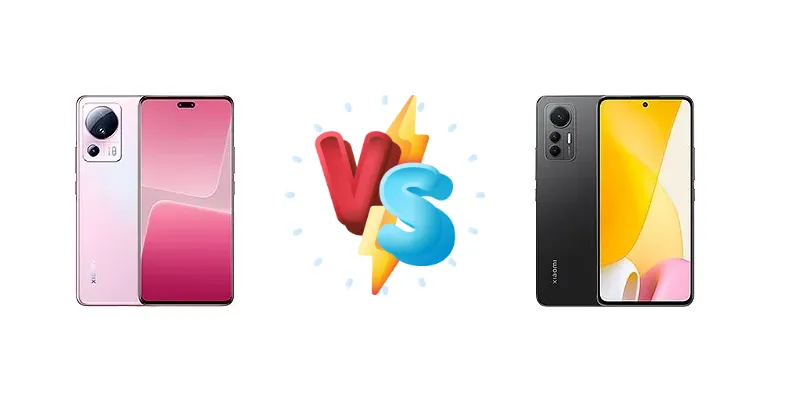
|
🏆 Quick Verdict
The Xiaomi 13 Lite boasts a brighter display and a newer, slightly faster chipset. However, the 12 Lite edges out with marginally better battery life and faster initial charging. Ultimately, the 13 Lite is a worthwhile upgrade if display quality and performance are priorities, while the 12 Lite remains a strong contender for budget-conscious buyers.
| PHONES | ||
|---|---|---|
| Phone Names | Xiaomi 13 Lite | Xiaomi 12 Lite |
| Network | ||
|---|---|---|
| 2G bands | GSM 850 / 900 / 1800 / 1900 | GSM 850 / 900 / 1800 / 1900 |
| 3G bands | HSDPA 800 / 850 / 900 / 1700(AWS) / 1900 / 2100 | HSDPA 850 / 900 / 1700(AWS) / 1900 / 2100 |
| 4G bands | 1, 2, 3, 4, 5, 7, 8, 12, 13, 17, 18, 19, 20, 26, 28, 32, 38, 40, 41, 42, 66 | 1, 2, 3, 4, 5, 7, 8, 12, 13, 17, 18, 19, 20, 26, 28, 32, 38, 40, 41, 42, 48, 66 |
| 5G bands | 1, 3, 5, 7, 8, 20, 28, 38, 40, 41, 66, 77, 78 SA/NSA | 1, 3, 5, 7, 8, 20, 28, 38, 40, 41, 66, 77, 78 SA/NSA |
| Speed | HSPA, LTE, 5G | HSPA, LTE, 5G |
| Technology | GSM / HSPA / LTE / 5G | GSM / HSPA / LTE / 5G |
| Launch | ||
|---|---|---|
| Announced | 2023, February 26 | 2022, July 09 |
| Status | Available. Released 2023, March 08 | Available. Released 2022, July 11 |
| Body | ||
|---|---|---|
| Build | Glass front (Gorilla Glass 5), glass back, plastic frame | Glass front (Gorilla Glass 5), glass back, plastic frame |
| Dimensions | 159.2 x 72.7 x 7.2 mm (6.27 x 2.86 x 0.28 in) | 159.3 x 73.7 x 7.3 mm (6.27 x 2.90 x 0.29 in) |
| SIM | · Nano-SIM + eSIM· Nano-SIM + Nano-SIM | Nano-SIM + Nano-SIM |
| Weight | 171 g (6.03 oz) | 173 g (6.10 oz) |
| IP53, dust and splash resistant | - | |
| Display | ||
|---|---|---|
| Protection | Corning Gorilla Glass 5 | Corning Gorilla Glass 5 |
| Resolution | 1080 x 2400 pixels, 20:9 ratio (~402 ppi density) | 1080 x 2400 pixels, 20:9 ratio (~402 ppi density) |
| Size | 6.55 inches, 103.6 cm2 (~89.5% screen-to-body ratio) | 6.55 inches, 103.6 cm2 (~88.2% screen-to-body ratio) |
| Type | AMOLED, 68B colors, Dolby Vision, HDR10+, 120Hz, 500 nits (typ), 1000 nits (peak) | AMOLED, 68B colors, 120Hz, Dolby Vision, HDR10+, 950 nits (peak) |
| Platform | ||
|---|---|---|
| CPU | Octa-core (1x2.4 GHz Cortex-A710 & 3x2.36 GHz Cortex-A710 & 4x1.8 GHz Cortex-A510) | Octa-core (1x2.4 GHz Cortex-A78 & 3x2.2 GHz Cortex-A78 & 4x1.9 GHz Cortex-A55) |
| Chipset | Qualcomm SM7450-AB Snapdragon 7 Gen 1 (4 nm) | Qualcomm SM7325 Snapdragon 778G 5G (6 nm) |
| GPU | Adreno 644 | Adreno 642L |
| OS | Android 12, MIUI 14 | Android 12, upgradable to Android 14, HyperOS |
| Memory | ||
|---|---|---|
| Card slot | No | No |
| Internal | 64GB 8GB RAM, 128GB 8GB RAM, 256GB 8GB RAM | 128GB 6GB RAM, 128GB 8GB RAM, 256GB 8GB RAM |
| UFS 2.2 | UFS 2.2 | |
| Main Camera | ||
|---|---|---|
| Features | Dual-LED dual-tone flash, HDR, panorama | Dual-LED dual-tone flash, HDR, panorama |
| Single | - | 32 MP, f/2.5, (wide), 1/2.8", 0.8µm, AF |
| Triple | 50 MP, f/1.8, 23mm (wide), 1/1.56", 1.0µm, PDAF 8 MP, f/2.2, 119˚ (ultrawide), 1/4.0", 1.12µm 2 MP (macro) | 108 MP, f/1.9, 26mm (wide), 1/1.52", 0.7µm, PDAF 8 MP, f/2.2, 120˚ (ultrawide), 1/4.0", 1.12µm 2 MP (macro) |
| Video | 4K@30fps, 1080p@30/60/120fps, 720p@960fps | 4K@30fps, 1080p@30/60/120fps; gyro-EIS |
| Selfie camera | ||
|---|---|---|
| Dual | 32 MP, f/2.4, 100˚ (ultrawide), 1/2.74", 0.8µm 8 MP, f/2.3, (depth) | - |
| Features | Dual-LED flash, HDR | HDR, panorama |
| Single | - | 32 MP, f/2.5, (wide), 1/2.8", 0.8µm, AF |
| Video | 1080p@30/60fps | 1080p@30/60fps, 720p@120fps |
| Sound | ||
|---|---|---|
| 3.5mm jack | No | No |
| 35mm jack | No | No |
| Loudspeaker | Yes | Yes, with dual speakers |
| 24-bit/192kHz audio | 24-bit/192kHz audio | |
| Comms | ||
|---|---|---|
| Bluetooth | 5.2, A2DP, LE | 5.2, A2DP, LE, aptX HD, aptX Adaptive |
| Infrared port | Yes | Yes |
| NFC | Yes (market/region dependent) | Yes (market/region dependent) |
| Positioning | GPS (L1), GLONASS (G1), BDS (B1I+B1c), GALILEO (E1), QZSS (L1) | GPS (L1), GLONASS (G1), BDS (B1I+B1c), GALILEO (E1), QZSS (L1) |
| Radio | No | No |
| USB | USB Type-C 2.0, OTG | USB Type-C 2.0, OTG |
| WLAN | Wi-Fi 802.11 a/b/g/n/ac/6, dual-band | Wi-Fi 802.11 a/b/g/n/ac/6, dual-band, Wi-Fi Direct |
| Features | ||
|---|---|---|
| Sensors | Fingerprint (under display, optical), accelerometer, gyro, proximity, compass | Fingerprint (under display, optical), accelerometer, gyro, compass |
| - | Virtual proximity sensing | |
| Battery | ||
|---|---|---|
| Charging | 67W wired, 100% in 40 min | 67W wired, PD3.0, QC4, 50% in 13 min |
| Type | Li-Po 4500 mAh | Li-Po 4300 mAh |
| Misc | ||
|---|---|---|
| Colors | Black, Lite Blue, Lite Pink | Black, Lite Green, Lite Pink |
| Models | - | 2203129G |
| Price | About 180 EUR | € 119.80 / $ 269.00 / £ 121.15 |
| SAR | - | 1.09 W/kg (head) 0.73 W/kg (body) |
| SAR EU | - | 0.60 W/kg (head) 1.00 W/kg (body) |
| Tests | ||
|---|---|---|
| Battery life | Endurance rating 93h | Endurance rating 100h |
| Camera | Photo / Video | Photo / Video |
| Display | Contrast ratio: Infinite (nominal) | Contrast ratio: Infinite (nominal) |
| Loudspeaker | -28.5 LUFS (Average) | -25.2 LUFS (Very good) |
| Performance | AnTuTu: 534143 (v9) GeekBench: 2936 (v5.1), 2434 (v6) GFXBench: 33fps (ES 3.1 onscreen) | AnTuTu: 528905 (v9) GeekBench: 2943 (v5.1) GFXBench: 29fps (ES 3.1 onscreen) |
Xiaomi 13 Lite
- Brighter Display
- Newer Chipset (Snapdragon 7 Gen 1)
- Faster Charging (40 min to 100%)
- Sleeker Design (generally)
- Slightly lower battery endurance
- Potentially higher price
Xiaomi 12 Lite
- Excellent Battery Life (100h endurance)
- Faster initial charging (50% in 13 min)
- Potentially lower price
- Proven Reliability
- Less bright display
- Older Chipset (Snapdragon 778G 5G)
Display Comparison
The Xiaomi 13 Lite takes the lead here with a measured peak brightness of 938 nits, significantly brighter than the 12 Lite's 824 nits. Both offer excellent contrast ratios (Infinite, nominally), resulting in vibrant colors and deep blacks. The 13 Lite's brighter screen will be more visible in direct sunlight.
Camera Comparison
Both phones feature capable camera systems, but detailed comparisons require more in-depth testing. Generally, the 13 Lite's newer image processing algorithms may offer slightly improved image quality, particularly in challenging lighting conditions. Both phones offer good video recording capabilities.
Performance
The Snapdragon 7 Gen 1 in the 13 Lite is a newer chipset built on a 4nm process, offering a slight performance advantage over the 12 Lite's Snapdragon 778G 5G (6nm). While both are capable of handling everyday tasks and moderate gaming, the 13 Lite should exhibit smoother multitasking and slightly faster app loading times. Real-world differences will be noticeable but not drastic.
Battery Life
The Xiaomi 12 Lite holds a slight edge in battery endurance, boasting an endurance rating of 100 hours compared to the 13 Lite's 93 hours. However, the 13 Lite's 67W charging is faster, reaching 100% in 40 minutes, while the 12 Lite reaches 50% in 13 minutes. This means the 13 Lite will charge faster, even if it doesn't last quite as long on a single charge.
Buying Guide
The Xiaomi 13 Lite is ideal for users who prioritize a vibrant display for media consumption and gaming, and appreciate a more modern chipset for smoother performance. The Xiaomi 12 Lite is a great choice for those seeking excellent battery life and a proven, reliable performer at a potentially lower price point.