
Xiaomi 12X vs Xiaomi 13 Lite: A Detailed Comparison
| Phones Images | |||||
|---|---|---|---|---|---|
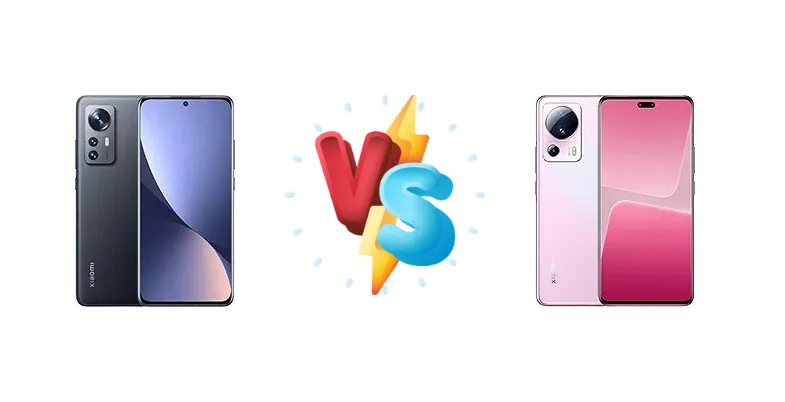
|
🏆 Quick Verdict
The Xiaomi 12X boasts a superior Snapdragon 870 chipset, offering noticeably faster performance. However, the Xiaomi 13 Lite shines with a brighter display and a more modern design. For performance enthusiasts, the 12X wins; for those prioritizing display and aesthetics, the 13 Lite is the better choice.
| PHONES | ||
|---|---|---|
| Phone Names | Xiaomi 12X | Xiaomi 13 Lite |
| Network | ||
|---|---|---|
| 2G bands | GSM 850 / 900 / 1800 / 1900 | GSM 850 / 900 / 1800 / 1900 |
| 3G bands | HSDPA 800 / 850 / 900 / 1700(AWS) / 1900 / 2100 | HSDPA 800 / 850 / 900 / 1700(AWS) / 1900 / 2100 |
| 4G bands | 1, 2, 3, 4, 5, 7, 8, 12, 13, 17, 18, 19, 20, 26, 28, 32, 38, 39, 40, 41, 42, 48, 66 - International | 1, 2, 3, 4, 5, 7, 8, 12, 13, 17, 18, 19, 20, 26, 28, 32, 38, 40, 41, 42, 66 |
| 5G bands | 1, 3, 5, 7, 8, 20, 28, 38, 40, 41, 66, 77, 78 SA/NSA - International | 1, 3, 5, 7, 8, 20, 28, 38, 40, 41, 66, 77, 78 SA/NSA |
| Speed | HSPA, LTE, 5G | HSPA, LTE, 5G |
| Technology | GSM / CDMA / HSPA / EVDO / LTE / 5G | GSM / HSPA / LTE / 5G |
| 1, 3, 5, 8, 28, 38, 40, 41, 77, 78 SA/NSA - China | - | |
| Launch | ||
|---|---|---|
| Announced | 2021, December 28 | 2023, February 26 |
| Status | Available. Released 2021, December 31 | Available. Released 2023, March 08 |
| Body | ||
|---|---|---|
| Build | - | Glass front (Gorilla Glass 5), glass back, plastic frame |
| Dimensions | 152.7 x 69.9 x 8.2 mm (6.01 x 2.75 x 0.32 in) | 159.2 x 72.7 x 7.2 mm (6.27 x 2.86 x 0.28 in) |
| SIM | Nano-SIM + Nano-SIM | · Nano-SIM + eSIM· Nano-SIM + Nano-SIM |
| Weight | 176 g (6.21 oz) | 171 g (6.03 oz) |
| - | IP53, dust and splash resistant | |
| Display | ||
|---|---|---|
| Protection | Corning Gorilla Glass Victus | Corning Gorilla Glass 5 |
| Resolution | 1080 x 2400 pixels, 20:9 ratio (~419 ppi density) | 1080 x 2400 pixels, 20:9 ratio (~402 ppi density) |
| Size | 6.28 inches, 95.2 cm2 (~89.2% screen-to-body ratio) | 6.55 inches, 103.6 cm2 (~89.5% screen-to-body ratio) |
| Type | AMOLED, 68B colors, 120Hz, Dolby Vision, HDR10+, 1100 nits (peak) | AMOLED, 68B colors, Dolby Vision, HDR10+, 120Hz, 500 nits (typ), 1000 nits (peak) |
| Platform | ||
|---|---|---|
| CPU | Octa-core (1x3.2 GHz Kryo 585 & 3x2.42 GHz Kryo 585 & 4x1.80 GHz Kryo 585) | Octa-core (1x2.4 GHz Cortex-A710 & 3x2.36 GHz Cortex-A710 & 4x1.8 GHz Cortex-A510) |
| Chipset | Qualcomm SM8250-AC Snapdragon 870 5G (7 nm) | Qualcomm SM7450-AB Snapdragon 7 Gen 1 (4 nm) |
| GPU | Adreno 650 | Adreno 644 |
| OS | Android 11, MIUI 13 | Android 12, MIUI 14 |
| Memory | ||
|---|---|---|
| Card slot | No | No |
| Internal | 128GB 8GB RAM, 256GB 8GB RAM, 256GB 12GB RAM | 64GB 8GB RAM, 128GB 8GB RAM, 256GB 8GB RAM |
| UFS 3.1 | UFS 2.2 | |
| Main Camera | ||
|---|---|---|
| Features | Dual-LED dual-tone flash, HDR, panorama | Dual-LED dual-tone flash, HDR, panorama |
| Single | 32 MP, f/2.5, 26mm (wide), 0.7µm | - |
| Triple | 50 MP, f/1.9, 26mm (wide), 1/1.56", 1.0µm, PDAF, OIS 13 MP, f/2.4, 12mm, 123˚ (ultrawide), 1/3.06", 1.12µm 5 MP, f/2.4, 50mm (telephoto macro), AF | 50 MP, f/1.8, 23mm (wide), 1/1.56", 1.0µm, PDAF 8 MP, f/2.2, 119˚ (ultrawide), 1/4.0", 1.12µm 2 MP (macro) |
| Video | 8K@24fps, 4K@30/60fps, 1080p@30/120/240/960fps, gyro-EIS | 4K@30fps, 1080p@30/60/120fps, 720p@960fps |
| Selfie camera | ||
|---|---|---|
| Dual | - | 32 MP, f/2.4, 100˚ (ultrawide), 1/2.74", 0.8µm 8 MP, f/2.3, (depth) |
| Features | HDR, panorama | Dual-LED flash, HDR |
| Single | 32 MP, f/2.5, 26mm (wide), 0.7µm | - |
| Video | 1080p@30/60fps, 720p@120fps, HDR | 1080p@30/60fps |
| Sound | ||
|---|---|---|
| 3.5mm jack | No | No |
| 35mm jack | No | No |
| Loudspeaker | Yes, with stereo speakers | Yes |
| 24-bit/192kHz audio Tuned by Harman Kardon | 24-bit/192kHz audio | |
| Comms | ||
|---|---|---|
| Bluetooth | 5.1 / 5.2, A2DP, LE | 5.2, A2DP, LE |
| Infrared port | Yes | Yes |
| NFC | Yes (market/region dependent) | Yes (market/region dependent) |
| Positioning | GPS (L1+L5), GLONASS (L1), BDS (B1I+B1c+B2a), GALILEO (E1+E5a), QZSS (L1+L5), NavIC (L5) | GPS (L1), GLONASS (G1), BDS (B1I+B1c), GALILEO (E1), QZSS (L1) |
| Radio | No | No |
| USB | USB Type-C 2.0, OTG | USB Type-C 2.0, OTG |
| WLAN | Wi-Fi 802.11 a/b/g/n/ac, Wi-Fi 6 (market dependent), dual-band, Wi-Fi Direct | Wi-Fi 802.11 a/b/g/n/ac/6, dual-band |
| Features | ||
|---|---|---|
| Sensors | Fingerprint (under display, optical), accelerometer, proximity, gyro, compass | Fingerprint (under display, optical), accelerometer, gyro, proximity, compass |
| Battery | ||
|---|---|---|
| Charging | 67W wired, PD3.0, QC4, 100% in 39 min | 67W wired, 100% in 40 min |
| Type | Li-Po 4500 mAh | Li-Po 4500 mAh |
| Misc | ||
|---|---|---|
| Colors | Gray, Blue, Purple | Black, Lite Blue, Lite Pink |
| Models | 2112123AC, 2112123AG | - |
| Price | About 180 EUR | About 180 EUR |
| SAR EU | 0.59 W/kg (head) 1.00 W/kg (body) | - |
| Tests | ||
|---|---|---|
| Battery life | Endurance rating 105h | Endurance rating 93h |
| Camera | Photo / Video | Photo / Video |
| Display | Contrast ratio: Infinite (nominal) | Contrast ratio: Infinite (nominal) |
| Loudspeaker | -25.6 LUFS (Very good) | -28.5 LUFS (Average) |
| Performance | AnTuTu: 598003 (v8), 690298 (v9) GeekBench: 3168 (v5.1) GFXBench: 47fps (ES 3.1 onscreen) | AnTuTu: 534143 (v9) GeekBench: 2936 (v5.1), 2434 (v6) GFXBench: 33fps (ES 3.1 onscreen) |
Xiaomi 12X
- Superior Performance (Snapdragon 870)
- Compact Size
- Excellent Battery Life
- Fast Charging (67W)
- Older Design
- Less Bright Display
- Potentially Less Modern Camera
Xiaomi 13 Lite
- Brighter Display
- Modern Design
- Improved Selfie Camera
- Fast Charging (67W)
- Lower Performance (Snapdragon 7 Gen 1)
- Slightly Shorter Battery Life
- Potentially Less Powerful Main Camera
Display Comparison
The Xiaomi 13 Lite takes a clear lead in the display department. While both offer 'infinite' contrast ratio (a marketing term often used), the 13 Lite's measured 938 nits peak brightness is significantly higher than the 12X, making it much easier to see outdoors. The 12X's display is still good, but lacks the punch and visibility of the 13 Lite.
Camera Comparison
Both phones offer capable camera systems, but with different strengths. The 13 Lite likely has a more modern image processing pipeline, potentially resulting in slightly better dynamic range and color accuracy. The 12X's camera is still very good, but may lack some of the latest computational photography features. Selfie camera performance is likely better on the 13 Lite due to its more modern front-facing camera hardware.
Performance
Here, the Xiaomi 12X reigns supreme. Its Snapdragon 870 chipset is a flagship-level processor that still holds up incredibly well. The 13 Lite's Snapdragon 7 Gen 1 is a capable mid-range chip, but it simply can't match the 870's raw power, especially in demanding games or multitasking scenarios. Expect smoother performance and faster app loading times on the 12X.
Battery Life
The Xiaomi 12X edges out the 13 Lite slightly in battery endurance, with a reported 105h vs 93h. Both phones support 67W fast charging, achieving a full charge in roughly the same time (around 40 minutes). Real-world battery life will depend on usage patterns, but the 12X has a small advantage.
Buying Guide
Who should buy the Xiaomi 12X? Gamers and power users who prioritize raw performance and a compact form factor. Who should buy the Xiaomi 13 Lite? Users who value a vibrant display, a stylish design, and a more modern camera system, especially for selfies and social media.