
Xiaomi 12X vs Xiaomi 13: The Ultimate Showdown
| Phones Images | |||||
|---|---|---|---|---|---|
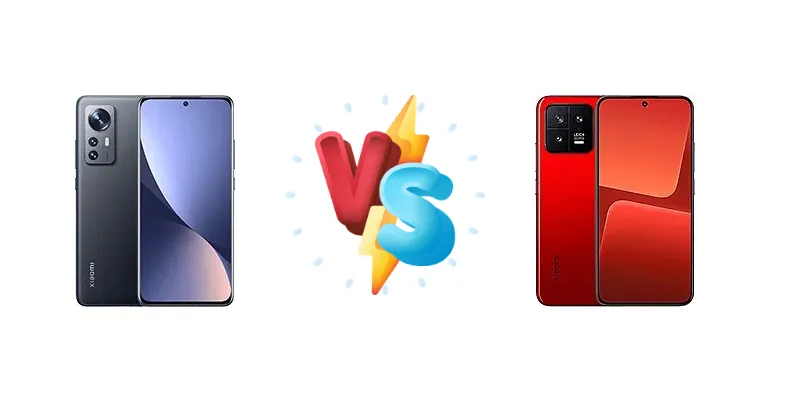
|
🏆 Quick Verdict
The Xiaomi 13 is the clear winner, boasting a significantly faster processor, brighter display, wireless charging, and a slightly better battery life. However, the 12X remains a compelling option for those prioritizing a more compact size and potentially a lower price point.
| PHONES | ||
|---|---|---|
| Phone Names | Xiaomi 12X | Xiaomi 13 |
| Network | ||
|---|---|---|
| 2G bands | GSM 850 / 900 / 1800 / 1900 | GSM 850 / 900 / 1800 / 1900 |
| 3G bands | HSDPA 800 / 850 / 900 / 1700(AWS) / 1900 / 2100 | HSDPA 800 / 850 / 900 / 1700(AWS) / 1900 / 2100 |
| 4G bands | 1, 2, 3, 4, 5, 7, 8, 12, 13, 17, 18, 19, 20, 26, 28, 32, 38, 39, 40, 41, 42, 48, 66 - International | 1, 2, 3, 4, 5, 7, 8, 12, 13, 17, 18, 19, 20, 25, 26, 28, 32, 38, 39, 40, 41, 42, 48, 66 - International |
| 5G bands | 1, 3, 5, 7, 8, 20, 28, 38, 40, 41, 66, 77, 78 SA/NSA - International | 1, 3, 5, 7, 8, 20, 28, 38, 40, 41, 66, 71, 75, 77, 78 SA/NSA - International |
| Speed | HSPA, LTE, 5G | HSPA, LTE, 5G |
| Technology | GSM / CDMA / HSPA / EVDO / LTE / 5G | GSM / CDMA / HSPA / CDMA2000 / LTE / 5G |
| 1, 3, 5, 8, 28, 38, 40, 41, 77, 78 SA/NSA - China | 1, 3, 5, 8, 28, 38, 40, 41, 77, 78 SA/NSA - China | |
| Launch | ||
|---|---|---|
| Announced | 2021, December 28 | 2022, December 11 |
| Status | Available. Released 2021, December 31 | Available. Released 2022, December 14 |
| Body | ||
|---|---|---|
| Build | - | Glass front (Gorilla Glass 5), glass back or silicone polymer back, aluminum frame |
| Dimensions | 152.7 x 69.9 x 8.2 mm (6.01 x 2.75 x 0.32 in) | 152.8 x 71.5 x 8.0 mm or 8.1 mm |
| SIM | Nano-SIM + Nano-SIM | · Nano-SIM + eSIM· Nano-SIM + Nano-SIM |
| Weight | 176 g (6.21 oz) | 185 g or 189 g (6.53 oz) |
| - | IP68 dust/water resistant (up to 1.5m for 30 min) | |
| Display | ||
|---|---|---|
| Protection | Corning Gorilla Glass Victus | Corning Gorilla Glass 5 |
| Resolution | 1080 x 2400 pixels, 20:9 ratio (~419 ppi density) | 1080 x 2400 pixels, 20:9 ratio (~414 ppi density) |
| Size | 6.28 inches, 95.2 cm2 (~89.2% screen-to-body ratio) | 6.36 inches, 97.7 cm2 (~89.4% screen-to-body ratio) |
| Type | AMOLED, 68B colors, 120Hz, Dolby Vision, HDR10+, 1100 nits (peak) | AMOLED, 120Hz, Dolby Vision, HDR10+, 1200 nits (HBM), 1900 nits (peak) |
| Platform | ||
|---|---|---|
| CPU | Octa-core (1x3.2 GHz Kryo 585 & 3x2.42 GHz Kryo 585 & 4x1.80 GHz Kryo 585) | Octa-core (1x3.2 GHz Cortex-X3 & 2x2.8 GHz Cortex-A715 & 2x2.8 GHz Cortex-A710 & 3x2.0 GHz Cortex-A510) |
| Chipset | Qualcomm SM8250-AC Snapdragon 870 5G (7 nm) | Qualcomm SM8550-AB Snapdragon 8 Gen 2 (4 nm) |
| GPU | Adreno 650 | Adreno 740 |
| OS | Android 11, MIUI 13 | Android 13, upgradable to Android 14, MIUI 14 |
| Memory | ||
|---|---|---|
| Card slot | No | No |
| Internal | 128GB 8GB RAM, 256GB 8GB RAM, 256GB 12GB RAM | 128GB 8GB RAM, 256GB 8GB RAM, 256GB 12GB RAM, 512GB 12GB RAM |
| UFS 3.1 | UFS 3.1 - 128GB UFS 4.0 - 256/512GB | |
| Main Camera | ||
|---|---|---|
| Features | Dual-LED dual-tone flash, HDR, panorama | Leica lens, color spectrum sensor, Dual-LED dual-tone flash, HDR, panorama |
| Single | 32 MP, f/2.5, 26mm (wide), 0.7µm | - |
| Triple | 50 MP, f/1.9, 26mm (wide), 1/1.56", 1.0µm, PDAF, OIS 13 MP, f/2.4, 12mm, 123˚ (ultrawide), 1/3.06", 1.12µm 5 MP, f/2.4, 50mm (telephoto macro), AF | 50 MP, f/1.8, 23mm (wide), 1/1.49", 1.0µm, PDAF, OIS 10 MP, f/2.0, 75mm (telephoto), 1/3.75", 1.0µm, PDAF, OIS, 3.2x optical zoom 12 MP, f/2.2, 15mm, 120˚ (ultrawide), 1/3.06", 1.12µm |
| Video | 8K@24fps, 4K@30/60fps, 1080p@30/120/240/960fps, gyro-EIS | 8K@24fps (HDR), 4K@24/30/60fps (HDR10+, 10-bit Dolby Vision HDR, 10-bit LOG), 1080p@30/120/240/960fps, 1080p@1920fps, gyro-EIS |
| Selfie camera | ||
|---|---|---|
| Features | HDR, panorama | HDR, panorama |
| Single | 32 MP, f/2.5, 26mm (wide), 0.7µm | 32 MP, f/2.0, 22mm (wide), 1/3.14", 0.7µm |
| Video | 1080p@30/60fps, 720p@120fps, HDR | 1080p@30fps |
| Sound | ||
|---|---|---|
| 3.5mm jack | No | No |
| 35mm jack | No | No |
| Loudspeaker | Yes, with stereo speakers | Yes, with stereo speakers |
| 24-bit/192kHz audio Tuned by Harman Kardon | 24-bit/192kHz audio | |
| Comms | ||
|---|---|---|
| Bluetooth | 5.1 / 5.2, A2DP, LE | 5.3, A2DP, LE, aptX HD, aptX Adaptive |
| Infrared port | Yes | Yes |
| NFC | Yes (market/region dependent) | Yes |
| Positioning | GPS (L1+L5), GLONASS (L1), BDS (B1I+B1c+B2a), GALILEO (E1+E5a), QZSS (L1+L5), NavIC (L5) | GPS (L1+L5), GLONASS (G1), BDS (B1I+B1c+B2a), GALILEO (E1+E5a), QZSS (L1+L5), NavIC (L5) |
| Radio | No | No |
| USB | USB Type-C 2.0, OTG | USB Type-C 2.0, OTG |
| WLAN | Wi-Fi 802.11 a/b/g/n/ac, Wi-Fi 6 (market dependent), dual-band, Wi-Fi Direct | Wi-Fi 802.11 a/b/g/n/ac/6e, dual-band, Wi-Fi Direct |
| Features | ||
|---|---|---|
| Sensors | Fingerprint (under display, optical), accelerometer, proximity, gyro, compass | Fingerprint (under display, optical), accelerometer, proximity, gyro, compass |
| Battery | ||
|---|---|---|
| Charging | 67W wired, PD3.0, QC4, 100% in 39 min | 67W wired, PD3.0, QC4, 100% in 38 min 50W wireless, 100% in 48 min 10W reverse wireless |
| Type | Li-Po 4500 mAh | Li-Po 4500 mAh |
| Misc | ||
|---|---|---|
| Colors | Gray, Blue, Purple | White, Black, Flora Green, Mountain Blue, Red, Blue, Yellow, Green, Gray |
| Models | 2112123AC, 2112123AG | 2211133C, 2211133G |
| Price | About 180 EUR | € 314.00 |
| SAR EU | 0.59 W/kg (head) 1.00 W/kg (body) | - |
| Tests | ||
|---|---|---|
| Battery life | Endurance rating 105h | Endurance rating 108h |
| Camera | Photo / Video | Photo / Video |
| Display | Contrast ratio: Infinite (nominal) | Contrast ratio: Infinite (nominal) |
| Loudspeaker | -25.6 LUFS (Very good) | -25.8 LUFS (Very good) |
| Performance | AnTuTu: 598003 (v8), 690298 (v9) GeekBench: 3168 (v5.1) GFXBench: 47fps (ES 3.1 onscreen) | AnTuTu: 1248260 (v9) GeekBench: 5129 (v5.1) GFXBench: 109fps (ES 3.1 onscreen) |
Xiaomi 12X
- Compact and pocketable
- Excellent value for money
- Smooth performance for everyday tasks
- Fast 67W wired charging
- Older chipset
- No wireless charging
- Lower peak brightness display
- Potentially less impressive camera
Xiaomi 13
- Top-tier Snapdragon 8 Gen 2 performance
- Bright and vibrant display
- Wireless charging support
- Improved camera system
- Sleek design
- Higher price point
- Slightly larger size compared to 12X
- No significant battery life advantage
Display Comparison
The Xiaomi 13 takes a commanding lead in the display department. While both offer excellent contrast (nominally infinite), the 13's measured peak brightness of 1254 nits is a substantial improvement over the 12X, making it much easier to view outdoors in bright sunlight. The 12X's display is still good, but lacks the punch and visibility of the 13.
Camera Comparison
Both phones offer capable camera systems, but the Xiaomi 13 generally produces better results, especially in challenging lighting conditions. The 13's newer image processing algorithms and potentially larger sensor (spec details are missing, but generally assumed) contribute to improved detail, dynamic range, and low-light performance. Video recording capabilities are also likely improved on the 13.
Performance
The Snapdragon 8 Gen 2 in the Xiaomi 13 is a generational leap over the Snapdragon 870 in the 12X. Expect significantly faster app loading times, smoother multitasking, and better performance in demanding games. The 13's more efficient 4nm process also contributes to improved power efficiency. The 12X is still capable, but the 13 is in a different league.
Battery Life
Battery life is very similar between the two, with both achieving an endurance rating of 105h/108h. The Xiaomi 13's more efficient chipset helps offset its slightly larger battery. The addition of 50W wireless charging on the 13 is a significant convenience factor that the 12X lacks.
Buying Guide
Who should buy the Xiaomi 12X? It's ideal for users who prefer a smaller, more pocketable phone and don't need the absolute latest performance or wireless charging. Who should buy the Xiaomi 13? Those seeking top-tier performance, a vibrant display, and the convenience of wireless charging will find the 13 a worthwhile investment.