
Xiaomi 12X vs Xiaomi 12T: The Ultimate Showdown
| Phones Images | |||||
|---|---|---|---|---|---|
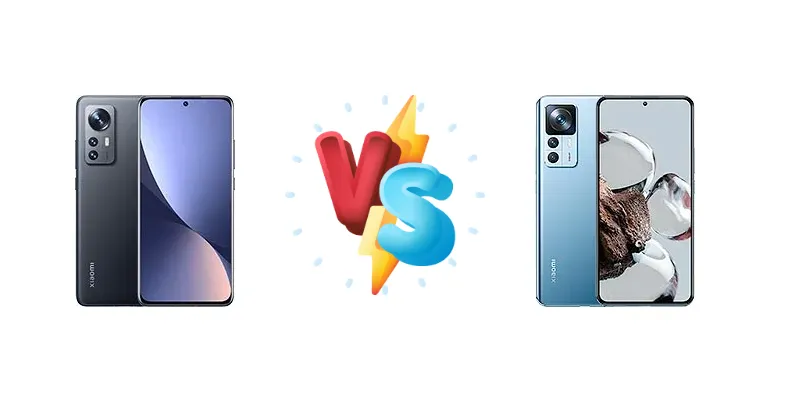
|
🏆 Quick Verdict
The Xiaomi 12T emerges as the overall winner thanks to its significantly faster charging, brighter display, and powerful Dimensity 8100 Ultra chipset. However, the 12X remains a strong contender, offering a more compact design and a proven Snapdragon 870 processor.
| PHONES | ||
|---|---|---|
| Phone Names | Xiaomi 12X | Xiaomi 12T |
| Network | ||
|---|---|---|
| 2G bands | GSM 850 / 900 / 1800 / 1900 | GSM 850 / 900 / 1800 / 1900 |
| 3G bands | HSDPA 800 / 850 / 900 / 1700(AWS) / 1900 / 2100 | HSDPA 800 / 850 / 900 / 1700(AWS) / 1900 / 2100 |
| 4G bands | 1, 2, 3, 4, 5, 7, 8, 12, 13, 17, 18, 19, 20, 26, 28, 32, 38, 39, 40, 41, 42, 48, 66 - International | 1, 2, 3, 4, 5, 7, 8, 12, 13, 17, 18, 19, 20, 26, 28, 32, 38, 40, 41, 66 |
| 5G bands | 1, 3, 5, 7, 8, 20, 28, 38, 40, 41, 66, 77, 78 SA/NSA - International | 1, 3, 5, 7, 8, 20, 28, 38, 40, 41, 66, 77, 78 SA/NSA |
| Speed | HSPA, LTE, 5G | HSPA, LTE, 5G |
| Technology | GSM / CDMA / HSPA / EVDO / LTE / 5G | GSM / HSPA / LTE / 5G |
| 1, 3, 5, 8, 28, 38, 40, 41, 77, 78 SA/NSA - China | - | |
| Launch | ||
|---|---|---|
| Announced | 2021, December 28 | 2022, October 04 |
| Status | Available. Released 2021, December 31 | Available. Released 2022, October 06 |
| Body | ||
|---|---|---|
| Dimensions | 152.7 x 69.9 x 8.2 mm (6.01 x 2.75 x 0.32 in) | 163.1 x 75.9 x 8.6 mm (6.42 x 2.99 x 0.34 in) |
| SIM | Nano-SIM + Nano-SIM | Nano-SIM + Nano-SIM |
| Weight | 176 g (6.21 oz) | 202 g (7.13 oz) |
| Display | ||
|---|---|---|
| Protection | Corning Gorilla Glass Victus | Corning Gorilla Glass 5 |
| Resolution | 1080 x 2400 pixels, 20:9 ratio (~419 ppi density) | 1220 x 2712 pixels, 20:9 ratio (~446 ppi density) |
| Size | 6.28 inches, 95.2 cm2 (~89.2% screen-to-body ratio) | 6.67 inches, 107.4 cm2 (~86.7% screen-to-body ratio) |
| Type | AMOLED, 68B colors, 120Hz, Dolby Vision, HDR10+, 1100 nits (peak) | AMOLED, 68B colors, 120Hz, HDR10+, 500 nits (typ), 900 nits (peak) |
| Platform | ||
|---|---|---|
| CPU | Octa-core (1x3.2 GHz Kryo 585 & 3x2.42 GHz Kryo 585 & 4x1.80 GHz Kryo 585) | Octa-core (4x2.85 GHz Cortex-A78 & 4x2.0 GHz Cortex-A55) |
| Chipset | Qualcomm SM8250-AC Snapdragon 870 5G (7 nm) | Mediatek Dimensity 8100 Ultra (5 nm) |
| GPU | Adreno 650 | Mali-G610 MC6 |
| OS | Android 11, MIUI 13 | Android 12, upgradable to Android 14, MIUI 14 |
| Memory | ||
|---|---|---|
| Card slot | No | No |
| Internal | 128GB 8GB RAM, 256GB 8GB RAM, 256GB 12GB RAM | 128GB 8GB RAM, 256GB 8GB RAM |
| UFS 3.1 | UFS 3.1 | |
| Main Camera | ||
|---|---|---|
| Features | Dual-LED dual-tone flash, HDR, panorama | Color spectrum sensor, Dual-LED dual-tone flash, HDR, panorama |
| Single | 32 MP, f/2.5, 26mm (wide), 0.7µm | - |
| Triple | 50 MP, f/1.9, 26mm (wide), 1/1.56", 1.0µm, PDAF, OIS 13 MP, f/2.4, 12mm, 123˚ (ultrawide), 1/3.06", 1.12µm 5 MP, f/2.4, 50mm (telephoto macro), AF | 108 MP, f/1.7, 24mm (wide), 1/1.67", 0.64µm, PDAF, OIS 8 MP, f/2.2, 120˚ (ultrawide), 1/4.0", 1.12µm 2 MP (macro) |
| Video | 8K@24fps, 4K@30/60fps, 1080p@30/120/240/960fps, gyro-EIS | 4K@30fps, 1080p@30/60/120/240fps, HDR |
| Selfie camera | ||
|---|---|---|
| Features | HDR, panorama | HDR, panorama |
| Single | 32 MP, f/2.5, 26mm (wide), 0.7µm | 20 MP, f/2.2, (wide), 1/3.47", 0.8µm |
| Video | 1080p@30/60fps, 720p@120fps, HDR | 1080p@30/60fps, HDR |
| Sound | ||
|---|---|---|
| 3.5mm jack | No | No |
| 35mm jack | No | No |
| Loudspeaker | Yes, with stereo speakers | Yes, with stereo speakers |
| 24-bit/192kHz audio Tuned by Harman Kardon | 24-bit/192kHz audio | |
| Comms | ||
|---|---|---|
| Bluetooth | 5.1 / 5.2, A2DP, LE | 5.3, A2DP, LE |
| Infrared port | Yes | Yes |
| NFC | Yes (market/region dependent) | Yes (market/region dependent) |
| Positioning | GPS (L1+L5), GLONASS (L1), BDS (B1I+B1c+B2a), GALILEO (E1+E5a), QZSS (L1+L5), NavIC (L5) | GPS (L1+L5), GLONASS (L1), BDS (B1I+B1c+B2a), GALILEO (E1+E5a), QZSS (L1+L5), NavIC (L5) |
| Radio | No | No |
| USB | USB Type-C 2.0, OTG | USB Type-C 2.0, OTG |
| WLAN | Wi-Fi 802.11 a/b/g/n/ac, Wi-Fi 6 (market dependent), dual-band, Wi-Fi Direct | Wi-Fi 802.11 a/b/g/n/ac/6, dual-band, Wi-Fi Direct |
| Features | ||
|---|---|---|
| Sensors | Fingerprint (under display, optical), accelerometer, proximity, gyro, compass | Fingerprint (under display, optical), accelerometer, gyro, proximity, compass |
| Battery | ||
|---|---|---|
| Charging | 67W wired, PD3.0, QC4, 100% in 39 min | 120W wired, 100% in 19 min |
| Type | Li-Po 4500 mAh | Li-Po 5000 mAh |
| Misc | ||
|---|---|---|
| Colors | Gray, Blue, Purple | Black, Silver, Blue |
| Models | 2112123AC, 2112123AG | 22071212AG |
| Price | About 180 EUR | € 181.96 / £ 283.32 |
| SAR | - | 1.09 W/kg (head) 1.09 W/kg (body) |
| SAR EU | 0.59 W/kg (head) 1.00 W/kg (body) | 0.99 W/kg (head) 0.99 W/kg (body) |
| Tests | ||
|---|---|---|
| Battery life | Endurance rating 105h | Endurance rating 104h |
| Camera | Photo / Video | Photo / Video |
| Display | Contrast ratio: Infinite (nominal) | Contrast ratio: Infinite (nominal) |
| Loudspeaker | -25.6 LUFS (Very good) | -25.0 LUFS (Very good) |
| Performance | AnTuTu: 598003 (v8), 690298 (v9) GeekBench: 3168 (v5.1) GFXBench: 47fps (ES 3.1 onscreen) | AnTuTu: 780204 (v9) GeekBench: 3756 (v5.1) |
Xiaomi 12X
- Compact and pocketable design
- Reliable Snapdragon 870 processor
- Excellent all-around performance
- Good value for money
- Slower charging speed
- Less bright display compared to 12T
- Camera performance slightly behind 12T
Xiaomi 12T
- Blazing-fast 120W charging
- Bright and vibrant display
- Powerful Dimensity 8100 Ultra chipset
- Improved camera capabilities
- Larger and less pocketable design
- Potentially higher price point
- Dimensity chipsets can sometimes have software optimization quirks
Display Comparison
The Xiaomi 12T boasts a significant advantage with its measured peak brightness of 954 nits, making it far more visible in direct sunlight. Both phones claim an 'infinite' contrast ratio, which is a nominal value and doesn't provide concrete data. The 12X's display is still good, but the 12T's brightness is a noticeable upgrade.
Camera Comparison
Both phones offer capable camera systems, but detailed camera comparisons require more in-depth testing. The 12T is expected to have a slight edge in low-light performance and video recording due to its newer sensor and image processing capabilities. Both offer versatile photo and video options.
Performance
The Mediatek Dimensity 8100 Ultra in the 12T generally outperforms the Snapdragon 870 in the 12X, especially in graphics-intensive tasks. While the 870 is still a capable chip, the 8100 Ultra offers a smoother experience for demanding games and applications. Both phones handle everyday tasks with ease.
Battery Life
Both phones have similar endurance ratings (105h vs 104h), suggesting comparable battery life in typical usage. However, the 12T's 120W charging is a game-changer, allowing it to charge from 0% to 100% in just 19 minutes, while the 12X takes 39 minutes with its 67W charging.
Buying Guide
The Xiaomi 12X is ideal for users who prioritize a smaller, more pocketable phone with a reliable processor and excellent all-around performance. The Xiaomi 12T is perfect for those who demand blazing-fast charging, a vibrant display, and top-tier performance for gaming and demanding tasks.