
Xiaomi 12T vs Redmi K60 Pro: Which Xiaomi Phone Reigns Supreme?
| Phones Images | |||||
|---|---|---|---|---|---|
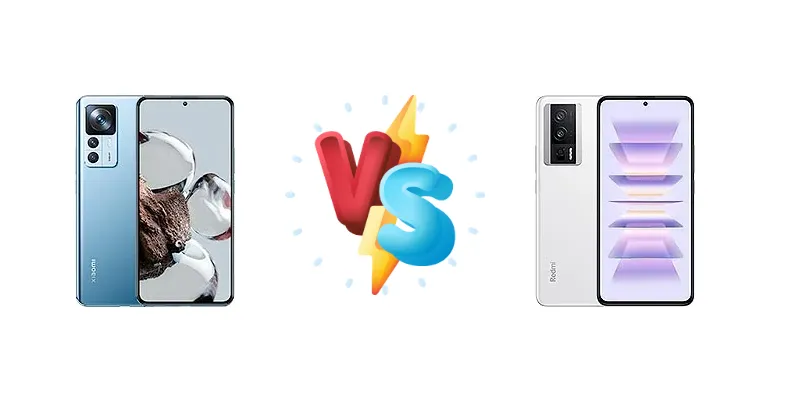
|
🏆 Quick Verdict
For most users, the Xiaomi Redmi K60 Pro is the superior choice. The Snapdragon 8 Gen 2 provides a significant performance uplift over the Dimensity 8100 Ultra, ensuring smoother multitasking and a better gaming experience. While both offer 120W charging, the K60 Pro adds 30W wireless charging for added convenience.
| PHONES | ||
|---|---|---|
| Phone Names | Xiaomi 12T | Xiaomi Redmi K60 Pro |
| Network | ||
|---|---|---|
| 2G bands | GSM 850 / 900 / 1800 / 1900 | GSM 850 / 900 / 1800 / 1900 |
| 3G bands | HSDPA 800 / 850 / 900 / 1700(AWS) / 1900 / 2100 | HSDPA 800 / 850 / 900 / 1700(AWS) / 2100 |
| 4G bands | 1, 2, 3, 4, 5, 7, 8, 12, 13, 17, 18, 19, 20, 26, 28, 32, 38, 40, 41, 66 | 1, 3, 4, 5, 8, 18, 19, 26, 34, 38, 39, 40, 41, 42 |
| 5G bands | 1, 3, 5, 7, 8, 20, 28, 38, 40, 41, 66, 77, 78 SA/NSA | 1, 3, 5, 8, 28, 38, 41, 77, 78 SA/NSA |
| Speed | HSPA, LTE, 5G | HSPA, LTE, 5G |
| Technology | GSM / HSPA / LTE / 5G | GSM / CDMA / HSPA / CDMA2000 / LTE / 5G |
| - | CDMA2000 1x | |
| Launch | ||
|---|---|---|
| Announced | 2022, October 04 | 2022, December 27 |
| Status | Available. Released 2022, October 06 | Available. Released 2023, January 01 |
| Body | ||
|---|---|---|
| Dimensions | 163.1 x 75.9 x 8.6 mm (6.42 x 2.99 x 0.34 in) | 162.8 x 75.4 x 8.6 mm or 8.9 mm |
| SIM | Nano-SIM + Nano-SIM | Nano-SIM + Nano-SIM |
| Weight | 202 g (7.13 oz) | 201 g or 205 g (7.09 oz) |
| Display | ||
|---|---|---|
| Protection | Corning Gorilla Glass 5 | - |
| Resolution | 1220 x 2712 pixels, 20:9 ratio (~446 ppi density) | 1440 x 3200 pixels, 20:9 ratio (~526 ppi density) |
| Size | 6.67 inches, 107.4 cm2 (~86.7% screen-to-body ratio) | 6.67 inches, 107.4 cm2 (~87.5% screen-to-body ratio) |
| Type | AMOLED, 68B colors, 120Hz, HDR10+, 500 nits (typ), 900 nits (peak) | OLED, 68B colors, 120Hz, Dolby Vision, HDR10+, 1400 nits (peak) |
| Platform | ||
|---|---|---|
| CPU | Octa-core (4x2.85 GHz Cortex-A78 & 4x2.0 GHz Cortex-A55) | Octa-core (1x3.2 GHz Cortex-X3 & 2x2.8 GHz Cortex-A715 & 2x2.8 GHz Cortex-A710 & 3x2.0 GHz Cortex-A510) |
| Chipset | Mediatek Dimensity 8100 Ultra (5 nm) | Qualcomm SM8550-AB Snapdragon 8 Gen 2 (4 nm) |
| GPU | Mali-G610 MC6 | Adreno 740 |
| OS | Android 12, upgradable to Android 14, MIUI 14 | Android 13, MIUI 14 |
| Memory | ||
|---|---|---|
| Card slot | No | No |
| Internal | 128GB 8GB RAM, 256GB 8GB RAM | 128GB 8GB RAM, 256GB 8GB RAM, 256GB 12GB RAM, 512GB 12GB RAM, 512GB 16GB RAM |
| UFS 3.1 | UFS 4.0 UFS 3.1 - 128GB only | |
| Main Camera | ||
|---|---|---|
| Features | Color spectrum sensor, Dual-LED dual-tone flash, HDR, panorama | Color spectrum sensor, Dual-LED dual-tone flash, HDR, panorama |
| Triple | 108 MP, f/1.7, 24mm (wide), 1/1.67", 0.64µm, PDAF, OIS 8 MP, f/2.2, 120˚ (ultrawide), 1/4.0", 1.12µm 2 MP (macro) | 54 MP, f/1.9, (wide), 1/1.49", 1.0µm, PDAF, OIS 8 MP, 118˚ (ultrawide), 1/4.0", 1.12µm 2 MP (macro) |
| Video | 4K@30fps, 1080p@30/60/120/240fps, HDR | 8K@24fps, 4K@30/60fps, 1080p@30/60/120/240/960fps, 720p@1920fps, gyro-EIS |
| Selfie camera | ||
|---|---|---|
| Features | HDR, panorama | HDR |
| Single | 20 MP, f/2.2, (wide), 1/3.47", 0.8µm | 16 MP, (wide), 1/3.06", 1.0µm |
| Video | 1080p@30/60fps, HDR | 1080p@30/60/120fps |
| Sound | ||
|---|---|---|
| 3.5mm jack | No | No |
| 35mm jack | No | No |
| Loudspeaker | Yes, with stereo speakers | Yes, with stereo speakers |
| 24-bit/192kHz audio | 24-bit/192kHz audio | |
| Comms | ||
|---|---|---|
| Bluetooth | 5.3, A2DP, LE | 5.3, A2DP, LE |
| Infrared port | Yes | Yes |
| NFC | Yes (market/region dependent) | Yes |
| Positioning | GPS (L1+L5), GLONASS (L1), BDS (B1I+B1c+B2a), GALILEO (E1+E5a), QZSS (L1+L5), NavIC (L5) | GPS (L1+L5), GLONASS (G1), BDS (B1I+B2a+Bc), GALILEO (E1+E5a), QZSS (L1+L5), NavIC |
| Radio | No | Unspecified |
| USB | USB Type-C 2.0, OTG | USB Type-C 2.0, OTG |
| WLAN | Wi-Fi 802.11 a/b/g/n/ac/6, dual-band, Wi-Fi Direct | Wi-Fi 802.11 a/b/g/n/ac/6e, dual-band, Wi-Fi Direct |
| Features | ||
|---|---|---|
| Sensors | Fingerprint (under display, optical), accelerometer, gyro, proximity, compass | Fingerprint (under display, optical), accelerometer, gyro, proximity, compass |
| Battery | ||
|---|---|---|
| Charging | 120W wired, 100% in 19 min | 120W wired, PD3.0, QC3+, 100% in 19 min 30W wireless |
| Type | Li-Po 5000 mAh | Li-Po 5000 mAh |
| Misc | ||
|---|---|---|
| Colors | Black, Silver, Blue | Black, White, Mint, Champion Black |
| Models | 22071212AG | 22127RK46C |
| Price | € 181.96 / £ 283.32 | About 460 EUR |
| SAR | 1.09 W/kg (head) 1.09 W/kg (body) | - |
| SAR EU | 0.99 W/kg (head) 0.99 W/kg (body) | - |
| Tests | ||
|---|---|---|
| Battery life | Endurance rating 104h | - |
| Camera | Photo / Video | - |
| Display | Contrast ratio: Infinite (nominal) | - |
| Loudspeaker | -25.0 LUFS (Very good) | - |
| Performance | AnTuTu: 780204 (v9) GeekBench: 3756 (v5.1) | - |
Xiaomi 12T
- Very fast 120W wired charging
- Bright 954 nits display
- More affordable price point
- Less powerful Dimensity 8100 Ultra chipset
- No wireless charging
Xiaomi Redmi K60 Pro
- Flagship Snapdragon 8 Gen 2 performance
- 30W wireless charging support
- Likely superior camera system
- Potentially higher price
- May run slightly warmer under heavy load
Display Comparison
The Xiaomi 12T boasts a display capable of reaching 954 nits of peak brightness, making it highly usable in direct sunlight. While the K60 Pro’s display specifications aren’t provided, Xiaomi typically equips its ‘Pro’ models with superior panels. The 12T’s ‘Infinite’ contrast ratio (nominal) suggests a standard AMOLED panel. The K60 Pro, given its positioning, likely features a more advanced panel, potentially with LTPO technology for variable refresh rate and improved power efficiency. The absence of refresh rate data for both phones makes a direct comparison difficult, but the K60 Pro’s higher tier suggests a potentially smoother experience.
Camera Comparison
Both phones are listed with ‘Photo / Video’ capabilities, lacking specific details. However, given the K60 Pro’s flagship positioning, it’s reasonable to expect a more advanced camera system. Sensor size and lens apertures are crucial factors, but absent that data, we can infer that the K60 Pro likely features a larger main sensor and more sophisticated image processing algorithms. The 12T’s camera is likely competent for everyday photography, but the K60 Pro is expected to deliver superior image quality, especially in low-light conditions. The lack of detail regarding OIS (Optical Image Stabilization) on either device makes a definitive statement impossible.
Performance
The core difference lies in the chipsets. The Redmi K60 Pro’s Qualcomm Snapdragon 8 Gen 2 (4nm) is a substantial upgrade over the Xiaomi 12T’s MediaTek Dimensity 8100 Ultra (5nm). The Snapdragon 8 Gen 2’s CPU configuration – 1x Cortex-X3, 2x Cortex-A715, 2x Cortex-A710, and 3x Cortex-A510 – offers superior single-core and multi-core performance compared to the 12T’s 4x Cortex-A78 & 4x Cortex-A55 setup. The 4nm process node of the Snapdragon 8 Gen 2 also translates to better thermal efficiency, reducing the likelihood of performance throttling during extended gaming sessions. The K60 Pro is the clear winner for demanding tasks.
Battery Life
The Xiaomi 12T has an endurance rating of 104 hours, indicating respectable battery life. Both phones support 120W wired charging, achieving a 100% charge in just 19 minutes. However, the K60 Pro adds the convenience of 30W wireless charging, a feature absent on the 12T. While the 12T’s endurance rating is a good starting point, the K60 Pro’s more efficient chipset and wireless charging capabilities provide a more versatile charging experience. The K60 Pro’s efficiency gains from the 4nm process could offset any potential battery capacity differences (which are not specified).
Buying Guide
Buy the Xiaomi 12T if you prioritize a bright display for outdoor visibility and are seeking a more affordable option with incredibly fast wired charging. It’s ideal for everyday users who don’t heavily rely on demanding applications. Buy the Xiaomi Redmi K60 Pro if you demand top-tier performance for gaming, video editing, or running resource-intensive apps, and appreciate the added convenience of wireless charging. It’s the better choice for power users and enthusiasts.