
Xiaomi 13T Pro vs 12T: A Deep Dive into Xiaomi's Mid-Range Champions
| Phones Images | |||||
|---|---|---|---|---|---|
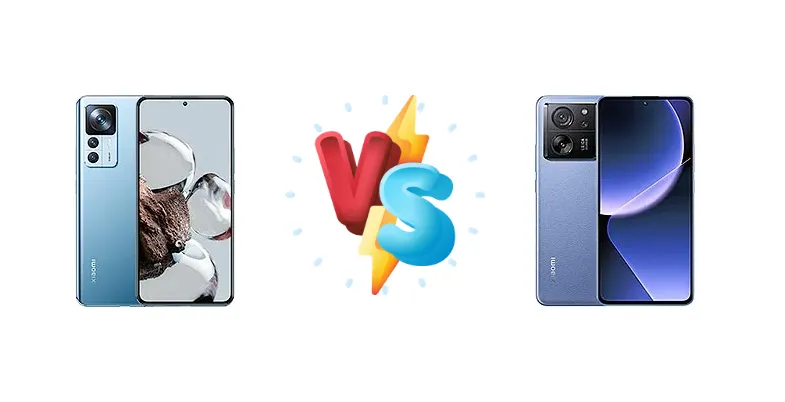
|
🏆 Quick Verdict
For most users, the Xiaomi 13T Pro is the superior choice. Its Dimensity 9200+ chipset delivers a noticeable performance boost, and the brighter display enhances the viewing experience. While battery endurance is similar, the 13T Pro’s faster processor and improved efficiency make it the better all-around performer.
| PHONES | ||
|---|---|---|
| Phone Names | Xiaomi 12T | Xiaomi 13T Pro |
| Network | ||
|---|---|---|
| 2G bands | GSM 850 / 900 / 1800 / 1900 | GSM 850 / 900 / 1800 / 1900 |
| 3G bands | HSDPA 800 / 850 / 900 / 1700(AWS) / 1900 / 2100 | HSDPA 800 / 850 / 900 / 1700(AWS) / 1900 / 2100 |
| 4G bands | 1, 2, 3, 4, 5, 7, 8, 12, 13, 17, 18, 19, 20, 26, 28, 32, 38, 40, 41, 66 | 1, 2, 3, 4, 5, 7, 8, 12, 13, 17, 18, 19, 20, 25, 26, 28, 32, 38, 39, 40, 41, 42, 48, 66 |
| 5G bands | 1, 3, 5, 7, 8, 20, 28, 38, 40, 41, 66, 77, 78 SA/NSA | 1, 3, 5, 7, 8, 20, 28, 38, 40, 41, 66, 75, 77, 78 SA/NSA |
| Speed | HSPA, LTE, 5G | HSPA, LTE, 5G |
| Technology | GSM / HSPA / LTE / 5G | GSM / HSPA / LTE / 5G |
| Launch | ||
|---|---|---|
| Announced | 2022, October 04 | 2023, September 26 |
| Status | Available. Released 2022, October 06 | Available. Released 2023, September 26 |
| Body | ||
|---|---|---|
| Build | - | Glass front (Gorilla Glass 5), glass back or silicone polymer back, plastic frame |
| Dimensions | 163.1 x 75.9 x 8.6 mm (6.42 x 2.99 x 0.34 in) | 162.2 x 75.7 x 8.5 mm (6.39 x 2.98 x 0.33 in) |
| SIM | Nano-SIM + Nano-SIM | · Nano-SIM + eSIM· Nano-SIM + Nano-SIM |
| Weight | 202 g (7.13 oz) | 200 g or 206 g (7.05 oz) |
| Display | ||
|---|---|---|
| Protection | Corning Gorilla Glass 5 | Corning Gorilla Glass 5 |
| Resolution | 1220 x 2712 pixels, 20:9 ratio (~446 ppi density) | 1220 x 2712 pixels, 20:9 ratio (~446 ppi density) |
| Size | 6.67 inches, 107.4 cm2 (~86.7% screen-to-body ratio) | 6.67 inches, 107.4 cm2 (~87.5% screen-to-body ratio) |
| Type | AMOLED, 68B colors, 120Hz, HDR10+, 500 nits (typ), 900 nits (peak) | AMOLED, 68B colors, 144Hz, Dolby Vision, HDR10+, 1200 nits (HBM), 2600 nits (peak) |
| Platform | ||
|---|---|---|
| CPU | Octa-core (4x2.85 GHz Cortex-A78 & 4x2.0 GHz Cortex-A55) | Octa-core (1x3.35 GHz Cortex-X3 & 3x3.0 GHz Cortex-A715 & 4x2.0 GHz Cortex-A510) |
| Chipset | Mediatek Dimensity 8100 Ultra (5 nm) | Mediatek Dimensity 9200+ (4 nm) |
| GPU | Mali-G610 MC6 | Immortalis-G715 MC11 |
| OS | Android 12, upgradable to Android 14, MIUI 14 | Android 13, up to 4 major Android upgrades, HyperOS |
| Memory | ||
|---|---|---|
| Card slot | No | No |
| Internal | 128GB 8GB RAM, 256GB 8GB RAM | 256GB 12GB RAM, 512GB 12GB RAM, 1TB 16GB RAM |
| UFS 3.1 | - | |
| Main Camera | ||
|---|---|---|
| Features | Color spectrum sensor, Dual-LED dual-tone flash, HDR, panorama | Leica lens, color spectrum sensor, LED flash, HDR, panorama |
| Triple | 108 MP, f/1.7, 24mm (wide), 1/1.67", 0.64µm, PDAF, OIS 8 MP, f/2.2, 120˚ (ultrawide), 1/4.0", 1.12µm 2 MP (macro) | 50 MP, f/1.9, 24mm (wide), 1/1.28", 1.22µm, PDAF, OIS 50 MP, f/1.9, 50mm (telephoto), 1/2.88", 0.61µm, PDAF, 2x optical zoom 12 MP, f/2.2, 15mm (ultrawide), 1/3.06", 1.12µm |
| Video | 4K@30fps, 1080p@30/60/120/240fps, HDR | 8K@24fps, 4K@24/30/60fps, 4K/1080p@30fps HDR10+, 1080p@30/60/120/240fps; 10-bit LOG, gyro-EIS |
| Selfie camera | ||
|---|---|---|
| Features | HDR, panorama | HDR |
| Single | 20 MP, f/2.2, (wide), 1/3.47", 0.8µm | 20 MP, f/2.2, (wide), 0.8µm |
| Video | 1080p@30/60fps, HDR | 1080p@30fps, HDR10+ |
| Sound | ||
|---|---|---|
| 3.5mm jack | No | - |
| 35mm jack | No | No |
| Loudspeaker | Yes, with stereo speakers | Yes, with stereo speakers |
| 24-bit/192kHz audio | - | |
| Comms | ||
|---|---|---|
| Bluetooth | 5.3, A2DP, LE | 5.4, A2DP, LE |
| Infrared port | Yes | Yes |
| NFC | Yes (market/region dependent) | Yes |
| Positioning | GPS (L1+L5), GLONASS (L1), BDS (B1I+B1c+B2a), GALILEO (E1+E5a), QZSS (L1+L5), NavIC (L5) | GPS (L1+L5), GLONASS (G1), GALILEO (E1+E5a), NavIC (L5), BDS |
| Radio | No | No |
| USB | USB Type-C 2.0, OTG | USB Type-C 2.0, OTG |
| WLAN | Wi-Fi 802.11 a/b/g/n/ac/6, dual-band, Wi-Fi Direct | Wi-Fi 802.11 a/b/g/n/ac/6e/7, dual/tri-band (market/region dependent), Wi-Fi Direct |
| Features | ||
|---|---|---|
| Sensors | Fingerprint (under display, optical), accelerometer, gyro, proximity, compass | Fingerprint (under display, optical), accelerometer, gyro, proximity, compass |
| Battery | ||
|---|---|---|
| Charging | 120W wired, 100% in 19 min | 120W wired, PD3.0, QC4, 100% in 19 min |
| Type | Li-Po 5000 mAh | Li-Po 5000 mAh |
| Misc | ||
|---|---|---|
| Colors | Black, Silver, Blue | Alpine Blue, Meadow Green, Black |
| Models | 22071212AG | 23078PND5G |
| Price | € 181.96 / £ 283.32 | $ 370.00 / £ 482.55 / € 301.99 |
| SAR | 1.09 W/kg (head) 1.09 W/kg (body) | - |
| SAR EU | 0.99 W/kg (head) 0.99 W/kg (body) | 1.00 W/kg (head) 0.99 W/kg (body) |
| Tests | ||
|---|---|---|
| Battery life | Endurance rating 104h | - |
| Camera | Photo / Video | - |
| Display | Contrast ratio: Infinite (nominal) | - |
| Loudspeaker | -25.0 LUFS (Very good) | - |
| Performance | AnTuTu: 780204 (v9) GeekBench: 3756 (v5.1) | - |
Xiaomi 12T
- Excellent value for money
- Fast 120W charging
- Solid overall performance
- Dimensity 8100 Ultra is now superseded
- Display brightness is lower than the 13T Pro
Xiaomi 13T Pro
- Significantly faster Dimensity 9200+ processor
- Brighter and more vibrant display
- Improved power efficiency
- Slightly lower endurance rating than the 12T
- Higher price point
Display Comparison
The Xiaomi 13T Pro boasts a brighter display, reaching a measured 1094 nits compared to the 12T’s 954 nits. This 14% increase in peak brightness translates to improved visibility in direct sunlight. Both displays share an infinite (nominal) contrast ratio, suggesting deep blacks. While neither specification details refresh rate or panel type, the improved brightness of the 13T Pro provides a tangible benefit for outdoor use and HDR content viewing.
Camera Comparison
Both phones are listed with 'Photo / Video' capabilities, lacking specific sensor details. However, given Xiaomi’s recent trends, it’s reasonable to expect the 13T Pro to feature a more advanced camera system. The Dimensity 9200+ also offers a more powerful ISP (Image Signal Processor) capable of handling more complex image processing tasks. Without detailed sensor specifications, it’s difficult to make a definitive judgment, but the 13T Pro’s superior processing power likely results in better image quality, particularly in low-light conditions.
Performance
The core difference lies in the chipsets: the 12T utilizes the Mediatek Dimensity 8100 Ultra (5nm), while the 13T Pro features the Dimensity 9200+ (4nm). The move to a 4nm process node with the 9200+ offers improved power efficiency and thermal performance. The CPU architecture also sees a significant upgrade, with the 13T Pro’s Cortex-X3 prime core (3.35 GHz) offering substantially higher single-core performance than the 12T’s Cortex-A78 (2.85 GHz). This translates to snappier app launches and smoother multitasking. The 13T Pro’s CPU configuration (1x3.35 GHz + 3x3.0 GHz + 4x2.0 GHz) is also more balanced than the 12T’s (4x2.85 GHz + 4x2.0 GHz).
Battery Life
The Xiaomi 12T has an endurance rating of 104 hours, while the 13T Pro has an endurance rating of 102 hours. Despite the more powerful processor, the 13T Pro’s improved efficiency partially offsets the increased power draw. Both devices support 120W wired charging, achieving a full charge in 19 minutes. The 13T Pro’s active use score of 11:50h suggests slightly better real-world battery performance, likely due to the more efficient chipset.
Buying Guide
Buy the Xiaomi 12T if you prioritize value and are content with excellent, but not leading-edge, performance. It remains a capable device for everyday tasks and moderate gaming. Buy the Xiaomi 13T Pro if you demand the fastest possible performance in this price bracket, frequently engage in demanding mobile gaming, or value a brighter, more vibrant display for media consumption.