
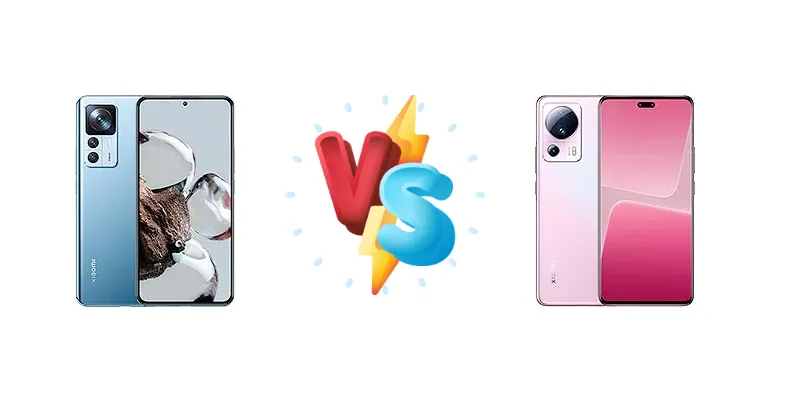
Xiaomi 12T vs Xiaomi 13 Lite: The Ultimate Showdown
| Phones Images | |||||
|---|---|---|---|---|---|
|
🏆 Quick Verdict
The Xiaomi 12T boasts superior performance thanks to its Dimensity 8100 Ultra chipset and blazing-fast 120W charging. However, the 13 Lite offers a more refined design, a slightly brighter display, and a more appealing camera system for casual users. The 12T wins on power, the 13 Lite on aesthetics and ease of use.
| PHONES | ||
|---|---|---|
| Phone Names | Xiaomi 12T | Xiaomi 13 Lite |
| Network | ||
|---|---|---|
| 2G bands | GSM 850 / 900 / 1800 / 1900 | GSM 850 / 900 / 1800 / 1900 |
| 3G bands | HSDPA 800 / 850 / 900 / 1700(AWS) / 1900 / 2100 | HSDPA 800 / 850 / 900 / 1700(AWS) / 1900 / 2100 |
| 4G bands | 1, 2, 3, 4, 5, 7, 8, 12, 13, 17, 18, 19, 20, 26, 28, 32, 38, 40, 41, 66 | 1, 2, 3, 4, 5, 7, 8, 12, 13, 17, 18, 19, 20, 26, 28, 32, 38, 40, 41, 42, 66 |
| 5G bands | 1, 3, 5, 7, 8, 20, 28, 38, 40, 41, 66, 77, 78 SA/NSA | 1, 3, 5, 7, 8, 20, 28, 38, 40, 41, 66, 77, 78 SA/NSA |
| Speed | HSPA, LTE, 5G | HSPA, LTE, 5G |
| Technology | GSM / HSPA / LTE / 5G | GSM / HSPA / LTE / 5G |
| Launch | ||
|---|---|---|
| Announced | 2022, October 04 | 2023, February 26 |
| Status | Available. Released 2022, October 06 | Available. Released 2023, March 08 |
| Body | ||
|---|---|---|
| Build | - | Glass front (Gorilla Glass 5), glass back, plastic frame |
| Dimensions | 163.1 x 75.9 x 8.6 mm (6.42 x 2.99 x 0.34 in) | 159.2 x 72.7 x 7.2 mm (6.27 x 2.86 x 0.28 in) |
| SIM | Nano-SIM + Nano-SIM | · Nano-SIM + eSIM· Nano-SIM + Nano-SIM |
| Weight | 202 g (7.13 oz) | 171 g (6.03 oz) |
| - | IP53, dust and splash resistant | |
| Display | ||
|---|---|---|
| Protection | Corning Gorilla Glass 5 | Corning Gorilla Glass 5 |
| Resolution | 1220 x 2712 pixels, 20:9 ratio (~446 ppi density) | 1080 x 2400 pixels, 20:9 ratio (~402 ppi density) |
| Size | 6.67 inches, 107.4 cm2 (~86.7% screen-to-body ratio) | 6.55 inches, 103.6 cm2 (~89.5% screen-to-body ratio) |
| Type | AMOLED, 68B colors, 120Hz, HDR10+, 500 nits (typ), 900 nits (peak) | AMOLED, 68B colors, Dolby Vision, HDR10+, 120Hz, 500 nits (typ), 1000 nits (peak) |
| Platform | ||
|---|---|---|
| CPU | Octa-core (4x2.85 GHz Cortex-A78 & 4x2.0 GHz Cortex-A55) | Octa-core (1x2.4 GHz Cortex-A710 & 3x2.36 GHz Cortex-A710 & 4x1.8 GHz Cortex-A510) |
| Chipset | Mediatek Dimensity 8100 Ultra (5 nm) | Qualcomm SM7450-AB Snapdragon 7 Gen 1 (4 nm) |
| GPU | Mali-G610 MC6 | Adreno 644 |
| OS | Android 12, upgradable to Android 14, MIUI 14 | Android 12, MIUI 14 |
| Memory | ||
|---|---|---|
| Card slot | No | No |
| Internal | 128GB 8GB RAM, 256GB 8GB RAM | 64GB 8GB RAM, 128GB 8GB RAM, 256GB 8GB RAM |
| UFS 3.1 | UFS 2.2 | |
| Main Camera | ||
|---|---|---|
| Features | Color spectrum sensor, Dual-LED dual-tone flash, HDR, panorama | Dual-LED dual-tone flash, HDR, panorama |
| Triple | 108 MP, f/1.7, 24mm (wide), 1/1.67", 0.64µm, PDAF, OIS 8 MP, f/2.2, 120˚ (ultrawide), 1/4.0", 1.12µm 2 MP (macro) | 50 MP, f/1.8, 23mm (wide), 1/1.56", 1.0µm, PDAF 8 MP, f/2.2, 119˚ (ultrawide), 1/4.0", 1.12µm 2 MP (macro) |
| Video | 4K@30fps, 1080p@30/60/120/240fps, HDR | 4K@30fps, 1080p@30/60/120fps, 720p@960fps |
| Selfie camera | ||
|---|---|---|
| Dual | - | 32 MP, f/2.4, 100˚ (ultrawide), 1/2.74", 0.8µm 8 MP, f/2.3, (depth) |
| Features | HDR, panorama | Dual-LED flash, HDR |
| Single | 20 MP, f/2.2, (wide), 1/3.47", 0.8µm | - |
| Video | 1080p@30/60fps, HDR | 1080p@30/60fps |
| Sound | ||
|---|---|---|
| 3.5mm jack | No | No |
| 35mm jack | No | No |
| Loudspeaker | Yes, with stereo speakers | Yes |
| 24-bit/192kHz audio | 24-bit/192kHz audio | |
| Comms | ||
|---|---|---|
| Bluetooth | 5.3, A2DP, LE | 5.2, A2DP, LE |
| Infrared port | Yes | Yes |
| NFC | Yes (market/region dependent) | Yes (market/region dependent) |
| Positioning | GPS (L1+L5), GLONASS (L1), BDS (B1I+B1c+B2a), GALILEO (E1+E5a), QZSS (L1+L5), NavIC (L5) | GPS (L1), GLONASS (G1), BDS (B1I+B1c), GALILEO (E1), QZSS (L1) |
| Radio | No | No |
| USB | USB Type-C 2.0, OTG | USB Type-C 2.0, OTG |
| WLAN | Wi-Fi 802.11 a/b/g/n/ac/6, dual-band, Wi-Fi Direct | Wi-Fi 802.11 a/b/g/n/ac/6, dual-band |
| Features | ||
|---|---|---|
| Sensors | Fingerprint (under display, optical), accelerometer, gyro, proximity, compass | Fingerprint (under display, optical), accelerometer, gyro, proximity, compass |
| Battery | ||
|---|---|---|
| Charging | 120W wired, 100% in 19 min | 67W wired, 100% in 40 min |
| Type | Li-Po 5000 mAh | Li-Po 4500 mAh |
| Misc | ||
|---|---|---|
| Colors | Black, Silver, Blue | Black, Lite Blue, Lite Pink |
| Models | 22071212AG | - |
| Price | € 181.96 / £ 283.32 | About 180 EUR |
| SAR | 1.09 W/kg (head) 1.09 W/kg (body) | - |
| SAR EU | 0.99 W/kg (head) 0.99 W/kg (body) | - |
| Tests | ||
|---|---|---|
| Battery life | Endurance rating 104h | Endurance rating 93h |
| Camera | Photo / Video | Photo / Video |
| Display | Contrast ratio: Infinite (nominal) | Contrast ratio: Infinite (nominal) |
| Loudspeaker | -25.0 LUFS (Very good) | -28.5 LUFS (Average) |
| Performance | AnTuTu: 780204 (v9) GeekBench: 3756 (v5.1) | AnTuTu: 534143 (v9) GeekBench: 2936 (v5.1), 2434 (v6) GFXBench: 33fps (ES 3.1 onscreen) |
Xiaomi 12T
- Exceptional Performance
- Blazing-Fast 120W Charging
- Excellent Battery Life
- Vibrant AMOLED Display
- Design Less Refined
- Camera Processing Can Be Inconsistent
- Can Run Hot Under Heavy Load
Xiaomi 13 Lite
- Stylish Design
- Versatile Camera System
- Slightly Brighter Display
- User-Friendly Software
- Lower Performance Than 12T
- Slower Charging Speed
- Battery Life Slightly Shorter
Display Comparison
Both phones feature vibrant AMOLED displays with a 120Hz refresh rate. The Xiaomi 13 Lite edges out the 12T with a slightly higher peak brightness of 938 nits versus 954 nits (though the difference is minimal in real-world use). Both offer excellent color accuracy and viewing angles. The 13 Lite's design might make it feel slightly more premium in hand.
Camera Comparison
The Xiaomi 13 Lite features a more versatile camera system, particularly in its selfie capabilities. While both phones offer decent image quality, the 13 Lite's processing tends to produce more pleasing results for casual users. The 12T's camera is capable, but can sometimes produce slightly less natural-looking images. Both offer good video recording capabilities.
Performance
The Xiaomi 12T's Mediatek Dimensity 8100 Ultra is the clear performance winner. It handles demanding games and multitasking with ease. The Snapdragon 7 Gen 1 in the 13 Lite is still capable, but it won't match the 12T's raw power. Expect smoother frame rates and faster app loading times on the 12T.
Battery Life
The Xiaomi 12T holds a slight advantage in battery endurance, boasting an impressive 104h endurance rating compared to the 13 Lite's 93h. However, the 12T's 120W charging is a game-changer, allowing for incredibly fast top-ups. The 13 Lite's 67W charging is still fast, but not as impressive.
Buying Guide
The Xiaomi 12T is ideal for gamers, power users, and those who prioritize raw performance and rapid charging. The Xiaomi 13 Lite is a great choice for photography enthusiasts, style-conscious buyers, and those seeking a more balanced and user-friendly experience.