
Xiaomi 12T vs Xiaomi 12 Lite: A Head-to-Head Showdown
| Phones Images | |||||
|---|---|---|---|---|---|
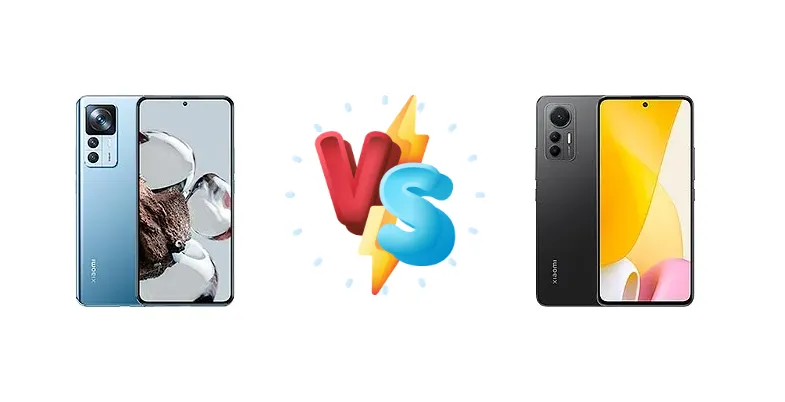
|
🏆 Quick Verdict
The Xiaomi 12T takes the crown for raw performance and charging speed thanks to its Dimensity 8100 Ultra chipset and 120W charging. However, the 12 Lite offers a more refined design, a slightly better display for color accuracy, and a more appealing price point for budget-conscious buyers.
| PHONES | ||
|---|---|---|
| Phone Names | Xiaomi 12T | Xiaomi 12 Lite |
| Network | ||
|---|---|---|
| 2G bands | GSM 850 / 900 / 1800 / 1900 | GSM 850 / 900 / 1800 / 1900 |
| 3G bands | HSDPA 800 / 850 / 900 / 1700(AWS) / 1900 / 2100 | HSDPA 850 / 900 / 1700(AWS) / 1900 / 2100 |
| 4G bands | 1, 2, 3, 4, 5, 7, 8, 12, 13, 17, 18, 19, 20, 26, 28, 32, 38, 40, 41, 66 | 1, 2, 3, 4, 5, 7, 8, 12, 13, 17, 18, 19, 20, 26, 28, 32, 38, 40, 41, 42, 48, 66 |
| 5G bands | 1, 3, 5, 7, 8, 20, 28, 38, 40, 41, 66, 77, 78 SA/NSA | 1, 3, 5, 7, 8, 20, 28, 38, 40, 41, 66, 77, 78 SA/NSA |
| Speed | HSPA, LTE, 5G | HSPA, LTE, 5G |
| Technology | GSM / HSPA / LTE / 5G | GSM / HSPA / LTE / 5G |
| Launch | ||
|---|---|---|
| Announced | 2022, October 04 | 2022, July 09 |
| Status | Available. Released 2022, October 06 | Available. Released 2022, July 11 |
| Body | ||
|---|---|---|
| Build | - | Glass front (Gorilla Glass 5), glass back, plastic frame |
| Dimensions | 163.1 x 75.9 x 8.6 mm (6.42 x 2.99 x 0.34 in) | 159.3 x 73.7 x 7.3 mm (6.27 x 2.90 x 0.29 in) |
| SIM | Nano-SIM + Nano-SIM | Nano-SIM + Nano-SIM |
| Weight | 202 g (7.13 oz) | 173 g (6.10 oz) |
| Display | ||
|---|---|---|
| Protection | Corning Gorilla Glass 5 | Corning Gorilla Glass 5 |
| Resolution | 1220 x 2712 pixels, 20:9 ratio (~446 ppi density) | 1080 x 2400 pixels, 20:9 ratio (~402 ppi density) |
| Size | 6.67 inches, 107.4 cm2 (~86.7% screen-to-body ratio) | 6.55 inches, 103.6 cm2 (~88.2% screen-to-body ratio) |
| Type | AMOLED, 68B colors, 120Hz, HDR10+, 500 nits (typ), 900 nits (peak) | AMOLED, 68B colors, 120Hz, Dolby Vision, HDR10+, 950 nits (peak) |
| Platform | ||
|---|---|---|
| CPU | Octa-core (4x2.85 GHz Cortex-A78 & 4x2.0 GHz Cortex-A55) | Octa-core (1x2.4 GHz Cortex-A78 & 3x2.2 GHz Cortex-A78 & 4x1.9 GHz Cortex-A55) |
| Chipset | Mediatek Dimensity 8100 Ultra (5 nm) | Qualcomm SM7325 Snapdragon 778G 5G (6 nm) |
| GPU | Mali-G610 MC6 | Adreno 642L |
| OS | Android 12, upgradable to Android 14, MIUI 14 | Android 12, upgradable to Android 14, HyperOS |
| Memory | ||
|---|---|---|
| Card slot | No | No |
| Internal | 128GB 8GB RAM, 256GB 8GB RAM | 128GB 6GB RAM, 128GB 8GB RAM, 256GB 8GB RAM |
| UFS 3.1 | UFS 2.2 | |
| Main Camera | ||
|---|---|---|
| Features | Color spectrum sensor, Dual-LED dual-tone flash, HDR, panorama | Dual-LED dual-tone flash, HDR, panorama |
| Single | - | 32 MP, f/2.5, (wide), 1/2.8", 0.8µm, AF |
| Triple | 108 MP, f/1.7, 24mm (wide), 1/1.67", 0.64µm, PDAF, OIS 8 MP, f/2.2, 120˚ (ultrawide), 1/4.0", 1.12µm 2 MP (macro) | 108 MP, f/1.9, 26mm (wide), 1/1.52", 0.7µm, PDAF 8 MP, f/2.2, 120˚ (ultrawide), 1/4.0", 1.12µm 2 MP (macro) |
| Video | 4K@30fps, 1080p@30/60/120/240fps, HDR | 4K@30fps, 1080p@30/60/120fps; gyro-EIS |
| Selfie camera | ||
|---|---|---|
| Features | HDR, panorama | HDR, panorama |
| Single | 20 MP, f/2.2, (wide), 1/3.47", 0.8µm | 32 MP, f/2.5, (wide), 1/2.8", 0.8µm, AF |
| Video | 1080p@30/60fps, HDR | 1080p@30/60fps, 720p@120fps |
| Sound | ||
|---|---|---|
| 3.5mm jack | No | No |
| 35mm jack | No | No |
| Loudspeaker | Yes, with stereo speakers | Yes, with dual speakers |
| 24-bit/192kHz audio | 24-bit/192kHz audio | |
| Comms | ||
|---|---|---|
| Bluetooth | 5.3, A2DP, LE | 5.2, A2DP, LE, aptX HD, aptX Adaptive |
| Infrared port | Yes | Yes |
| NFC | Yes (market/region dependent) | Yes (market/region dependent) |
| Positioning | GPS (L1+L5), GLONASS (L1), BDS (B1I+B1c+B2a), GALILEO (E1+E5a), QZSS (L1+L5), NavIC (L5) | GPS (L1), GLONASS (G1), BDS (B1I+B1c), GALILEO (E1), QZSS (L1) |
| Radio | No | No |
| USB | USB Type-C 2.0, OTG | USB Type-C 2.0, OTG |
| WLAN | Wi-Fi 802.11 a/b/g/n/ac/6, dual-band, Wi-Fi Direct | Wi-Fi 802.11 a/b/g/n/ac/6, dual-band, Wi-Fi Direct |
| Features | ||
|---|---|---|
| Sensors | Fingerprint (under display, optical), accelerometer, gyro, proximity, compass | Fingerprint (under display, optical), accelerometer, gyro, compass |
| - | Virtual proximity sensing | |
| Battery | ||
|---|---|---|
| Charging | 120W wired, 100% in 19 min | 67W wired, PD3.0, QC4, 50% in 13 min |
| Type | Li-Po 5000 mAh | Li-Po 4300 mAh |
| Misc | ||
|---|---|---|
| Colors | Black, Silver, Blue | Black, Lite Green, Lite Pink |
| Models | 22071212AG | 2203129G |
| Price | € 181.96 / £ 283.32 | € 119.80 / $ 269.00 / £ 121.15 |
| SAR | 1.09 W/kg (head) 1.09 W/kg (body) | 1.09 W/kg (head) 0.73 W/kg (body) |
| SAR EU | 0.99 W/kg (head) 0.99 W/kg (body) | 0.60 W/kg (head) 1.00 W/kg (body) |
| Tests | ||
|---|---|---|
| Battery life | Endurance rating 104h | Endurance rating 100h |
| Camera | Photo / Video | Photo / Video |
| Display | Contrast ratio: Infinite (nominal) | Contrast ratio: Infinite (nominal) |
| Loudspeaker | -25.0 LUFS (Very good) | -25.2 LUFS (Very good) |
| Performance | AnTuTu: 780204 (v9) GeekBench: 3756 (v5.1) | AnTuTu: 528905 (v9) GeekBench: 2943 (v5.1) GFXBench: 29fps (ES 3.1 onscreen) |
Xiaomi 12T
- Blazing-fast 120W charging
- Powerful Dimensity 8100 Ultra chipset
- Brighter display
- Excellent main camera
- Design can feel less premium
- Color accuracy on display not as good as 12 Lite
- Can get warm under heavy load
Xiaomi 12 Lite
- Stylish and lightweight design
- Accurate color reproduction on display
- Good portrait camera
- More affordable price
- Less powerful chipset
- Slower charging speed
- Performance can struggle with demanding games
Display Comparison
The Xiaomi 12T boasts a brighter display at 954 nits peak brightness compared to the 12 Lite's 824 nits. While both have excellent contrast ratios (Infinite nominal), the 12T's higher brightness makes it more visible in direct sunlight. The 12 Lite, however, often receives praise for its more accurate color reproduction, making it preferable for media consumption where color fidelity is key.
Camera Comparison
Both phones offer capable camera systems, but with different strengths. The 12T generally produces more detailed photos, especially in good lighting conditions. The 12 Lite often excels in portrait mode, delivering pleasing bokeh effects. Video recording capabilities are comparable, though the 12T might offer slightly better stabilization. Low-light performance is generally similar, with both phones benefiting from night mode.
Performance
Here, the Xiaomi 12T clearly wins. The Mediatek Dimensity 8100 Ultra is significantly more powerful than the Snapdragon 778G 5G found in the 12 Lite. Expect smoother multitasking, faster app loading times, and significantly better gaming performance on the 12T. The 12 Lite is still capable, but it won't handle demanding tasks as effortlessly.
Battery Life
Both phones offer similar endurance ratings (104h vs 100h), suggesting comparable real-world battery life. However, the Xiaomi 12T's 120W charging is a game-changer, allowing it to charge from 0% to 100% in just 19 minutes, while the 12 Lite's 67W charging takes around 13 minutes to reach 50%. This difference in charging speed is a significant advantage for the 12T.
Buying Guide
The Xiaomi 12T is ideal for gamers, power users, and anyone prioritizing speed and fast charging. The Xiaomi 12 Lite is a great choice for those seeking a stylish, well-rounded phone with a good camera and a more affordable price tag, prioritizing aesthetics and a smoother everyday experience.