
Xiaomi 12T vs Samsung Galaxy S23 FE: A Deep Dive into Mid-Range Flagship Contenders
| Phones Images | |||||
|---|---|---|---|---|---|
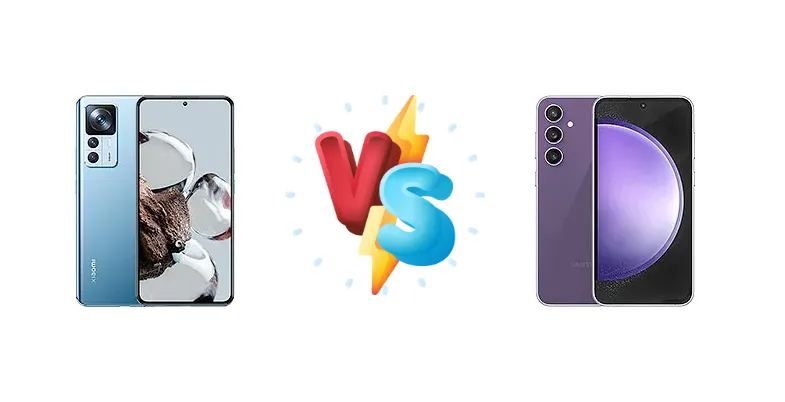
|
🏆 Quick Verdict
For the average user prioritizing all-day usability and a polished software experience, the Samsung Galaxy S23 FE emerges as the stronger choice. While the Xiaomi 12T boasts incredibly fast charging, the S23 FE’s more efficient processor and optimized software translate to better real-world battery life and sustained performance.
| PHONES | ||
|---|---|---|
| Phone Names | Xiaomi 12T | Samsung Galaxy S23 FE |
| Network | ||
|---|---|---|
| 2G bands | GSM 850 / 900 / 1800 / 1900 | GSM 850 / 900 / 1800 / 1900 |
| 3G bands | HSDPA 800 / 850 / 900 / 1700(AWS) / 1900 / 2100 | HSDPA 850 / 900 / 1700(AWS) / 1900 / 2100 |
| 4G bands | 1, 2, 3, 4, 5, 7, 8, 12, 13, 17, 18, 19, 20, 26, 28, 32, 38, 40, 41, 66 | 1, 2, 3, 4, 5, 7, 8, 12, 13, 17, 20, 26, 28, 38, 40, 41, 66 - International |
| 5G bands | 1, 3, 5, 7, 8, 20, 28, 38, 40, 41, 66, 77, 78 SA/NSA | 1, 2, 3, 5, 7, 8, 20, 28, 38, 40, 41, 66, 77, 78 SA/NSA/Sub6 - International |
| Speed | HSPA, LTE, 5G | HSPA, LTE, 5G |
| Technology | GSM / HSPA / LTE / 5G | GSM / HSPA / LTE / 5G |
| Launch | ||
|---|---|---|
| Announced | 2022, October 04 | 2023, October 04 |
| Status | Available. Released 2022, October 06 | Available. Released 2023, October 05 |
| Body | ||
|---|---|---|
| Build | - | Glass front (Gorilla Glass 5), glass back (Gorilla Glass 5), aluminum frame |
| Dimensions | 163.1 x 75.9 x 8.6 mm (6.42 x 2.99 x 0.34 in) | 158 x 76.5 x 8.2 mm (6.22 x 3.01 x 0.32 in) |
| SIM | Nano-SIM + Nano-SIM | · Nano-SIM· Nano-SIM + Nano-SIM· Nano-SIM + Nano-SIM + eSIM (max 2 at a time) |
| Weight | 202 g (7.13 oz) | 209 g (7.37 oz) |
| Display | ||
|---|---|---|
| Protection | Corning Gorilla Glass 5 | Corning Gorilla Glass 5 |
| Resolution | 1220 x 2712 pixels, 20:9 ratio (~446 ppi density) | 1080 x 2340 pixels, 19.5:9 ratio (~403 ppi density) |
| Size | 6.67 inches, 107.4 cm2 (~86.7% screen-to-body ratio) | 6.4 inches, 100.5 cm2 (~83.2% screen-to-body ratio) |
| Type | AMOLED, 68B colors, 120Hz, HDR10+, 500 nits (typ), 900 nits (peak) | Dynamic AMOLED 2X, 120Hz, HDR10+, 1450 nits (peak) |
| Platform | ||
|---|---|---|
| CPU | Octa-core (4x2.85 GHz Cortex-A78 & 4x2.0 GHz Cortex-A55) | Octa-core (1x2.8 GHz Cortex-X2 & 3x2.50 GHz Cortex-A710 & 4x1.8 GHz Cortex-A510) - InternationalOcta-core (1x3.00 GHz Cortex-X2 & 3x2.50 GHz Cortex-A710 & 4x1.80 GHz Cortex-A510) - USA |
| Chipset | Mediatek Dimensity 8100 Ultra (5 nm) | Exynos 2200 (4 nm) - InternationalQualcomm SM8450 Snapdragon 8 Gen 1 (4 nm) - USA |
| GPU | Mali-G610 MC6 | Xclipse 920 - InternationalAdreno 730 - USA |
| OS | Android 12, upgradable to Android 14, MIUI 14 | Android 13, up to 4 major Android upgrades, One UI 8 |
| Memory | ||
|---|---|---|
| Card slot | No | No |
| Internal | 128GB 8GB RAM, 256GB 8GB RAM | 128GB 8GB RAM, 256GB 8GB RAM |
| UFS 3.1 | - | |
| Main Camera | ||
|---|---|---|
| Features | Color spectrum sensor, Dual-LED dual-tone flash, HDR, panorama | LED flash, HDR, panorama |
| Triple | 108 MP, f/1.7, 24mm (wide), 1/1.67", 0.64µm, PDAF, OIS 8 MP, f/2.2, 120˚ (ultrawide), 1/4.0", 1.12µm 2 MP (macro) | 50 MP, f/1.8, 23mm (wide), 1/1.57", 1.0µm, dual pixel PDAF, OIS 8 MP, f/2.4, 76mm (telephoto), 1/4.5", 1.0µm, PDAF, OIS, 3x optical zoom 12 MP, f/2.2, 13mm, 123˚ (ultrawide), 1/3.0", 1.12µm |
| Video | 4K@30fps, 1080p@30/60/120/240fps, HDR | 8K@24fps, 4K@30/60fps, 1080p@30/60/120/240fps |
| Selfie camera | ||
|---|---|---|
| Features | HDR, panorama | - |
| Single | 20 MP, f/2.2, (wide), 1/3.47", 0.8µm | 10 MP, f/2.4, 25mm (wide), 1/3.0", 1.22µm |
| Video | 1080p@30/60fps, HDR | 4K@30/60fps, 1080p@30/60fps; gyro-EIS |
| Sound | ||
|---|---|---|
| 3.5mm jack | No | - |
| 35mm jack | No | No |
| Loudspeaker | Yes, with stereo speakers | Yes, with stereo speakers |
| 24-bit/192kHz audio | - | |
| Comms | ||
|---|---|---|
| Bluetooth | 5.3, A2DP, LE | 5.3, A2DP, LE |
| Infrared port | Yes | - |
| NFC | Yes (market/region dependent) | Yes |
| Positioning | GPS (L1+L5), GLONASS (L1), BDS (B1I+B1c+B2a), GALILEO (E1+E5a), QZSS (L1+L5), NavIC (L5) | GPS, GLONASS, GALILEO, BDS |
| Radio | No | Unspecified |
| USB | USB Type-C 2.0, OTG | USB Type-C, OTG |
| WLAN | Wi-Fi 802.11 a/b/g/n/ac/6, dual-band, Wi-Fi Direct | Wi-Fi 802.11 a/b/g/n/ac/6e, dual-band, Wi-Fi Direct |
| Features | ||
|---|---|---|
| Sensors | Fingerprint (under display, optical), accelerometer, gyro, proximity, compass | Fingerprint (under display, optical), accelerometer, gyro, compass |
| Battery | ||
|---|---|---|
| Charging | 120W wired, 100% in 19 min | 25W wired, PD3.0, 50% in 30 min 15W wireless Reverse wireless |
| Type | Li-Po 5000 mAh | Li-Ion 4500 mAh |
| Misc | ||
|---|---|---|
| Colors | Black, Silver, Blue | Mint, Cream, Graphite, Purple, Indigo, Tangerine |
| Models | 22071212AG | SM-S711B, SM-S711B/DS, SM-S711U1, SM-S711U, SM-S711W, SM-S7110, SM-S711N |
| Price | € 181.96 / £ 283.32 | $ 219.95 / C$ 327.90 / £ 248.99 / € 272.00 / ₹ 34,999 |
| SAR | 1.09 W/kg (head) 1.09 W/kg (body) | 0.80 W/kg (head) 0.72 W/kg (body) |
| SAR EU | 0.99 W/kg (head) 0.99 W/kg (body) | 0.76 W/kg (head) 1.04 W/kg (body) |
| Tests | ||
|---|---|---|
| Battery life | Endurance rating 104h | - |
| Camera | Photo / Video | - |
| Display | Contrast ratio: Infinite (nominal) | - |
| Loudspeaker | -25.0 LUFS (Very good) | - |
| Performance | AnTuTu: 780204 (v9) GeekBench: 3756 (v5.1) | - |
Xiaomi 12T
- Incredibly fast 120W charging
- Powerful Dimensity 8100 Ultra processor
- Competitive price point
- Potentially shorter battery life
- Less refined software experience
- Missing wireless charging
Samsung Galaxy S23 FE
- More efficient processor (Snapdragon/Exynos)
- Versatile camera system (likely)
- Wireless and reverse wireless charging
- Slower 25W charging
- Potential thermal throttling (Exynos variant)
- Higher price
Display Comparison
Both devices feature excellent displays, with the Galaxy S23 FE edging out the Xiaomi 12T in peak brightness at 985 nits compared to the 12T’s 954 nits. While the difference is subtle, it translates to slightly better visibility under direct sunlight. Both displays offer an 'infinite' (nominal) contrast ratio, typical of OLED panels. However, the S23 FE’s panel is likely to benefit from Samsung’s superior color calibration and potentially a more sophisticated LTPO implementation, though this isn’t explicitly stated in the provided data. The lack of refresh rate information for both devices is a notable omission, but both are expected to offer at least 120Hz.
Camera Comparison
Both phones are listed as having 'Photo / Video' capabilities, offering limited insight. Without sensor size or megapixel counts, a detailed comparison is difficult. However, Samsung’s image processing is generally more saturated and contrast-rich, appealing to a wider audience. The S23 FE likely benefits from Samsung’s advanced computational photography algorithms. The Xiaomi 12T may offer a more natural color profile. The absence of details regarding OIS (Optical Image Stabilization) is a significant gap in the provided data, impacting low-light performance and video stabilization.
Performance
The chipset choice is a key differentiator. The Xiaomi 12T utilizes the Mediatek Dimensity 8100 Ultra (5nm), while the Galaxy S23 FE comes in two variants: the Exynos 2200 (4nm) internationally and the Snapdragon 8 Gen 1 (4nm) in the USA. The 4nm process node of both S23 FE chips offers a theoretical efficiency advantage over the 5nm Dimensity 8100 Ultra, potentially leading to less thermal throttling during sustained workloads. The Snapdragon 8 Gen 1 variant of the S23 FE boasts a slightly higher peak CPU clock speed (3.00 GHz vs 2.85 GHz on the 12T), but the real-world impact will depend on software optimization. The Exynos 2200, however, has historically been known for thermal management issues, a potential drawback for gamers.
Battery Life
The Xiaomi 12T boasts a remarkable 120W wired charging capability, achieving a full charge in just 19 minutes. This is a significant advantage over the Galaxy S23 FE’s 25W charging, which takes 30 minutes to reach 50%. However, the S23 FE offers 15W wireless charging and reverse wireless charging, features absent on the 12T. While the 12T has an endurance rating of 104 hours, the S23 FE achieves 8:28 hours of active use. This suggests the S23 FE’s more efficient processor and software optimization translate to better real-world battery life despite a potentially smaller battery capacity. The S23 FE’s active use score provides a more practical measure of battery performance than the 12T’s endurance rating.
Buying Guide
Buy the Xiaomi 12T if you absolutely need the fastest possible charging speeds and prioritize peak CPU performance for demanding tasks. It’s ideal for users who frequently top up their phones throughout the day and don’t mind potentially shorter battery longevity. Buy the Samsung Galaxy S23 FE if you value a more refined user experience, a versatile camera system, and longer-lasting battery life, even if it means sacrificing some charging speed and raw processing power.