
Xiaomi 12T vs Samsung Galaxy A54: The Ultimate Showdown
| Phones Images | |||||
|---|---|---|---|---|---|
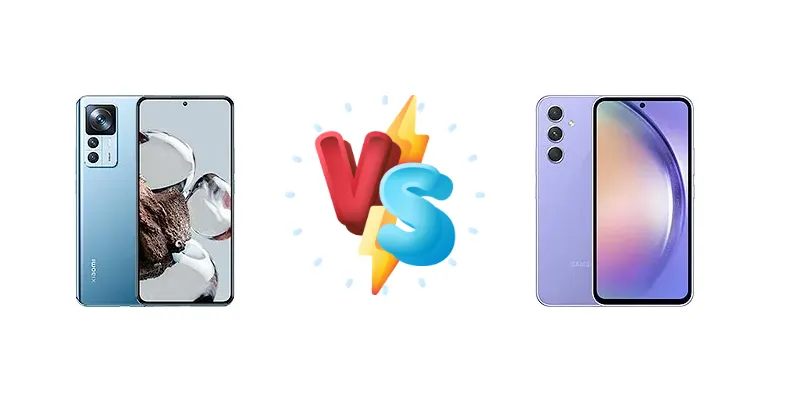
|
🏆 Quick Verdict
The Xiaomi 12T boasts significantly faster charging and a more powerful chipset, making it ideal for performance-focused users. However, the Galaxy A54 offers superior battery life and Samsung's reliable software experience, appealing to those prioritizing longevity and a polished user interface. It's a close call!
| PHONES | ||
|---|---|---|
| Phone Names | Xiaomi 12T | Samsung Galaxy A54 |
| Network | ||
|---|---|---|
| 2G bands | GSM 850 / 900 / 1800 / 1900 | GSM 850 / 900 / 1800 / 1900 |
| 3G bands | HSDPA 800 / 850 / 900 / 1700(AWS) / 1900 / 2100 | HSDPA 850 / 900 / 1700(AWS) / 1900 / 2100 |
| 4G bands | 1, 2, 3, 4, 5, 7, 8, 12, 13, 17, 18, 19, 20, 26, 28, 32, 38, 40, 41, 66 | 1, 2, 3, 4, 5, 7, 8, 12, 17, 20, 26, 28, 32, 38, 40, 41, 66 - International |
| 5G bands | 1, 3, 5, 7, 8, 20, 28, 38, 40, 41, 66, 77, 78 SA/NSA | 1, 3, 7, 8, 20, 28, 38, 40, 41, 77, 78 SA/NSA/Sub6 - International |
| Speed | HSPA, LTE, 5G | HSPA, LTE, 5G |
| Technology | GSM / HSPA / LTE / 5G | GSM / HSPA / LTE / 5G |
| - | 25, 41, 66, 71 SA/NSA/Sub6/mmWave - USA | |
| Launch | ||
|---|---|---|
| Announced | 2022, October 04 | 2023, March 15 |
| Status | Available. Released 2022, October 06 | Available. Released 2023, March 24 |
| Body | ||
|---|---|---|
| Build | - | Glass front (Gorilla Glass 5), glass back (Gorilla Glass 5), plastic frame |
| Dimensions | 163.1 x 75.9 x 8.6 mm (6.42 x 2.99 x 0.34 in) | 158.2 x 76.7 x 8.2 mm (6.23 x 3.02 x 0.32 in) |
| SIM | Nano-SIM + Nano-SIM | · Nano-SIM + eSIM· Nano-SIM + Nano-SIM |
| Weight | 202 g (7.13 oz) | 202 g (7.13 oz) |
| - | IP67 dust/water resistant (up to 1m for 30 min) | |
| Display | ||
|---|---|---|
| Protection | Corning Gorilla Glass 5 | Corning Gorilla Glass 5 |
| Resolution | 1220 x 2712 pixels, 20:9 ratio (~446 ppi density) | 1080 x 2340 pixels, 19.5:9 ratio (~403 ppi density) |
| Size | 6.67 inches, 107.4 cm2 (~86.7% screen-to-body ratio) | 6.4 inches, 100.5 cm2 (~82.9% screen-to-body ratio) |
| Type | AMOLED, 68B colors, 120Hz, HDR10+, 500 nits (typ), 900 nits (peak) | Super AMOLED, 120Hz, HDR10+, 1000 nits (HBM) |
| Platform | ||
|---|---|---|
| CPU | Octa-core (4x2.85 GHz Cortex-A78 & 4x2.0 GHz Cortex-A55) | Octa-core (4x2.4 GHz Cortex-A78 & 4x2.0 GHz Cortex-A55) |
| Chipset | Mediatek Dimensity 8100 Ultra (5 nm) | Exynos 1380 (5 nm) |
| GPU | Mali-G610 MC6 | Mali-G68 MP5 |
| OS | Android 12, upgradable to Android 14, MIUI 14 | Android 13, up to 4 major Android upgrades, One UI 7 |
| Memory | ||
|---|---|---|
| Card slot | No | microSDXC (uses shared SIM slot) |
| Internal | 128GB 8GB RAM, 256GB 8GB RAM | 128GB 4GB RAM, 128GB 6GB RAM, 128GB 8GB RAM, 256GB 6GB RAM, 256GB 8GB RAM |
| UFS 3.1 | - | |
| Main Camera | ||
|---|---|---|
| Features | Color spectrum sensor, Dual-LED dual-tone flash, HDR, panorama | LED flash, panorama, HDR |
| Single | - | 32 MP, f/2.2, 26mm (wide), 1/2.8", 0.8µm |
| Triple | 108 MP, f/1.7, 24mm (wide), 1/1.67", 0.64µm, PDAF, OIS 8 MP, f/2.2, 120˚ (ultrawide), 1/4.0", 1.12µm 2 MP (macro) | 50 MP, f/1.8, 23mm (wide), 1/1.56", 1.0µm, PDAF, OIS 12 MP, f/2.2, 13mm, 123˚ (ultrawide), 1/3.X", 1.12µm 5 MP (macro) |
| Video | 4K@30fps, 1080p@30/60/120/240fps, HDR | 4K@30fps, 1080p@30/60fps, 720p@480fps, gyro-EIS |
| Selfie camera | ||
|---|---|---|
| Features | HDR, panorama | - |
| Single | 20 MP, f/2.2, (wide), 1/3.47", 0.8µm | 32 MP, f/2.2, 26mm (wide), 1/2.8", 0.8µm |
| Video | 1080p@30/60fps, HDR | 4K@30fps, 1080p@30/60fps |
| Sound | ||
|---|---|---|
| 3.5mm jack | No | No |
| 35mm jack | No | No |
| Loudspeaker | Yes, with stereo speakers | Yes, with stereo speakers |
| 24-bit/192kHz audio | - | |
| Comms | ||
|---|---|---|
| Bluetooth | 5.3, A2DP, LE | 5.3, A2DP, LE |
| Infrared port | Yes | - |
| NFC | Yes (market/region dependent) | Yes (market/region dependent) |
| Positioning | GPS (L1+L5), GLONASS (L1), BDS (B1I+B1c+B2a), GALILEO (E1+E5a), QZSS (L1+L5), NavIC (L5) | GPS, GLONASS, GALILEO, BDS |
| Radio | No | No |
| USB | USB Type-C 2.0, OTG | USB Type-C 2.0, OTG |
| WLAN | Wi-Fi 802.11 a/b/g/n/ac/6, dual-band, Wi-Fi Direct | Wi-Fi 802.11 a/b/g/n/ac/6, dual-band, Wi-Fi Direct |
| Features | ||
|---|---|---|
| Sensors | Fingerprint (under display, optical), accelerometer, gyro, proximity, compass | Fingerprint (under display, optical), accelerometer, gyro, compass, barometer (USA only) |
| - | Virtual proximity sensing | |
| Battery | ||
|---|---|---|
| Charging | 120W wired, 100% in 19 min | 25W wired |
| Type | Li-Po 5000 mAh | 5000 mAh |
| Misc | ||
|---|---|---|
| Colors | Black, Silver, Blue | Lime, Graphite, Violet, White |
| Models | 22071212AG | SM-A546V, SM-A546U, SM-A546U1, SM-A546B, SM-A546B/DS, SM-A546E, SM-A546E/DS, SM-A5460, SM-A546M, SM-A546M/DS, SM-A546W |
| Price | € 181.96 / £ 283.32 | € 210.00 / $ 119.11 / £ 169.95 / ₹ 28,999 |
| SAR | 1.09 W/kg (head) 1.09 W/kg (body) | 0.81 W/kg (head) 0.67 W/kg (body) |
| SAR EU | 0.99 W/kg (head) 0.99 W/kg (body) | 0.69 W/kg (head) 1.34 W/kg (body) |
| Tests | ||
|---|---|---|
| Battery life | Endurance rating 104h | Endurance rating 119h |
| Camera | Photo / Video | Photo / Video |
| Display | Contrast ratio: Infinite (nominal) | Contrast ratio: Infinite (nominal) |
| Loudspeaker | -25.0 LUFS (Very good) | -26.6 LUFS (Good) |
| Performance | AnTuTu: 780204 (v9) GeekBench: 3756 (v5.1) | AnTuTu: 506678 (v9) GeekBench: 2703 (v5.1), 2797 (v6) GFXBench: 25fps (ES 3.1 onscreen) |
Xiaomi 12T
- Blazing-fast 120W charging
- Powerful Dimensity 8100 Ultra chipset
- Vibrant AMOLED display
- Competitive price
- Inconsistent camera processing
- Less durable build compared to A54
- No IP rating for water resistance
Samsung Galaxy A54
- Excellent battery life
- Smooth and reliable software experience
- Durable design with IP67 water resistance
- Vibrant 120Hz display
- Slower charging speed
- Less powerful chipset than 12T
- Exynos 1380 performance not as strong as Dimensity 8100 Ultra
Display Comparison
Both phones feature vibrant displays, but the Galaxy A54 edges out the Xiaomi 12T with a slightly higher peak brightness of 980 nits versus 954 nits. Both have excellent contrast ratios (nominal 'infinite'). The A54's display is also known for its color accuracy and smooth 120Hz refresh rate, while the 12T's AMOLED panel delivers deep blacks and vivid colors. The A54 also has Gorilla Glass 5 for added protection.
Camera Comparison
Both phones offer versatile camera systems. The Galaxy A54 is generally praised for its consistent image quality and reliable processing, particularly in challenging lighting conditions. The Xiaomi 12T's camera can produce stunning images in ideal conditions, but its processing can sometimes be inconsistent. Video recording capabilities are comparable, with both offering 4K recording.
Performance
The Xiaomi 12T's Mediatek Dimensity 8100 Ultra chipset provides a noticeable performance advantage over the Galaxy A54's Exynos 1380. This translates to smoother multitasking, faster app loading times, and better gaming performance. While the A54 is capable, the 12T is the clear winner for those demanding the most from their device.
Battery Life
The Galaxy A54 shines in battery life, boasting an endurance rating of 119h compared to the Xiaomi 12T's 104h. While both offer all-day battery life for moderate users, the A54 provides greater peace of mind. The 12T's 120W charging is a game-changer, allowing for a full charge in just 19 minutes, a significant advantage over the A54's 25W charging.
Buying Guide
Who should buy the Xiaomi 12T? Gamers, power users, and those who value rapid charging and raw performance. Who should buy the Samsung Galaxy A54? Users prioritizing battery life, a smooth software experience, and a more durable design with IP67 water resistance.