
Xiaomi 12T vs OnePlus 11R: A Deep Dive into Performance and Value
| Phones Images | |||||
|---|---|---|---|---|---|
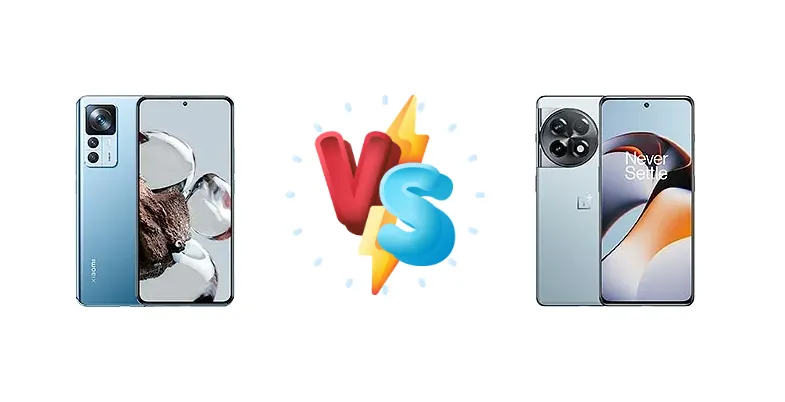
|
🏆 Quick Verdict
For most users, the OnePlus 11R emerges as the stronger contender. Its Snapdragon 8+ Gen 1 chipset delivers superior performance and efficiency compared to the Dimensity 8100 Ultra, making it ideal for demanding tasks and gaming. While the Xiaomi 12T boasts faster charging, the 11R’s overall package offers a more balanced experience.
| PHONES | ||
|---|---|---|
| Phone Names | Xiaomi 12T | OnePlus 11R |
| Network | ||
|---|---|---|
| 2G bands | GSM 850 / 900 / 1800 / 1900 | GSM 850 / 900 / 1800 / 1900 |
| 3G bands | HSDPA 800 / 850 / 900 / 1700(AWS) / 1900 / 2100 | HSDPA 850 / 900 / 1700(AWS) / 2100 |
| 4G bands | 1, 2, 3, 4, 5, 7, 8, 12, 13, 17, 18, 19, 20, 26, 28, 32, 38, 40, 41, 66 | 1, 3, 4, 5, 8, 28, 34, 38, 39, 40, 41 |
| 5G bands | 1, 3, 5, 7, 8, 20, 28, 38, 40, 41, 66, 77, 78 SA/NSA | 1, 3, 5, 8, 28, 40, 41, 77, 78 SA/NSA |
| Speed | HSPA, LTE, 5G | HSPA, LTE (3CA), 5G |
| Technology | GSM / HSPA / LTE / 5G | GSM / CDMA / HSPA / LTE / 5G |
| - | CDMA 800 | |
| Launch | ||
|---|---|---|
| Announced | 2022, October 04 | 2023, February 07 |
| Status | Available. Released 2022, October 06 | Available. Released 2023, February 21 |
| Body | ||
|---|---|---|
| Build | - | Glass front, glass back (Gorilla Glass 5), plastic frame |
| Dimensions | 163.1 x 75.9 x 8.6 mm (6.42 x 2.99 x 0.34 in) | 163.4 x 74.3 x 8.7 mm (6.43 x 2.93 x 0.34 in) |
| SIM | Nano-SIM + Nano-SIM | Nano-SIM + Nano-SIM |
| Weight | 202 g (7.13 oz) | 204 g (7.20 oz) |
| Display | ||
|---|---|---|
| Protection | Corning Gorilla Glass 5 | - |
| Resolution | 1220 x 2712 pixels, 20:9 ratio (~446 ppi density) | 1240 x 2772 pixels, 20:9 ratio (~451 ppi density) |
| Size | 6.67 inches, 107.4 cm2 (~86.7% screen-to-body ratio) | 6.74 inches, 109.2 cm2 (~90.0% screen-to-body ratio) |
| Type | AMOLED, 68B colors, 120Hz, HDR10+, 500 nits (typ), 900 nits (peak) | Fluid AMOLED, 1B colors, 120Hz, HDR10+, 1450 nits (peak) |
| Platform | ||
|---|---|---|
| CPU | Octa-core (4x2.85 GHz Cortex-A78 & 4x2.0 GHz Cortex-A55) | Octa-core (1x3.0 GHz Cortex-X2 & 3x2.5 GHz Cortex-A710 & 4x1.80 GHz Cortex-A510) |
| Chipset | Mediatek Dimensity 8100 Ultra (5 nm) | Qualcomm SM8475 Snapdragon 8+ Gen 1 (4 nm) |
| GPU | Mali-G610 MC6 | Adreno 730 |
| OS | Android 12, upgradable to Android 14, MIUI 14 | Android 13, upgradable to Android 15, OxygenOS 15 |
| Memory | ||
|---|---|---|
| Card slot | No | No |
| Internal | 128GB 8GB RAM, 256GB 8GB RAM | 128GB 8GB RAM, 256GB 16GB RAM, 512GB 18GB RAM |
| UFS 3.1 | UFS 3.1 | |
| Main Camera | ||
|---|---|---|
| Features | Color spectrum sensor, Dual-LED dual-tone flash, HDR, panorama | Color spectrum sensor, LED flash, HDR, panorama |
| Single | - | 16 MP, f/2.4, 24mm (wide), 1/3.09", 1.0µm |
| Triple | 108 MP, f/1.7, 24mm (wide), 1/1.67", 0.64µm, PDAF, OIS 8 MP, f/2.2, 120˚ (ultrawide), 1/4.0", 1.12µm 2 MP (macro) | 50 MP, f/1.8, 24mm (wide), 1/1.56", 1.0µm, multi-directional PDAF, OIS 8 MP, f/2.2, 120˚ (ultrawide), 1/4.0", 1.12µm 2 MP (macro) |
| Video | 4K@30fps, 1080p@30/60/120/240fps, HDR | 4K@30/60fps, 1080p@30/60/240fps, gyro-EIS |
| Selfie camera | ||
|---|---|---|
| Features | HDR, panorama | HDR |
| Single | 20 MP, f/2.2, (wide), 1/3.47", 0.8µm | 16 MP, f/2.4, 24mm (wide), 1/3.09", 1.0µm |
| Video | 1080p@30/60fps, HDR | 1080p@30fps |
| Sound | ||
|---|---|---|
| 3.5mm jack | No | No |
| 35mm jack | No | No |
| Loudspeaker | Yes, with stereo speakers | Yes, with stereo speakers |
| 24-bit/192kHz audio | 24-bit/192kHz audio | |
| Comms | ||
|---|---|---|
| Bluetooth | 5.3, A2DP, LE | 5.3, A2DP, LE, aptX HD |
| Infrared port | Yes | Yes |
| NFC | Yes (market/region dependent) | Yes |
| Positioning | GPS (L1+L5), GLONASS (L1), BDS (B1I+B1c+B2a), GALILEO (E1+E5a), QZSS (L1+L5), NavIC (L5) | GPS (L1+L5), GLONASS (G1), BDS (B1I+B1c+B2a), GALILEO (E1+E5a), QZSS (L1+L5) |
| Radio | No | No |
| USB | USB Type-C 2.0, OTG | USB Type-C 2.0 |
| WLAN | Wi-Fi 802.11 a/b/g/n/ac/6, dual-band, Wi-Fi Direct | Wi-Fi 802.11 a/b/g/n/ac/6, dual-band |
| Features | ||
|---|---|---|
| Sensors | Fingerprint (under display, optical), accelerometer, gyro, proximity, compass | Fingerprint (under display, optical), accelerometer, gyro, proximity, compass |
| Battery | ||
|---|---|---|
| Charging | 120W wired, 100% in 19 min | 100W wired |
| Type | Li-Po 5000 mAh | Li-Po 5000 mAh |
| Misc | ||
|---|---|---|
| Colors | Black, Silver, Blue | Galactic Silver, Sonic Black, Solar Red |
| Models | 22071212AG | CPH2487 |
| Price | € 181.96 / £ 283.32 | About 600 EUR |
| SAR | 1.09 W/kg (head) 1.09 W/kg (body) | 1.16 W/kg (head) 0.61 W/kg (body) |
| SAR EU | 0.99 W/kg (head) 0.99 W/kg (body) | - |
| Tests | ||
|---|---|---|
| Battery life | Endurance rating 104h | - |
| Camera | Photo / Video | - |
| Display | Contrast ratio: Infinite (nominal) | - |
| Loudspeaker | -25.0 LUFS (Very good) | - |
| Performance | AnTuTu: 780204 (v9) GeekBench: 3756 (v5.1) | - |
Xiaomi 12T
- Incredibly fast 120W charging
- High peak display brightness (954 nits)
- Respectable battery endurance (104h)
- Dimensity 8100 Ultra chipset is less powerful than Snapdragon 8+ Gen 1
- Camera specs are unknown, potentially lagging behind the 11R
OnePlus 11R
- Snapdragon 8+ Gen 1 offers superior performance and efficiency
- Potentially better thermal management
- Likely more refined software experience
- Slower charging speed (100W vs 120W)
- Display brightness specs are unknown
Display Comparison
The Xiaomi 12T features a display capable of reaching 954 nits of peak brightness, ensuring excellent visibility even in direct sunlight. While the OnePlus 11R’s display specs aren’t provided, OnePlus typically prioritizes color accuracy and refresh rates in this segment. The 12T’s ‘Infinite’ contrast ratio (nominal) suggests a typical AMOLED panel, but without specifics on color gamut coverage or PWM dimming frequency, it’s difficult to assess its overall quality relative to the 11R. The 12T’s brightness advantage is a clear win for outdoor use.
Camera Comparison
Both phones are listed as having 'Photo / Video' capabilities, lacking specific details. Without sensor size, aperture, or OIS information, a direct comparison is impossible. However, given the market positioning, it’s likely both phones feature a primary sensor in the 50MP-108MP range. The image processing style will likely differ – Xiaomi often leans towards more saturated colors, while OnePlus aims for a more natural look. The absence of detail makes it difficult to assess which phone offers a superior camera experience, but the 11R’s potential for better image stabilization due to Qualcomm’s ISP is a possibility.
Performance
This is where the core difference lies. The OnePlus 11R is equipped with the Qualcomm Snapdragon 8+ Gen 1 (4nm), a flagship-level chipset known for its performance and efficiency. The Xiaomi 12T utilizes the Mediatek Dimensity 8100 Ultra (5nm). While both are powerful, the Snapdragon 8+ Gen 1’s Cortex-X2 prime core clocked at 3.0 GHz provides a significant advantage in single-core performance, crucial for responsive UI and app loading. The 4nm process node of the Snapdragon also translates to better thermal management and power efficiency compared to the 5nm Dimensity, potentially reducing throttling during extended gaming sessions. The 11R’s CPU configuration (1x3.0 GHz Cortex-X2, 3x2.5 GHz Cortex-A710, 4x1.80 GHz Cortex-A510) is architecturally superior for demanding workloads.
Battery Life
The Xiaomi 12T boasts an endurance rating of 104 hours, suggesting a respectable battery life. However, its standout feature is the 120W wired charging, capable of fully charging the device in just 19 minutes. The OnePlus 11R offers 100W wired charging, which is still incredibly fast, but slower than the 12T. Without knowing the battery capacity of the 11R, it’s difficult to definitively say which phone has the better battery life. The 12T’s faster charging is a significant convenience factor, especially for users who frequently need to top up their battery quickly.
Buying Guide
Buy the Xiaomi 12T if you prioritize incredibly fast charging and a bright display for media consumption, and are willing to trade some raw processing power. Buy the OnePlus 11R if you demand top-tier performance for gaming and multitasking, and value a more efficient chipset that will likely offer better long-term stability and sustained performance.