
Xiaomi 12T vs Google Pixel 7a: A Deep Dive into Performance, Camera, and Value
| Phones Images | |||||
|---|---|---|---|---|---|
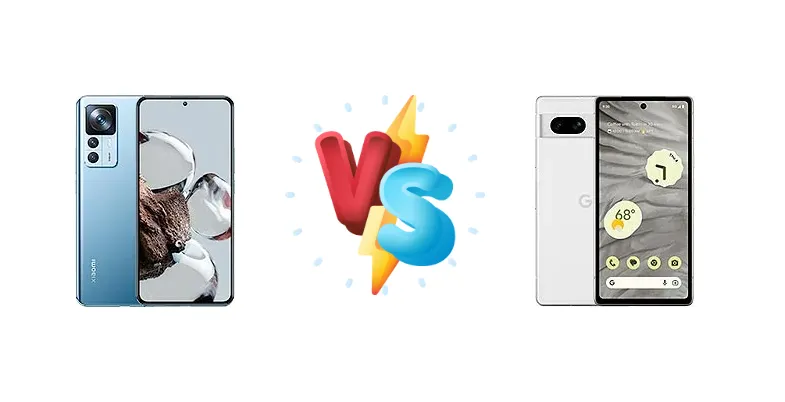
|
🏆 Quick Verdict
For the average user prioritizing camera quality and a seamless software experience, the Google Pixel 7a is the superior choice. However, the Xiaomi 12T wins for those who demand the fastest charging speeds and sustained performance during demanding tasks, offering a compelling value proposition.
| PHONES | ||
|---|---|---|
| Phone Names | Xiaomi 12T | Google Pixel 7a |
| Network | ||
|---|---|---|
| 2G bands | GSM 850 / 900 / 1800 / 1900 | GSM 850 / 900 / 1800 / 1900 |
| 3G bands | HSDPA 800 / 850 / 900 / 1700(AWS) / 1900 / 2100 | HSDPA 800 / 850 / 900 / 1700(AWS) / 1900 / 2100 |
| 4G bands | 1, 2, 3, 4, 5, 7, 8, 12, 13, 17, 18, 19, 20, 26, 28, 32, 38, 40, 41, 66 | 1, 2, 3, 4, 5, 7, 8, 12, 13, 14, 17, 20, 25, 26, 28, 29, 30, 38, 40, 41, 48, 66, 71 - GWKK3, G0DZQ |
| 5G bands | 1, 3, 5, 7, 8, 20, 28, 38, 40, 41, 66, 77, 78 SA/NSA | 1, 2, 3, 5, 7, 8, 12, 14, 20, 25, 28, 30, 38, 41, 48, 66, 71, 77, 78 SA/NSA/Sub6 - GWKK3 |
| Speed | HSPA, LTE, 5G | HSPA, LTE, 5G |
| Technology | GSM / HSPA / LTE / 5G | GSM / HSPA / LTE / 5G |
| - | 1, 2, 3, 5, 7, 8, 12, 20, 25, 28, 38, 40, 41, 66, 75, 76, 77, 78, 79 SA/NSA/Sub6 - GHL1X, G82U8 | |
| Launch | ||
|---|---|---|
| Announced | 2022, October 04 | 2023, May 10 |
| Status | Available. Released 2022, October 06 | Available. Released 2023, May 10 |
| Body | ||
|---|---|---|
| Build | - | Glass front (Gorilla Glass 3), aluminum frame, plastic back |
| Dimensions | 163.1 x 75.9 x 8.6 mm (6.42 x 2.99 x 0.34 in) | 152 x 72.9 x 9 mm (5.98 x 2.87 x 0.35 in) |
| SIM | Nano-SIM + Nano-SIM | Nano-SIM + eSIM |
| Weight | 202 g (7.13 oz) | 193.5 g (6.84 oz) |
| - | IP67 dust/water resistant (up to 1m for 30 min) | |
| Display | ||
|---|---|---|
| Protection | Corning Gorilla Glass 5 | Corning Gorilla Glass 3 |
| Resolution | 1220 x 2712 pixels, 20:9 ratio (~446 ppi density) | 1080 x 2400 pixels, 20:9 ratio (~429 ppi density) |
| Size | 6.67 inches, 107.4 cm2 (~86.7% screen-to-body ratio) | 6.1 inches, 90.7 cm2 (~81.8% screen-to-body ratio) |
| Type | AMOLED, 68B colors, 120Hz, HDR10+, 500 nits (typ), 900 nits (peak) | OLED, HDR, 90Hz |
| - | Always-on display | |
| Platform | ||
|---|---|---|
| CPU | Octa-core (4x2.85 GHz Cortex-A78 & 4x2.0 GHz Cortex-A55) | Octa-core (2x2.85 GHz Cortex-X1 & 2x2.35 GHz Cortex-A78 & 4x1.80 GHz Cortex-A55) |
| Chipset | Mediatek Dimensity 8100 Ultra (5 nm) | Google Tensor G2 (5 nm) |
| GPU | Mali-G610 MC6 | Mali-G710 MP7 |
| OS | Android 12, upgradable to Android 14, MIUI 14 | Android 13, upgradable to Android 15, up to 5 major Android upgrades |
| Memory | ||
|---|---|---|
| Card slot | No | No |
| Internal | 128GB 8GB RAM, 256GB 8GB RAM | 128GB 8GB RAM |
| UFS 3.1 | UFS 3.1 | |
| Main Camera | ||
|---|---|---|
| Dual | - | 64 MP, f/1.9, 26mm (wide), 1/1.73", 0.8µm, dual pixel PDAF, OIS 13 MP, f/2.2, 120˚ (ultrawide), 1.12µm |
| Features | Color spectrum sensor, Dual-LED dual-tone flash, HDR, panorama | Dual-LED flash, Pixel Shift, Auto-HDR, panorama |
| Triple | 108 MP, f/1.7, 24mm (wide), 1/1.67", 0.64µm, PDAF, OIS 8 MP, f/2.2, 120˚ (ultrawide), 1/4.0", 1.12µm 2 MP (macro) | - |
| Video | 4K@30fps, 1080p@30/60/120/240fps, HDR | 4K@30/60fps, 1080p@30/60/120/240fps, OIS |
| Selfie camera | ||
|---|---|---|
| Features | HDR, panorama | HDR, panorama |
| Single | 20 MP, f/2.2, (wide), 1/3.47", 0.8µm | 13 MP, f/2.2, 20mm (ultrawide), 1.12µm |
| Video | 1080p@30/60fps, HDR | 4K@30fps, 1080p@30fps |
| Sound | ||
|---|---|---|
| 3.5mm jack | No | No |
| 35mm jack | No | No |
| Loudspeaker | Yes, with stereo speakers | Yes, with stereo speakers |
| 24-bit/192kHz audio | - | |
| Comms | ||
|---|---|---|
| Bluetooth | 5.3, A2DP, LE | 5.3, A2DP, LE |
| Infrared port | Yes | - |
| NFC | Yes (market/region dependent) | Yes |
| Positioning | GPS (L1+L5), GLONASS (L1), BDS (B1I+B1c+B2a), GALILEO (E1+E5a), QZSS (L1+L5), NavIC (L5) | GPS, GLONASS, GALILEO, BDS, QZSS, NavIC |
| Radio | No | No |
| USB | USB Type-C 2.0, OTG | USB Type-C 3.2 |
| WLAN | Wi-Fi 802.11 a/b/g/n/ac/6, dual-band, Wi-Fi Direct | Wi-Fi 802.11 a/b/g/n/ac/6e, tri-band |
| Features | ||
|---|---|---|
| Sensors | Fingerprint (under display, optical), accelerometer, gyro, proximity, compass | Fingerprint (under display, optical), accelerometer, gyro, proximity, compass, barometer |
| Battery | ||
|---|---|---|
| Charging | 120W wired, 100% in 19 min | 18W wired, PD3.0 7.5W wireless |
| Type | Li-Po 5000 mAh | Li-Po 4385 mAh |
| Misc | ||
|---|---|---|
| Colors | Black, Silver, Blue | Charcoal, Snow, Sea, Coral |
| Models | 22071212AG | GWKK3, GHL1X, G0DZQ, G82U8 |
| Price | € 181.96 / £ 283.32 | € 179.90 / $ 150.00 / £ 170.00 / ₹ 25,980 |
| SAR | 1.09 W/kg (head) 1.09 W/kg (body) | - |
| SAR EU | 0.99 W/kg (head) 0.99 W/kg (body) | - |
| Tests | ||
|---|---|---|
| Battery life | Endurance rating 104h | - |
| Camera | Photo / Video | - |
| Display | Contrast ratio: Infinite (nominal) | - |
| Loudspeaker | -25.0 LUFS (Very good) | - |
| Performance | AnTuTu: 780204 (v9) GeekBench: 3756 (v5.1) | - |
Xiaomi 12T
- Blazing-fast 120W charging
- Powerful Dimensity 8100 Ultra chipset for gaming
- Longer battery endurance (104h)
- Camera details are vague
- Software experience may not be as refined as Pixel
Google Pixel 7a
- Exceptional camera quality and image processing
- Clean and intuitive software experience
- Guaranteed software updates from Google
- Slower 18W charging
- Shorter battery endurance (76h)
- Tensor G2 can be less power efficient
Display Comparison
Both the Xiaomi 12T and Pixel 7a feature AMOLED displays, but differ in peak brightness. The Pixel 7a edges out the 12T with a measured 1070 nits compared to the 12T’s 954 nits, offering slightly better visibility in direct sunlight. While both boast an 'infinite' contrast ratio (typical for AMOLED), the 12T’s display technology isn’t specified, while the Pixel 7a’s likely benefits from Google’s color calibration expertise. Bezels appear comparable in initial impressions, but detailed measurements would be needed to confirm.
Camera Comparison
Both phones are marketed as having strong camera systems, but their approaches differ. The Pixel 7a leverages Google’s computational photography prowess, relying on software algorithms to enhance image quality. While specific sensor details are missing, the Pixel 7a’s strength lies in its image processing pipeline, delivering consistently excellent results in various lighting conditions. The Xiaomi 12T’s camera system is described as 'Photo / Video' without further detail, suggesting a focus on versatility. Without sensor size or aperture information, it’s difficult to assess its low-light performance. The Pixel 7a’s emphasis on software optimization likely provides a more consistent and user-friendly experience, while the 12T may offer more manual control options for experienced photographers.
Performance
The chipset is where these phones diverge significantly. The Xiaomi 12T utilizes the Mediatek Dimensity 8100 Ultra (5nm), featuring an octa-core configuration with four high-performance Cortex-A78 cores clocked at 2.85 GHz. The Pixel 7a, however, employs Google’s in-house Tensor G2 (5nm) chip, with a unique core arrangement – two Cortex-X1 cores at 2.85 GHz, two Cortex-A78 cores at 2.35 GHz, and four Cortex-A55 cores at 1.80 GHz. While clock speeds are similar, the Tensor G2’s architecture prioritizes AI and machine learning tasks, enhancing features like voice recognition and image processing. The 12T’s Dimensity 8100 Ultra is generally expected to deliver higher raw GPU performance, making it more suitable for demanding games, while the Tensor G2 excels in tasks leveraging its AI capabilities. Both phones utilize 8GB of RAM, but the RAM type (LPDDR5x vs. standard LPDDR5) isn’t specified for the 12T, potentially giving the Pixel 7a a slight edge in memory bandwidth.
Battery Life
Battery life is a clear advantage for the Xiaomi 12T, boasting an endurance rating of 104 hours compared to the Pixel 7a’s 76 hours. However, this doesn’t tell the whole story. The Pixel 7a’s Tensor G2 chip is known to be less power-efficient than the Dimensity 8100 Ultra. The 12T also features a game-changing 120W wired charging, achieving a full charge in just 19 minutes, while the Pixel 7a is limited to 18W wired charging with PD3.0 and 7.5W wireless charging. This difference in charging speed is substantial, making the 12T ideal for users who frequently need to top up their battery quickly.
Buying Guide
Buy the Xiaomi 12T if you need a phone that can go from 0 to 100% in under 20 minutes, and you frequently engage in resource-intensive activities like gaming or video editing. Buy the Google Pixel 7a if you prioritize a consistently excellent camera, a clean and intuitive software experience with guaranteed updates, and a more balanced overall package.