
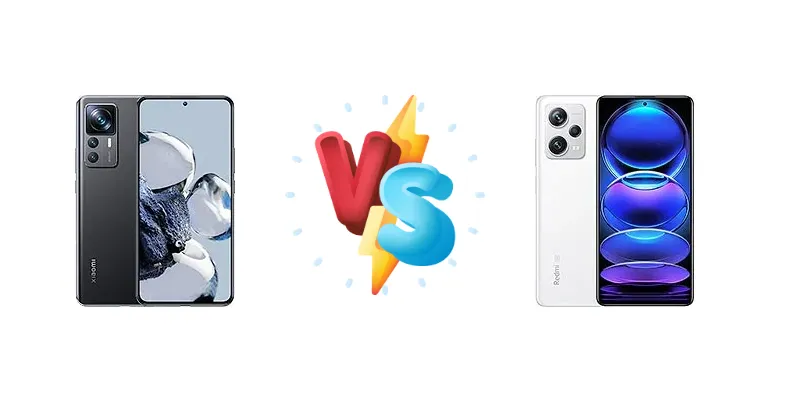
Xiaomi 12T Pro vs Redmi Note 12 Pro+: A Head-to-Head Showdown
| Phones Images | |||||
|---|---|---|---|---|---|
|
🏆 Quick Verdict
The Xiaomi 12T Pro edges out the Redmi Note 12 Pro+ thanks to its superior Snapdragon 8+ Gen 1 chipset, offering noticeably faster performance. While both offer 120W charging and excellent displays, the 12T Pro's raw power makes it the better overall choice for demanding users.
| PHONES | ||
|---|---|---|
| Phone Names | Xiaomi 12T Pro | Xiaomi Redmi Note 12 Pro+ |
| Network | ||
|---|---|---|
| 2G bands | GSM 850 / 900 / 1800 / 1900 | GSM 850 / 900 / 1800 / 1900 - SIM 1 & SIM 2 |
| 3G bands | HSDPA 800 / 850 / 900 / 1700(AWS) / 1900 / 2100 | HSDPA 800 / 850 / 900 / 1900 / 2100 |
| 4G bands | 1, 2, 3, 4, 5, 7, 8, 12, 13, 17, 18, 19, 20, 25, 26, 28, 32, 38, 39, 40, 41, 42, 48, 66 | 1, 3, 5, 8, 19, 34, 38, 39, 40, 41 - International, China |
| 5G bands | 1, 3, 5, 7, 8, 20, 28, 38, 40, 41, 66, 77, 78, 75 SA/NSA | 1, 3, 5, 8, 28, 38, 40, 41, 77, 78 SA/NSA - International |
| Speed | HSPA, LTE, 5G | HSPA, LTE-A (CA), 5G |
| Technology | GSM / HSPA / LTE / 5G | GSM / CDMA / HSPA / EVDO / LTE / 5G |
| - | 1, 3, 5, 8, 28, 38, 41, 77, 78 SA/NSA - China | |
| Launch | ||
|---|---|---|
| Announced | 2022, October 04 | 2022, October 27 |
| Status | Available. Released 2022, October 06 | Available. Released 2022, November 01 |
| Body | ||
|---|---|---|
| Build | - | Glass front (Gorilla Glass 5), glass back |
| Dimensions | 163.1 x 75.9 x 8.6 mm (6.42 x 2.99 x 0.34 in) | 162.9 x 76 x 8.9 mm (6.41 x 2.99 x 0.35 in) |
| SIM | · Nano-SIM + eSIM· Nano-SIM + Nano-SIM | Dual SIM (Nano-SIM, dual stand-by) |
| Weight | 205 g (7.23 oz) | 208.4 g (7.34 oz) |
| IP53, dust and splash resistant | IP53, dust and splash resistant | |
| Display | ||
|---|---|---|
| Protection | Corning Gorilla Glass 5 | Corning Gorilla Glass 5 |
| Resolution | 1220 x 2712 pixels, 20:9 ratio (~446 ppi density) | 1080 x 2400 pixels, 20:9 ratio (~395 ppi density) |
| Size | 6.67 inches, 107.4 cm2 (~86.7% screen-to-body ratio) | 6.67 inches, 107.4 cm2 (~86.8% screen-to-body ratio) |
| Type | AMOLED, 68B colors, 120Hz, Dolby Vision, HDR10+, 500 nits (typ), 900 nits (peak) | OLED, 1B colors, 120Hz, Dolby Vision, HDR10+, 500 nits (typ), 900 nits (HBM) |
| Platform | ||
|---|---|---|
| CPU | Octa-core (1x3.19 GHz Cortex-X2 & 3x2.75 GHz Cortex-A710 & 4x2.0 GHz Cortex-A510) | Octa-core (2x2.6 GHz Cortex-A78 & 6x2.0 GHz Cortex-A55) |
| Chipset | Qualcomm SM8475 Snapdragon 8+ Gen 1 (4 nm) | Mediatek MT6877V Dimensity 1080 (6 nm) |
| GPU | Adreno 730 | Mali-G68 MC4 |
| OS | Android 12, upgradable to Android 14, HyperOS | Android 12, MIUI 13 |
| Memory | ||
|---|---|---|
| Card slot | No | No |
| Internal | 128GB 8GB RAM, 256GB 8GB RAM, 256GB 12GB RAM | 256GB 8GB RAM, 256GB 12GB RAM |
| UFS 3.1 | UFS 2.2 | |
| Main Camera | ||
|---|---|---|
| Features | Color spectrum sensor, Dual-LED dual-tone flash, HDR, panorama | Dual-LED dual-tone flash, HDR, panorama |
| Triple | 200 MP, f/1.7, (wide), 1/1.22", 0.64µm, PDAF, OIS 8 MP, f/2.2, 120˚ (ultrawide), 1/4.0", 1.12µm 2 MP (macro) | 200 MP, f/1.7, 24mm (wide), 1/1.4", 0.56µm, PDAF, OIS 8 MP, f/2.2, 120˚ (ultrawide), 1/4", 1.12µm 2 MP, f/2.4, (macro) |
| Video | 8K@24fps, 4K@30/60fps, 1080p@30/60/120/240fps, HDR10+ | 4K@30fps, 1080p@30/60/120fps, 720p@960fps |
| Selfie camera | ||
|---|---|---|
| Features | HDR, panorama | HDR |
| Single | 20 MP, f/2.2, (wide), 1/3.47", 0.8µm | 16 MP, f/2.5, (wide), 1/3.06", 1.0µm |
| Video | 1080p@30/60fps, HDR | 1080p@30/60fps |
| Sound | ||
|---|---|---|
| 3.5mm jack | No | Yes |
| 35mm jack | No | - |
| Loudspeaker | Yes, with stereo speakers | Yes, with stereo speakers |
| Tuned by Harman Kardon 24-bit/192kHz audio | 24-bit/192kHz audio | |
| Comms | ||
|---|---|---|
| Bluetooth | 5.2, A2DP, LE, aptX HD | 5.2, A2DP, LE |
| Infrared port | Yes | Yes |
| NFC | Yes (market/region dependent) | Yes (market/region dependent) |
| Positioning | GPS (L1+L5), GLONASS (L1), BDS (B1I+B1c+B2a), GALILEO (E1+E5a), QZSS (L1+L5), NavIC (L5) | GPS (L1), GLONASS (G1), BDS (B1I+B1c), GALILEO (E1), QZSS (L1) |
| Radio | No | No |
| USB | USB Type-C 2.0, OTG | USB Type-C 2.0, OTG |
| WLAN | Wi-Fi 802.11 a/b/g/n/ac/6, dual-band, Wi-Fi Direct | Wi-Fi 802.11 a/b/g/n/ac/6, dual-band, Wi-Fi Direct |
| Features | ||
|---|---|---|
| Sensors | Fingerprint (under display, optical), accelerometer, gyro, proximity, compass | Fingerprint (side-mounted), accelerometer, proximity, gyro, compass |
| Battery | ||
|---|---|---|
| Charging | 120W wired, 100% in 19 min | 120W wired, PD3.0, 100% in 19 min (advertised) |
| Type | Li-Po 5000 mAh | Li-Po 5000 mAh, non-removable |
| Misc | ||
|---|---|---|
| Colors | Black, Silver, Blue | Arctic White, Iceberg Blue, Obsidian Black, Trend edition |
| Models | 22081212UG, 22081212G | 22101316UCP, 22101316UG |
| Price | $ 208.76 / € 167.62 | $ 348.00 / £ 439.00 / € 399.00 / ₹ 29,949 |
| SAR | 1.08 W/kg (head) 1.07 W/kg (body) | - |
| SAR EU | 1.00 W/kg (head) 1.00 W/kg (body) | - |
| Tests | ||
|---|---|---|
| Battery life | Endurance rating 91h | Endurance rating 88h |
| Camera | Photo / Video | Photo / Video |
| Display | Contrast ratio: Infinite (nominal) | Contrast ratio: Infinite (nominal) |
| Loudspeaker | -24.1 LUFS (Very good) | -26.7 LUFS (Good) |
| Performance | AnTuTu: 1032185 (v9) GeekBench: 4081 (v5.1) GFXBench: 65fps (ES 3.1 onscreen) | AnTuTu: 498710 (v9) GeekBench: 2208 (v5.1), 2372 (v6) GFXBench: 22fps (ES 3.1 onscreen) |
Xiaomi 12T Pro
- Superior Performance (Snapdragon 8+ Gen 1)
- High Peak Brightness Display
- Fast 120W Charging
- Excellent Build Quality
- Potentially Higher Price
- Camera may not match 200MP hype
- Software experience can be inconsistent
Xiaomi Redmi Note 12 Pro+
- 200MP Main Camera
- Fast 120W Charging
- Competitive Price
- Good All-Around Performance
- Dimensity 1080 Chipset (less powerful)
- Lower Peak Brightness than 12T Pro
- Software experience can be inconsistent
Display Comparison
Both phones boast vibrant AMOLED displays with 120Hz refresh rates and excellent color accuracy. The Xiaomi 12T Pro's measured 913 nits peak brightness gives it a slight advantage in outdoor visibility. Both have 'Infinite' contrast ratios, a nominal term indicating very high contrast. Resolution is likely FHD+ on both, though specific pixel counts should be verified.
Camera Comparison
The Redmi Note 12 Pro+ is often touted for its 200MP main camera, which promises incredible detail. However, megapixels aren't everything. The 12T Pro's camera system, while potentially lower in megapixel count, benefits from the Snapdragon's image processing capabilities. Both phones likely offer excellent video recording capabilities, but the 12T Pro's chipset may provide slightly better stabilization and dynamic range. Real-world testing is crucial here.
Performance
This is where the 12T Pro shines. The Snapdragon 8+ Gen 1 is a flagship-level chipset, significantly outperforming the Dimensity 1080 in the Redmi Note 12 Pro+. Expect smoother multitasking, faster app loading, and significantly better gaming performance on the 12T Pro. The 12T Pro also benefits from potentially better thermal management due to its higher-end chipset.
Battery Life
Both phones offer impressive battery life, with the 12T Pro achieving a slightly higher endurance rating (91h vs 88h). The 120W charging is a standout feature on both, promising a full charge in around 19 minutes. Battery capacity is likely similar, around 5000mAh.
Buying Guide
Who should buy the Xiaomi 12T Pro? Gamers, power users, and anyone prioritizing top-tier performance. Who should buy the Xiaomi Redmi Note 12 Pro+? Users seeking a great all-around phone with a fantastic camera and fast charging, at a slightly more affordable price point.