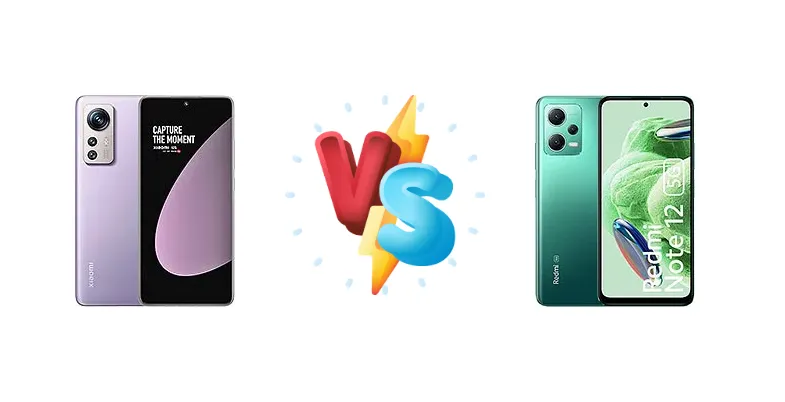
Xiaomi offers a diverse range of smartphones, catering to various budgets and needs. Two popular contenders are the flagship Xiaomi 12S and the more budget-friendly Redmi Note 12. This comprehensive comparison will delve into their key features, performance, and overall value to help you decide which one is right for you.
🏆 Quick Verdict
The Xiaomi 12S is the clear winner for performance and camera quality thanks to its Snapdragon 8+ Gen 1 chipset and premium optics. However, the Redmi Note 12 offers exceptional battery life and a more affordable price point, making it a compelling choice for budget-conscious users.
| Network |
|---|
| 2G bands | GSM 850 / 900 / 1800 / 1900 | GSM 850 / 900 / 1800 / 1900 |
| 3G bands | HSDPA 800 / 850 / 900 / 1700(AWS) / 1900 / 2100 | HSDPA 850 / 900 / 2100 |
| 4G bands | 1, 2, 3, 4, 5, 7, 8, 18, 19, 26, 34, 38, 39, 40, 41, 42 | 1, 3, 5, 8, 40, 41 |
| 5G bands | 1, 3, 5, 8, 28, 38, 40, 41, 77, 78 SA/NSA | 1, 3, 5, 8, 28, 40, 78 SA/NSA |
| Speed | HSPA, LTE, 5G | HSPA, LTE, 5G |
| Technology | GSM / CDMA / HSPA / EVDO / LTE / 5G | GSM / HSPA / LTE / 5G |
| | CDMA2000 1xEV-DO | - |
| Launch |
|---|
| Announced | 2022, July 04 | 2022, October 27 |
| Status | Available. Released 2022, July 07 | Available. Released 2023, January 11 |
| Body |
|---|
| Build | Glass front (Gorilla Glass Victus), glass back or eco leather back, aluminum frame | - |
| Dimensions | 152.7 x 69.9 x 8.2 mm or 8.7 mm | 165.9 x 76.2 x 8 mm (6.53 x 3.00 x 0.31 in) |
| SIM | Nano-SIM + Nano-SIM | Nano-SIM + Nano-SIM |
| Weight | 179 g / 182 g (6.31 oz) | 188 g (6.63 oz) |
| | - | IP53, dust and splash resistant |
| Display |
|---|
| Protection | Corning Gorilla Glass Victus | Corning Gorilla Glass 3 |
| Resolution | 1080 x 2400 pixels, 20:9 ratio (~419 ppi density) | 1080 x 2400 pixels, 20:9 ratio (~395 ppi density) |
| Size | 6.28 inches, 95.2 cm2 (~89.2% screen-to-body ratio) | 6.67 inches, 107.4 cm2 (~85.0% screen-to-body ratio) |
| Type | AMOLED, 68B colors, 120Hz, Dolby Vision, HDR10+, 1100 nits (peak) | AMOLED, 120Hz, 1200 nits (peak) |
| Platform |
|---|
| CPU | Octa-core (1x3.19 GHz Cortex-X2 & 3x2.75 GHz Cortex-A710 & 4x1.80 GHz Cortex-A510) | Octa-core (2x2.0 GHz Cortex-A78 & 6x1.8 GHz Cortex-A55) |
| Chipset | Qualcomm SM8475 Snapdragon 8+ Gen 1 (4 nm) | Qualcomm SM4375 Snapdragon 4 Gen 1 (6 nm) |
| GPU | Adreno 730 | Adreno 619 |
| OS | Android 12, MIUI 13 | Android 12, MIUI 14 (International), MIUI 13 (India) |
| Memory |
|---|
| Card slot | No | microSDXC (uses shared SIM slot) |
| Internal | 128GB 8GB RAM, 256GB 8GB RAM, 256GB 12GB RAM, 512GB 12GB RAM | 128GB 4GB RAM, 128GB 6GB RAM, 256GB 8GB RAM |
| | UFS 3.1 | UFS 2.2 |
| Main Camera |
|---|
| Features | Leica lens, color spectrum sensor, Dual-LED dual-tone flash, HDR, panorama | Dual-LED dual-tone flash, HDR, panorama |
| Single | 32 MP, f/2.5, 26mm (wide), 0.7µm | - |
| Triple | 50 MP, f/1.9, 24mm (wide), 1/1.28", 1.22µm, dual pixel PDAF, OIS
13 MP, f/2.4, 15mm, 123˚ (ultrawide), 1/3.06", 1.12µm
5 MP, f/2.4, 50mm (telephoto macro), AF | 48 MP, f/1.8, (wide), PDAF
8 MP, f/2.2, 120˚ (ultrawide), 1/4.0", 1.12µm
2 MP (macro) |
| Video | 8K@24fps, 4K@30/60fps, 1080p@30/60fps, 720p@1920fps, gyro-EIS | 1080p@30fps |
| Selfie camera |
|---|
| Features | HDR, panorama | HDR |
| Single | 32 MP, f/2.5, 26mm (wide), 0.7µm | 13 MP, f/2.5, (wide), 1/3.0" |
| Video | 1080p@30/60fps, 720p@120fps, HDR | 1080p@30fps |
| Sound |
|---|
| 3.5mm jack | No | Yes |
| 35mm jack | No | Yes |
| Loudspeaker | Yes, with stereo speakers | Yes |
| | 24-bit/192kHz audio
Tuned by Harman Kardon | 24-bit/192kHz audio |
| Comms |
|---|
| Bluetooth | 5.2, A2DP, LE, aptX HD, aptX Adaptive | 5.1, A2DP, LE |
| Infrared port | Yes | Yes |
| NFC | Yes | Yes (market/region dependent) |
| Positioning | GPS (L1+L5), GLONASS (L1), BDS (B1I+B1c+B2a), GALILEO (E1+E5a), QZSS (L1+L5), NavIC (L5) | GPS, GLONASS |
| Radio | No | Unspecified |
| USB | USB Type-C 2.0, OTG | USB Type-C 2.0, OTG |
| WLAN | Wi-Fi 802.11 a/b/g/n/ac/6e, dual-band, Wi-Fi Direct | Wi-Fi 802.11 a/b/g/n/ac, dual-band |
| Features |
|---|
| Sensors | Fingerprint (under display, optical), accelerometer, gyro, proximity, compass | Fingerprint (side-mounted), accelerometer, gyro, proximity, compass |
| Battery |
|---|
| Charging | 67W wired, PD3.0, QC4, 100% in 42 min
50W wireless, 100% in 57 min
10W reverse wireless | 33W wired, 50% in 22 min |
| Type | Li-Po 4500 mAh | Li-Po 5000 mAh |
| Misc |
|---|
| Colors | Gray, White, Purple, Green | Frosted Green, Matte Black, Mystique Blue |
| Models | 2206123SC | 22111317I, 22111317G |
| Price | About 570 EUR | € 151.99 / $ 219.99 / ₹ 11,999 |
| SAR | - | 1.09 W/kg (head) 1.05 W/kg (body) |
| SAR EU | - | 0.68 W/kg (head) 0.91 W/kg (body) |
| Tests |
|---|
| Battery life | - |
Endurance rating 101h
|
| Camera | - |
Photo / Video |
| Display | - |
Contrast ratio: Infinite (nominal) |
| Loudspeaker | - |
-28.0 LUFS (Good)
|
| Performance | - |
AnTuTu: 360745 (v9)
GeekBench: 1998 (v5.1), 2017 (v6) |
Xiaomi 12S
- Exceptional Performance
- Premium Camera System
- Fast Charging (67W)
- Vibrant AMOLED Display
- High Refresh Rate Display
- Higher Price
- Battery Life Not as Long as Redmi Note 12
- Can get warm under heavy load
Xiaomi Redmi Note 12
- Excellent Battery Life
- Affordable Price
- Large Display
- Fast Charging (33W)
- Good Value for Money
- Lower Performance
- Less Advanced Camera
- LCD Display (not as vibrant as AMOLED)
- Plastic Build
Display Comparison
The Xiaomi 12S typically features an AMOLED display with a high refresh rate (often 120Hz) and vibrant colors, while the Redmi Note 12 has a standard LCD panel. The 12S generally offers better brightness and color accuracy. The Redmi Note 12's contrast ratio is listed as 'infinite' which is a nominal value and doesn't necessarily translate to superior image quality in real-world use.
Camera Comparison
The Xiaomi 12S boasts a more advanced camera system, likely including a larger sensor and more sophisticated image processing algorithms. Expect better low-light performance, sharper details, and more versatile shooting options. The Redmi Note 12's camera is adequate for everyday snapshots but lacks the premium features of the 12S.
Performance
The Snapdragon 8+ Gen 1 in the Xiaomi 12S provides significantly faster processing speeds and smoother multitasking compared to the Snapdragon 4 Gen 1 in the Redmi Note 12. The 12S excels in demanding tasks like gaming and video editing.
Battery Life
The Redmi Note 12 shines in battery life, consistently delivering impressive endurance ratings. While the Xiaomi 12S also offers decent battery performance, it doesn't match the longevity of the Redmi Note 12. Both phones support fast charging, but the Redmi Note 12's 33W charging is slightly slower than the 12S's 67W wired charging.
Buying Guide
The Xiaomi 12S is ideal for power users, mobile gamers, and photography enthusiasts who demand top-tier performance and a premium camera experience. The Redmi Note 12 is perfect for everyday users who prioritize long battery life, a large display, and a budget-friendly price tag.
Frequently Asked Questions
❓ Is the Xiaomi 12S worth the extra money?
If you prioritize performance, camera quality, and a premium display, the Xiaomi 12S is worth the investment. However, if you're on a budget and value battery life above all else, the Redmi Note 12 is a more sensible choice.
❓ What is the difference between the Snapdragon 8+ Gen 1 and Snapdragon 4 Gen 1?
The Snapdragon 8+ Gen 1 is a flagship-level chipset offering significantly higher performance and efficiency compared to the Snapdragon 4 Gen 1, which is a mid-range processor.