
Xiaomi 12S vs 12 Pro (Dimensity): A Deep Dive into Xiaomi's Flagship Showdown
| Phones Images | |||||
|---|---|---|---|---|---|
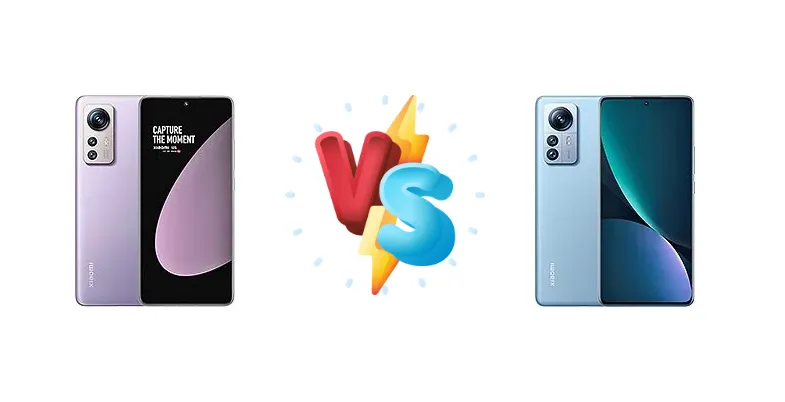
|
🏆 Quick Verdict
For most users, the Xiaomi 12 Pro (Dimensity) emerges as the stronger choice. Its Dimensity 9000+ chipset delivers comparable, and often superior, performance with potentially better thermal management, while maintaining the same 67W charging speed as the 12S. The 12S remains a viable option if found at a significantly lower price.
| PHONES | ||
|---|---|---|
| Phone Names | Xiaomi 12S | Xiaomi 12 Pro (Dimensity) |
| Network | ||
|---|---|---|
| 2G bands | GSM 850 / 900 / 1800 / 1900 | GSM 850 / 900 / 1800 / 1900 |
| 3G bands | HSDPA 800 / 850 / 900 / 1700(AWS) / 1900 / 2100 | HSDPA 800 / 850 / 900 / 1700(AWS) / 1900 / 2100 |
| 4G bands | 1, 2, 3, 4, 5, 7, 8, 18, 19, 26, 34, 38, 39, 40, 41, 42 | 1, 2, 3, 4, 5, 7, 8, 18, 19, 26, 34, 38, 39, 40, 41, 42 |
| 5G bands | 1, 3, 5, 8, 28, 38, 40, 41, 77, 78 SA/NSA | 1, 3, 5, 8, 28, 38, 40, 41, 77, 78 SA/NSA |
| Speed | HSPA, LTE, 5G | HSPA, LTE, 5G |
| Technology | GSM / CDMA / HSPA / EVDO / LTE / 5G | GSM / CDMA / HSPA / EVDO / LTE / 5G |
| CDMA2000 1xEV-DO | CDMA2000 1xEV-DO | |
| Launch | ||
|---|---|---|
| Announced | 2022, July 04 | 2022, July 04 |
| Status | Available. Released 2022, July 07 | Available. Released 2022, July 13 |
| Body | ||
|---|---|---|
| Build | Glass front (Gorilla Glass Victus), glass back or eco leather back, aluminum frame | - |
| Dimensions | 152.7 x 69.9 x 8.2 mm or 8.7 mm | 163.6 x 74.6 x 8.2 mm (6.44 x 2.94 x 0.32 in) |
| SIM | Nano-SIM + Nano-SIM | Nano-SIM + Nano-SIM |
| Weight | 179 g / 182 g (6.31 oz) | 201 g (7.09 oz) |
| Display | ||
|---|---|---|
| Protection | Corning Gorilla Glass Victus | Corning Gorilla Glass Victus |
| Resolution | 1080 x 2400 pixels, 20:9 ratio (~419 ppi density) | 1440 x 3200 pixels, 20:9 ratio (~521 ppi density) |
| Size | 6.28 inches, 95.2 cm2 (~89.2% screen-to-body ratio) | 6.73 inches, 109.4 cm2 (~89.6% screen-to-body ratio) |
| Type | AMOLED, 68B colors, 120Hz, Dolby Vision, HDR10+, 1100 nits (peak) | LTPO2 AMOLED, 1B colors, 120Hz, Dolby Vision, HDR10+, 1000 nits (HBM), 1500 nits (peak) |
| Platform | ||
|---|---|---|
| CPU | Octa-core (1x3.19 GHz Cortex-X2 & 3x2.75 GHz Cortex-A710 & 4x1.80 GHz Cortex-A510) | Octa-core (1x3.20 GHz Cortex-X2 & 3x2.85 GHz Cortex-A710 & 4x1.80 GHz Cortex-A510) |
| Chipset | Qualcomm SM8475 Snapdragon 8+ Gen 1 (4 nm) | Mediatek Dimensity 9000+ (4 nm) |
| GPU | Adreno 730 | Mali-G710 MC10 |
| OS | Android 12, MIUI 13 | Android 12, MIUI 13 |
| Memory | ||
|---|---|---|
| Card slot | No | No |
| Internal | 128GB 8GB RAM, 256GB 8GB RAM, 256GB 12GB RAM, 512GB 12GB RAM | 128GB 8GB RAM, 256GB 12GB RAM |
| UFS 3.1 | UFS 3.1 | |
| Main Camera | ||
|---|---|---|
| Features | Leica lens, color spectrum sensor, Dual-LED dual-tone flash, HDR, panorama | Color spectrum sensor, Dual-LED dual-tone flash, HDR, panorama |
| Single | 32 MP, f/2.5, 26mm (wide), 0.7µm | 32 MP, f/2.5, 26mm (wide), 0.7µm |
| Triple | 50 MP, f/1.9, 24mm (wide), 1/1.28", 1.22µm, dual pixel PDAF, OIS 13 MP, f/2.4, 15mm, 123˚ (ultrawide), 1/3.06", 1.12µm 5 MP, f/2.4, 50mm (telephoto macro), AF | 50 MP, f/1.9, 24mm (wide), 1/1.28", 1.22µm, dual pixel PDAF, OIS 13 MP, f/2.4, 15mm, 123˚ (ultrawide), 1/3.06", 1.12µm 5 MP, f/2.4, 50mm (telephoto macro), AF |
| Video | 8K@24fps, 4K@30/60fps, 1080p@30/60fps, 720p@1920fps, gyro-EIS | 4K@30/60fps, 1080p@30/60/120fps, gyro-EIS |
| Selfie camera | ||
|---|---|---|
| Features | HDR, panorama | HDR, panorama |
| Single | 32 MP, f/2.5, 26mm (wide), 0.7µm | 32 MP, f/2.5, 26mm (wide), 0.7µm |
| Video | 1080p@30/60fps, 720p@120fps, HDR | 1080p@30/60fps, 720p@120fps |
| Sound | ||
|---|---|---|
| 3.5mm jack | No | No |
| 35mm jack | No | No |
| Loudspeaker | Yes, with stereo speakers | Yes, with stereo speakers |
| 24-bit/192kHz audio Tuned by Harman Kardon | 24-bit/192kHz audio Tuned by Harman Kardon | |
| Comms | ||
|---|---|---|
| Bluetooth | 5.2, A2DP, LE, aptX HD, aptX Adaptive | 5.3, A2DP, LE |
| Infrared port | Yes | Yes |
| NFC | Yes | Yes |
| Positioning | GPS (L1+L5), GLONASS (L1), BDS (B1I+B1c+B2a), GALILEO (E1+E5a), QZSS (L1+L5), NavIC (L5) | GPS (L1+L5), GLONASS (L1), BDS (B1I+B1c+B2a), GALILEO (E1+E5a), QZSS (L1+L5), NavIC (L5) |
| Radio | No | No |
| USB | USB Type-C 2.0, OTG | USB Type-C 2.0, OTG |
| WLAN | Wi-Fi 802.11 a/b/g/n/ac/6e, dual-band, Wi-Fi Direct | Wi-Fi 802.11 a/b/g/n/ac/6, dual-band, Wi-Fi Direct |
| Features | ||
|---|---|---|
| Sensors | Fingerprint (under display, optical), accelerometer, gyro, proximity, compass | Fingerprint (under display, optical), accelerometer, gyro, proximity, compass |
| Battery | ||
|---|---|---|
| Charging | 67W wired, PD3.0, QC4, 100% in 42 min 50W wireless, 100% in 57 min 10W reverse wireless | 67W wired, PD3.0, QC4 |
| Type | Li-Po 4500 mAh | Li-Po 5160 mAh |
| Misc | ||
|---|---|---|
| Colors | Gray, White, Purple, Green | Gray, Blue |
| Models | 2206123SC | 2207122MC |
| Price | About 570 EUR | About 570 EUR |
Xiaomi 12S
- Faster Wireless Charging (50W)
- Qualcomm Snapdragon Ecosystem
- Potential Software Optimizations
- Slightly Lower CPU Clock Speeds
- Potential for More Thermal Throttling
Xiaomi 12 Pro (Dimensity)
- Slightly Faster CPU Cores
- Potentially Better Thermal Management
- Strong Overall Performance
- No Wireless Charging
- MediaTek Chipset (Perceived Preference)
Display Comparison
While both phones likely feature high-quality AMOLED displays (data not provided), the focus here isn't on panel differences. The core distinction lies in the processing power driving the visuals. Both are expected to have 120Hz refresh rates, but the chipset's ability to maintain those high refresh rates during demanding tasks is key. The Snapdragon 8+ Gen 1's image signal processor (ISP) will impact image processing speed, but the Dimensity 9000+'s ISP is also highly capable.
Camera Comparison
Without detailed camera sensor information, a direct comparison is limited. However, both phones are expected to feature capable camera systems. The Snapdragon 8+ Gen 1's ISP is known for its excellent image processing, particularly in low-light conditions. The Dimensity 9000+ also has a powerful ISP, and Xiaomi's image processing algorithms will play a significant role in the final image quality. The real-world difference will likely be subtle, depending on Xiaomi's software tuning.
Performance
The Xiaomi 12 Pro (Dimensity) boasts a slight CPU clock speed advantage with its 3.20 GHz Cortex-X2 core compared to the 12S's 3.19 GHz core. More significantly, the Dimensity 9000+ features slightly faster Cortex-A710 cores (2.85 GHz vs 2.75 GHz). Both chips are built on a 4nm process, but the Dimensity 9000+ is generally regarded as more efficient, potentially leading to less thermal throttling under sustained load. The 12S benefits from Qualcomm's Snapdragon optimizations, but the Dimensity 9000+ often matches or exceeds the 8+ Gen 1 in benchmarks and real-world gaming.
Battery Life
Both devices share the same 67W wired charging capability, achieving a full charge in approximately 42 minutes. The 12S also offers 50W wireless charging and 10W reverse wireless charging, features absent in the 12 Pro (Dimensity). While battery capacity isn't specified, the Dimensity 9000+'s improved efficiency could translate to slightly longer battery life despite potentially similar capacities. The 12S's wireless charging is a significant advantage for users who prefer cable-free power-ups.
Buying Guide
Buy the Xiaomi 12S if you prioritize Qualcomm's ecosystem and potentially benefit from optimized software support for specific apps, and if you find it at a substantial discount. Buy the Xiaomi 12 Pro (Dimensity) if you want a more consistently powerful processor, potentially better sustained performance during extended gaming sessions, and are comfortable with MediaTek's silicon. Both phones offer excellent value, but the Dimensity variant edges ahead in raw power.