
Xiaomi 12S Ultra vs Xiaomi 13 Ultra: The Ultimate Flagship Battle
| Phones Images | |||||
|---|---|---|---|---|---|
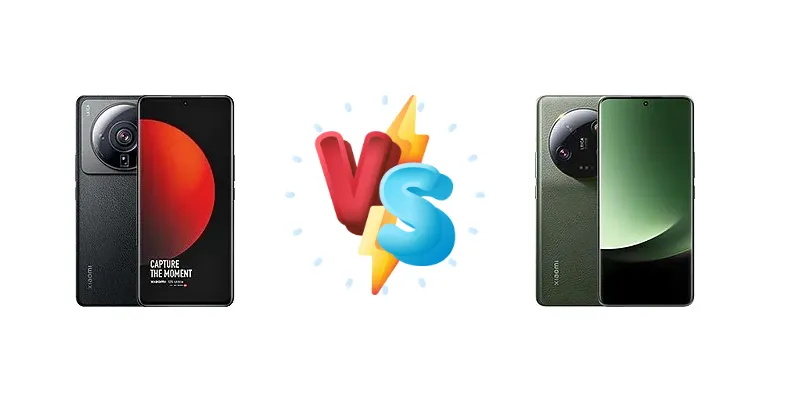
|
🏆 Quick Verdict
The Xiaomi 13 Ultra emerges as the clear winner, offering a faster Snapdragon 8 Gen 2 chip, significantly quicker charging, and a slightly improved camera system. While the 12S Ultra remains a capable device, the 13 Ultra’s advancements make it the superior choice for most users.
| PHONES | ||
|---|---|---|
| Phone Names | Xiaomi 12S Ultra | Xiaomi 13 Ultra |
| Network | ||
|---|---|---|
| 2G bands | GSM 850 / 900 / 1800 / 1900 | GSM 850 / 900 / 1800 / 1900 |
| 3G bands | HSDPA 800 / 850 / 900 / 1700(AWS) / 1900 / 2100 | HSDPA 800 / 850 / 900 / 1700(AWS) / 1900 / 2100 |
| 4G bands | 1, 2, 3, 4, 5, 7, 8, 12, 17, 18, 19, 26, 34, 38, 39, 40, 41, 42 | 1, 2, 3, 4, 5, 7, 8, 18, 19, 20, 26, 28, 38, 40, 41, 66 - International |
| 5G bands | 1, 3, 5, 8, 28, 38, 40, 41, 77, 78, 79 SA/NSA | 1, 3, 5, 7, 8, 20, 28, 38, 40, 41, 77, 78, 79 SA/NSA - International |
| Speed | HSPA, LTE, 5G | HSPA, LTE, 5G |
| Technology | GSM / CDMA / HSPA / EVDO / LTE / 5G | GSM / CDMA / HSPA / EVDO / LTE / 5G |
| CDMA2000 1xEV-DO | CDMA2000 1xEV-DO | |
| Launch | ||
|---|---|---|
| Announced | 2022, July 04 | 2023, April 18 |
| Status | Available. Released 2022, July 09 | Available. Released 2023, April 21 |
| Body | ||
|---|---|---|
| Build | Glass front (Gorilla Glass Victus), eco leather back, aluminum frame | Glass front (Gorilla Glass Victus), eco leather back, aluminum frame |
| Dimensions | 163.2 x 75 x 9.1 mm (6.43 x 2.95 x 0.36 in) | 163.2 x 74.6 x 9.1 mm (6.43 x 2.94 x 0.36 in) |
| SIM | Nano-SIM + Nano-SIM | Nano-SIM + Nano-SIM |
| Weight | 225 g (7.94 oz) | 227 g (8.01 oz) |
| IP68 dust/water resistant (up to 1.5m for 30 min) | IP68 dust/water resistant (up to 1.5m for 30 min) | |
| Display | ||
|---|---|---|
| Protection | Corning Gorilla Glass Victus | Corning Gorilla Glass Victus |
| Resolution | 1440 x 3200 pixels, 20:9 ratio (~522 ppi density) | 1440 x 3200 pixels, 20:9 ratio (~522 ppi density) |
| Size | 6.73 inches, 108.9 cm2 (~89.0% screen-to-body ratio) | 6.73 inches, 108.9 cm2 (~89.5% screen-to-body ratio) |
| Type | LTPO2 AMOLED, 1B colors, 120Hz, Dolby Vision, HDR10+, 1000 nits (HBM), 1500 nits (peak) | LTPO AMOLED, 68B colors, 120Hz, Dolby Vision, HDR10+, 1300 nits (HBM), 2600 nits (peak) |
| Platform | ||
|---|---|---|
| CPU | Octa-core (1x3.19 GHz Cortex-X2 & 3x2.75 GHz Cortex-A710 & 4x1.80 GHz Cortex-A510) | Octa-core (1x3.2 GHz Cortex-X3 & 2x2.8 GHz Cortex-A715 & 2x2.8 GHz Cortex-A710 & 3x2.0 GHz Cortex-A510) |
| Chipset | Qualcomm SM8475 Snapdragon 8+ Gen 1 (4 nm) | Qualcomm SM8550-AB Snapdragon 8 Gen 2 (4 nm) |
| GPU | Adreno 730 | Adreno 740 |
| OS | Android 12, MIUI 13 | Android 13, upgradable to Android 14, HyperOS |
| Memory | ||
|---|---|---|
| Card slot | No | No |
| Internal | 256GB 8GB RAM, 256GB 12GB RAM, 512GB 12GB RAM | 256GB 12GB RAM, 512GB 12GB RAM, 512GB 16GB RAM, 1TB 16GB RAM |
| UFS 3.1 | UFS 4.0 | |
| Main Camera | ||
|---|---|---|
| Features | Laser AF, color spectrum sensor, Leica lenses, Dual-LED flash, HDR, panorama | Laser AF, color spectrum sensor, Leica lenses, Dual-LED flash, HDR, panorama, 67mm filter ring holder (optional) |
| Quad | - | 50 MP, f/1.9 or f/4.0, 23mm (wide), 1.0"-type, 1.6µm, dual pixel PDAF, OIS 50 MP, f/1.8, 75mm (telephoto), 1/2.51", 0.7µm, dual pixel PDAF, OIS, 3.2x optical zoom 50 MP, f/3.0, 120mm (periscope telephoto), 1/2.51", 0.7µm, dual pixel PDAF, OIS, 5x optical zoom 50 MP, f/1.8, 12mm, 122˚ (ultrawide), 1/2.51", 0.7µm, dual pixel PDAF TOF 3D, (depth) |
| Single | 32 MP, f/2.4, 25mm (wide), 0.7µm | - |
| Triple | 50 MP, f/1.9, 23mm (wide), 1.0"-type, 1.6µm, dual pixel PDAF, OIS 48 MP, f/4.1, 120mm (periscope telephoto), 1/2.0", 0.8µm, PDAF, OIS, 5x optical zoom 48 MP, f/2.2, 13mm, 128˚ (ultrawide), 1/2.0", 0.8µm, dual pixel PDAF TOF 3D, (depth) | - |
| Video | 8K@24fps, 4K@30/60fps, 1080p@30/60/120/240fps, 720p@3840fps, gyro-EIS, Dolby Vision HDR 10-bit rec. (4K, 1080p) | 8K@24fps, 4K@24/30/60fps, 1080p@30/60/120/240/480/960/1920fps, gyro-EIS, Dolby Vision HDR 10-bit rec. (4K@60fps, 1080p) |
| Selfie camera | ||
|---|---|---|
| Features | HDR, panorama | HDR, panorama |
| Single | 32 MP, f/2.4, 25mm (wide), 0.7µm | 32 MP, f/2.0, 22mm (wide), 1/3.14", 0.7µm |
| Video | 1080p@30fps | 1080p@30/60fps, gyro-EIS |
| Sound | ||
|---|---|---|
| 3.5mm jack | No | No |
| 35mm jack | No | No |
| Loudspeaker | Yes, with stereo speakers | Yes, with stereo speakers |
| 24-bit/192kHz audio Tuned by Harman Kardon | 24-bit/192kHz audio | |
| Comms | ||
|---|---|---|
| Bluetooth | 5.2, A2DP, LE, aptX HD, aptX Adaptive | 5.3, A2DP, LE, aptX HD, aptX Adaptive |
| Infrared port | Yes | Yes |
| NFC | Yes | Yes |
| Positioning | GPS (L1+L5), GLONASS (L1), BDS (B1I+B1c+B2a), GALILEO (E1+E5a), QZSS (L1+L5), NavIC (L5) | GPS (L1+L5), GLONASS (L1), BDS (B1I+B1c+B2a), GALILEO (E1+E5a), QZSS (L1+L5), NavIC (L5) |
| Radio | No | No |
| USB | USB Type-C 2.0, OTG | USB Type-C 3.2, DisplayPort, OTG |
| WLAN | Wi-Fi 802.11 a/b/g/n/ac/6e, dual-band, Wi-Fi Direct, DLNA | Wi-Fi 802.11 a/b/g/n/ac/6e/7, tri-band, Wi-Fi Direct |
| Features | ||
|---|---|---|
| Sensors | Fingerprint (under display, optical), accelerometer, gyro, compass, barometer | Fingerprint (under display, optical), accelerometer, proximity, gyro, compass, barometer |
| Virtual proximity sensing | Virtual proximity sensing | |
| Battery | ||
|---|---|---|
| Charging | 67W wired, PD3.0, QC4, 100% in 41 min 50W wireless, 100% in 52 min 10W reverse wireless | 90W wired, PD3.0, QC4, 100% in 35 min 50W wireless, 100% in 49 min 10W reverse wireless |
| Type | Li-Po 4860 mAh | Li-Po 5000 mAh |
| Misc | ||
|---|---|---|
| Colors | Black, Dark Green | Black, Olive Green, White, Orange, Yellow, Blue |
| Models | 2203121C | 2304FPN6DC, 2304FPN6DG |
| Price | $ 288.00 | € 797.98 / $ 389.69 |
| SAR EU | - | 0.99 W/kg (head) 1.00 W/kg (body) |
| Tests | ||
|---|---|---|
| Battery life | Endurance rating 93h | - |
| Camera | Photo / Video | - |
| Display | Contrast ratio: Infinite (nominal) | - |
| Loudspeaker | -25.6 LUFS (Very good) | - |
| Performance | AnTuTu: 1039412 (v9) GeekBench: 4300 (v5.1) GFXBench: 51fps (ES 3.1 onscreen) | - |
Xiaomi 12S Ultra
- Excellent camera system
- Powerful Snapdragon 8+ Gen 1
- Bright and vibrant display
- Fast charging (67W)
- Older chipset compared to 13 Ultra
- Slower charging than 13 Ultra
- Potentially lower availability
Xiaomi 13 Ultra
- Latest Snapdragon 8 Gen 2 chipset
- Significantly faster charging (90W)
- Improved camera system with larger sensor
- Excellent display with high peak brightness
- Higher price
- Potentially larger and heavier
Display Comparison
Both phones feature excellent AMOLED displays, but the 13 Ultra edges ahead with a slightly higher peak brightness of 1207 nits compared to the 12S Ultra's 1065 nits. Both offer vibrant colors and excellent contrast (effectively infinite). The 13 Ultra may also have slightly improved color accuracy. Both have excellent viewing angles and support HDR content.
Camera Comparison
Both phones have exceptional camera systems, but the 13 Ultra’s larger sensor and improved image processing algorithms give it an advantage. The 13 Ultra generally captures more detail, better dynamic range, and improved low-light performance. Both offer impressive zoom capabilities, but the 13 Ultra’s software enhancements further refine the results. Video recording is excellent on both, with support for 8K resolution.
Performance
The Snapdragon 8 Gen 2 in the 13 Ultra provides a noticeable performance boost over the Snapdragon 8+ Gen 1 in the 12S Ultra. Expect smoother multitasking, faster app loading times, and improved gaming performance on the 13 Ultra. Both phones handle demanding tasks with ease, but the 13 Ultra’s chip is demonstrably more efficient.
Battery Life
The 13 Ultra boasts a slightly better endurance rating (108h vs 93h) and a significantly faster charging speed (90W wired vs 67W wired). While both offer wireless charging, the 13 Ultra’s 50W wireless charging is also faster. Active use scores also favor the 13 Ultra (10:09h vs unspecified for 12S Ultra).
Buying Guide
Who should buy the Xiaomi 12S Ultra? It's a great option for those seeking a premium camera experience and powerful performance at a potentially lower price point (due to being an older model). Who should buy the Xiaomi 13 Ultra? Ideal for users who prioritize the latest technology, fastest charging speeds, and the absolute best camera capabilities Xiaomi has to offer.