
Xiaomi 12S Ultra vs Samsung Galaxy S23 Ultra: The Ultimate Flagship Battle
| Phones Images | |||||
|---|---|---|---|---|---|
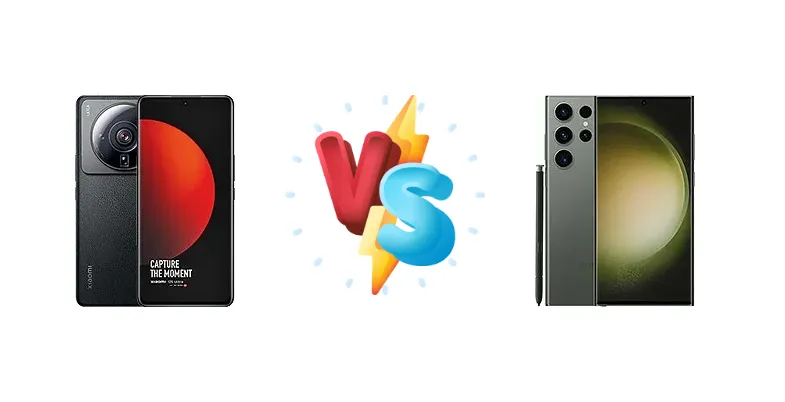
|
🏆 Quick Verdict
The Samsung Galaxy S23 Ultra edges out the Xiaomi 12S Ultra thanks to its brighter display, more consistent software experience, and longer-term software support. While the Xiaomi offers incredible camera hardware, Samsung's overall polish and broader appeal make it the winner.
| PHONES | ||
|---|---|---|
| Phone Names | Xiaomi 12S Ultra | Samsung Galaxy S23 Ultra |
| Network | ||
|---|---|---|
| 2G bands | GSM 850 / 900 / 1800 / 1900 | GSM 850 / 900 / 1800 / 1900 |
| 3G bands | HSDPA 800 / 850 / 900 / 1700(AWS) / 1900 / 2100 | HSDPA 850 / 900 / 1700(AWS) / 1900 / 2100 |
| 4G bands | 1, 2, 3, 4, 5, 7, 8, 12, 17, 18, 19, 26, 34, 38, 39, 40, 41, 42 | 1, 2, 3, 4, 5, 7, 8, 12, 13, 17, 18, 19, 20, 25, 26, 28, 32, 38, 39, 40, 41, 66 - International |
| 5G bands | 1, 3, 5, 8, 28, 38, 40, 41, 77, 78, 79 SA/NSA | 1, 2, 3, 5, 7, 8, 12, 20, 25, 28, 38, 40, 41, 66, 75, 77, 78 SA/NSA/Sub6 - International |
| Speed | HSPA, LTE, 5G | HSPA, LTE (up to 7CA), 5G |
| Technology | GSM / CDMA / HSPA / EVDO / LTE / 5G | GSM / CDMA / HSPA / EVDO / LTE / 5G |
| CDMA2000 1xEV-DO | 1, 7, 28, 41, 66, 71, 78, 258, 260, 261 SA/NSA/Sub6/mmWave - USA | |
| Launch | ||
|---|---|---|
| Announced | 2022, July 04 | 2023, February 01 |
| Status | Available. Released 2022, July 09 | Available. Released 2023, February 17 |
| Body | ||
|---|---|---|
| Build | Glass front (Gorilla Glass Victus), eco leather back, aluminum frame | Glass front (Gorilla Glass Victus 2), glass back (Gorilla Glass Victus 2), aluminum frame |
| Dimensions | 163.2 x 75 x 9.1 mm (6.43 x 2.95 x 0.36 in) | 163.4 x 78.1 x 8.9 mm (6.43 x 3.07 x 0.35 in) |
| SIM | Nano-SIM + Nano-SIM | · Nano-SIM + eSIM· Nano-SIM + Nano-SIM + eSIM (max 2 at a time) |
| Weight | 225 g (7.94 oz) | 234 g (8.25 oz) |
| IP68 dust/water resistant (up to 1.5m for 30 min) | IP68 dust/water resistant (up to 1.5m for 30 min) Armor aluminum frame with tougher drop and scratch resistance (advertised) Stylus (Bluetooth integration, accelerometer, gyro) | |
| Display | ||
|---|---|---|
| Protection | Corning Gorilla Glass Victus | Corning Gorilla Glass Victus 2 |
| Resolution | 1440 x 3200 pixels, 20:9 ratio (~522 ppi density) | 1440 x 3088 pixels, 19.3:9 ratio (~500 ppi density) |
| Size | 6.73 inches, 108.9 cm2 (~89.0% screen-to-body ratio) | 6.8 inches, 114.7 cm2 (~89.9% screen-to-body ratio) |
| Type | LTPO2 AMOLED, 1B colors, 120Hz, Dolby Vision, HDR10+, 1000 nits (HBM), 1500 nits (peak) | Dynamic AMOLED 2X, 120Hz, HDR10+, 1200 nits (HBM), 1750 nits (peak) |
| - | Always-on display | |
| Platform | ||
|---|---|---|
| CPU | Octa-core (1x3.19 GHz Cortex-X2 & 3x2.75 GHz Cortex-A710 & 4x1.80 GHz Cortex-A510) | Octa-core (1x3.36 GHz Cortex-X3 & 2x2.8 GHz Cortex-A715 & 2x2.8 GHz Cortex-A710 & 3x2.0 GHz Cortex-A510) |
| Chipset | Qualcomm SM8475 Snapdragon 8+ Gen 1 (4 nm) | Qualcomm SM8550-AC Snapdragon 8 Gen 2 (4 nm) |
| GPU | Adreno 730 | Adreno 740 |
| OS | Android 12, MIUI 13 | Android 13, up to 4 major Android upgrades, One UI 8 |
| Memory | ||
|---|---|---|
| Card slot | No | No |
| Internal | 256GB 8GB RAM, 256GB 12GB RAM, 512GB 12GB RAM | 256GB 8GB RAM, 256GB 12GB RAM, 512GB 12GB RAM, 1TB 12GB RAM |
| UFS 3.1 | UFS 4.0 | |
| Main Camera | ||
|---|---|---|
| Features | Laser AF, color spectrum sensor, Leica lenses, Dual-LED flash, HDR, panorama | Laser AF, LED flash, auto-HDR, panorama |
| Quad | - | 200 MP, f/1.7, 24mm (wide), 1/1.3", 0.6µm, multi-directional PDAF, OIS 10 MP, f/2.4, 70mm (telephoto), 1/3.52", 1.12µm, PDAF, OIS, 3x optical zoom 10 MP, f/4.9, 230mm (periscope telephoto), 1/3.52", 1.12µm, PDAF, OIS, 10x optical zoom 12 MP, f/2.2, 13mm, 120˚ (ultrawide), 1/2.55", 1.4µm, dual pixel PDAF, Super Steady video |
| Single | 32 MP, f/2.4, 25mm (wide), 0.7µm | 12 MP, f/2.2, 26mm (wide), Dual Pixel PDAF |
| Triple | 50 MP, f/1.9, 23mm (wide), 1.0"-type, 1.6µm, dual pixel PDAF, OIS 48 MP, f/4.1, 120mm (periscope telephoto), 1/2.0", 0.8µm, PDAF, OIS, 5x optical zoom 48 MP, f/2.2, 13mm, 128˚ (ultrawide), 1/2.0", 0.8µm, dual pixel PDAF TOF 3D, (depth) | - |
| Video | 8K@24fps, 4K@30/60fps, 1080p@30/60/120/240fps, 720p@3840fps, gyro-EIS, Dolby Vision HDR 10-bit rec. (4K, 1080p) | 8K@24/30fps, 4K@30/60fps, 1080p@30/60/120/240fps, HDR10+, stereo sound rec., gyro-EIS |
| Selfie camera | ||
|---|---|---|
| Features | HDR, panorama | HDR, HDR10+ |
| Single | 32 MP, f/2.4, 25mm (wide), 0.7µm | 12 MP, f/2.2, 26mm (wide), 1/3.2", 1.12µm, dual pixel PDAF |
| Video | 1080p@30fps | 4K@30/60fps, 1080p@30fps |
| Sound | ||
|---|---|---|
| 3.5mm jack | No | No |
| 35mm jack | No | No |
| Loudspeaker | Yes, with stereo speakers | Yes, with stereo speakers |
| 24-bit/192kHz audio Tuned by Harman Kardon | 32-bit/384kHz audio Tuned by AKG | |
| Comms | ||
|---|---|---|
| Bluetooth | 5.2, A2DP, LE, aptX HD, aptX Adaptive | 5.3, A2DP, LE |
| Infrared port | Yes | - |
| NFC | Yes | Yes |
| Positioning | GPS (L1+L5), GLONASS (L1), BDS (B1I+B1c+B2a), GALILEO (E1+E5a), QZSS (L1+L5), NavIC (L5) | GPS, GALILEO, GLONASS, BDS, QZSS |
| Radio | No | No |
| USB | USB Type-C 2.0, OTG | USB Type-C 3.2, OTG |
| WLAN | Wi-Fi 802.11 a/b/g/n/ac/6e, dual-band, Wi-Fi Direct, DLNA | Wi-Fi 802.11 a/b/g/n/ac/6e, tri-band, Wi-Fi Direct |
| Features | ||
|---|---|---|
| Sensors | Fingerprint (under display, optical), accelerometer, gyro, compass, barometer | Fingerprint (under display, ultrasonic), accelerometer, gyro, proximity, compass, barometer |
| Virtual proximity sensing | Samsung DeX, Samsung Wireless DeX (desktop experience support) Bixby natural language commands and dictation Samsung Pay (Visa, MasterCard certified) Ultra Wideband (UWB) support | |
| Battery | ||
|---|---|---|
| Charging | 67W wired, PD3.0, QC4, 100% in 41 min 50W wireless, 100% in 52 min 10W reverse wireless | 45W wired, PD3.0, 65% in 30 min 15W wireless (Qi) 4.5W reverse wireless |
| Type | Li-Po 4860 mAh | Li-Ion 5000 mAh |
| Misc | ||
|---|---|---|
| Colors | Black, Dark Green | Phantom Black, Green, Cream, Lavender, Graphite, Sky Blue, Lime, Red, BMW M Edition |
| Models | 2203121C | SM-S918B, SM-S918B/DS, SM-S918U, SM-S918U1, SM-S918W, SM-S918N, SM-S9180, SM-S918E, SM-S918E/DS |
| Price | $ 288.00 | € 549.90 / $ 454.99 / £ 433.00 |
| SAR | - | 1.12 W/kg (head) 0.92 W/kg (body) |
| SAR EU | - | 0.96 W/kg (head) 1.40 W/kg (body) |
| Tests | ||
|---|---|---|
| Battery life | Endurance rating 93h | Endurance rating 126h |
| Camera | Photo / Video | Photo / Video |
| Display | Contrast ratio: Infinite (nominal) | Contrast ratio: Infinite (nominal) |
| Loudspeaker | -25.6 LUFS (Very good) | -25.6 LUFS (Very good) |
| Performance | AnTuTu: 1039412 (v9) GeekBench: 4300 (v5.1) GFXBench: 51fps (ES 3.1 onscreen) | AnTuTu: 1241531 (v9) GeekBench: 4927 (v5.1) GFXBench: 67fps (ES 3.1 onscreen) |
Xiaomi 12S Ultra
- Exceptional 1-inch camera sensor
- Fast wired charging
- Unique design
- Powerful Snapdragon 8+ Gen 1
- Software experience can be inconsistent
- Slower wireless charging
- Less consistent battery life in real-world use
- Limited software update support
Samsung Galaxy S23 Ultra
- Brighter and more vibrant display
- More consistent software experience
- Long-term software updates
- Versatile camera system
- Excellent battery life
- Slower wired charging compared to Xiaomi
- Wireless charging is slower
- Design is less distinctive
Display Comparison
The Samsung Galaxy S23 Ultra takes the display crown with a measured peak brightness of 1274 nits, significantly brighter than the Xiaomi 12S Ultra's 1065 nits. Both offer excellent contrast ratios (infinite nominal), vibrant colors, and smooth refresh rates. However, Samsung's display is noticeably more visible in direct sunlight. The S23 Ultra also benefits from its adaptive refresh rate technology, dynamically adjusting to conserve battery.
Camera Comparison
The Xiaomi 12S Ultra boasts a massive 1-inch Sony IMX989 sensor, promising exceptional image quality. It excels in low-light photography and offers unique creative possibilities. The S23 Ultra, however, delivers more consistent results across various lighting conditions and offers a more versatile camera system with its telephoto lenses. Samsung's image processing is also generally preferred for its natural look.
Performance
Both phones are powered by Snapdragon chips – the 12S Ultra with the Snapdragon 8+ Gen 1 and the S23 Ultra with the Snapdragon 8 Gen 2. The Gen 2 offers a noticeable performance advantage, particularly in sustained workloads and gaming, thanks to its improved efficiency and thermal management. While the 12S Ultra is still incredibly fast, the S23 Ultra feels smoother and more responsive overall.
Battery Life
The Samsung Galaxy S23 Ultra demonstrates superior battery endurance in active use, scoring 13:24h. While the Xiaomi 12S Ultra boasts an impressive endurance rating of 93h (old), real-world usage often falls short. The S23 Ultra's more efficient chipset and optimized software contribute to its longer battery life. Charging speeds are also a factor, with the Xiaomi offering faster wired charging (67W) but the S23 Ultra reaching 65% in just 30 minutes.
Buying Guide
Who should buy the Xiaomi 12S Ultra? Photography enthusiasts seeking exceptional camera hardware and a unique design. Who should buy the Samsung Galaxy S23 Ultra? Users prioritizing a polished software experience, long-term software updates, and a versatile all-around flagship.