
Xiaomi 12S Pro vs Redmi K60 Pro: A Detailed Showdown
| Phones Images | |||||
|---|---|---|---|---|---|
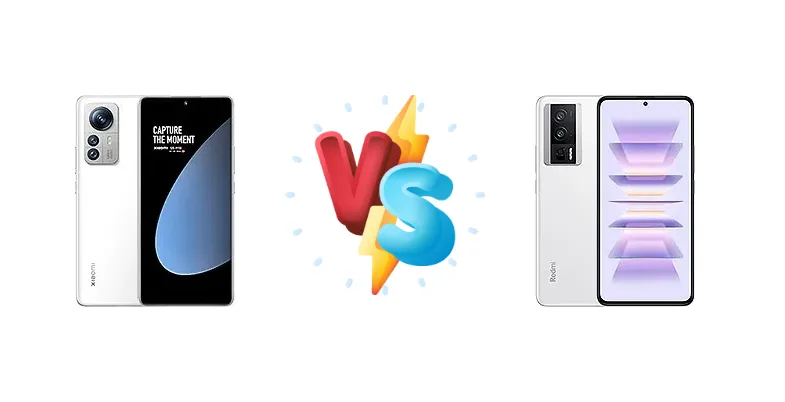
|
🏆 Quick Verdict
The Redmi K60 Pro edges out the 12S Pro thanks to its newer Snapdragon 8 Gen 2 chipset, offering superior performance and efficiency. While the 12S Pro boasts faster wireless charging and a potentially better camera system (depending on the variant), the K60 Pro's overall package provides better value.
| PHONES | ||
|---|---|---|
| Phone Names | Xiaomi 12S Pro | Xiaomi Redmi K60 Pro |
| Network | ||
|---|---|---|
| 2G bands | GSM 850 / 900 / 1800 / 1900 | GSM 850 / 900 / 1800 / 1900 |
| 3G bands | HSDPA 800 / 850 / 900 / 1700(AWS) / 1900 / 2100 | HSDPA 800 / 850 / 900 / 1700(AWS) / 2100 |
| 4G bands | 1, 2, 3, 4, 5, 7, 8, 12, 17, 18, 19, 26, 34, 38, 39, 40, 41, 42 | 1, 3, 4, 5, 8, 18, 19, 26, 34, 38, 39, 40, 41, 42 |
| 5G bands | 1, 3, 5, 8, 28, 38, 40, 41, 77, 78, 79 SA/NSA | 1, 3, 5, 8, 28, 38, 41, 77, 78 SA/NSA |
| Speed | HSPA, LTE, 5G | HSPA, LTE, 5G |
| Technology | GSM / CDMA / HSPA / EVDO / LTE / 5G | GSM / CDMA / HSPA / CDMA2000 / LTE / 5G |
| CDMA2000 1xEV-DO | CDMA2000 1x | |
| Launch | ||
|---|---|---|
| Announced | 2022, July 04 | 2022, December 27 |
| Status | Available. Released 2022, July 07 | Available. Released 2023, January 01 |
| Body | ||
|---|---|---|
| Build | Glass front (Gorilla Glass Victus), glass back or eco leather back, aluminum frame | - |
| Dimensions | 163.6 x 74.6 x 8.2 mm or 8.7 mm | 162.8 x 75.4 x 8.6 mm or 8.9 mm |
| SIM | Nano-SIM + Nano-SIM | Nano-SIM + Nano-SIM |
| Weight | 203 g / 204 g (7.16 oz) | 201 g or 205 g (7.09 oz) |
| Display | ||
|---|---|---|
| Protection | Corning Gorilla Glass Victus | - |
| Resolution | 1440 x 3200 pixels, 20:9 ratio (~521 ppi density) | 1440 x 3200 pixels, 20:9 ratio (~526 ppi density) |
| Size | 6.73 inches, 109.4 cm2 (~89.6% screen-to-body ratio) | 6.67 inches, 107.4 cm2 (~87.5% screen-to-body ratio) |
| Type | LTPO AMOLED, 1B colors, 120Hz, Dolby Vision, HDR10+, 1000 nits (HBM), 1500 nits (peak) | OLED, 68B colors, 120Hz, Dolby Vision, HDR10+, 1400 nits (peak) |
| Platform | ||
|---|---|---|
| CPU | Octa-core (1x3.19 GHz Cortex-X2 & 3x2.75 GHz Cortex-A710 & 4x1.80 GHz Cortex-A510) | Octa-core (1x3.2 GHz Cortex-X3 & 2x2.8 GHz Cortex-A715 & 2x2.8 GHz Cortex-A710 & 3x2.0 GHz Cortex-A510) |
| Chipset | Qualcomm SM8475 Snapdragon 8+ Gen 1 (4 nm) | Qualcomm SM8550-AB Snapdragon 8 Gen 2 (4 nm) |
| GPU | Adreno 730 | Adreno 740 |
| OS | Android 12, MIUI 13 | Android 13, MIUI 14 |
| Memory | ||
|---|---|---|
| Card slot | No | No |
| Internal | 128GB 8GB RAM, 256GB 8GB RAM, 256GB 12GB RAM, 512GB 12GB RAM | 128GB 8GB RAM, 256GB 8GB RAM, 256GB 12GB RAM, 512GB 12GB RAM, 512GB 16GB RAM |
| UFS 3.1 | UFS 4.0 UFS 3.1 - 128GB only | |
| Main Camera | ||
|---|---|---|
| Features | Leica lens, color spectrum sensor, Dual-LED dual-tone flash, HDR, panorama | Color spectrum sensor, Dual-LED dual-tone flash, HDR, panorama |
| Single | 32 MP, f/2.5, 26mm (wide), 0.7µm | - |
| Triple | 50 MP, f/1.9, 24mm (wide), 1/1.28", 1.22µm, dual pixel PDAF, OIS 50 MP, f/1.9, 50mm (telephoto), PDAF, 2x optical zoom 50 MP, f/2.2, 115˚ (ultrawide) | 54 MP, f/1.9, (wide), 1/1.49", 1.0µm, PDAF, OIS 8 MP, 118˚ (ultrawide), 1/4.0", 1.12µm 2 MP (macro) |
| Video | 8K@24fps (HDR), 4K@30/60fps (HDR10+), 1080p@30/120/240/960fps, 720p@1920fps, gyro-EIS | 8K@24fps, 4K@30/60fps, 1080p@30/60/120/240/960fps, 720p@1920fps, gyro-EIS |
| Selfie camera | ||
|---|---|---|
| Features | HDR, panorama | HDR |
| Single | 32 MP, f/2.5, 26mm (wide), 0.7µm | 16 MP, (wide), 1/3.06", 1.0µm |
| Video | 1080p@30/60fps, 720p@120fps, HDR10+ | 1080p@30/60/120fps |
| Sound | ||
|---|---|---|
| 3.5mm jack | No | No |
| 35mm jack | No | No |
| Loudspeaker | Yes, with stereo speakers | Yes, with stereo speakers |
| 24-bit/192kHz audio Tuned by Harman Kardon | 24-bit/192kHz audio | |
| Comms | ||
|---|---|---|
| Bluetooth | 5.2, A2DP, LE, aptX HD, aptX Adaptive | 5.3, A2DP, LE |
| Infrared port | Yes | Yes |
| NFC | Yes | Yes |
| Positioning | GPS (L1+L5), GLONASS (L1), BDS (B1I+B1c+B2a), GALILEO (E1+E5a), QZSS (L1+L5), NavIC (L5) | GPS (L1+L5), GLONASS (G1), BDS (B1I+B2a+Bc), GALILEO (E1+E5a), QZSS (L1+L5), NavIC |
| Radio | No | Unspecified |
| USB | USB Type-C 2.0, OTG | USB Type-C 2.0, OTG |
| WLAN | Wi-Fi 802.11 a/b/g/n/ac/6e, dual-band, Wi-Fi Direct | Wi-Fi 802.11 a/b/g/n/ac/6e, dual-band, Wi-Fi Direct |
| Features | ||
|---|---|---|
| Sensors | Fingerprint (under display, optical), accelerometer, gyro, compass | Fingerprint (under display, optical), accelerometer, gyro, proximity, compass |
| Virtual proximity sensing | - | |
| Battery | ||
|---|---|---|
| Charging | 120W wired, PD3.0, QC4, 100% in 19 min 50W wireless, 100% in 42 min 10W reverse wireless | 120W wired, PD3.0, QC3+, 100% in 19 min 30W wireless |
| Type | Li-Po 4600 mAh | Li-Po 5000 mAh |
| Misc | ||
|---|---|---|
| Colors | Gray, White, Purple, Green | Black, White, Mint, Champion Black |
| Models | 2206122SC | 22127RK46C |
| Price | About 670 EUR | About 460 EUR |
Xiaomi 12S Pro
- Potentially superior camera (Leica variant)
- Faster wireless charging
- Premium design and build quality
- Excellent display
- Older chipset (Snapdragon 8+ Gen 1)
- Higher price point
- Wireless charging speed not as fast as some competitors
Xiaomi Redmi K60 Pro
- Newer and more powerful chipset (Snapdragon 8 Gen 2)
- Excellent value for money
- Vibrant and bright display
- Fast wired charging
- Camera may not match the 12S Pro (Leica variant)
- Wireless charging speed is slower
- Design may be less premium
Display Comparison
Both phones feature excellent AMOLED displays with high refresh rates (likely 120Hz). The Redmi K60 Pro is expected to have slightly higher peak brightness and potentially better color accuracy due to its newer panel. The 12S Pro's display is known for its vibrant colors and smooth scrolling, but the K60 Pro's improvements are likely to be noticeable.
Camera Comparison
The Xiaomi 12S Pro, particularly the Leica variant, is often praised for its camera capabilities, offering excellent image quality and versatile lens options. The Redmi K60 Pro's camera is still very capable, but may not match the 12S Pro's overall image quality, especially in low light. However, software processing improvements on the K60 Pro could close the gap.
Performance
The Redmi K60 Pro's Snapdragon 8 Gen 2 is a significant upgrade over the 12S Pro's Snapdragon 8+ Gen 1. Expect noticeably faster processing speeds, improved gaming performance, and better power efficiency from the K60 Pro. Both phones handle everyday tasks with ease, but the K60 Pro shines in demanding scenarios.
Battery Life
Both phones offer 120W wired charging, ensuring incredibly fast charging times. The Redmi K60 Pro has a 50W wireless charging, while the 12S Pro has 50W wireless and 10W reverse wireless. Battery capacity is likely similar, but the K60 Pro's more efficient chipset should translate to slightly better battery life overall.
Buying Guide
The Xiaomi 12S Pro is ideal for users prioritizing a premium design, potentially superior camera quality (especially if opting for the Leica variant), and faster wireless charging. The Redmi K60 Pro is the better choice for those seeking maximum performance, excellent value for money, and a vibrant display, without breaking the bank.