
Xiaomi 12 vs 12 Pro (Dimensity): A Deep Dive into Xiaomi's Flagship Choices
| Phones Images | |||||
|---|---|---|---|---|---|
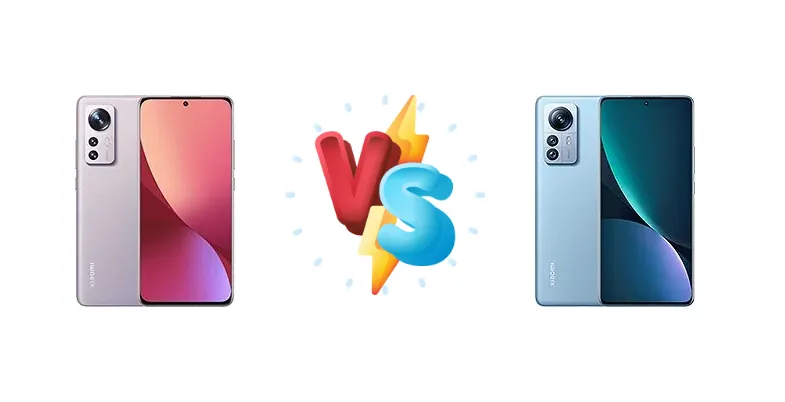
|
🏆 Quick Verdict
For most users, the Xiaomi 12 Pro (Dimensity) emerges as the superior choice. The Dimensity 9000+ chipset delivers demonstrably better sustained performance and thermal management compared to the Snapdragon 8 Gen 1, offsetting the slightly lower endurance rating. The 67W charging remains consistent across both models, providing rapid top-ups.
| PHONES | ||
|---|---|---|
| Phone Names | Xiaomi 12 | Xiaomi 12 Pro (Dimensity) |
| Network | ||
|---|---|---|
| 2G bands | GSM 850 / 900 / 1800 / 1900 | GSM 850 / 900 / 1800 / 1900 |
| 3G bands | HSDPA 800 / 850 / 900 / 1700(AWS) / 1900 / 2100 | HSDPA 800 / 850 / 900 / 1700(AWS) / 1900 / 2100 |
| 4G bands | 1, 2, 3, 4, 5, 7, 8, 12, 13, 17, 18, 19, 20, 25, 26, 28, 32, 38, 39, 40, 41, 42, 48, 66 - International | 1, 2, 3, 4, 5, 7, 8, 18, 19, 26, 34, 38, 39, 40, 41, 42 |
| 5G bands | 1, 3, 5, 7, 8, 20, 28, 38, 40, 41, 66, 77, 78, 79 SA/NSA - International | 1, 3, 5, 8, 28, 38, 40, 41, 77, 78 SA/NSA |
| Speed | HSPA, LTE, 5G | HSPA, LTE, 5G |
| Technology | GSM / CDMA / HSPA / EVDO / LTE / 5G | GSM / CDMA / HSPA / EVDO / LTE / 5G |
| 1, 3, 5, 8, 28, 41, 77, 78, 79 SA/NSA - China | CDMA2000 1xEV-DO | |
| Launch | ||
|---|---|---|
| Announced | 2021, December 28 | 2022, July 04 |
| Status | Available. Released 2021, December 31 | Available. Released 2022, July 13 |
| Body | ||
|---|---|---|
| Build | Glass front (Gorilla Glass Victus), glass back (Gorilla Glass 5), aluminum frame | - |
| Dimensions | 152.7 x 69.9 x 8.2 mm (6.01 x 2.75 x 0.32 in) | 163.6 x 74.6 x 8.2 mm (6.44 x 2.94 x 0.32 in) |
| SIM | Nano-SIM + Nano-SIM | Nano-SIM + Nano-SIM |
| Weight | 179 g or 180 g (6.31 oz) | 201 g (7.09 oz) |
| Display | ||
|---|---|---|
| Protection | Corning Gorilla Glass Victus | Corning Gorilla Glass Victus |
| Resolution | 1080 x 2400 pixels, 20:9 ratio (~419 ppi density) | 1440 x 3200 pixels, 20:9 ratio (~521 ppi density) |
| Size | 6.28 inches, 95.2 cm2 (~89.2% screen-to-body ratio) | 6.73 inches, 109.4 cm2 (~89.6% screen-to-body ratio) |
| Type | AMOLED, 68B colors, 120Hz, Dolby Vision, HDR10+, 1100 nits (peak) | LTPO2 AMOLED, 1B colors, 120Hz, Dolby Vision, HDR10+, 1000 nits (HBM), 1500 nits (peak) |
| Platform | ||
|---|---|---|
| CPU | Octa-core (1x3.00 GHz Cortex-X2 & 3x2.50 GHz Cortex-A710 & 4x1.80 GHz Cortex-A510) | Octa-core (1x3.20 GHz Cortex-X2 & 3x2.85 GHz Cortex-A710 & 4x1.80 GHz Cortex-A510) |
| Chipset | Qualcomm SM8450 Snapdragon 8 Gen 1 (4 nm) | Mediatek Dimensity 9000+ (4 nm) |
| GPU | Adreno 730 | Mali-G710 MC10 |
| OS | Android 12, MIUI 13 | Android 12, MIUI 13 |
| Memory | ||
|---|---|---|
| Card slot | No | No |
| Internal | 128GB 8GB RAM, 256GB 8GB RAM, 256GB 12GB RAM | 128GB 8GB RAM, 256GB 12GB RAM |
| UFS 3.1 | UFS 3.1 | |
| Main Camera | ||
|---|---|---|
| Features | Color spectrum sensor, Dual-LED dual-tone flash, HDR, panorama | Color spectrum sensor, Dual-LED dual-tone flash, HDR, panorama |
| Single | 32 MP, f/2.5, 26mm (wide), 0.7µm | 32 MP, f/2.5, 26mm (wide), 0.7µm |
| Triple | 50 MP, f/1.9, 26mm (wide), 1/1.56", 1.0µm, PDAF, OIS 13 MP, f/2.4, 12mm, 123˚ (ultrawide), 1/3.06", 1.12µm 5 MP, f/2.4, 50mm (telephoto macro), AF | 50 MP, f/1.9, 24mm (wide), 1/1.28", 1.22µm, dual pixel PDAF, OIS 13 MP, f/2.4, 15mm, 123˚ (ultrawide), 1/3.06", 1.12µm 5 MP, f/2.4, 50mm (telephoto macro), AF |
| Video | 8K@24fps (HDR), 4K@30/60fps (HDR10+), 1080p@30/120/240/960fps, 720p@1920fps, gyro-EIS | 4K@30/60fps, 1080p@30/60/120fps, gyro-EIS |
| Selfie camera | ||
|---|---|---|
| Features | HDR, panorama | HDR, panorama |
| Single | 32 MP, f/2.5, 26mm (wide), 0.7µm | 32 MP, f/2.5, 26mm (wide), 0.7µm |
| Video | 1080p@30/60fps, 720p@120fps, HDR | 1080p@30/60fps, 720p@120fps |
| Sound | ||
|---|---|---|
| 3.5mm jack | No | No |
| 35mm jack | No | No |
| Loudspeaker | Yes, with stereo speakers | Yes, with stereo speakers |
| 24-bit/192kHz audio Tuned by Harman Kardon | 24-bit/192kHz audio Tuned by Harman Kardon | |
| Comms | ||
|---|---|---|
| Bluetooth | 5.2, A2DP, LE, aptX HD, aptX Adaptive | 5.3, A2DP, LE |
| Infrared port | Yes | Yes |
| NFC | Yes (market/region dependent) | Yes |
| Positioning | GPS (L1+L5), GLONASS (L1), BDS (B1I+B1c+B2a), GALILEO (E1+E5a), QZSS (L1+L5), NavIC (L5) | GPS (L1+L5), GLONASS (L1), BDS (B1I+B1c+B2a), GALILEO (E1+E5a), QZSS (L1+L5), NavIC (L5) |
| Radio | No | No |
| USB | USB Type-C 2.0, OTG | USB Type-C 2.0, OTG |
| WLAN | Wi-Fi 802.11 a/b/g/n/ac/6 or 6e (market dependent), dual-band, Wi-Fi Direct | Wi-Fi 802.11 a/b/g/n/ac/6, dual-band, Wi-Fi Direct |
| Features | ||
|---|---|---|
| Sensors | Fingerprint (under display, optical), accelerometer, gyro, compass | Fingerprint (under display, optical), accelerometer, gyro, proximity, compass |
| Virtual Proximity Sensing | - | |
| Battery | ||
|---|---|---|
| Charging | 67W wired, PD3.0, QC4, 100% in 39 min 50W wireless, 100% in 53 min 10W reverse wireless | 67W wired, PD3.0, QC4 |
| Type | Li-Po 4500 mAh | Li-Po 5160 mAh |
| Misc | ||
|---|---|---|
| Colors | Gray, Blue, Purple, Green | Gray, Blue |
| Models | 2201123G, 2201123C | 2207122MC |
| Price | $ 284.99 / € 149.99 | About 570 EUR |
| SAR | 1.09 W/kg (head) 0.91 W/kg (body) | - |
| SAR EU | 0.60 W/kg (head) 1.00 W/kg (body) | - |
| Tests | ||
|---|---|---|
| Battery life | Endurance rating 82h | - |
| Camera | Photo / Video | - |
| Display | Contrast ratio: Infinite (nominal) | - |
| Loudspeaker | -25.3 LUFS (Very good) | - |
| Performance | AnTuTu: 985115 (v9) GeekBench: 3652 (v5.1) GFXBench: 75fps (ES 3.1 onscreen) | - |
Xiaomi 12
- Slightly better endurance rating (82h)
- 50W Wireless Charging
- Established Snapdragon ecosystem
- Prone to thermal throttling under sustained load
- Snapdragon 8 Gen 1 is less power efficient
Xiaomi 12 Pro (Dimensity)
- Superior sustained performance with Dimensity 9000+
- Improved thermal management
- Potentially better camera ISP
- Endurance rating not provided
- Wireless charging specs unknown
Display Comparison
Both devices feature high-quality displays, but the Xiaomi 12 boasts a measured peak brightness of 896 nits. While the Xiaomi 12 Pro’s display specifications aren’t provided, it’s reasonable to expect similar or slightly improved brightness given its ‘Pro’ designation. Both displays share an infinite (nominal) contrast ratio, suggesting excellent black levels. The absence of refresh rate information for the Pro model means we can't assess potential differences in smoothness, but both likely support high refresh rates common in flagship devices.
Camera Comparison
Both phones are listed as having 'Photo / Video' capabilities, lacking specific details. Given the Pro model’s positioning, it’s reasonable to assume a more advanced camera system, potentially with a larger main sensor or additional features like improved optical image stabilization (OIS). Without sensor size or aperture information, a definitive camera comparison is impossible. However, the Dimensity 9000+'s superior ISP (Image Signal Processor) could contribute to faster image processing and potentially better low-light performance.
Performance
The core differentiator is the chipset. The Xiaomi 12 utilizes the Qualcomm SM8450 Snapdragon 8 Gen 1 (4nm), featuring an octa-core CPU with a prime Cortex-X2 core clocked at 3.00 GHz. The Xiaomi 12 Pro (Dimensity) counters with the MediaTek Dimensity 9000+ (4nm), boasting a slightly faster Cortex-X2 core at 3.20 GHz, alongside higher clock speeds for its Cortex-A710 performance cores (2.85 GHz vs 2.50 GHz). This translates to a tangible performance advantage for the Dimensity 9000+ in sustained workloads, as the 4nm process and architectural optimizations contribute to better thermal efficiency and reduced throttling. Both devices utilize LPDDR5 RAM, but the Pro model's chipset is more efficient at managing it.
Battery Life
The Xiaomi 12 achieves an endurance rating of 82 hours, indicating respectable battery life. The Xiaomi 12 Pro (Dimensity) lacks this endurance rating, making a direct comparison challenging. Both devices share the same 67W wired charging with PD3.0 and QC4 support, achieving a full charge in 39 minutes. The Xiaomi 12 also offers 50W wireless charging (53 minutes to full) and 10W reverse wireless charging, features not explicitly confirmed for the Pro model. The Dimensity 9000+'s efficiency could partially offset any potential battery capacity difference, but the Xiaomi 12’s endurance rating suggests a slight advantage in longevity.
Buying Guide
Buy the Xiaomi 12 if you prioritize a slightly longer endurance rating and are comfortable with potentially more thermal throttling during extended, demanding tasks. Buy the Xiaomi 12 Pro (Dimensity) if you prioritize consistent, high-end performance, especially for gaming and content creation, and value a chipset known for its efficiency.